
Last week, our account of the sensational murder trial of Clara Smith Hamon reached its long-awaited conclusion. After days of testimony, conflicting evidence, andimpassionedarguments by some of the most accomplished attorneys in Oklahoma and Texas, twelve menretiredtodecidewhether Clara had murdered Jake L. Hamon, one of Oklahoma’s wealthiest and most influential political figures. The trial had attracted national attention, exposed a relationship that had remained largely concealed for years, and placed the fate of a young woman in the hands of a jury that had listened to two irreconcilable accounts of what occurred inside a room atArdmore’sRandolHotelon November 21, 1920.
The jurors returned approximately thirty-nine minutes later. Their verdict was unmistakable: “Not guilty as charged in the information.” Clara Smith Hamon was acquitted. The Daily Ardmoreite announced the result in the language of a newspaper reporting the climax of an extraordinary trial: “SMITH TRIAL ENDS IN ACQUITTAL.” Another headline declared, “‘NOT GUILTY!’ IS VERDICT OF JURY.” The woman who had fled Oklahoma following Hamon’s death, traveled across Texas into Mexico, returned voluntarily to face prosecution, and endured the public examination of her most intimate affairs was free.
The courtroom erupted in applause when the verdict was announced. Contemporary accounts described an enthusiastic demonstration by spectators who had crowded into the room to witness the conclusion of the trial. The jurors themselves reportedly smiled broadly, and Clara expressed her gratitude to the men who had acquitted her. The Ardmore Statesman later reported that the defense attorneys received numerous congratulations. For Charles Arthur Coakley,theformerMarshall County Attorney whose remarkable career we have followed throughout this series, the verdict marked the successful conclusion of another significant criminal defense, this time in a courtroom watched by much of the nation.
Contemporary reporting recorded Clara’s reaction in wordsthatcapturedtheenormous relief of the moment. “I amthehappiestwomanalive. I knew that you would free me,” she reportedly declared. The statement reflected the conclusion of an ordeal that had consumed nearly four months of her life and exposed her most intimate affairs to public scrutiny. She had entered the courtroom charged with the murder of one of Oklahoma’s most influential men, facing the possibility of imprisonment for life or even a sentence of death. She left it acquitted by twelve jurors after less than an hour of deliberation.
The speed of the verdict immediatelyraisedquestions about what had persuaded the jury. Had the jurors believed Clara’s account of the struggle? Had they accepted herclaimofself-defense?Had the prosecution’s conflicting witnesses created reasonable doubt? Or had the defense’s portrayal of Hamon’s treatment of Clara produced sympathy that the State could not overcome? The verdict itself did not answer those questions. It established only that the jury found Clara not guilty of the offense charged under the instructions given. It did not constitute a formal finding that every detail of her testimony was true, nor did it identify which defense theory the jurors accepted.
Yet the jurors themselves soon began speaking, and their comments provided an extraordinary glimpse into the thinking of the twelve men who had decided one of Oklahoma’smostsensational murder cases.
What the Jurors Said
One of the most revealing accounts appeared in the press shortly after the verdict. W. A. Jolly, an Ardmore resident who served on the jury, described what happened when the men entered the jury room. According to his account, he initially announced that he favored a first-degree murder verdict, apparently to test the feelings of the others. Another juror immediately declared that he favored acquitting Clara without delay. Jolly then acknowledged that he agreed. The exchange was extraordinary because it suggested that the jurors had reached their individual conclusions before formally beginning deliberations. Jolly told the reporter that the men then sat around briefly before taking a single vote.
The account offered a glimpse into the practical workings of a jury that had just heard days of testimony but required only minutes to reach unanimity. It also illustrated something experienced trial lawyers have understood for generations: jurors do not necessarily wait until they enter the jury room to begin deciding a case. They listen,observe,comparetestimony, and form impressions throughout the proceedings. A witness who appears evasive may lose credibility long before cross-examination concludes. Another witness, speaking quietly and without apparent exaggeration, may persuade a jury without ever realizing the impression being made. By the time the final attorney sits down, the essential judgments concerning credibility may already have been formed.
Even more striking were the remarks attributed to the jury’s foreman, B. F. C. Loughridge, whom some contemporary reports described as seventy-eight years old. Loughridge reportedly said therehadneverbeenanyreal question about acquitting Clara. Although the jurors had not discussed the case among themselves before receiving it, he suggested that each man could sense how the others felt. “There never was any question about acquitting her from the start,” Loughridge reportedly declared. He explained that the jurors had not discussed the case before receiving it officially, but that “there was that look in the eyes of each man”whichtoldhimwhatthe others were thinking.
Theforemanthenmadean observation that must have been particularly striking to the lawyers who had spent hours delivering their closing arguments. “The arguments merely took up our time as we did not consider them at all. We already had our mind fully made up.” Consider the significance of that statement. The prosecution had sought to persuade the jury that Clara deliberately shot JakeHamon.Thedefensehad argued that the State failed to prove a criminal homicide. The lawyers had spent hours organizing evidence, exposing contradictions, appealing to the jurors’ understanding of human nature, and explaining why Oklahoma law required a particular verdict. Yet according to the foreman, the twelve men had already decided the case before the lawyers completed their arguments.
If those statements accurately reflected the jurors’ thinking, the case had effectively been decided before the closingargumentsconcluded. That does not mean the arguments were unimportant as a matter of law or trial procedure. It means that, at least according to these jurors’ later descriptions, the evidence and Clara’s testimony had already made the decisive impression. Closing arguments remain an essential part of a criminal trial, allowing attorneys to explain howtheevidencefitstogether and why the law supports their position. But a lawyer cannot assume that the jury is waiting until closing argument to decide what it believes.Sometimesthemost important argument comes from carefully examining a witness days before lawyers formally address the jury.
The foreman’s remarks also invite caution. Jurors speaking to reporters after a sensational verdict may simplify what happened in the jury room, and individual jurors' recollections do not necessarily explain the reasoning of all twelve. Indeed, a subsequent report in the Ardmore Statesman described a somewhat different voting sequence. According to that newspaper, the first ballot produced eleven votes for acquittal and one for conviction, followed by a standing vote in which all twelve agreed upon a not-guilty verdict. Other contemporary accounts described a single secret ballot confirmed by a rising vote. The difference is not enough to cast doubt on the acquittal, but it shows how even the jury’s brief deliberations became the subject of conflicting newspaper accounts.
The result was especially remarkable because the jury had several alternatives. It could have convicted Clara of murder, found her guilty of one of the lesser degrees of manslaughter, or acquitted her. The men were not forced to choose between first-degree murder and complete exoneration. Judge Champion had carefully explained the intermediate offenses and the circumstances under which a killing might be excusable or justified. Their verdict therefore rejected criminal liability under the charges and instructions submitted. The surviving written instructions confirm that the jurors were required to consider whether Clara reasonably believed herself in danger of death or serious bodily injury and whether the evidence established an unlawful killing beyond a reasonable doubt.
It remains impossible to know with certainty whether the jurors concluded that the pistol discharged accidentally, that Clara acted in lawful self-defense, or simply that the State had failed to prove any criminal offense beyond a reasonable doubt. A unanimous verdict does not necessarily mean twelve jurors reached their conclusion for identical reasons. It means they agreed upon the result. What we do know is that the twelve men reached unanimity in approximately thirty-nine minutes, ending the case with a speed that astonished observers who had followed its complicated proceedings.
FortheStateofOklahoma, the prosecution was over. For Clara Smith Hamon, the verdict meant freedom and the chance to begin her life anew. But for others whose lives had been touched by Jake Hamon’s death, the consequences of the tragedy were far from over.
The Verdict and the Hamon Family
The acquittal of Clara SmithHamonwasatriumph for the defense, but for Georgia Hamon and her children, it brought little comfort. They had lost a husband and father, endured months of sensational publicity, and watched as the most intimate details of their family life were exposed before a crowded courtroom and a national audience. The trial had been more than an effort to determinewhetherClarawas criminally responsible for Jake Hamon’s death. It had become a public examination of the dead man’s character, his marriage, and his long relationship with the woman accused of killing him.
Remarkably, Georgia had predicted the outcome before the trial even began. Two days before the proceedings opened in March 1921, she spoke with a newspaper reporter about the approaching prosecution. Her assessment was unequivocal: “No jury in America will convict Clara Smith.” She believed Clara had successfully cultivated an image of innocence and vulnerability that would make conviction nearly impossible. Georgia continued, “So well has she played her part as an eternal ‘vamp’ that she has deceived even the ministers of justice.” The statements, reported in the Lawton Constitution on March 9, revealed the widow’s bitterness toward Clara and her conviction that public sympathy had already shifted decisively in the younger woman’s favor.
The word “vamp” carried a particular meaning in the popular culture of the period. Derived from “vampire,” it was commonly used to describe a seductive woman who supposedly exercised an irresistible influence over men, often leading them to moral or financial ruin. In the silent-film era, the term had become associated with alluring and dangerous female characters portrayed on the screen. Georgia’s description of Clara as an “eternal vamp” was therefore more than a casual insult. She believed Clara had manipulated not onlyJakeHamonbutalsothe newspapers, the public, and perhaps even those responsible for administering justice. There would be a remarkable irony in those words when, only months later, Clara attempted to establish herself as a motion-picture actress.
Throughout the trial, Georgia occupied an extraordinarily difficult position. Contemporary newspaper accounts described her sitting in the courtroom dressed in mourning clothes, sometimes directly opposite Clara, with only a few feet separating them. One reporter estimated the distance between the women at approximately thirty inches. Although their lives had been connected through Jake Hamonforyears,theyreportedly avoided acknowledging one another. Now they were forced to confront the consequences of that relationship in a courtroom where every expression, movement, and reaction might become another detail in the next day’s newspapers.
For Georgia, the proceedings presented a painful contradiction. She wanted justice for her husband’s death, yet the prosecution necessarily required the disclosure of circumstances that had already brought humiliation to her family. The defense portrayed Clara as a young woman who had surrendered years of her life to a wealthy and powerful man, only to suffer emotional distress and alleged physical mistreatment. Georgia, meanwhile, was the lawful wife who had endured her husband’s prolonged involvement with another woman. As Clara’s attorneys developed their defense, Georgia was forced to listen while witnesses described a relationship that had existed alongside her marriage for more than a decade.
On March 17, Georgia attended the final proceedings as the attorneys completed their arguments and the case was submitted to the jury. According to an Associated Press account published the following morning, she remained in the courtroom throughout the day, dressed in deep mourning and sitting directlyoppositeClara.When the jurors finally retired to deliberate, however, Georgia and her nineteen-year-old son, Jake L. Hamon Jr., left the courthouse. The newspaper reported that she departed in tears. Neither Georgia nor any other member of the Hamon family was present when the jury returned its verdict approximately forty minutes later.
While spectators applauded Clara’s acquittal and her attorneys received congratulations, theatmosphereatthe Hamon residence was very different. According to the Associated Press, Georgia’s emotional condition had become so fragile that her family decided not to tell her immediately what had happened. Those at the home reportedly explained that she would not be informed of the verdict until the following daybecauseofconcernsabout her physical and mental condition. Her son feared that learning how quickly the jury had acquitted Clara might cause his mother to collapse.
The circumstances were particularly poignant because Georgia had already anticipated the result. She had publicly declared that no jury would convict Clara, yet the reality of the acquittal was apparently more than her family believed she could bear at that moment. After months of publicity, days of testimony, and hours of arguments, the prosecution had ended without a conviction. Nothing the family had endured during the proceedings could now change that result.
Therewasanotherpainful consequence of the trial for the Hamon family. During his lifetime, Jake Hamon had been known as a wealthy businessman, railroad promoter, oil investor, and influential Republican political figure. His role in the events surrounding Warren G. Harding’s presidential nomination had attracted national attention, and political associates believed he might receive an important position in the incoming administration. His business interests extended far beyond Carter County, and his influence had reached into the highest levels of Oklahoma and national politics.
Yet in death, those accomplishments had been overshadowed by revelations concerning his private life. The man who had helped shape political events and accumulated a considerable fortunewasnowremembered by much of the public as the central figure in a sensational murder trial. Testimony about his relationship with Clara, the arrangements he madetosupporther,andallegations about how he treated her had become inseparable from accounts of his career. A courtroom judged his reputation, where he could neither explain his conduct nor answer the accusations against him.
The acquittal also left unresolved matters that extended beyond the criminal prosecution. Questions concerning Hamon’s estate, Clara’s business interests, and claims that he had made financial provisions for her would continue after the courtroom emptied. Whatever the jury concluded about criminal responsibility, its verdict could not determine the rights of every person affected by Hamon’s death or settle the disputes arising from his complicated personal and financial affairs.
For Georgia and her children, however, the most immediate consequences were personal rather than legal. They would have to continue their lives without the husband and father whose death had brought them into the national spotlight. They would also have to contend with the knowledge that his name, once associated primarily with wealth, political influence, and business achievement, had become permanently connected to a scandal that newspapers across the country had followed with extraordinary interest.
Georgia’s prediction before the trial had proved correct. Clara Smith Hamon had not been convicted. The historical record cannot conclusively answerwhetherthe widow’s harsh assessment of Clara was justified. What is clear is that the two women emerged from the proceedings facing profoundly different circumstances.
Clara left the courthouse free, surrounded by supporters and attracting offers that promised new opportunities and financial rewards. Georgia returned to a home without her husband, carrying the grief of his death and the additional burden of having seen their marriage subjected to public scrutiny. And the publicity was not finished. Within months, Clara would travel to Hollywood and attempt to transform the events surrounding Jake Hamon’s death into a motion picture in which she would portray herself.
For Georgia Hamon, the trial had ended. But the public fascination with the woman acquitted of killing her husband was only beginning.
HollywoodWasCalling: Clara’s New Beginning
For Clara Smith Hamon, the acquittal opened doors to opportunities that would have seemed unimaginable just weeks earlier. The woman who had stood trial for the murder of one of Oklahoma’s wealthiest and most politically influential men had become a national celebrity. Her photograph had appeared in newspapers across the country, and millions of Americans had followed theextraordinarystory of her relationship with Jake Hamon, her flight to Mexico, and her eventual acquittal. Now, as Clara contemplated her future, promoters in the rapidly expanding motionpicture industry saw an opportunity to transform that notoriety into a profitable business venture.
The day following the verdict, Clara met with her attorneys to discuss possible motion-picture contracts. Within days, newspapers reported offers promising substantial compensation for her appearance in films. One account claimed that she had signed a two-year agreement providing $1,500 per week, an extraordinary sum in 1921. Although the precise terms of the various proposals are difficult to establish, the interest was genuine. But Clara’s involvement would extend considerably beyond signing a contract to appear before motion-picture cameras. She would become an officer and director of a company organized to capitalize upon her celebrity.
There was also a religious dimension to her immediate plans. Contemporary newspapers reported that Clara intended to join the First Christian Church in Ardmore, where members of her family were already congregants. She reportedly expressed a desire to begin a new life guided by Christian principles. After months of accusations, testimony, and public scrutiny, the announcement suggested that Clara hoped to put the past behind her, even as the entertainment industry offered her a future built upon the very events she was attempting to escape.
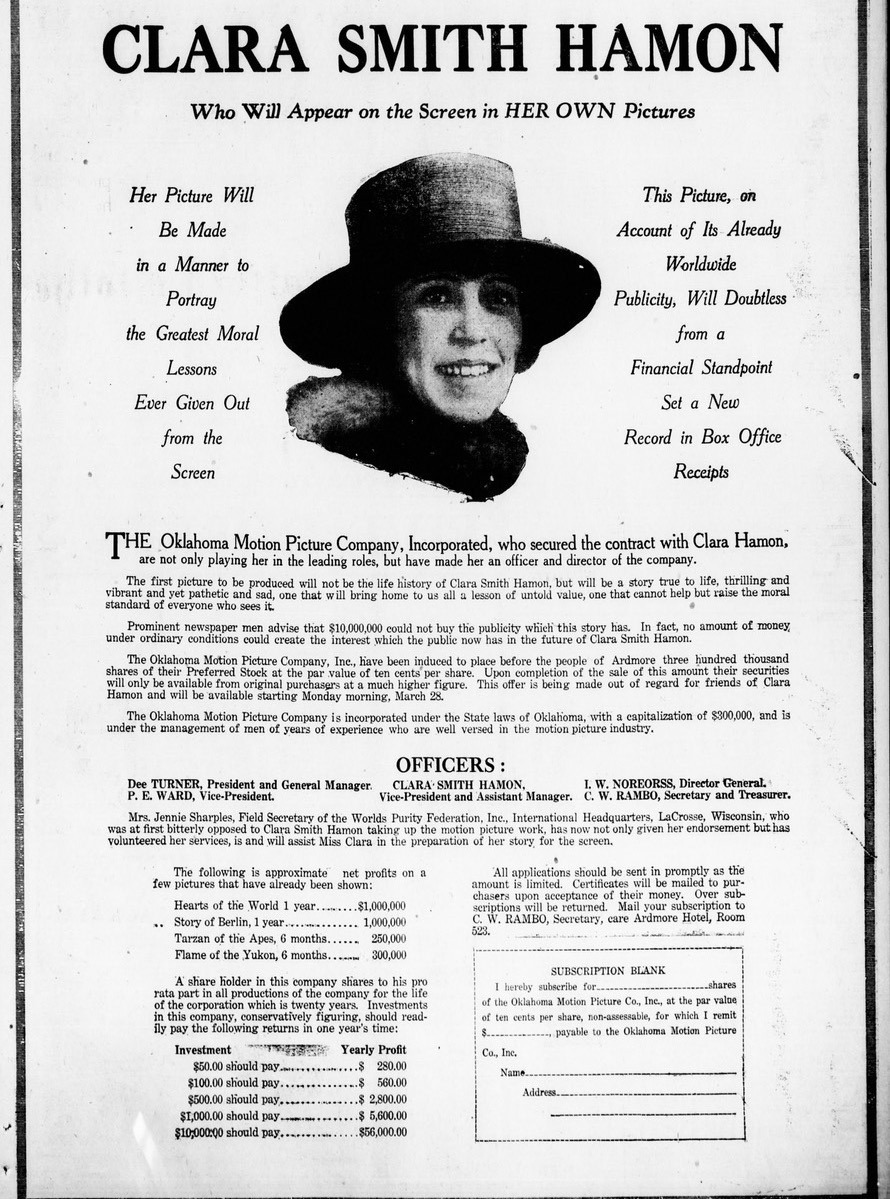
On March 27, 1921, just ten days after the acquittal, the Daily Ardmoreite published a remarkable advertisement promoting the Oklahoma Motion Picture Company, Inc. The announcement offers an extraordinary glimpse into the commercial ambitions surrounding Clara and how promoters intended to exploit the publicity generated by her trial.
Clara was not simply being hired as an actress. According to the advertisement, the company was “not only playing her in the leading roles, but have made her an officer and director of the company.” It was an important distinction. She was not merely the attraction around which the enterprise was being organized; she had been givenaformalpositionwithin its corporate structure. The woman who had spent years financially dependent upon Jake Hamon was now being presented as both a prospective motion-picture star and a participant in the management of a business venture that promised substantial financial rewards.
The advertisement identified Dee Turner as president and general manager, P. E. Ward as vice-president, and I. W. Norcross as director general. Clara herself was named the company’s vice president and assistant manager. The promoters assured prospective investors that experienced men familiar with the motion-picture industry would manage the enterprise.
Significantly, the advertisement announced that the company’s first production would not be a straightforward dramatization of Clara’s life. Instead, it promised something broader, describing the proposed picture as “a story true to life, thrilling and vibrant and yet pathetic and sad,” one that would teach audiences a valuable moral lesson. The promoters insisted that the production would “raise the moral standard of everyone who sees it.”
The language was carefully chosen. Clara’s notoriety had arisen from a relationship that many Americans regarded as scandalous, followed byashootingandasensational murder prosecution. The company therefore tried to present her entry into motion pictures not as an effort to profit from tragedy, but as a chance to promote morality and redemption. This was an ambitious claim, especially given the circumstances that had made Clara famous.
The advertisement also revealed the financial expectations surrounding the venture. Its promoters declared that prominent newspapermen believed “$10,000,000 could not buy the publicity which this story has.” They continued: “In fact, no amount of money under ordinary conditions could create the interest which the public now has in the future of Clara Smith Hamon.”
The statement demonstrated how thoroughly the promoters understood the commercial value of Clara’s name. Her trial had generated publicity on a scale that most motion-picture companies could never afford topurchase.Newspapershad already introduced her to a national audience, and the promoters hoped that curiosity about her future would translate into ticket sales.
The company was also seeking investors. According to the advertisement, the Oklahoma Motion Picture Company had arranged to offer Ardmore residents 300,000 shares of preferred stock at ten cents per share, representing a proposed sale of $30,000. The promoters warned that once those shares were sold, the securities would be available only from existing purchasers at substantially higher prices. The opportunity was presented as a special accommodation to Clara’s friends and supporters in Ardmore.
Clara’snamewasthecompany’s principal attraction, and her formal association with its management gave prospective investors an additional reason to believe that she was committed to the enterprise. The advertisement does not establish whether her appointment ultimately provided meaningful control over corporate decisions or substantial personal wealth. Nevertheless, it represented a remarkable reversal of circumstances. Only ten days earlier, Clara had faced the possibility of a murderconvictionanddeath. Now she occupied a corporate positioninacompanyseeking investors on the strength of her celebrity.
Perhaps the most remarkable portion of the advertisement concerned the endorsement of Mrs. Jennie Sharples, field secretary of the World’s Purity Federation, Inc., an organization headquartered in La Crosse, Wisconsin. According to the company’s announcement, Sharples had initially been bitterly opposed to Clara’s proposed motion-picture career. She had apparently regarded the undertaking as morally objectionable, an understandable position for someone associated with an organization devoted to promoting public morality.
But the advertisement claimed that Sharples had changed her mind. Not only had she endorsed Clara’s participation in the industry, but she had also volunteered to assist in preparing Clara’s story for the screen.
The significance of that announcement should not be overlooked. The promoters were attempting to answer anticipated criticism before it could threaten their investment. By associating Clara with a representative of the World’s Purity Federation, they sought to reassure prospective investors and audiences that the proposed pictures would carry a moral message rather than merely exploit a notorious criminal case. The advertisement portrayed Clara’s entry into the industry as a transformation from scandal to redemption, with religious and moral approval offered as evidence of that transformation's sincerity.
However, an important distinction existed between the company’s promises and what ultimately happened. The March 27 advertisement specifically stated that its first picture would not be Clara’s life history. Yet the film they eventually produced, titled Fate, drew directly on her relationship with Jake Hamon and the events surrounding his death. Whether the original plans changed, or whether theadvertisementwasmeant to make the project more acceptable to prospective investors and moral critics, the announcement alone cannot establish that. What is clear is that the company’s early public assurances differed from the direction the eventual production would take.
It was a remarkable transformation. Butthepromoters were about to discover that public curiosity did not necessarily translate into public acceptance.
The Making of Fate
Clara eventually traveled to California to pursue her motion-picture ambitions. There,theyplannedafeature film based on the events that had made her famous. The resulting production was titled Fate, with Clara appearing as herself, actor John InceportrayingJakeHamon, and John Gorman serving as directorandwriter.Financial support came from Texas oil interests, including William E. Weathers, whose involvement would later become important when the film encountered legal difficulties.
Production began in Hollywood on May 30, 1921. Contemporary film-industry records associated the project with Warner Brothers facilities, althoughthepicturewas not a conventional Warner Brothers production. The completed film consisted of eight reels, making it a substantial feature rather than a brief novelty intended merely to capitalize upon Clara’s name.
The story followed the essential outline of her relationship with Hamon, portraying the years of dependence, emotional conflict, and alleged mistreatment that preceded the shooting at the Randol Hotel. It then dramatized Clara’s flight, return to Oklahoma, prosecution, and acquittal. In substance, the picture adopted the interpretation advanced by her defense attorneys during the murder trial: Clara was presented as a woman driven to desperation by the conduct of a wealthy and powerful man, rather than as a calculating murderer.
The film was therefore an attempt to tell the story from Clara’s perspective. Unlike the courtroom proceedings, where prosecutors could challenge her account and introduce conflicting evidence, the motion picture allowed its creatorstodeterminehowthe characters and events would be portrayed. The resulting production was a dramatization of disputed historical events, not an independent reconstruction of everything that occurred between Clara and Hamon.
For Clara, however, Fate represented an opportunity to shape the public’s understanding of her experiences while establishing financial independence. She was no longer merely the subject of newspaper reports or courtroom testimony. She was participating in the creation of a motion picture intended to reach audiences throughout the country.
The production also brought an unexpected development in her personal life. Clara and director John Gorman became romantically involved, and in August 1921, only five months after her acquittal, they married. Contemporary newspapers reported the marriage with considerable interest, and the announcement apparently surprised members of Clara’s family. Her sister, Mrs. P. D. Walling of Wilson, Oklahoma, reportedly had not anticipated that the professional relationship would develop into marriage.
One newspaper preserved the brief message Clara sent announcing the event: “Married John Gorman 4:30 p. m., wonderful man and good.—Clara.”
The marriage suggested that Clara was attempting to establish a permanent life in California. She had entered the motion-picture industry, become the star of a feature film, and married its director. The years she spent in Hamon’s shadow seemed to give way to a future shaped by her own ambitions.
But the picture had not yet reached a broad audience, and the controversy surrounding its exhibition was growing.
Hollywood Turns Against Clara
Opposition to Fate developed even before production was completed. Influential figures within the motionpicture industry questioned whether theaters should exhibit a film featuring a woman whose celebrity arose from a sensational killing. The National Association of the Motion Picture Industry urged exhibitors to refuse the picture, while other organizations expressed similar objections. William A. Brady, a prominent theatrical producer and industry spokesman,wasamongthose encouraging theater owners to prevent its distribution.
The objections reflected growing industry concern about public morality and the threat of government censorship. Motion pictures had become enormously popular, but religious organizations, civic groups, and political leaders frequently criticized films they considered sensational or morally objectionable. Industry leaders understood that controversial productions could strengthen calls for greater regulation, and Clara’s proposed picture presented precisely the kind of controversy many wanted to avoid.
Critics argued that allowing Clara to reenact the events surrounding Hamon’s deathwouldrewardnotoriety and encourage the belief that involvement in a sensational crime could lead to wealth and celebrity. Others objected to seeing Hamon portrayed unfavorably in a film based on Clara’s version of the tragedy. For his family and those who had known him personally, the picture threatened to reopen painful memories while turning disputed allegations into entertainment.
The campaign against Fate soon became a serious commercial obstacle. Industry organizationsencouraged theaterownerstorefuseexhibition contracts, and exhibitors faced the possibility of public protests and criticism if they agreed to show the picture. Even those who believed the film might attract substantial audiences had reason to hesitate. Without theaters willing to exhibit it, the producers could not recover their investment, regardless of the curiosity surrounding Clara’s name.
In Oklahoma, opposition was especially intense. The shooting and trial remained fresh in public memory, and many residents regarded the proposed film as an exploitation of a tragedy that had already brought unwanted attention to the state. In Ardmore, where Hamon had lived, conducted business, and died, municipal authorities adopted an ordinance intended to prevent the picture’s exhibition. The measure reportedly passed by a single vote, reflecting the divided feelings that continued to surround Clara and the case.
The controversy was particularly striking given the promises made in the March 27 advertisement. The Oklahoma Motion Picture Company had assured prospective investors that Clara’s motion-picture work would elevate public morality, and it had promoted the endorsement of a representative of the World’s Purity Federation. Yet the production that eventually emerged was being condemned by other influential voices as an objectionable commercializationof a notorious killing.
Clara’s celebrity, which had made the enterprise attractive to investors, had become its greatest obstacle. The promoters had counted upon the public’s familiarity withhernametoattractaudiences. Their opponents used that same notoriety as the principal reason the picture should not be shown.
Thedispute would eventually move beyond newspaper criticism, industry resolutions, and municipal ordinances. Financial interests were involved, contracts had been made, and considerable resources had been invested in a film whose commercial future was increasingly uncertain. Before long, the controversy would reach the courts, where questions concerning ownership, distribution, and the right to exhibitFatewoulddetermine whether Clara’s motion-picture ambitions could survive.
The woman who had recently emerged victorious from one courtroom was about to discover that another legal battle awaited her.
Another Jury, Another Acquittal
The most remarkable episode in the film’s troubled history occurred in San Francisco, where Fate opened in September 1921. The picture attracted official attention almost immediately, and authorities moved to prevent its continued exhibition. William E. Weathers, who had helped finance the production, was arrested in connection with the showing of the film after officials contended that its contents violated laws governing indecent or immoral exhibitions.
Theprosecutionpresented an unusual problem. Unlike the murder case in Ardmore, thequestionwasnotwhether Clara had unlawfully killed Jake Hamon. The issue was whether a motion picture dramatizing the events surrounding that killing was itself unlawful to exhibit. The authorities argued the picture was objectionable because of its subject matter and how it portrayed Clara’s relationship with Hamon.
Weathers contested the accusation and demanded a jury trial. To determine whether the picture violated the law, the jury was permitted to view the film itself. The entire eight-reel production was shown in the courtroom so that the jurors could decide whether its contents were indecent or otherwise prohibited.
The resulting jury was composed of twelve married women.
The contrast with Clara’s murder trial could hardly have been more striking. In Ardmore, twelve men had listened to testimony concerning the shooting and acquitted Clara of murder. In SanFrancisco,twelvewomen watched Clara reenact the events on a motion-picture screen and were asked to determine whether the resulting production violated the law.
After viewing the film, the women acquitted Weathers. Contemporary accounts described a deliberation lasting about ten minutes before the jury returned a not-guilty verdict. Once again, a jury rejected an accusation arising from Clara Smith Hamon’s story, and once again it reached its decision with remarkable speed.
The outcome was a legal victory for the film’s promoters, but it did little to solve their larger problem. A verdict that the picture was not criminally indecent did not require theaters to exhibit it, distributors to handle it, or newspapers to accept advertisements promoting it. Industry opposition continued, and the picture struggled to obtain the widespread distribution its investors had anticipated.
The San Francisco proceedings nevertheless revealed the unusual position Clara occupied in American popularculture.Hercriminal trial had been transformed into a motion picture, and the motion picture had generated another criminal proceeding. The first jury had decided whether she was guilty of murder. The second had decided whether her dramatization of the events was unlawful to show.
Both juries returned verdicts of not guilty.
But neither verdict could compel the public to embrace Clara as a motion-picture star.
The Picture Comes to Oklahoma
Despite efforts to suppress Fate, the film was not entirely kept from audiences. Contemporary records establish that it was exhibited in several communities, including towns in Oklahoma. This distinction matters because later accounts sometimes suggest the picture was completelysuppressedbefore anyone could see it.
The surviving evidence tells a more complicated story.
In November 1921, Fate was shown in Bristow, Oklahoma. Newspaper accounts also document screenings in other communities, including Marietta and Wilson, and reports indicate that the picture reached Comanche. The exhibitions were limited, and some faced official inter- and some faced official interference, but they show that Clara’s film reached paying audiences.
The Oklahoma screenings were particularly significant because many viewers would have been familiar with the case from the beginning. They had read the newspaper accounts of Hamon’s shooting, Clara’s flight, her return to Oklahoma, and the sensational trial in Ardmore. Somemayhaveknownpeople connected with the events. Others may have followed the testimony closely enough to recognize the differences between the film’s portrayal and the evidence presented in court.
For those audiences, Fate was not simply another silent melodrama. It dramatized events that had occurred in their own state, involving people whose names had dominated newspaper headlines for months.
The exhibition in Comanche reportedly attracted considerable interest, but local officers intervened and stopped the showing during the fourth reel. The interruption illustrated the practical difficulties facing the film’s promoters. Even where theater owners were willing to exhibit the picture and audiences were willing to pay to see it, local authorities could intervene and prevent the performance from continuing.
The film also faced obstacles in New York, where the newly established state motion-picture censorship commission refused to approve it for exhibition. The commission issued a certificate of disapproval in October 1921, effectively preventing the picture from being shown legally in New York theaters. The producers challenged the decision and attempted to negotiate changes that might satisfy the censors.
Scenes considered for possibleremovalincludedthe depiction of Clara’s marriage to Hamon’s nephew and the enthusiastic celebration that followed her acquittal. Those scenes were central to the story the filmmakers wanted to tell, but opponents also considered them objectionable.
Thecontroversycontinued into 1922, when New York courts upheld the refusal to license the picture. By then, the production’s prospects had deteriorated considerably. Its investors had spent substantial sums, its promoters had anticipated nationwide distribution, and Clara had hoped that the film would launch a successful acting career. Instead, Fate had become the subject of boycotts, censorship proceedings, criminal charges, and disputes over whether it should be exhibited at all.
The picture that was supposed to transform Clara’s notoriety into lasting celebrity was becoming a commercial failure.
The Film That Disappeared
The ultimate fate of Fate has become almost as intriguing as the story it attempted to portray. Later accountsfrequentlyclaimthat the controversy surrounding the picture resulted in the destruction of every copy, sometimes describing the prints as deliberately burned. Although the story has become part of the legend surrounding Clara Smith Hamon, the surviving historical evidence does not conclusively establish how the film was destroyed or lost.
What is known is that no complete print of Fate is presently known to survive. The National Film Preservation Board has included it among America’s lost silent feature films. Whether its disappearance resulted from deliberate destruction, commercial abandonment, or the deterioration of nitrate film remains uncertain. Early motion pictures were particularly vulnerable to loss because nitrate stock was highly flammable and deteriorated with age. Thousands of silent films disappeared through fires, improper storage, and the routine disposal of prints considered commercially worthless.
The opposition to Fate undoubtedly damaged its prospects for widespread exhibition and financial success. With limited opportunities for distribution, there was little commercial incentive to preserve the production. However, the often-repeated claim that every copy was deliberately burned should be distinguished from the documented fact that the film is now considered lost.
Its disappearance represents a significant historical loss. Had the picture survived, modern audiences could have watched Clara portray herself in a dramatization of the events surrounding Jake Hamon’s death. Historians could have compared the film’s presentation with the testimony, newspaper accounts, and original court records, providing an extraordinary glimpse into how Clara wished the public to remember her story.
Instead, only the contemporary advertisements, production records, newspaper descriptions, and accounts of the film’s exhibition remain to tell us what audiences might have seen.
There is a final irony. Clara intended Fate to preserve her version of the tragedy for future generations. Yet the courtroom records that once threatened her freedom have survived, while the motion picture she hoped would secure her future has vanished.
Clara Smith Hamon had escaped a murder conviction, but she could not escape the shadowofJakeHamon.Even in Hollywood, her future remained inseparable from her past.
The Marriage That Did Not Last
Clara’s marriage to director John Gorman initially appeared to offer the possibility of personal happiness alongside her new career. Their relationship had developed during the production of Fate, and the marriage attracted newspaper attention because of Clara’s continuing notoriety. For a woman who had spent years involved with a married man and whose private life had been exposed in extraordinary detail during a murder trial, the prospect of establishing a conventional marriage may have represented an important emotional beginning.
But the marriage did not endure.
By 1924, Clara had sought a divorce from Gorman, alleging cruelty and excessive drinking. The accusations were particularly troubling because they echoed elements of the relationship with Jake Hamon that Clara had described during her trial. Once again, she alleged that a man with whom she had become romantically involved had subjected her to conduct that made the relationship intolerable.
The divorce proceedings attracted renewed newspaper attention, although nothing approaching the extraordinary publicity that had surrounded the murder trial. In June 1925, the marriage wasdissolved.Contemporary accounts recorded Clara’s complaints about Gorman’s behavior and her dissatisfaction with their life together.
Thefailureofthemarriage marked another disappointment in Clara’s attempt to build a new life after the acquittal. Her motion-picture career had not developed as she hoped, the film that was supposed to make her a star hadencounteredoverwhelming opposition, and her marriage to its director had ended in divorce.
There is no reliable evidence that Clara established a sustained career as a motion-picture actress after Fate. The picture appears to havebeenheronlysignificant film appearance. Whatever acting ambitions she possessed, theywerenotrealized in the manner she and her promoters had envisioned.
Bythemiddleofthe1920s, the extraordinary public fascination thathadsurrounded Clara was beginning to fade. The newspapers that once reportedhereverymovement had found new scandals, new celebrities, and new subjects of public interest. The country had changed as well. The Harding administration had been overtaken by scandal, the motion-picture industry was expanding rapidly, and the sensational events of 1920 and 1921 were becoming part of Oklahoma’s recent history rather than daily news.
Clara remained recognizable to those who remembered the Hamon case, but the celebrity that had briefly made her one of the most discussed women in America was no longer sufficient to sustain a career.
She spent much of the rest of her life outside the national spotlight.
To Be Continued…
For Clara Smith Hamon, the acquittal had promised a new beginning. She had escaped a murder conviction, entered the motion-picture business, become an officer and director of a company, and married the man directing her first film. For a brief moment, it appeared that the tragedy in Ardmore might become the foundation of an extraordinary new life.
But Hollywood would prove far less welcoming than its initial promises suggested. The motion picture that was supposed to make Clara a star encountered fierce opposition, and the future she envisioned would unfold very differently than she had hoped.
And what of Charles Arthur Coakley, the Marshall Countyattorneywhosecourtroom skills had helped secure her acquittal? For Coakley, the Hamon trial was another remarkable chapter in an already distinguished legal career. But his story was far from finished. Other defendants, other courtrooms, and other sensational cases awaited the lawyer whose reputation for defending those accused of the most serious crimes continued to grow.
Next week, in The Lion of the Courtroom, we will follow Clara Smith Hamon through the remaining years of her remarkable life and what ultimately became of the woman whose name had once dominated newspaper headlines across America. WewillalsoreturntoCharles Arthur Coakley and the extraordinary legal career that made him one of Oklahoma’s most formidable courtroom advocates.
The jury had spoken, and Clara Smith Hamon had walked away a free woman. But freedom was only the beginningofthenextchapter.
And for the Lion of the Courtroom, there were still battles to be fought