
The rails were down and the whistle was already carrying across the open prairie before anyone stopped to wonder what sort of town would gather in its shadow.
In these past weeks, we have lingered at that very edge. We followed the Frisco’s patient march southward— its surveyors carving quiet lines through the Chickasaw Nation, the iron trailing behind them like a promise not yet fully spoken. We watched Randolph come into being, not by design, but by the simple fact that the train chose to pause there. We saw Helen rise from little more than a name and a need, and Kingston itself shift its ground—lifted, almost bodily, by the decision of where the rails would rest.
And we saw something harder, something closer to the bone. We saw Madill rise where the railroad chose to plant its flag, drawing life toward it with a force that could not be resisted. In that rising, Oakland—older,established, once secure in its place—paid the price. Trade, movement, and attention bent toward the rails, and for a time it seemed as though Oakland might be left behind by the very progress it had once welcomed. But the story did not end there. In time, the iron found its way to Oakland as well, and with it came a depot, a renewed connection, and a measure of what had been lost.
We watched Woodville uproot and move in pursuit of thatsamelifeline,andwesaw a modest country settlement grow into the bustling town of Aylesworth, drawn into existence by the steady, unyielding pull of the railroad.
And at the center of it all stood the depot. Not yet grand. Not yet permanent. But essential.
The Frisco was not in the business of building monuments— not in those early days. It was in the business of movement.
When the line was driven through what would become Marshall County, time mattered more than appearance. Every mile of track laid was a mile that could carry freight, a mile that could bring settlers, a mile that could begin paying for itself. The railroad built forward, not backward, and it built fast.
So, the first depots—Madill’s amongthem—rosefrom timber.
They were plain structures, framed in wood, often set close to the track with little more than a raised platform and a roofline that stretched outward to shield passengers and freight from the weather. Inside, there might be a small waiting room, a ticket office, and a freight space—nothing more than what was required to keep the line functioning.
No architect’s signature marked them. No stone was laid to outlast the years. These buildings were not meanttoimpress—theywere meant to serve.
In those early days, their verysimplicitywasbydesign. These depots were not the work of architects, but of railroad engineers—men tasked not with beauty, but with efficiency. They were drawn with a carpenter’s eye and a builder’s hand, meant to be raised quickly, with as little complication as possible. In many cases, the materials themselves were prepared in advance—cut,measured,and loaded onto railcars—then shipped forward along the advancing line. As the track reached a new point, the pieces arrived with it, ready to be assembled almost as soon as they were unloaded.
It was a system built for repetition. The Frisco, like many railroads of its time, maintained what amounted to a pattern book of depot designs—a catalog of proven forms from which its officials could choose. A particular design, once selected, might appear not just once, but a dozen times or more along the line, each nearly identical to the last, save for minor adjustments dictated by location or need.
Speed was the governing principle. Ease of construction was the rule. The railroad was pushing forward, and the depots were expected to keep pace—rising in wood and nail as quickly as the iron reached them, marking each new stop not with grandeur, but with function.
And serve they did. They became the gathering point for the town before the town even knew it was one. Farmers came to them with cotton and livestock. Merchants waited for shipments. Travelers stepped down into a place that, in many cases, had no name beyond the one printed on a timetable.
The depot was the beginning.
But beginnings rarely remain unchanged.
Railroads, for all their romance in memory, were cold in their calculations.
The Frisco watched its lines the way a banker watches his ledger. Every shipment counted. Every passenger noted. Every town was measured not by hope, but by output. And over time, patterns began to emerge.
Some stops remained little more than that—places where a train slowed, took on a crate or two, and moved on.
Butothers—Madillamong them—began to swell.
Freight increased. Cotton rolled in from the surrounding countryside in greater volume. Cattle shipments grew. Passenger traffic rose as families, merchants, and travelers found their way along the line. What had once been a modest stop became a place of steady activity.
And the wooden depot— built for a beginning—began to show its limits.
Platforms grew crowded. Freight space proved too small. The wear of years, of weather, of constant use began to take its toll on structures that had never been intended to carry such a burden for so long.
More than that, there was something less tangible, but no less important.
Perception. A town’s depot was its face to the world. Travelers judged a place, fairly or not, by what they saw when they stepped from the train. A sagging wooden structure spoke of transience. A substantial building spoke of permanence.
The Frisco understood this.
Not every town received a new depot.
That decision was never sentimental. It was earned.
The railroad looked first to the numbers—freight volume, passenger counts, revenue generated along that stretch of line. A town that moved goods, that filled railcars, that justified the stop in dollars and cents, made its case without ever speaking a word.
But numbers alone were not always enough.
Locationmattered.Atown positioned as a shipping hub, drawing from a wide agricultural hinterland, carried more weight than one that served only itself. Growth matteredaswell—notmerely what a place was, but what it was becoming. A rising town, one pushing outward with new businesses and new people, signaled future return on investment.
And then, though rarely written down, there was pressure.
Communitiesasked.Leaders petitioned. Newspapers agitated. The railroad might be a business, but it did not operate in silence. It heard the voices of the towns along its line, even if it answered them only when the ledger agreed.
When all of those factors aligned—when the numbers justified it, when the location supported it, when the future seemedtopromisemore—the Frisco acted.
The wooden depots, those first rough outposts of the iron road, gave way to something else. Brick. Stone. Concrete.
Structures meant not for a moment, but for an era.
And it was at that point— when Madill had proven itself, when the need had outgrown the temporary—that the conversation turned from whether a new depot would come…to what kind of depot it would be.
The first public sign came cautiouslyenough.OnMarch 31, 1911, the Marshall County News Democrat reported, “The report is that the Frisco people have set aside funds and submitted plans to the Corporation Commission for building a new depot here.” It was only a report, still shaded with uncertainty, but it was enough to stir the town. Madill had long since outgrown thecrudewoodenstationthat had served the town in its earlier years. The old depot had been built in the first rush of railroad expansion, when the Frisco, like so many lines of that era, erected plain timber structures as quickly as the rails advanced—functional depots, designed by engineers, assembled from precut material, and intended to serve the immediate needs of a working line. But Madill was no longer a rough beginning. By 1911, it had become a shipping point, a trading center, and an established community whose business and population demanded more.
Within a week, the matter had moved from rumor to public debate. On April 5, 1911, the Madill Times reported under the headline “MassMeetingVotetoLocate Depot” that “A Mass Meeting of the citizens of Madill was held in the Court House” to discuss the location of the proposed new station. Corporation Commissioner George A. Henshaw was present and “explained fully the kind of depot to be built, which had been agreed upon by the Commission and the Railroad Company officials.” The paper then gave the public its first concrete measure of what the Frisco was promising: “The building will be 153 feet by 30, and will be built at a cost of $17,000.”
For a town like Madill, that was no small undertaking. This was not patchwork or repair. It was investment, scale, and intention.
But it did not take long for the matter to turn from one of simple construction into one of control. The question was no longer just what kind of depot would be built, but where it would stand. That choice carried weight. The railroad looked first to its own convenience of operation, but the people of Madill saw further. They understood that the placement of that station would govern the very shape of the town—its streets, its trade, its access, even the face Main Street would present to the world.
When the Frisco first set down its wooden depot, it placed it at the east end of Main Street—at a time when Main itself did not yet stretch that far. The town, in a sense, had been asked to grow toward the railroad. But Madill was not content to leave that future to chance. As the Madill Times recorded, a motion was brought before the assembled citizens declaring “it the sense of this meeting that the new depot be placed north of Main Street,” and it was carried—unanimously. That word carries its own quiet force. There was no division in the room. The town knew its mind, and it spoke with one voice.
The next week, on April 7, 1911, the Marshall County News Democrat published in full a letter from Commissioner Henshaw to Judge J. W. Falkner, which remains one of the key documents in the entire story. Henshaw explained that railroad official Mr. Tyler had suggested placing the depot “in the street south of Main Street. In other words, let that street be closed, and Main Street opened.” Henshaw admitted atoncethatsuchaplanwould provoke resistance. “This I very readily understood would meet with considerable objection,” he wrote, especially because of existing property and gin interests. He then laid out, perhaps moreclearlythananyonehad before, why the railroad was pressing so hard for room. “The passenger depot with the freight anyway near it, will take up considerable space, and with the necessary equipment for loading and unloading freight and transferring of freight, more room will be required than the ordinary citizen would anticipate.”
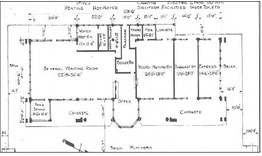
Yet the same letter also gave the town its first real glimpse inside the building itself. Henshaw emphasized that this was “the passenger depot alone” and that the freight depot would be elsewhere. He then described the interior in detail: a general white waiting room measuring more than 1,400 square feet; a women’s rest room of 225 square feet that would contain “several big rocking chairs”; separate toilets; a 312-square-foot ticket office; a news stand; a segregated waitingroomandfacilitiesfor Black passengers; a baggage room; and a United States Express room of 896 square feet. He estimated the structure itself at $12,500 before sidewalksandplatforms,and “between sixteen and seventeen thousand dollars” once water, sewerage, and related improvementswereincluded. Then came the phrase that captured the heart of the matter: “It is going to be beautifully arranged, everything modern and up-to-date.”
That line marked a turning point. Madill was no longer speaking merely of replacing an old depot. It was speaking of modernity, arrangement, comfort, and civic presentation.
The issue of location remained unsettled through April, but by the end of the month, an agreement had been reached. On April 27, 1911, the Madill Times announced, “Depot Location Settled,” reporting that the local committee had met with W. T. Tyler, general manager of the Frisco, Superintendent S. A. Charles, and A. M. Conley, assistant general freight agent. “It was practically agreed that the new depot be built just North of Main Street,” the paper said, “the platform coming up to Main Street.” The platform itself would be “about 700 feet long,” and the A. & C. Division linefromArdmorewould come in on the west side of the depot. Taliaferro Street would remain open. The railroad even agreed to fix Main Street “in good shape across their property,” possibly with crushed rock. The total cost of the contemplated improvements was now estimated at “in the neighborhood of $30,000.” In other words, what had first been publicly described as a $17,000 project was already growing in scale and ambition.
The Marshall County News Democrat of April 28, 1911, covered the same conference with even more emphasis on the town’s resistance torailroadconvenience. Tyler had first submitted a blueprint placing the depot south of Main and closing Taliaferro Street, the paper said, but “the committee objected to this location or the closing of any open street.” After the discussion, Tyler agreed to return the blueprint sorevisedplanscouldbe developed for a location north of Main Street. The article described the revised track arrangement and repeated the growing estimate of $30,000, concluding with an approving note: “The Frisco is evidencing a desire to do all they can to meet the wishes of the citizens of Madill in this matter…Speed the day.”
But the day did not come quickly. Through the spring and into the next year, the town was forced to wait. On June 1, 1911, the Madill Times published a letter assuring Judge Falkner that “Our agreement with the citizens of Madill will be carried out to the letter.” The News Democrat of June 2 carried substantially the same assurance and emphasized that the north-of-Main location and the opening of Main Street were part of the agreed plan. On June 16, the Marshall County News Democratobservedthat“The town has outgrown the present depot.” That may have been the truest statement in the whole controversy. Madill had simply outgrown what had once been enough. A week later, on June 23, 1911, the paper reported that Frisco officials came to town in a private car, submitted plans and blueprints to the citizens’ committee, and left the members “well satisfied.” It confirmed that the passenger depot would stand just north of Main Street, and that the original depot would be converted into a freight building and moved south of Taliaferro Street. Even then, however, the work still did not begin at once.
By August 4, 1911, the MarshallCountyNewsDemocrat reported that the Frisco people had informed the local committee that work would begin in September and that “A more desirable improvement for Madill cannot be imagined.” In October 1911, the Madill Times reported that “Several carloads of material have already arrived for the new depot, and work will begin at once. Two or three cars of sand and brick have been unloaded, and several more are now on the tracks.” The article added that “Some forty or fifty men will be put at work the first of the week in moving the present depot and rearranging the tracks for the new building.” Thewholeimprovement program was estimated at $30,000.OnOctober13,1911, the Marshall County News Democrat wrote under “New Depot Under Way” that the Frisco had “about 15 cars of material here and will put about fifty men on the job next week getting things ready for the erection of our depot,” then broke into unguarded civic pride: “We are going to have a new depot, and a good one. Hurrah for the Frisco.” In another local note, the paper remarked, “The new depot and hotel on Main Street will add much to the appearance of the town.”
Even then, the process stretched onward. By May of 1912, the mood had become testier. In the Madill Times of May 16, 1912, Commissioner Henshaw openly acknowledged the impatience of the town. “Some of the people at Madill appreciate the situation and are waiting with a reasonable degree of patience,” he wrote, but “Others want to insist the delay is due to neglect.” That letter is valuable because it shows the delay was not merely an inconvenience. The people were restless and beginning to look for someone to blame.
The answer appeared the following week in a letter from General Manager W. T. Tyler, published in the Madill Times on May 23, 1912. Tyler denied that weather or expense was truly the central cause of delay and instead offered the explanation that changestheentirestory:“The Madill depot has actually been delayed because of Mr. Nixon’s negotiations with outside architects for a new design of depot. This includes the depots at Madill, Ada, Afton and Claremore.”
There it was, in plain language. Madill was no longer to receive an ordinary station. The Frisco was reaching beyond its usual engineering channels to seek a new design. The town had crossed into another class of depotbuilding altogether.
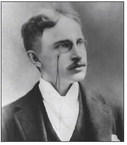
Itwasinthatmoment—almost quietly, almost without the town itself fully realizing it—that the story of Madill’s depot crossed paths with a broader current moving through American architecture. For the man ultimately tied to its design was Louis Singleton Curtiss, a figure as complex and compelling as any to leave his mark upon the built landscape of the Midwest—a man whose life, like his buildings, seemed to stand somewhere between tradition and invention, between what had been and what was yet to come.
Curtiss was born on July 1, 1865, in Belleville, Ontario, Canada, the son of Don Carlos Curtiss, a dry goods merchant, and Frances Elvira Crowell Curtiss. His beginnings were not remarkable, at least not on their face. But the early loss of both parents—his father in 1883, his mother scarcely more than a year later—left him unmoored at a young age and perhaps set the tone for a life that would remain, in many respects, solitary and self-directed. There are suggestions—never fully confirmed—that he studied engineering at the University of Toronto, and perhaps architecture in Paris at the famed École des Beaux-Arts. Whether those claims were true or carefully cultivated myth, even his contemporaries could not say. Curtiss himself offered little clarification. He preferred, it seems, that his origins remain indistinct.
By 1887, he had arrived in Kansas City—a city then surging with growth, opportunity, and ambition. It was the kind of place where a young man with talent and nervemightmakesomething of himself. Curtiss found work first as a draftsman, then quickly advanced, forming a partnership in 1889 with Frederick C. Gunn. Together, the firm of Gunn & Curtiss began producing substantial work—courthouses, hotels, public buildings— often in the grand European styles that still held sway at the close of the nineteenth century. Among their early commissions was theimposingTarrantCounty Courthouse in Fort Worth, Texas, a structure of such scale and presence that it rivaled state capitols in its ambition. They also designed the Missouri State Building for the 1893 World’s Columbian Exposition in Chicago, placing Curtiss, even at that early stage, within the orbit of national architectural significance.
But Curtiss was not a man inclined to remain within established boundaries.
When the partnership dissolved in 1899, he struck out on his own, and it was in that independence that his work began to change. No longer content to merely echo historical forms, he began experimenting—quietly at first, then more boldly—with new ideas, new materials, and new expressions. He designed theaters such as the Standard, later the Folly Theater, in Kansas City, buildings that still carried the language of European classicism but hinted at something more individual beneath the surface. He worked on residences that blended influences—Prairie Style horizontality, Arts and Crafts intimacy, touches of the exotic and the modern— into something that could not easily be categorized.
And then came the turning point.
In 1908–1909, Curtiss completed the Boley Clothing Company Building in downtown Kansas City. At a glance, it might have seemed like another commercial structure rising in a growing city. But in truth, it was something far more radical. Its exterior walls— glass and metal, hung from the structural frame—did not bear weight in the traditional sense. They were, instead, what would later be called a curtain wall, one of the earliest true examples of such a system anywhere in the world. Sunlight flooded the interior. The building seemed lighter, more open, more modern than anything around it. At the time, many did not fully grasp what Curtiss had done. But in hindsight, it stands as a quiet revolution—a step toward the glass towers that would define cities decades later.
Curtiss was, by then, moving steadily away from the past and toward something distinctly his own.
It was in those same years that another opportunity opened before him—one that would bring his work into towns like Madill. The railroads, expanding and modernizing, began to look beyond their own engineers and pattern books. They sought architects who could give their stations not only function, but identity. Curtiss, with his growing reputation for innovation and his willingness to experiment, found himself in demand.
He became, in effect, a railroad architect.
His work in this field spread across the Midwest and the Southwest. He designed stations and related facilities for the Santa Fe Railroad and for Fred Harvey’s network of hotels and dining establishments that accompanied it. Among his projects were the El Bisonte HotelinHutchinson,Kansas, in 1906; the Harvey House in Emporia, Kansas, in 1907; the Sequoyah Hotel in Syracuse, Kansas, in 1908; and the El Ortiz Hotel in Lamy, New Mexico, in 1909. These were not merely utilitarian structures. They drew upon regional influences—Southwestern motifs, Spanish Colonial forms—blending them with Curtiss’s own developing style.
And then came the depots themselves.
Between 1909 and 1912, Curtiss designed a series of railroad stations that would define his work in this field. In Texas, he produced depots at Sweetwater, Lubbock, Snyder, and Post—each reflecting a balance between practical railroad needs and architectural expression. In Kansas, he designed the Union Terminal at Wichita, a structure that combined Beaux-Arts formality with more modern elements along its extended facades. In Missouri, he created the Joplin Union Depot, a building of scale and presence that stood as one of the region's most significant railroad structures. These stations were not identical. They were not drawn from a pattern book. Each responded, in its way, to place, to function, and to Curtiss’s evolving vision.
It was also during this same period that Curtiss turned his hand to stations within Oklahoma, including the Frisco depot at Ada—one that, when set beside Madill, reveals the architect’s habit of refining and repeating a successful form. Indeed, the Madill Union Station did not stand alone in its design. It belonged to a small family of depots—its closest kin being the Santa Fe depot at Post, Texas,andtheFriscodepotat Ada, Oklahoma. These were, in essence, sister stations— built from the same architectural idea, sharing the same proportions, the same general arrangement, and the same visual character, differing only in minor details of finish and ornament more in line with their local surroundings. Where the earlier pattern-book depots of the Friscohadbeentheproductof engineering repetition, these weresomethingmoredeliberate: architectural repetition, guided by a single creative mind, adapted just enough to fit each place while preserving a recognizable identity across the landscape.
And through all of it, one constant remained: he believed that a railroad station should mean something.
It should not merely house passengers. It should represent the town. It should signal arrival—not just of trains, but of progress.
Curtiss’s personal life, meanwhile, unfolded in a manner as unconventional as his work. He was widely regarded as eccentric, even flamboyant. He dressed in white suits, smoked incessantly— custom cigarettes ordered in large quantities— and was known to pay his bills in gold coin. He drove one of the fastest automobiles in Kansas City at a time when such machines were still a novelty. He spoke in elaborate language, made grand pronouncements, and cultivated, whether intentionally or not, an air of theatrical individuality.
Yet for all that outward display, he remained deeply private.
Henevermarried.Asingle failed romance is said to have left a deep mark on him, though details remain scarce. He gave few interviews, left behind almost no personal writings, and in at least one version of his will, requested that his papers be destroyed upon his death. Whether they were or not, none have ever been found. Even basic details of his education and early life remain uncertain, obscuredbytimeandperhaps by his own design.
As the years wore on, the bright edge of his career began, almost imperceptibly at first, to dull. The currents of taste shifted, as they always do. Public preference turned elsewhere. Patrons who had oncesoughthimoutfellaway, one by one. In his prime, contemporaries had spoken of him in lofty terms—more than one called him the Frank Lloyd Wright of Kansas City—a comparison that spoke not only to his talent, but to the singular, almost restless originality of his designs. Yet even such praise could not hold back the slow turning of the tide.
By the 1910s and into the early 1920s, his work had narrowed largely to residential commissions—homes that still bore the mark of his distinctive vision, but carried it on a quieter, more restrained scale. He withdrew moreandmorefromthe public eye, retreating into his studio, where he spent long, solitary hours refining ideas that, in many cases, would never find their way into brick and stone.
Then, on June 24, 1924, Louis Curtiss died at his drafting table in Kansas City, just days shy of his fifty-ninth birthday. The cause was given as a hemorrhage of the lungs, though whispers of other possibilities lingered. In a final echo of the reserved and enigmatic life he had led, he was laid to rest in an unmarked grave.
And yet, for all that, his legacy endured—in courthouses and theaters, in hotels and houses, and in the railroad stations that carried his vision across the landscape.
It is within that legacy that Madill’s depot must be understood.
When Curtiss turned his attention to a station, he did not see merely a place where trains stopped. He saw a threshold—a point where movement met settlement, where the wider world touched a single town. He understood that the depot would be, for many, the first impression of that place, and for others, the last.
And so, when his hand shaped the plans that would become the Madill Union Station, he brought with him not only skill, but philosophy.
For Curtiss, a depot was never just a building.
It was a declaration. At last, in September of 1912, the long wait gave way to visible action. The Madill Times of September 5 reported, “Work on the surveying and cleaning away preparatory for the actual construction began Tuesday.” By Wednesday morning, “some 30 hands were at work,” and “theywantedallthementhey could get.” Cars of gravel had already arrived. The article promised “good platforms,” a new freight arrangement, and“muchmoreconvenience for the general public here than we have had here before.” The next day, the Marshall CountyNewsDemocrat raised the scale considerably, stating that “More than one hundred and fifty men are at work in the Frisco yards, changing tracks, platforms and unloading material for the construction of our new depot.” It called the structure “modern in every way,” and noted the building of additional walks.
Construction continued in earnest. The Madill Times later noted that several more carloads of material had arrived, and that forty or fifty men were at work moving the old depot and rearranging the tracks. The News Democrat joyfully declared, “We are going to have a new depot, and a good one for the Frisco.” That line, simple and unguarded, captured the town’s mood better than any polished editorial could have done.
Even so, there were pauses. On November 8, 1912, the Marshall County News Democrat reassured its readers that work had resumed, “Material is arriving daily, and the foundation is being laid,” and “there will be no break in the work until the structure is completed.” A “structure, modern and convenient in every detail” was promised. By February 21, 1913, the paper predicted that the depot would be completed “within the next two months.” That proved a little optimistic, but not wildly so. By June 5, 1913, the Madill Times could say with local plainness and pride, “The new Frisco depot just being completed is about the prettiest we have seen.”
At last, in September of 1913, completion became official. On September 5, the Marshall County News Democrat reported that telegraphic dispatches had informed local agent Alsup that the proper officers of the Frisco had “formally received the passenger depot building at Madill from the contractor.” Furniture and fixtures would be moved in at once. The same article recorded that Mayor Marsh and other representative citizens favored a banquet and smoker for Frisco officials “as a token of the appreciation of the city of the good things which the company has given us in this passenger station.” A week later, the paper observed with some charm that Agent Alsup now wore “the keys of the building at his belt and the pleasantest of pleasant smiles on his genial features.”
The opening itself became one of the notable social events in the town’s history. On September 18, 1913, the Madill Times reported under a large headline that the new Frisco depot had been publicly opened the previous Monday, with “several hundred people in attendance.” One of the officials stationedatthewaiting-room door presented every lady with “a white carnation and chrysanthemum.”Therewas music by an orchestra, and the reception was given by “the ever courteous Frisco officials.” The newspaper then summed up the building in terms no local reader could mistake: “The new depot is a beautiful construction, being far ahead of the majority of depots in other towns of Madill’s size and population. We are proud of it.”
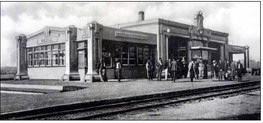
And the pride was not misplaced, for what stood before them that day was no ordinary station, but a structure conceived on a grand and deliberate scale. Its broad, balanced plan stretched confidently along the platform, anchored by a spacious general waiting room more than fifty feet in length—a civic hall as much as a place of transit. Around it, the rooms of the depot unfolded with purpose: offices set at the center, baggage and express rooms handling the steady rhythm of commerce, and smaller, more private spaces arranged with the precision of a building meant to serve both people and industry.
Yet its true distinction lay not merely in its size or its modern construction, but in thewayitwelcomedthelight. Thedepotwasencircledonall four sides by large windows, opening the structure to the prairie sun from every direction. Morning and afternoon alike, light would spill across the interior, filling the waiting rooms and softening the otherwise solid lines of concrete and brick. It was a building that refused to feel closed or confined. Instead, itbreathed—open,luminous, and alive.
That sensibility bore the unmistakable influence of its architect, Louis Curtiss, whose work had long shown a preference for structures that embraced light rather than shut it out. In Kansas City, his celebrated Boley Building—often cited as one of the earliest true glass curtainwallbuildings—stood as a bold declaration of that philosophy, its wide expanses of glass drawing daylight deep into its interior. In Madill, the expression was more restrained, shaped by purpose and place, yet the idea remained the same: light was not decoration, but design.
Constructed of concrete, with a flat tar-and-gravel roof, electric lighting, and hot-water heat, the depot spoke in the language of permanence. It marked a clear departure from the temporary wooden stations of earlier years, declaring instead that Madill had reached a stage where such a structure was not only warranted, but expected. And along its face, the long brick platform—edged with concrete curbing—formed the final threshold where town and train met, where the dailymovementofpeopleand goods would pass in steady procession.
In all, the building stood as more than a depot. It was a statement of arrival—of a town that had grown into its place and now claimed it with confidence, in concrete, in glass, and in light.
That evening, the celebration moved to the Rock Hotel, where the businessmen of Madill honored the visiting railway officials with a banquet. “Covers were laid for a hundred guests,” the Madill Times wrote. Present were Commissioner Henshaw, General Superintendent Frates, Superintendent Hopkins, CommissionerofHighways Suggs, General Agent Dogerel, C. J. Windsor, and others, including “our old friend and former townsman Dispatcher Moreland.” Under themanagementof“mine host” Jones, the Rock Hotel diningroomwastransformed into “a banquet hall.” There “was spread a Lucullian feast of sterling edibles and dainty viands, embroidered with bouquets of roses and chrysanthemums.” At nine o’clock, Mayor Marsh opened with an address of welcome. David Russell served as toastmaster and explained that the occasion was intended to express the pride the people felt in “the beautiful new depot” and their appreciation to the Frisco for providing “so handsome and enduring a structure.” The speeches that followed all turned around a common idea: that the relationship between public service corporation and public ought to be oneofmutualunderstanding, and that old bitterness was giving way to “a growing sense of community of interest and goodwill.”
The railroad itself agreed. In the October 1913 issue of the Frisco Man, the company’s own magazine described the event as a reception and banquet tendered by the citizens of Madill following “the formal opening to the public and old-time house-warming given by the company in the matter of the occupancy of the new $35,000 Union Depot, which it has just completed at this point.” That amount—$35,000—is striking. What had first entered public discussion as a $17,000 depot had, by the time of completion, grown into a $35,000 union station. That alone tells something of theproject'senlargementand of the importance Madill had come to hold.
The station did not cease evolving once the doors opened. By November 7, 1913, the Marshall County NewsDemocratreportedthat new electric light fixtures were being installed and that the building would soon be fully equipped with “fine drops and chandeliers,” while additional outside lighting would also be added. This was a depot built not only for service, but for impression. It was meant to be seen in daylight and after dark alike.
For more than half a century, Madill Union Station served as the railroad gateway to the county seat. Through it moved freight, express, mail, passengers, news, and all the human traffic of small-town life. The Madill Record later preserved glimpses of that long middle age—schedule changes in 1933, the “Black and Gold limited” racing through on its inaugural run in 1938, branch-lineandturntableadjustments in the early 1940s, improvedmain-lineservicein 1944, and the notable 1945 change that finally brought northbound and southbound trains into Madill at 7 p.m. instead of in the “wee small hours of the morning.”
In March 1933, Frisco suspended two daily trains and made schedule changes to others. In January 1938, the“BlackandGoldLimited,” Frisco’s crack passenger operation between Tulsa and Houston, raced through Madill on its initial run. In 1940, temporary schedule changes were made on the Ardmore-Hugo line while reconstruction proceeded at Ardmore. In July 1942, regular service was resumed. Thatsamesummer,however, Madill businessmen fought to keep passenger service on theArdmore-Madill-Durant-Hugo line, arguing before the Corporation Commission that the line was needed, that business had increased, and that the problem was not lack of need so much as outdated equipment and inconvenient schedules. In August 1944, Frisco announced improved service to Texas on the Black Gold. And in July 1945, the Madill Record celebrated a major convenience: Frisco main-line passenger trains would now meet in Madill at 7 p.m. daily, rather than in the “wee small hours of the morning.”
Yet time, like the railroad itself, never stands still. Passenger traffic began its long decline. Cars multiplied. Roadsimproved.Thebranchline “dinky” aged. Schedules grew less convenient. By 1942,localbusinessmenwere already fighting proposed service cuts on the Ardmore-Madill-Durant-Hugo line, arguing that the train itself was outdated and its hours poorly suited to the public. By January 8, 1959, the Madill Record could write with unmistakable sadness, “The once proud and busy Madill passenger depot is practically abandoned by the traveling public.” Only two passenger trains remained, one north at 1:26 a.m. and one south at 3:16 a.m., and local ticket sales were down to a mere handful each month.
The end came that same year. On July 16, 1959, the Madill Record warned that Frisco planned to discontinue theBlackGoldbetween Tulsa and Dallas, a move that would bring passenger service in Madill effectively to an end. The article noted that the trains still provided excellent mail service and that the town would likely fight the proposal. A month later, the paper lamented that declining rail passenger service had become a “vicious circle”: as business dropped, service worsened, and as service worsened, business dropped further. On December 31, 1959, the final announcement came. “Passenger Train Service Will End Here January 19,” the Madill Record declared. If the trains were on time, the northbound Frisco would leave Madill at 1:26 a.m. headed for Tulsa, and the southbound would leave at 3:16 a.m. for Dallas, “making it the last passenger train to serve Madill.” The paper blamed the decline chiefly on the growth of the automobile.
After that, the depot entered its afterlife. Freight service remained. Offices lingered. But the purpose for which the building had been erected was gone. In May 1962, the Madill Record reported that Frisco workers were tearing down the old freight depot and replacing it with a new prefabricated steel building costing around $20,000. The company planned to move all local offices into the new structure and “possibly lease the old passenger building, which presently houses the telegraph office.” By December of that year, the paper reported that Frisco had indeed abandoned the old passenger building and concentrated its work in the new freight structure. The old passenger depot was leased to Texoma Grain Company.
The building lingered for a few more years, diminished and repurposed, while the railroad withdrew into smaller, more practical quarters. But then, after fifty-two years, the railroad erased it.
On August 12, 1965, the Frisco demolished the Madill Union Station.
There was no public warning. No farewell notice. No announced timetable for destruction. Demolition began early in the morning, before mostMadillpeoplewereeven up and moving. By the time folks began heading toward the square and going about the business of the day, the railroad had already knocked down most of the building. What had taken years of planning, delay, argument, construction, and celebration to bring into being was reduced in a few morning hours, with scarcely a chance for the town to gather and look its last.
It was an abrupt and almost ruthless ending, and it marked not only the loss of a building but the closing of a long chapter in Marshall County’s railroad history.
Madill’s depot did not fall alone in the longer story of the railroad across Marshall County. In time, others followed. The Frisco tore down theKingstondepot—theoriginal structure raised there in 1900—and even earlier, the depots at Woodville and Aylesworthweresweptaway in the great upheaval of the early1940s,whenthecoming ofLakeTexomaforcedtowns, tracks, and buildings to yield to the rising water. One by one, the stations that had once marked the lifeline of the county disappeared, as if the railroad itself were slowly erasing the very footprints it had first laid down.
And yet, in an irony that borders on the cruel, the town that had once been passed over—the town that had lost out when the railroad chose Madill—became the one place where a depot endured. Oakland,whichhadwatched opportunity shift elsewhere in those early days, was left, in the end, with the only surviving Frisco depot in the county. No longer a station, no longer a place of arrivals and departures, it was converted into a residence and lived on quietly as a house.
There is something fitting in that turn of events. The town that had been denied the full measure of the railroad’s promise was the one that, in the end, held on to its last physical trace.
There is something fitting, and something mournful, in that roll call. Madill’s grand union station, Kingston’s original 1900 depot, Woodville, Aylesworth—all gone. The line that had once planted its wooden depots in quick succession and later crowned its stronger towns with brick and stone had, in the end, turned back upon its own handiwork. The railroad that built these structures when towns were young destroyed them when the age thatneededthemhadpassed.
And yet not all was lost. If one wishes to see, in the flesh, what the Madill Union Station looked like, the road still leads outward. Travel to Ada, Oklahoma, or to Post, Texas, and there, in those surviving sister depots, one may still read the lines of the vanished station at Madill. Their walls, proportions, and general arrangement preserve the form that Louis Curtiss and the railroad once gave to this town. They stand today not as abandoned relics, but as useful civic buildings, still serving the public through chambers of commerce and other community-support functions. In that sense, they offersomethingmorethanarchitectural comparison.They offer a ghost image of Madill’s own lost depot—a glimpse of what once stood on the Frisco grounds in Marshall County for more than half a century.
And so, the arc was complete. What began in the age of wooden depots and raw expansion had risen, in Madill, to brick permanence and civic pride. The old railroad- engineer pattern had given way to architectural ambition. The station had been fought over, planned, delayed, expanded, praised, illuminated, celebrated, and finally outlived. It had stood atthecenterofthetown’sconnection to the outside world, thenwatchedthatconnection passgraduallyontohighways and into automobiles.
And so, this last installment of The Iron Road ends where the story itself must end: not at the moment of building, but at the moment of loss. The railroad came first with rough wooden depots, built quickly and cheaply to hold a place until thefuturedeclaredwhatkind of town would rise there. In Madill, the future answered with confidence. The town outgrew its first station, fought for a better location, earned a grander structure, and celebrated the opening of a handsome modern union depot designed in a new architectural spirit. For fiftytwo years that station stood asthepublicfaceofMadill—a place of arrivals and departures, a threshold between local life and the wider world. Then, one August morning in 1965, before most of the town had even come awake, the railroad tore it down.
But even as the depot fell, the railroad itself did not end. It changed, as railroads always have—quietly, decisively, and without ceremony.
The St. Louis–San Francisco Railway—the Frisco— continued on for another fifteen years beyond the destruction of the Madill depot. Then, on November 21, 1980, it ceased to exist as an independent line. That afternoon, at precisely 3:10 p.m. Central Standard Time, the final papers were filed, and the Frisco was formally merged into the Burlington Northern Railroad. What had once been a proud system stretching across the Midwest and South became part of something larger, its identityabsorbedintoagrowing network. The acquisition added more than 4,500 miles of track to Burlington Northern, extending the reach of the line that had once laid rails through Madill and the surrounding prairie.
Even that was not the end of the line.
In time, the railroad world consolidated further, as it always had in cycles of growth and absorption. On September 22, 1995, the Burlington Northern Railroad joined with the Atchison, Topeka andSantaFeRailwaytoform the Burlington Northern and Santa Fe Railway. Though the corporate merger was finalized on that date, the full operational union of the two systems was not completed until December 31, 1996, when the lines, schedules, and working systems were fully integrated into a single railroad. In 2005, the name itself was shortened, becoming whatisnowknownsimply as BNSF Railway.
What emerged from those changes was one of the largest freight networks in North America—a system far removed in scale from the early days of the Frisco, yet still, in its bones, connected to it.
And so, the story does not end in 1965, nor even in 1980.
It carries forward. The rails that once served Madill still form part of a living network. Freight still moves where passenger trains once ran. The iron road itself, though altered, still binds together towns, cities, and regions in ways both visible and unseen.
But the depot—that threshold, that meeting place between the local and the distant—that is gone.
And yet the story remains. Itremainsinthenewspapers, in the surviving sister depots at Ada and Post, in the memory of the square and the tracks, and in the broader history of the Frisco’s rise, retreat, transformation, and absorption across Marshall County and beyond. The buildings are mostly gone now.Thewhistlesarefainter. The platforms are empty. Yet the iron road still runs through the history of this county, and if these installments have done their work, then perhaps you, the reader, can still hear it—somewhere beyond the silence—rolling south through the prairie, carrying with it the memory of depots, towns, the age that built them, and the railroad world that outlived them.