
The iron road did not creep quietly into the southern reaches of Indian Territory.
It came with purpose and momentum, carrying with it surveyors’ stakes, steel rails, and the promise—sometimes the illusion—of prosperity. In Part I of this series, we followed the advance of the St. Louis-San Francisco Railway as it pushed southward through the Chickasaw Nation, establishing small but vital outposts like the station at Randolph. Those early depots were more than simple wooden buildings beside the track. They were anchors of civilization in a land that, until then, had known travel by horse trail and wagon road. Where the railroad planted a station, people gathered. Merchants followed. Post offices appeared. Before long, a town began to take shape around the platform.
As the rails continued their slow march southward, the influence of the railroad reached far beyond the track itself. A line drawn on a surveyor’s map could determine the fate of entire communities. Some settlements flourished because the railroad chose to stop there. Others faded when the trains passed them by. In Indian Territory, where towns were still few and distances long, the arrival of a depot could transform a quiet stretch of prairie into the center oftrade for miles around.
That transformation was about to happen again.
In this next chapter of “The Iron Road Comes South,” we turn our attention to the place that would soon become the heart of Marshall County— Madill. Long before it was a town, Madill existed first as a railroad station, a name placed on the timetable of the Frisco line as the company extended its reach through the Chickasaw Nation. Around that station, a community would rise, drawn by the opportunities created whenever the iron road chose a place to stop.
But the birth of Madill was not merely the creation of another depot along the line. It was part of a larger story that unfolded across Oklahoma during the great age of railroad expansion—a story in which the railroads themselves often named the stations first, and the towns followed afterward. Before arriving at the station that would become Madill, it is necessary to understand how that pattern unfolded across the territory. In Oklahoma’s early railroad era, it was often the depot—not the town—that came first.
Across Oklahoma Territory and Indian Territory, the railroads did far more than move freight and passengers. They laid down the skeleton upon which the modern map of the state would grow. Before the coming of the iron rails, settlements were scattered and uncertain clusters of cabins along creeks, trading posts beside old military roads, and small agricultural communities tied to wagon routes that could vanish after a hard season or a shift in trade. The railroad changed that world almost overnight. When the steel lines pushed across the prairie in the closing decades of the nineteenth century, they did not simply pass through existing communities; they decided which communities would live and which would fade. In many places, the railroad first marked a point on its survey map, assigned it a name for use in telegraph orders and train schedules, and only afterward did a town arise around that name. In this way, the railroad companies quite literally wrote the geography of Oklahoma.
The mechanics of the steam railroad required such a system. A locomotive of the late nineteenth century could not travel indefinitely without stopping. Water had to be replenished, coal or wood loaded, and freight transferred to wagons and stock pens. For that reason, railroad companies typically established stations at regular intervals—often between eight and ten miles apart—so trains could safely operate across long stretches of prairie. Each of these stations required a siding where trains could pass, a small depot building to house the station agent, a telegraph office through which train orders were transmitted, and, frequently, a water tank, stock pens, and a freight platform. Once that infrastructure appeared, commerce followed. Farmers hauled cotton, grain, cattle, and timber to the depot because the railroad provided the only reliable path to distant markets. Merchants built stores near the tracks. A post office soon followed, and before long, a town began to form.
In many cases, the railroad name preceded the town entirely. Railroad engineers or company officials assigned a name to the station while the line was still under construction. That name appeared on maps, timetables, and telegraph dispatches long before settlers gathered there. When merchants and homesteaders eventually clustered around the depot, the station’s name simply became the town’s name. The railroad had effectively baptized the settlement before the first permanent buildings were erected.
No railroad shaped Oklahoma’s place names more extensively than the Atchison, Topeka and Santa Fe Railway. The Santa Fe pushed south through Kansas and into Indian Territory during the 1880s, laying the foundation for many communities that would later become major cities. One of the earliest and most famous examples is Edmond. Originally, the location had been identified only by a mile marker along the Santa Fe line. In March of 1887, the railroad formally named the station E dmond in honor of Edmond Schuyler Burdick, a Santa Fe freight agent who had worked for the company in Kansas. When settlers gathered around the depot, they simply adopted the name the railroad had already given it.
Purcell followed a similar pattern. Located at an important junction where the Santa Fe connected with its Gulf, Colorado and Santa Fe subsidiary, the town was named for Edward B. Purcell, a vice president of the railroad. Norman, another Santa Fe community, was named for Abner Norman, a surveyor associated with the railroad’s early work in the region. In each of these cases, the pattern remained the same: a railroad station first, a town second, and a name drawn from the world of the railroad itself.
Other Santa Fe towns demonstrate how varied the naming traditions could be.
Ardmore, for example, likely drew its name from Ardmore, Pennsylvania, reflecting the tendency of some railroad officials to borrow names from places familiar to them in the East. Marietta was reportedly named for the wife of a railroad official, another example of how personal associations sometimes found their way onto the map.
Strong City commemorates William Barstow Strong, one of the most influential presidents of the Santa Fe system during the late nineteenth century. Gage, Arnett, and Shattuck likewise bear the names of Santa Fe officials or directors who played roles in the expansion of the railroad’s western lines.
Waynoka provides another intriguing case. The Santa Fe selected the name, which is believed to derive from a corrupted Native American expression meaning “sweet water.” The railroad frequently drew upon Indigenous words when naming stations across the plains, sometimes preserving authentic tribal names and sometimes modifying them into forms that railroad officials considered easier to pronounce or spell. In doing so, the railroad companies inadvertently preserved fragments of earlier cultural landscapes even as they reshaped them. The St. Louis-San Francisco Railway—the Frisco— followed its own distinctive traditions when naming stations across Indian Territory.
The Frisco often honored political allies, company officials, or personal connections of railroad executives.
Bristow, for instance, took its name from Joseph L. Bristow, a Kansas politician who served as Fourth Assistant Postmaster General before becoming a United States senator. His association with railroad expansion helped place his name on the map of Indian Territory.
Chelsea offers another vivid example. A railroad official with ties to England selected the name in memory of the Chelsea district of London. That choice reflects the cosmopolitan influences that occasionally appeared in railroad naming practices.
Surveyors and officials who had traveled widely sometimes brought memories of distant cities with them, leaving echoes of Europe scattered across the plains of Oklahoma.
Other Frisco towns grew out of local landmarks encountered during construction. Antlers received its name from a striking landmark— a pile of deer antlers placed in a tree near a spring where railroad surveyors camped during the building of the line. The name stuck, and when the depot was built, the surrounding settlement adopted it as well. Talihina represents another unique example. The name comes from Choctaw words, often interpreted as “iron road,” an acknowledgment that the railroad had become the defining feature of the community.
The Frisco also left its mark on towns such as Afton, Chandler, Wyandotte, and Idabel. Afton likely derived its name from the River Afton in Scotland, reflecting the cultural background of some railroad officials.
Chandler was named for George Chandler, a government official connected to territorial affairs and railroad development. Wyandotte grew around a Frisco station established in northeastern Indian Territory. Idabel combined the names of Ida and Belle, daughters of a railroad official, demonstrating once again how personal connections often influenced the naming of new communities.
The Chicago, Rock Island and Pacific Railroad—known simply as the Rock Island— played an equally significant role in shaping Oklahoma’s geography. While the Rock Island sometimes adopted names already in use, it frequently formalized them by establishing stations that anchored towns’ growth. Enid remains the most famous example. Before the Cherokee Outlet land run of 1893, the railroad had already established a station bearing that name. When thousands of settlers rushed into the region during the land opening, they found the railroad depot already standing there, and the town that formed adopted the station’s name.
The origin of the word “Enid” has long been debated.
Some historians believe it came from Alfred, Lord Tennyson’s Idylls of the King, in which Enid appears as a character in Arthurian legend.
Others have suggested different explanations. Regardless of its literary roots, the name illustrates how railroad officials sometimes drew upon literature and culture when selecting station names.
El Reno provides another example of the Rock Island station naming system. The name originated from nearby Fort Reno, named after Civil War General Jesse L.
Reno, but it was the Rock Island’s decision to establish a major division point there that transformed the settlement into an important city. Waurika, whose name derives from a Comanche phrase meaning “pure water,” became another Rock Island railroad town serving the surrounding ranching country. Guymon, located in the Oklahoma Panhandle, took its name from a local merchant, E. T. Guymon, who collaborated with railroad officials in establishing the station.
Hennessey represents yet another instance of railroad naming influence. The town commemorates Pat Hennessey, a cattleman who died on the Chisholm Trail.
Although the name honored a local figure rather than a railroad official, the establishment of the station by the Rock Island cemented the name in official use.
Kingfisher, Renfrow, and other towns likewise grew around railroad stations that formalized and stabilized communities already forming on the frontier.
The Missouri-Kansas-Texas Railway, better known as the Katy, also contributed to the naming of numerous Oklahoma towns. Dewey, for example, was named for Admiral George Dewey following his famous victory at Manila Bay during the Spanish-American War.
Muskogee, while rooted in earlier Native American settlement, was developed and expanded as a major railroad hub by the Katy and other lines intersecting there.
Adair, Savanna, Kiowa, and Chouteau similarly grew around railroad stations that connected agricultural and ranching regions to national markets.
The patterns behind these names reveal the complex forces shaping the territory.
Some towns honored railroad executives or politicians who supported railroad expansion. Others borrowed names fromeastern cities, European locations, or literary sources familiar to railroad officials.
Still others preserved Native American words connected to the geography or culture of the land through which the rails passed. Occasionally, a name arose from a local landmark or an event remembered by the railroad surveyors themselves. Regardless of the name’s origin, the decisive factor remained the same: the railroad chose the station site. Once that decision was made, the surrounding region reorganized itself around the depot.
Farmers hauled their crops there. Merchants built stores nearby. Wagon roads gradually shifted toward the station, and eventually streets and town plats followed. In this way, the railroads became the architects of Oklahoma’s settlement pattern.
By the time Oklahoma approached statehood in 1907, hundreds of communities across the territory owed their existence—or at least their names—to the railroads that crossed the prairie. The Santa Fe, the Frisco, the Rock Island, and the Katy each left distinct fingerprints on the map. Their surveyors selected the stopping points. Their officials chose the names. And their steel rails drew settlers and commerce to those locations with irresistible force.
Among all these railroad towns, however, one example illustrates the process with particular clarity. In the southern Indian Territory, a settlement once believed the railroad would pass through it and become its lifeline. Yet when the tracks were finally laid, the railroad chose a different route—only a few miles away. At that new location, a station appeared bearing the name of a Frisco director. Around that depot, a town would soon rise, and the name printed on the railroad timetable would become the name of the community itself. That story belongs to the place that would soon be known as Madill.
When the St. Louis-San Francisco Railway pushed its steel southward through the Chickasaw Nation in 1900, the railroad did not enter an empty country.
Several communities already existed across the landscape that would later become Marshall County, places whose origins lay in ranching, farming, and the civic life of the Chickasaw Nation long before the whistle of a locomotive echoed across the prairie. The railroad would change their fortunes and reshape their connections to the wider world, but most of these towns were not born of the railroad itself. They were already there.
When the Frisco Railroad first entered the region, it encountered a chain of towns already present across the landscape—Woodville, Helen (soon to become Kingston), Oakland, and later Aylesworth along the branch line.
Each had its own story, its own people, and its own identity formed before the arrival of the locomotive. More on those stories in upcoming installments.
Only one place in what would become Marshall County began differently.
Along that original northsouth run of the railroad, there was a single station established where no town yet stood—no courthouse square, no stores, no cluster of homes waiting beside the tracks. There was only prairie, a survey stake, and a name chosen before the town itself existed.
That station was Madill.
Unlike the earlier communities ofWoodville, Kingston, Oakland, or Aylesworth, the place that would become Madill began with the railroad itself. There was no town there at first. There was only a point along the survey line of the St. Louis-San Francisco Railway, the Frisco’s great southbound extension from Sapulpa in the Indian Territory to Sherman, Texas.
When the line was completed around the turn of the twentieth century, it stretched 208 miles across the Creek and Chickasaw Nations, opening a corridor of transportation through land that was still largely rural but rich with promise. A contemporary report in the St. Louis Post-Dispatch described the country through whichthenewrailroadranas “comparatively undeveloped, but rich in possibilities. The soil is a heavy black loam, graduallygivingawaytoward the southern extremity of the line to the waxy ‘black land’ formation which has made northern Texas famous. It is a well-watered and timbered country, producing cotton, corn and other products of the temperate zone in great abundance.”
Along that new railroad extension, stations had to be established at regular intervals. And when a station was built where no town yet existed, the railroad itself provided the name.
The responsibility for naming the new stations fell to B. F. Yoakum, the powerful president and general manager of the Frisco system, whose influence over the railroad’s expansion acrosstheSouthwestwasimmense. Yoakum approached the naming of towns with a mixture of practicality and personal sentiment. As the Post-Dispatch explained, the task of christening the new communities “fell to President and General Manager B. F. Yoakum, who honored a number of his intimate friends, as well as several of his faithful subordinates, by bestowing their names upon the most promising townsites.”
Yoakum himself openly acknowledged the motive behind the practice. Speaking of the new stations, he remarked: “I take this manner of giving the new towns distinction. Perhaps, in time, if they grow fast enough, they may serve to help perpetuate the fame of the gentlemen after whom they are named.”
In this way, the new railroad towns along the Frisco’s southern extension became something of a roll call of prominent men connected to the railroad or to the business world of St. Louis, the city that served as the Frisco’s headquarters. The newspaper observed with a touch of humor that “Nearly a dozen of the flourishing towns on the new Red River division of the St. Louis & San Francisco Railway are named after prominent St. Louisans.”
And that “the time table reads like a page from the blue book.”
Among the communities named in this fashion were Francis, Scullin, Beggs, Winchell, Spaulding, Hamilton, and Gray, each honoring a figure connected in some way to the railroad.
ThetownofFrancis,forexample, was named for David R. Francis, the former governor of Missouri and later mayor of St. Louis, who had also served as president of the Louisiana Purchase Exposition Company. Located almost midway between Sapulpa and Sherman, the railroad expected Francis to become an important point along the line. The Post-Dispatch predicted confidently that the town “is certain to be a county seat in the new state to be carved out of the present Indian Territory, and will probably have railroad shops and other aids to greatness.”
Another station, Scullin, wasnamedforJohnScullin,a St. Louis industrialist known for his involvement in street railways, steel foundries, and railroad construction. Other stops honored officials of the Frisco system itself, including Beggs, named for H. C. Beggs, vice-president and assistant to the general manager; Hamilton, for S. H. Hamilton, the company’s secretary and treasurer; Spaulding, for W. B. Spaulding, the Frisco’s general claims agent; and Gray, for C. R. Gray, superintendent of transportation.
Even railroad executives themselves were honored along the line. Winchell took its name from Benjamin J. Winchell, who at the time was president of the Kansas City, Fort Scott & Memphis Railroad but had previously served as the Frisco’s general passenger agent. The newspaper notedwithamusement that when corporate consolidations eventually returned Winchell to St. Louis, he would have the satisfaction of issuing orders that affected “his namesake town down in the Indian Territory.”
Among these newly christened stations was one bearing the name Madill.
The name honored Judge George A. Madill, president of the Union Trust Company of St. Louis, a respected jurist and prominent citizen who also served as a director of the St. Louis & San Francisco Railway. According to the Post-Dispatch, Yoakum himself persuaded the judge to allow the railroad to use his name for one of the new towns along the line. As the newspaper reported: “Judge George A. Madill, president of the Union Trust Co., well-known jurist and prominent citizen and also a director of the St. Louis & San Francisco Railway, was prevailed upon by Mr. Yoakum to allow one of the new towns to bear his name, and the selection was accordingly made.”
At the time the name was chosen, there was no town at the site at all. There was only the railroad line cutting southward through the Chickasaw Nation and the expectation that where a depot appeared, settlement would soon follow.
The Post-Dispatch located the new station precisely within the geography of the Frisco system, noting that “Madill is 603 miles southwest of St. Louis and only a little more than thirty miles north of the Texas line. Its promoters say that it also is a ‘comer.’” Whether any of those newly named stations would grow into cities remained uncertain. As the article observed, only time would reveal whether towns such as Francis, Madill, Beggs, Winchell, and Spaulding might someday rival the great city whose citizens had lent them their names. But the newspaper predicted that even if they never became large urban centers, “they will soon develop into flourishing towns, unless all signs fail.”
Much depended on events then unfolding across the Indian Territory. With the allotment of tribal lands underway and the region movingsteadilytowardopening and eventual statehood, observers expected a surge of immigration and development acrosstheterritory.The newspaper predicted that the country along the new railroad might soon witness “a repetition of the magical growth of Oklahoma.”
In that environment, the naming of a railroad station often marked the true beginning of a town.
There was no ceremony to accompany the moment. As the newspaper wryly remarked, “Unlike battleships and babies, no special ceremony marks the christening of a new town, and no presents are expected from the godfather.”
Yet the simple act of placing a name on a railroad timetable could transform a lonely stretch of prairie into the nucleus of a community. Such was the case with Madill. The name appeared first—on railroad maps, construction schedules, and timetables—before the town itself existed.
If the station name of Madill came first from the Frisco Railroad, the town of Madill was brought into being by men who moved faster than the law. That is the plain truth of it. The place did not begin in the usual orderly fashion, with clear title, lawful townsite proceedings, and then gradual settlement. It began instead with a railroad stop, a speculative vision, and two men willing to gamble that by the time the law caught up with them, the town would already be too real to destroy.
Those two men were Isaac Overton Lewis and William Norborne Taliaferro.
When the St. Louis and San Francisco Railway surveyed its north–south line through Pickens County in 1900, the established town of Oakland expected the railroad to come through its streets. Oakland was already the leading settlement in that part of the Chickasaw Nation. It was the county seat of Pickens County and the Chickasaw government center in the county. It had stores, schools, churches, hotels, restaurants, a newspaper and local importance that made its citizens confident the iron road would naturally favor them. But the railroad had its own calculations. A directroutethroughOakland would have required a grade the Frisco did not want. The company preferred a line slightly to the east. That decision seems minor on paper. Ontheground,itchangedthe future of the region.
Lewis and Taliaferro saw immediately what others only gradually understood: where the railroad stopped, tradewouldstop;wheretrade stopped, a town would rise. If Oakland had missed the line, the new center of life would have to be built where the depot stood. But there was a serious obstacle. The land on which they proposed to found their town was still tribal land.
That point cannot be overstated. At the time Madill was first laid out, neither Lewis nor Taliaferro held fee-simple title to the ground. The land was still part of the communal estate of the ChickasawNation.Although both men occupied and used the land, and although allotment loomed on the horizon, the land had not yet been allotted, patented, or lawfully converted into privately owned town lots. Under the legal system then governing Indian Territory, that mattered enormously.
The entire era was defined by the machinery of allotment. The Dawes Act, the Atoka Agreement, the Curtis Act, and later the Supplemental Agreement all formed part of the federal design for dismantling communal triballandholdingand replacing it with individual allotments and federally supervised townsites. Existing towns were to be surveyed, appraised, and sold under federal authority, with the proceeds benefiting the tribal governments. Congress had constructed an orderly, if harsh, system for turning tribal soil into private property. Lewis and Taliaferro, however, did not wait for that system to finish its work.
Instead, they organized the Madill Townsite Company, cut streets into the prairie,markedoffblocksand lots, and began offering those lots to merchants and settlers before title had passed. This was no small technical defect. It went to the core of the law.
The federal government’s position was that citizens awaiting allotment could occupy and use land, and could in some circumstances rent it for agriculture or grazing, but they could not create a townsite on their own initiative. The creation of towns on tribal land had been reserved to the federal townsite process. If private men could simply seize on a railroad stop, lay out a town, and begin selling or leasing lots before allotment, then the entire federal scheme for equitable allotment “by value” would be undermined. That is precisely why the government acted.
The case that followed was styled United States et al. v. I. O. Lewis et al. The plaintiffs were not merely disgruntled private rivals. They included the United States, joined by the Choctaw Nation and the Chickasaw Nation. On the other side stood Isaac Overton Lewis, William Norborne Taliaferro, Thomas Dorsey Taliaferro, and the Madill Townsite Company. The object of the suit was simple and devastating: the government sought an injunction to stop the creation of Madill before it became permanent.
In plain terms, the government asked the court to forbid the defendants from continuing to survey, plat, lease, sell, or otherwise build the new town.
Newspapers of the day understoodimmediatelyhow high the stakes were. One report described the scene starkly: Oakland had incorporated and was proceeding under the legal framework of the Atoka Agreement, while the new Frisco town of Madill, about two miles away, was “platting 1,280 acres of land into a townsite, laying off streets and blocks.” Another observed that the fight between Oakland and Madill would be “a fight to the finish.” That was no exaggeration. If the government prevailed, Madill would likely die before it truly lived.
The government’s case rested on several major arguments.
First, federal lawyers argued that the defendants’ pre-allotment rights were limited. Under Section 16 of the Curtis Act, they insisted, land in possession before allotment could be occupied and rented only for agricultural and grazing purposes. It could not be transformed into a speculative townsite of lots, alleys, parks, and business corners. In the government’s view, Lewis and Taliaferro were not lawfully using the land; they were abusing possession rights to create an urban property scheme Congress had never authorized.
Second, the government argued that by subdividing the land into lots and blocks, the defendants were destroying the principle of allotment by value. This point was central. If one man could turn an acre of prairie into expensive town lots before allotment, then that land would suddenly become worth many times more than ordinary farm land. How, then, could the Dawes Commission divide tribal lands fairly? The wholearithmeticofallotment would collapse. One business lot might become worth more than another citizen’s full allotment. Madill, in the government’s eyes, threatened not just one tract of land but the integrity of the allotment process itself.
Third, the government argued that Lewis and Taliaferro were usurping federal authority over townsites. Congress had reserved the surveying, platting, appraising, and sale of town lots to the federal process. Existing towns were to be handled through official channels. By creating Madill privately, the defendants were not merely moving too quickly—they were displacing the very system Congress had established.
Fourth, the government argued that the so-called “leases” being offered in Madill were really sales disguised as leases. This was one of the sharpest parts of the case. U.S. Attorney W. B. Johnson examined the lot contracts and concluded they were legal fictions. The prices—reported at figures such as $250 to $750 for business lots—plainly revealed speculative town-building, not temporary agricultural renting. Johnson warned that by selling only a few of these lots, the promoters could make more than the underlying allotments would ever be worth. In short, they were cashing in on tribal land before it lawfully belonged to them.
The government therefore sought equitable relief. It did not ask merely to punish the defendants afterward. It wanted the court to stop the townfromtakingshapeatall.
That request came before Judge Hosea Townsend, the federal judge for the Southern District of Indian Territory, sitting in Ardmore.
Townsend’srulingbecame the hinge upon which Madill turned.
After hearing the arguments, Townsend refused to issue the injunction. His reasoning was critical. He read the law differently than the government did. In his view, a citizen in possession of land pending allotment had the right to use it and receive rents from it, and he did not find in the law any express limitation on the form those rents could take. If a man rented his land in ten-acre tracts, fifty-acre tracts, or by lots and blocks, Townsend asked in substance, where exactly had Congress forbidden that? He did not say the defendants’ conduct was ideal. He simply held that the government had not shown grounds for equity to step in and stop them.
His refusal was devastating to the government’s immediate strategy. The court would not strangle Madill in its cradle. But that did not mean the legal challenge ended there.
The Department of the Interior and federal officials began looking for other ways to stop or weaken the new town. At one point, federal authorities considered criminal prosecutions under Revised Statutes § 2118, an old law that imposed penalties on persons who settled on or surveyed Indian land secured by treaty. Inspector J. George Wright urged action. U.S. Attorney Johnson received instructions to consider prosecutions not only against Lewis and Taliaferro butagainstothersinvolvedin platting unauthorized towns on tribal lands. Newspapers reportedthatthegovernment was moving against “boomers” and “speculators,” and that warrants had already been issued.
The threat was real. Section 2118 carried a $1,000 penalty, and in theory the government could even seek removal of the offenders.
At the same time, the federal government explored administrative pressure. Officials considered trying to deny the town the practical tools of life—a depot and a post office. The logic was simple: no lawful townsite, no station grounds; no station grounds, no functioning railroad town. Oakland’s supporters pursued their owncounterattack.MayorEd Sacra petitioned Chickasaw Governor Douglas H. Johnston to restrain the Frisco from building through the new town. Oakland’s postmaster, John M. Vandervort, appealed to Washington to deny Madill a post office, arguing that the town itself was contrary to law. Oakland businessmenpurchased newspaper advertisements pleading their case and arguing that Oakland had lawful title processes behind it while Madill rested on insecure ground.
Their argument was powerful because it was not mere jealousy. It was, in legal terms, substantially true. Oakland was proceeding through the recognized framework. Madill was not. And yet Madill had something Oakland did not: momentum.
While the government debated prosecutions, appeals, and administrative restraint, Lewis and Taliaferro kept building. Merchants began moving in. Businesses announced relocations. Streets were graded. Stores and boarding houses appeared. The depot stood there. Investors sensed that Townsend’s ruling, even if narrow, meant the town had survived the first blow. By the time the government’s appeal could fully work its way through the courts, Madill was no longer just a legal theory. It was becoming a fact.
That practical reality mattered. Courtsmayeraseaplat more easily than a community. Once merchants have relocated, lots have changed hands, and buildings are going up, law begins to chase life rather than command it.
The federal government eventually changed course. In September 1900, the Department advised that prosecutions under Section 2118 should be suspended until further notice. The Department still pursued an appeal from Townsend’s ruling, and it still attempted to tighten federal control over townsite questions. But the criminal hammer was quietly lowered. The arrest warrants, though reportedly issued, were never served. Washington had begun to understand that the legal terrain was less certain than it had hoped—and that Madill might already be too far advanced to kill cleanly. That is what makes the founding of Madill so remarkable.
This was not simply a case of eager developers laying out a new railroad town. It was a case in which the United States, the Choctaw Nation, and the Chickasaw Nation joined to try to stop the town from being born. It was a case in which the town’s promoters were accused of creating an illegal townsite on communal tribal land before allotment. It was a case in which lot sales were denounced as disguised speculation, in which criminal prosecution was threatened, in which the railroad depot and post office themselves were considered tools of suppression, and in which a federal judge’s refusal to grant an injunction created just enough breathing room for the town to survive.
Madill, in other words, was not inevitable. It was a gamble.
Lewis and Taliaferro did not wait for full title. They did not wait for allotment patents. They did not wait for Washington’s permission. They built first and trusted that if they moved fast enough, commerce, people, and momentum would make the town too real to erase. And in the end, that gamble worked.
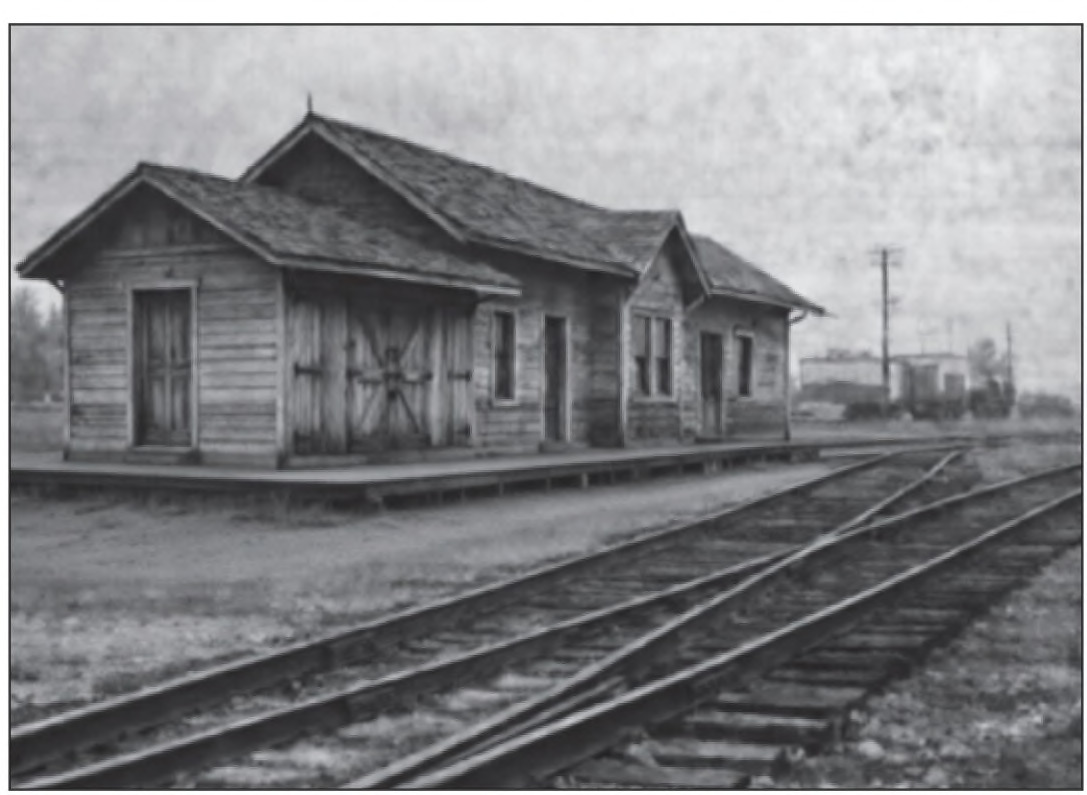
The law did not bless Madill so much as fail to stop it in time. Out of that narrow opening—between federal design and frontier audacity— the town took shape. The first depot, constructed in 1900, rose quickly once the line was completed—a wooden structure, practical andunadorned,muchlikethe earlier station at Randolph. It was not built to impress. It was built to function. Yet in those early years, function was everything, for the depot was not merely a building. It was the beating heart of the town.
Like most Frisco depots of the period, the structure followed a familiar pattern. There was a freight room, where cotton bales, produce, and goods from distant markets passedthroughitsdoors. There was a ticket office, and within it the indispensable telegraph station, where the language of dots and dashes carried orders, schedules, and news up and down the line. And there were separate waiting rooms for white and Black passengers, a stark reminder that even as the railroad bound regions together, the customs of the time still divided the people who traveled upon it.
The depot stood at a place that would define the town’s layout for generations. It was located at the east end of Main Street, where the street simply stopped at the railroad. Beyond it lay the tracks, stretching north and south like a steel horizon. In front of the depot ran the road that came to be known plainly and fittingly as Depot Street, a north–south artery that paralleled the rails and carried the daily traffic of wagons, drays, and later automobiles.
Across that street, anchoring the opposite corner, stood another structure just as important to the life of the railroad: the Frisco Hotel.
Built by the railroad itself, the hotel rose as a two-story wooden building, substantial for its time, designed to serve both the needs of the railroad and the traveling public. It contained guest rooms, a large lobby, and a café, and it quickly became one of the liveliest places in the young town. Railroad crews—engineers, brakemen, conductors— used it as a place of rest between runs. Travelers stepping off the train found lodging there within sight of the depot. Meals were served at all hours to match the irregular rhythms of railroad life.
This was not unique to Madill. Across Oklahoma and the Indian Territory, the railroads often built or encouraged the construction of hotels near their depots. The reasons were practical. Trains did not always run on convenient schedules. Crews needed lodging between assignments. Passengers arriving late in the day—or in the dead of night—required a place to stay. A depot without a nearby hotel was incomplete. A hotel without a railroad was often empty. The two grew together, each sustaining the other.
In Madill, the pairing of depot and hotel created an immediate center of gravity. Main Street flowed directly into the depot, and life flowed with it. Freight wagons lined up along the platform. Cotton buyers and merchants gathered near the tracks. Passengers arrivedanddeparted with the daily trains. News, mail, and goods all passed through that single point. As the town grew, so too did the railroad’s presence within it.
By about 1906, the Frisco maintained approximately tenfull-timeemployeesworking out of the depot itself— station agents, telegraph operators, freight handlers, and clerks who kept the daily business of the railroad moving. Beyond those, there were thirty to forty additional railroad men living in and around Madill—engineers, brakemen, conductors, and maintenance crews whose worktiedthemtothelinethat ran through the town. Their wages circulated through local businesses. Their families became part of the community. The railroad was no longer just a line passing through Madill; it was one of its largest employers and one of its defining institutions.
Yet for all its importance, the original depot remained what it had been from the beginning: a simple wooden structure built for a frontier town that had quickly outgrown its beginnings.
By 1907, the citizens of Madill had begun to take notice. The town was no longer a speculative outpost. It was a growing commercial center, a shipping point for cotton and agricultural products, and a place of increasing importance along the Frisco line. The modest depot that had once been sufficient now seemed too small, too plain, and too temporary for a town that believed itself to be on the rise. And so the people of Madill began to press the railroad.
They wanted something more—a larger, finer depot, one that matched the ambitions of the town that had grown up around it.
The little wooden station at the end of Main Street had done its work. But the town it had helped create was already looking beyond it. One day, the push and the determination would succeed, and Madill would finally get the depot it deserved. More on that soon.
In the end, when B. F. Yoakum looked out across the new Frisco line from Sapulpa to Sherman in 1901, he saw more than depots and prairie. He saw a future—a chain of towns that, in his words, might “serve to help perpetuate the fame of the gentlemen after whom they are named.”
The names were carefully chosen, drawn from the boardrooms and business circles of St. Louis. And the confidence behind them was unmistakable.
The St. Louis Post-Dispatch spoke with that same optimism. It listed the new towns—Francis, Madill, Scullin, Beggs, Winchell, Spaulding,andParkell—and suggested that even if they did not rise to the stature of St. Louis itself, they would at least become “flourishing towns, unless all signs fail.”
Time, however, has a way of sorting such predictions.
Today, several of those names exist only in the fading ink of old railroad timetables and newspaper columns. Winchell. Spaulding. Scullin. Parkell. Once marked out on maps, once spoken with expectation, once thought to be “the most promising townsites” along the line, they are gone. Not diminished. Not reduced. Gone. No streets. No depots. No lingering town squares. The prairie took them back, as if they had never been.
PerhapsnoneofYoakum’s predictions carries more quiet irony than his remark about Parkell, which was described at the time as “likely to prove one of the best towns on the road.” It is a line that reads today almost like a ghost. For where Parkell was expected to rise, nothing remains.
And yet not all of the Frisco’s towns met that fate. A few endured.
Along that same Sapulpato Denison line, only three towns formed directly because of the railroad still survive today: Schulter, in Okmulgee County; Francis, in Pontotoc County; and Madill, hereinMarshallCounty. But survival alone does not tell the whole story.
According to the 2020 census, Schulter stands at a population of 422. Francis, once expected to become a countyseatandaplaceofconsequence along the line, now numbers 244. They remain, yes—but as small, quiet towns, far removed from the ambitions that accompanied their founding.
Only one of the Frisco’s railroad-born towns along that line grew beyond those modest beginnings. Only one fulfilled the promise that Yoakum saw in the distance.
That town is Madill. Madill did not merely survive. It endured, expanded, and established itself as the principal community of the region. It became not just a stop along the railroad, but a center of commerce, of government, and of daily life. It is, notably, the only town formed directly by the Frisco along that line to become a county seat—a distinction that speaks not just to its survival, but to its success.
There is something fitting in that outcome.
Madill was the town that began differently. It was the town that did not exist until the railroad named it, the town that was built before its land was even legally secured, the town that faced legal challenge before it had fully taken shape. It was, from the beginning, a place born of risk, of urgency, and of determination.
And perhaps that is why it endured.
Where others were planned, Madill was fought for.
Where others were expected, Madillwasuncertain.
Where others faded, Madill held fast.
In the end, the railroad gave many towns their names.
But only a few kept them. Andamongthose,onlyone becamewhattherailroadhad hoped they all might be. Our Madill!