
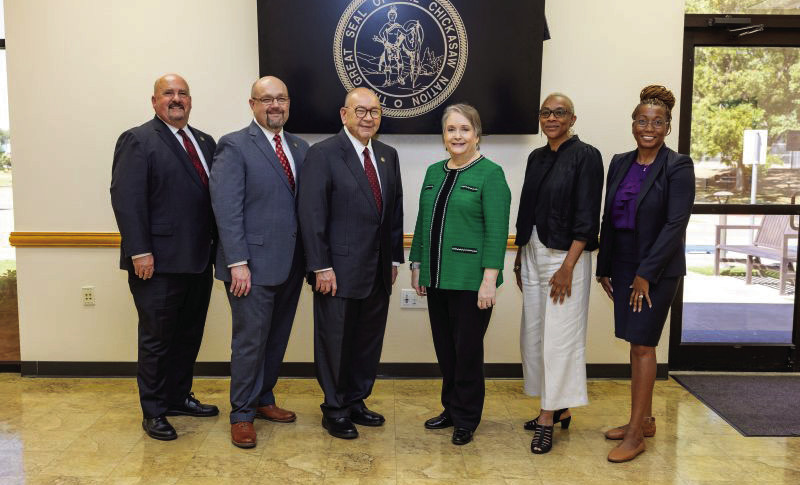
A delegation from the U.S. Department of Housing and Urban Development (HUD) recently visited the Chickasaw Nation to mark progress made during a partnership stretching back more than a half century.
“The Department of Housing and Urban Development has been a true partner for us. Quality housing has been and continues to be foundational to the success, health and security of Chickasaw people and our families,” Governor Anoatubby said. “In 50 years, we’ve built a strong partnership with the Department of Housing and Urban Development. That relationship and much of the assistance that HUD has provided us has been pivotal in our effort to develop and do thethingsthatweneedtodo.”
Funding from HUD has been instrumental in the Chickasaw Nation’s ability to develop facilities such as community centers and service centers, and infrastructureimprovements in the communit ies throughout the Chickasaw Nation.
Collaboration with HUD and other institutions throughoutthecommunities, including cities, counties and the state, is the key to progress, Governor Anoatubby said.
“We get a whole lot more done when we partner with each other than we do if we try to do it alone. This collaborationandpartnership have been integral to our growth and the success of the Chickasaw Nation, the cities and towns that our people are living in, and the communities all throughout the Chickasaw Nation treaty territory,” he said.
“It’s all done through a collaborative effort and an effort that’s designed to have resources that we have available to work toward a common goal with economic development. It has really added a lot to our ability to do the job better.”
Governor Anoatubby recalled a HUD and Chickasaw Housing Authority housing project in hishometownofTishomingo, Oklahoma, when he was a high school student.
“I remember there was a lot of excitement in the community. We didn’t have a lot of quality housing, and that became the pillar of our relationship with Department of Housing and Urban Development.”
Before the Chickasaw Nation’smissionwasformally adopted, both entities were working to improve lives, Governor Anoatubby said.
“It was very clear that the leadership of the Chickasaw Nation and HUD were working toward a mission that we would later set, and that is ‘to enhance the overall quality of life of the Chickasaw people,’ and we have made that a part of everything that we do each and every day.”
When Governor Anoatubby began work with the Chickasaw Nation in 1975, the Indian Self-DeterminationandEducation Assistance Act (ISDEAA) also became law.
“(It)gaveusmoreauthority over our business and our own future. We were able to develop the Chickasaw Nation,” he said.
By working toward the mission, developing programs, utilizing the legal aspects of the ISDEAA and eventually developing economic strategies, the Chickasaw Nation improved tribal revenue and had less dependence on federal funds.
“HUD has been a great partner to us and really enhancedourabilitytoevolve into what we have today and meet the ever-changing needs of our communities,” Governor Anoatubby said.
During the visit, the group toured the Chickasaw Nation Medical Center campus; Tashka Inchokka’, a neighborhood community constructed for Chickasaw veterans; Hilltop Meadow neighborhood;theChickasaw Nation Child Development Center; the Chickasaw Wellness Center; and the Ada community center.
Chickasaw Nation Housing Established in 1966, the Chickasaw Housing Authority was one of the first such entities in the state formed with the mission to extend housing programs to Chickasaw people.
It was organized just three years after Overton James’ appointment as Governor of the Chickasaw Nation and before the existence of tribal headquarters or businesses.
The Chickasaw Housing Authority’s function was to administer programs from a new federal agency, the Department of Housing and Urban Development (HUD) in Chickasaw Nation boundaries.
“Housing is foundational to the success of Chickasaw families,” Chickasaw Nation Secretary of Community Services Wayne Scribner said.
“The Chickasaw Nation’s longstanding relationship with HUD has helped us provideprogramsandservices to support housing needs and community development for our citizens.
“We have worked with HUD for more than 50 years, building a strong and successful partnership. Their recent visit to Ada allowed us to share the progress we have made for Chickasaw families in the community,” Scribner said.
Throughoutthe1970sand ‘80s, the Chickasaw Housing Authority worked hard to secure limited and extremely competitive HUD grants to fund projects.
The housing authority and the Chickasaw Nation worked diligently to develop several housing programs, including home ownership servicesandrentalassistance for low-income residents. WhiletherewasaChickasaw preference for services, the housingauthorityalsoserved other low-income residents of Oklahoma.
The Indian Housing Act of 1988, a housing program developed specifically for First Americans, provided anothersteptowardassisting Chickasaw people to obtain safe homes.
The 1988 act streamlined acquiring grant funds for the Chickasaw Housing Authority.
The act amended the 1937 Public Housing Act, added funding and regulations specific to First American housing authorities, and created a First American housing unit that addressed First Americans’ unique needs.
The ability to expand housing programs came with the 1996 passage of the Native American Housing Assistance and Self-Determination Act, or NAHASDA, which allowed tribes to receive and control theuseofHUDfundsdirectly.
NAHASDA allowed for flexibility with provided funding, tailoring housing programs to the specific needs of their citizens.
Addressingthecontinually changing housing needs of its Chickasaw citizens, the Chickasaw Nation has developed a number of housing services in addition tohomeownershipandrental assistance for low-income families. Other services include homeownership counseling and home loan services, home maintenance and repair, as well as home improvement assistance, driveway construction and storm shelter installation.
For more information, visit Chickasaw.net.