
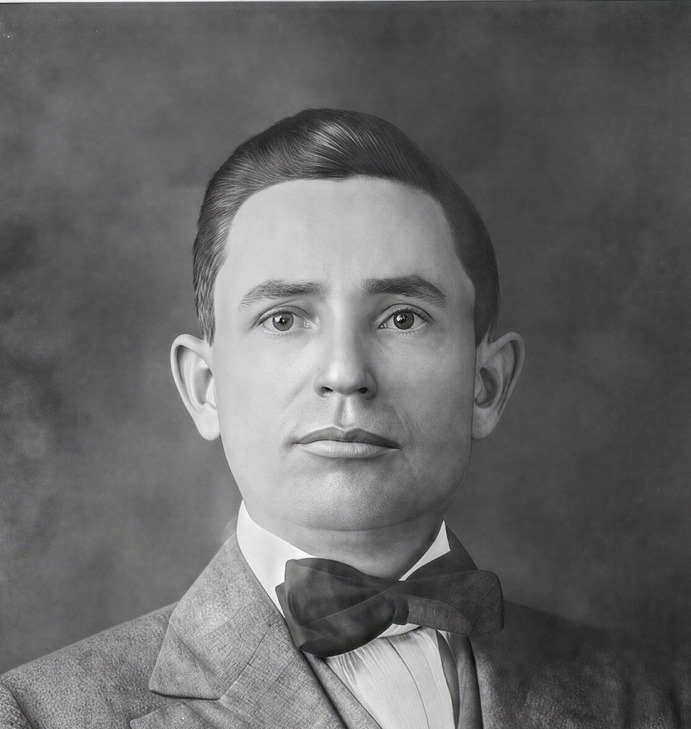
Part I of this series ended not with a murder trial, but with cattle thieves slipping through the Red River bottoms betweenOklahomaand Texas while a young county attorney named Charles Arthur Coakley attempted to drag a new system of law and order into a region where older frontier habits still lingered stubbornly beneath the surface.
By the time his first term as Marshall County Attorney drew toward its close in January 1915, Coakley had already helped dismantle a significant interstate cattlerustling operation, coordinated prosecutions with Texas authorities, and established himself as one of the rising young courtroom lawyers in southern Oklahoma. He had proven himself intelligent, strategic, fearless, and unusually capable for a man still in his twenties.
Yet the first chapter of his legal career was ending. In many respects, the next phase of his life would prove even more important.
Coakley served as Marshall County Attorney from January 1913 until January 1915.Unlikemanyambitious young prosecutors, he sought nosecondterm.Attheconclusion of his first and only term, he quietly stepped away from public office. George Sneed succeeded him after running unopposed for the position.
The surviving public record appears silent regarding why Coakley declined to seek re-election in 1914. No newspaper editorial, campaign statement, or public explanation has yet surfaced explaining the decision. But one likely factor becomes obviouswhenviewedthrough both historical and modern eyes: Money. The salary of Marshall County Attorney during Coakley’stenurewas$133.33 per month. Adjusted for inflation, that figure equates to approximately $4,447 per month today, or roughly $53,000 annually in modern terms.
Even by the standards of 1915, that was not substantial compensation for a talented lawyer handling serious criminal prosecutions across a growing county. By modernstandards,itbecomes even easier to understand why a young attorney with Coakley’s intellect, ambition, and courtroom ability may have concluded that private practice offered a far greater future than continued public service.
Indeed, one of the striking realities of early Oklahoma government is how modestly many important public officials were compensated despite carrying enormous responsibility. That reality ties directly into the governmental system under which Coakley operated—a system very different from the one modern Oklahomans know today.
When Oklahoma entered the Union in 1907, its governmental structure reflected the state’s deep frontier suspicion of concentrated political power. The men who framed Oklahoma’s Constitution had lived through territorial politics, Reconstruction politics, railroad influence, federal appointments, machine patronage, and the lingering memory of authority concentrated in distant hands. They intentionally designedagovernmentstructure that kept public officials closely tethered to the voters and frequently held them accountable. That philosophy shaped county government from the beginning.
Under the original 1907 Oklahoma Constitution, Article XVII, Section 2 created the various county offices and established a system in which local officers were regularly elected. County attorneys, sheriffs, county clerks, treasurers, assessors, court clerks, and commissioners all operated under comparatively short terms of office. All county officials, including county attorneys, served two-year terms.
Electionscameconstantly. Political accountability was immediate and relentless.
Importantly, however, the original constitutional system did not impose term limits upon county officers. Unlike certain statewide executive offices, county officials were generally free to seek reelection repeatedly and remain in office indefinitely, so long as voters continued to return them to power.
That distinction matters historically. Modern readers sometimes assume early Oklahoma distrusted long tenure itself, but that was only partially true. The real concern was not continuous servicesomuchascontinuous accountability. The framers did not necessarily object to a county officer serving multiple terms. What they objected to was allowing that officer to drift too far away from direct voter control.
Thus, under the original constitutional framework, county attorneys like Charles Arthur Coakley could seek second, third, or later terms without restriction. Immediate succession was fully permitted for county officers. This sharply contrasted with certain statewide positions. The Governor of Oklahoma, for example, originally could not serve consecutive terms at all—a restriction that remained in place until constitutional changesinthe1960s. County officers, by contrast, faced no such prohibition.
Their challenge was different.
The challenge was survival.
Every two years, they had to stand before the voters again. Every two years, the public rendered judgment. Every two years, political allies had to be maintained, enemies managed, and reputations defended.
For county attorneys, especially, that system created extraordinary political pressure. Criminal prosecutions are never politically neutral. Every major case created supporters and critics. Every acquittal angered someone. Every prosecution created accusations of favoritism or unfairness from one side or the other. In rural Oklahoma counties, where everyone knew everyone else and local relationships ran generations deep, the county attorney often stood directly in the middle of intensely personal community conflicts.
County attorneys like Coakley, therefore, existed in a world where they were never far from the next campaign. A prosecutor could not simply retreat into bureaucratic anonymity. He remained a public figure constantly exposed to public judgment.
That old county attorney system differed dramatically from the prosecutorial structure modern Oklahoma lawyers recognize today. In Coakley’s era, each county had its own elected county attorney who handled prosecutions within that county alone. The office was intensely local in character. Thecountyattorneyknewthe sheriffs, deputies, judges, jurors, ranchers, businessmen, editors, and often the defendants themselves. In many rural counties, the county attorney personally handled virtually every major criminal prosecution. There was no large staff insulating the elected prosecutor from the courtroom itself. In smaller counties, the elected county attorney was often the courtroom lawyer personally trying the case before the jury.
That system carried both strengths and weaknesses. On the one hand, county attorneys operated with a level of local familiarity and direct accountability almost impossible to imagine in the modern era. They understood the people they served because they lived among them daily. They knew the histories of the families appearing before them. They understood local tensions, local politics, local feuds, and local reputations in ways no distant prosecutor ever could.
On the other hand, the system also created relentless political vulnerability. The short two-year terms ensured that county attorneys remained perpetually exposed to public opinion, local factionalism, and the uncertainties of election politics. Every controversial prosecution carried political risk. Every influential defendant had friends, relatives, allies, or business associates capable of exerting pressure. A prosecutor who aggressively enforced the law could quickly make powerful enemies. Yet a prosecutor perceived as weak or selective could just as quickly lose public confidence.
The result was a uniquely personal form of justice administration.
In many ways, the old county attorney system resembled frontier politics more than modern professional prosecution. The office demandednotonlylegalskill, but political instinct, personal courage, public reputation, and constant visibility.
Young lawyers like CharlesArthurCoakleylived directly inside that system. When Coakley prosecuted organized cattle thieves in Marshall County between 1913 and 1915, he did so knowingthatthesamepublic watching those courtroom battles would soon decide whether he remained in office. Every prosecution unfolded not merely inside a courtroom, but inside an intensely local political culture where newspapers commented openly upon cases, courthouse crowds followed proceedings closely, and the next election never stood very far away.
As someone who later served as District Attorney for Oklahoma’s Twentieth Judicial District—which included Marshall County itself—I find the contrast between the two systems especially striking.
When I was elected District Attorney at age thirtyfour, I operated under a very different prosecutorial framework than the one Coakley had known. By my era, Oklahoma had long abandoned the old county attorney structure in favor of the modern district attorney system. That transformation occurredduringthesweeping judicial and prosecutorial reforms of the mid-1960s.
In 1965, Oklahoma officially abolished the office of county attorney and replaced it with the modern office of District Attorney, serving multi-county prosecutorial districts. The first district attorney elections were held in1966,andthenewlyelected district attorneys took office in January 1967. Notably, the change in prosecutorial structure coincided with the change in term length.
County attorneys had served two-year terms for the entire duration of the office's existence under Oklahoma’s originalconstitutionalframework. But the newly created district attorney offices were established with four-year terms from the outset. Thus, the extension of prosecutorial terms from two years to four years happened at precisely the same moment the old county attorney system itself disappeared.
The office changed. The structure changed. The scale of prosecution changed.
The old model of a single- county prosecutor gave way to larger prosecutorial districts intended to professionalize and modernize Oklahoma’s criminal justice system. The modern district attorney structure created broader jurisdictions, larger staffs, greater administrative continuity, and less constant electoral pressure than the old two-year county attorney cycle had imposed.
Yet despite those structural changes, some things remained remarkably familiar.
The courtroom itself did not change nearly as much. The pressures remained. The burden of judgment remained. The weight of deciding whom to prosecute, whom to trust, and what justice required remained. The necessity of persuading juries remained. The human drama remained.
For all the changes in Oklahoma’s legal structure, the essential demands placed upon trial lawyers and prosecutors remain surprisingly constant.Perhapsthatiswhy lawyers like Coakley still feel strangely recognizable across the gulf of more than a century.
When Coakley left office in January 1915, he returned to private practice and reunited with his former law partner, F. E. Kennamer, reforming the firm of Kennamer and Coakley in Madill. The partnership resumed operations in the McMillan Building, a structure modern Marshall County residents now know astheSouthernCoachWorks building.
That return to private practice proved enormously significant—not merely to Coakley’s career, but to the criminal history of Marshall County itself. By leaving the county attorney’s office, Coakley stepped away from the role of the state’s lawyer and began the transformation into something else entirely: the advocate for the accused.
It is difficult now, looking backward with the benefit of history, not to see the transition as pivotal. The young prosecutor who had dismantled a cattle-rustling enterprise was about to enter the arena that would ultimatelymakehimfamous. Thelessonshehadlearnedas county attorney—the building of cases, the use of accomplice testimony, the psychology of juries, the pressure placed upon witnesses, the strengths and weaknesses of criminal investigations— would now become weapons deployed from the opposite side of the courtroom.
But before following Coakley into that first great murder trial, it is worth pausing over the man whose name stood beside his on the office door.
Franklin Elmore Kennamer was no minor figure in Oklahoma legal history. In fact, if measured by office, title, and judicial rank, Kennamer’s public career would eventually climb even higher than Coakley’s. He would become a justice of the Oklahoma Supreme Court, then a United States District Judge, first in the Eastern District of Oklahoma and later in the newly created Northern District. He would sit on the federal bench through the hard years of Prohibition, build a reputation as one of the state’s hardest-working judges, and retire after two decades on the state and federal benches.
Yet Kennamer’s career also illustrates a striking truth about the legal profession.
Not every able lawyer is made for the same arena.
Coakley and Kennamer were both capable lawyers. Both were respected. Both possessed intelligence, discipline, and ambition. But the surviving record suggests they were very different kindsoflawyers.Coakleywas thecourtroomgladiator—the advocate whose gifts naturally drew him toward jury combat, murder defenses, pressure, risk, and the dangerous art of persuasion. Kennamer, by contrast, appears to have been steadier, more institutional, more suited to the orderly world of judicial administration than to the raw emotional theater of high-stakes criminal trial practice.
That is not a criticism of Kennamer. Quite the opposite. The law needs both kinds of men.
The transition from the well of the courtroom to the height of the bench is often treated as a promotion. In truth, for many elite trial lawyers, it is not a promotion at all. It is a different calling. The great trial lawyer is a performer, strategist, hunter, and persuader. He thrives on conflict. He must seize the rhythm of the courtroom, read jurors' faces, sense weakness in witnesses, and speak at the precise moment when the case can still be turned.
A judge lives under different commands.
A judge cannot hunt. A judge cannot argue the case. A judge cannot openly take sides. The judge must listen while other lawyers—sometimes clumsily, sometimes brilliantly—fight the battle he no longer fights. The robe demands restraint rather than attack, patience rather than domination, management ratherthanpersuasion. For some trial lawyers, that would feel less like elevation than confinement.
That distinction helps explain why brilliant trial lawyersdonotalwaysbecome greatjudgesandwhylawyers who were never dazzling before a jury sometimes become excellent jurists. The traits do not perfectly overlap. A lawyer who is bold, intuitive, aggressive, and emotionally forceful may struggle to maintainneutrality.Another lawyer, less electric before a jury but patient, methodical, organized, and eventempered, may be exactly what a courtroom needs on the bench.
Kennamer seems to have belonged more naturally to that second world.
He was not without courtroom ability. One family account described him as “an effective speaker and pleader at the bar,” and John N. Bulman of Mill Creek, though a Democrat, reportedly said that “F. E. Kennamer is the second-best lawyer in the State of Oklahoma.” That is high praise, especially for a Republican lawyer practicing in a Democrat country of southern Oklahoma. But Kennamer’s lasting fame did not come from murder defenses or legendary jury performances. It came from the bench.
That later path had deep roots in the man himself.
FranklinElmoreKennamer wasbornJanuary12,1879, in Kennamer Cove, Marshall County, Alabama, the son of Seaborn F. Kennamer and Nancy Elizabeth Mitchell Kennamer. He was reared on a farm in the mountain countryofnorthernAlabama, in a community named for his family. He attended local public schools, studied for a time at Scottsboro Normal College, and read law in the office of Judge Virgil Bouldin.
Fromearlylife,Kennamer showed ambition and stubbornness. WhentheSpanish-American War broke out in 1898, he volunteered. His parents wanted him to remain home and help on the farm, but he was determined to go. At Mobile, he was initially rejected because he was too light, but through what one account called a will “that will take no denial,” he managed to enlist as a musician in Company I, Second Alabama Volunteers.
After the war, he returned toJacksonCounty,Alabama, and entered politics as a Republican in the deep Democratic South. In 1900, he ran for the Alabama Legislature and came surprisingly close to victory against Democratic opposition. In 1901, with his name reportedly not even printed on the ticket, he came within thirty votes of being elected to the Alabama Constitutional Convention from Jackson County.
That detail tells us something important about Kennamer. He was not merely a lawyer. He was a political man from the beginning— persistent, principled, and willing to stand for office even where party odds ran heavily against him.
He taught school in Alabama and eventually came west to Indian Territory, settling at Madill in the early years of the new century. He married Lillie Florence at Tishomingo on April 8, 1903. She was born in Greenwood, Arkansas, the daughter of Charles Payton Florence and Angeline McNabb Florence. Kennamer was admitted to the bar in 1905 and soon entered legal practice in Madill.
It was there that his path crossed with Charles Arthur Coakley.
The two men practiced together for years. Later accounts statedthatKennamer practiced law with Charles A. Coakley for fifteen years, though the partnership was interrupted at times by Coakley’s service as county attorney and by other professional changes. Afterward, Kennamer practiced with his brother, John Shepard Kennamer, under the firm name Kennamer & Kennamer.
Kennamer was also a deeply religious man. He and his wife were members of the Church of Christ, and while living in Madill, he was a devotedmemberoftheMadill Church of Christ. That part of his life should not be treated as a mere passing biographical note. For many men of his generation, church identity was not simply a matter of denominationallabels.Itwas part of their public character, social world, moral vocabulary, and daily discipline. Kennamer’s later obituary notices continued to identify him as a member of the Church of Christ, suggesting that his faith remained a visible part of his identity throughout his life.
That moral seriousness may help explain the kind of judge he later became.
In 1920, Kennamer was elected as a Republican member of the Oklahoma Supreme Court from the Eighth District. That alone was remarkable. He had settled in Madill, in the region often called Oklahoma’s Little Dixie, a land where Democratic politics ran deep. Yet he remained a Republican, “staunch in his beliefs,” as the Chelsea Reporter later put it, and somehow found his way to statewide judicial office during the Republican surge that accompanied the Harding-Coolidge era.
To understand the next stage of Kennamer’s career, one must step back briefly into the structure of Oklahoma’s federal courts.
When Oklahoma entered the Union on November 16, 1907, the new state inherited not only the geography of two former territories, but also two very different legal worlds. In fact, Oklahoma’s federal judicial system technically predated statehood itself. Congress officially established the federal district courts of Oklahoma on June 16,1906,morethanayearbefore Oklahoma formally entered the Union. The courts, however, did not become fully operational until statehood arrived on November 16, 1907. In many respects, Congress was preparing in advance for the enormous legal transition statehood would require.
At statehood, Oklahoma contained only two federal judicial districts: the Eastern District of Oklahoma and the Western District of Oklahoma. There was no Northern District yet. That would come later.
The division reflected the political and historical realities from which the new state had been assembled. The old Indian Territory became the foundation of the Eastern District, while the former Oklahoma Territory became the Western District. In many ways, the line separating the two districts also marked the meeting point between different frontier experiences, settlement patterns, and legal cultures.
The Eastern District inherited much of the old Indian Territory world—a region long shaped by tribal governments, federal courts, cattle trails, outlaw country, and the sprawling criminal jurisdiction once exercised by federal judges and deputy marshals before statehood. The legal atmosphere of the Eastern District still carried the lingering shadow of Fort Smith, Muskogee, and the old federal courts that had governed Indian Territory during its roughest years.
The Western District reflected a somewhat different history, shaped more heavily by the former Oklahoma Territory, land runs, homesteading, territorial government, and the political machinery thathadgrownaroundOklahoma City and Guthrie.
For nearly two decades after statehood, those two federal districts bore Oklahoma’s entire federal judicial burden. But the state was growing rapidly. The population expanded. Oil booms transformed towns into cities. Federal criminal dockets exploded during Prohibition. Tulsa emerged as one of the wealthiest oil centers in America. Increasingly, lawyers, politicians, and judges recognized that Oklahoma’s federal court structure needed reorganization.
In 1924, President Calvin Coolidge appointed Kennamer to the federal bench in the Eastern District of Oklahoma. At that time, the Eastern District remained enormous, both geographically and in workload. Judge Robert Williams—former governor of Oklahoma and former chief justice of the Oklahoma Supreme Court— had long complained about the crushing size of the docket, especially after national Prohibition dramatically increased federal criminal prosecutions.
The federal courts, Williams once remarked, had effectively become “police courts” because of the flood of liquor prosecutions. Kennamer entered the federal judiciary during that difficult period, and that growing pressure helped create the judicial opening that transformed his career.
Then, in 1925, Congress fundamentally reshaped Oklahoma’s federal court system by creating a third district: the Northern District of Oklahoma.
The new district was carved largely out of the Eastern District, along with several counties taken from the Western District. Tulsa became the headquarters of the new federal court, and Franklin Elmore Kennamer became its first federal judge.
That moment permanently tiedKennamer’sname to the institutional history of Oklahoma’sfederaljudiciary. He was no longer merely a former Madill lawyer or state supreme court justice. He became one of the central judicial figures in the rapidly developing legal world of northern Oklahoma during the oil-boom years, the Prohibition era, and the turbulent decades that followed.
His appointment also placed him within one of the rarest family distinctions in American judicial history.
The Chelsea Reporter laternotedthatJudgeFranklin Elmore Kennamer and his brother, Charles B. Kennamer of Alabama, were believed to have been the only two brothers serving simultaneously as federal judges in the United States. At the same time, another Kennamer brother reportedly served as a federal district attorney. That made the Kennamer family not merelylocallyprominent,but almost singular in American legal life.
Even today, sibling federal judges remain rare. There have been other notable examples: Stephen Breyer served on the United States Supreme Court while his brother, Charles Breyer, served as a federal district judge in California; Richard and Morris Arnold served together on the United States Court of Appeals for the Eighth Circuit, even sitting together on appellate panels; and in the early Republic, ChiefJusticeJohnMarshall’s brother, James Markham Marshall, also served as a federal judge. Such examples are exceptional precisely because the federal judiciary is small, selective, and politically difficult to enter. For two brothers from the same family to sit on the federal bench at the same time is a distinction few legal families have ever known.
That point gives Kennamer’s story added weight. He was not simply a former Madill lawyer who found his way into federal service. He belonged to a remarkable legal family whose reach extended from Alabama to Oklahoma and into the federal judiciary itself. The boy from Kennamer Cove, the young man once rejected for military service because he was too light, the Republican lawyer who made his way in Oklahoma’s Democratic country, eventually became part of a family name that occupied more than one federal courtroom at once.
It also underscores the contrast between Kennamer and Coakley. Coakley’s fame would come from the well of the courtroom, from standing before juries in difficult criminal cases and fighting with voice, instinct, and nerve. Kennamer’s fame would come from the bench, from discipline, administration, docket control, and the institutional authority of the robe.Onebecamememorable because of the verdicts he sought. The other because of the judgments he entered.
By all accounts, Kennamer worked hard.
The Tulsa World of May 2, 1960, described him as one of Oklahoma’shardest-working federal judges and noted that he was seldom reversed. His associatessaidhisknowledge of the cases on his docket was among the best of the federal judges then sitting in Oklahoma. One of his chief purposes, the paper reported, was to keep his docket clear rather than allow cases to pile up.
That is the mark of the legal technician at his best. Not flashy. Not theatrical. But disciplined, prepared, efficient, and serious.
During Prohibition, Kennamer became known for imposing stiff penalties on bootleggers. The Tulsa Tribune reported that he sent to prison such thennotorious bootleggers as “Little Steve” Stevens, Sandy McMillan, the Morris gang, and Lawrence Lytton. Yet after national Prohibition was repealed, he softened his approach, explaining that he did not intend to send “small moonshiners to the penitentiary when the federal government permits men to operate unmolested in large-scale tax-paid liquor business.”
That statement is revealing. It shows a judge capable of adjusting his sense of justice to changing legal and moral circumstances. He had enforced the law severely when Prohibition was the law. But when the national policy changed, he recognized the unfairness of crushing small-time offenders while larger lawful liquor interests operated openly elsewhere.
In1940,Kennamerretired from the federal bench earlier than required. As the Tulsa World later quoted him, “I have been on the state and federal benches 20 years and I’m tired.” Yet even after retirement, he remained on call and often sat in federal cases. He moved to a small ranch near Chelsea, in the Catale community, where he fished, worked around the place, and lived quietly until his death.
Judge Franklin Elmore Kennamer died on May 1, 1960, in a Nowata hospital after suffering from a heart ailment. He was eighty-one years old. The Chelsea Reporter noted that funeral services were held at the Church of Christ, with Judge Royce H. Savage delivering the eulogy. Members of the Tulsa County Bar Association served as honorary pallbearers. The tributes that followed remembered him as a hardworking judge, a veteran of the Spanish-American War, a Republican in Democratic country, a member of the Church of Christ, and a man who had risen from an Alabama farm to the federal bench.
His family story, like his public career, carried its own chapters of triumph and sorrow. He and Lillie Florence Kennamer had children, including Opal, Juanita, Vivian, Franklin Elmore Jr., and Phillip Millholland Kennamer. Vivian died in infancy in 1910. Phillip, later known as Phil Kennamer, became the center of one of Oklahoma’smostsensational criminal cases after the 1934 shooting death of John F. Gorrell Jr. in Tulsa.
And in that painful chapter, history folded back upon itself. When Phil Kennamer was tried, Judge Kennamer’s old Madill law partner, Charles A. Coakley, was part of the defense team. By any practical measure, Coakley was successful. Phil Kennamer was acquitted of murder and convicted instead of the lesser offense of manslaughter, receiving a twenty-fiveyear sentence.
But before the courtroom battle ever began, there had first come the terrible private moment no father—judge or otherwise—ever truly prepares to face. Newspaper accounts later recalled that Judge Kennamer himself, tears standing in his eyes, turned his son over to authorities after the killing. It is one of the most haunting images connected to the case: the federal judge who had spent a lifetime enforcing the law personally surrendering his own son to that same system of justice.
There is something profoundly tragic in that picture.
The old jurist who had presided over criminal prosecutions, sentenced bootleggers, and worn the authority of the federal robe for years suddenly stood not as judge, but as father. All the discipline, reputation, and authority built across decades could not spare him from heartbreak inside his own family.
And standing beside the Kennamers during that public storm was Charles Arthur Coakley.
The same lawyer who had once prosecuted cattle thieves for Marshall County now helped defend the son of his former law partner and friend in one of the most closely watched criminal cases of its era. The old partnership formed years earlier in Madill unexpectedly echoed forward into a sensational Tulsa homicide prosecution.
History has a way of circling back upon itself.
Phil Kennamer later received release from prison and entered military service duringWorldWarII.In1944, during the war that reshaped the modern world, he died in a parachute operation during the invasion of southern France.
That detail gives the story an additional layer of sorrow and complexity.
The young man once standingatthecenterofscandal, headlines,andcourtroom notoriety ultimately died in military service during one of the greatest conflicts in human history. His life moved from sensational criminal prosecution to wartime sacrifice in Europe—a path almost impossible to imagine during the dark days of the Tulsa trial.
ThattragedyplacedJudge Kennamer in a painful public spotlight many years after he had first risen from Madill’s small-town legal world. It is a reminder that even men who spend their lives judging others are not spared sorrow inside their own homes.
But in 1915, none of that was yet known.
In 1915, Franklin Elmore Kennamerwasstillarespected Madill lawyer, a former partner now reunited with Charles Arthur Coakley as the two men re-opened their practice in the McMillan Building. One would eventually climb to the Oklahoma Supreme Court and then the federal bench. The other would become increasingly known for defending men accused of murder.
One man moved toward the robe.
The other moved toward the fight.
Together, for a time, they stood at the center of Madill’s legal life under the name KennamerandCoakley.And just beyond their office door, one of the most sensational murder cases in Marshall County history was waiting.
In that coming case, the partnership would matter. Kennamer, who would later become known for the discipline and steadiness of the bench, stood beside Coakley in one of the most sensational murder trials Marshall County had ever seen. Coakley would take his first great step into murder defense, but he would not take it entirely alone.
Violence was coming. Newspaper headlines were coming. Courtroom warfare was coming.
And for the first time in his career, Charles Arthur Coakley would stand beside a man accused of murder rather than against him.
That case would begin the next great chapter in the rise of Charles Arthur Coakley.