

Few images in American history carry the weight of memory like the photograph of Marines raising the flag atop Mount Suribachi on the island of Iwo Jima. Captured by Associated Press photographer Joe Rosenthal, it would become one of the most enduring images of the Second World War — and perhaps the most iconic photograph in the history of the United States military. The picture came to symbolize victory, determination, and the indomitable spirit of the menwhofoughtinthePacific.
The photograph became a symbol of triumph; the men in this story remind us of the price paid before triumph ever arrived.
By the time the flag was raised on February 23, 1945, thebattlewasalreadysoaked in loss. The invasion of Iwo Jima had begun four days earlier,onFebruary19,when thousands of Marines surged toward the island’s black volcanic beaches in one of the most ambitious amphibious assaults of the war. The operation was planned on a scale reminiscent of the landings atNormandy,withfleets stretching across the horizon and endless waves of landing craft carrying young Americans into a storm of fire.
But Iwo Jima was no open beachhead. Japanese defenses hadbeendugdeepinto volcanicrock,hiddenbeneath the surface in tunnels and fortified positions designed to turn every yard of sand into a killing ground. The soft ashlike beaches bogged down men and machinery alike, leaving Marines exposed as theystruggledforwardunder relentless artillery, machinegun fire, and mortar shells. The battle for the mountain would come later; first came the grim work of surviving the shoreline itself.
It was on that unforgiving ground — on the second day of the invasion, February 20, 1945 — that two sons of Marshall County, both Marines, both young men far from Oklahoma’s red earth, were killed in combat before American forces ever reached the heights of Suribachi. Of the sixty-one Marshall County servicemen who gave their lives during World War II, this was the only day on which two men from the county died in the same battle, a quiet but solemn distinction etched into local history. This Friday, February 20th, marks the eighty-first anniversary of their sacrifice — a date that reminds us how the passage of decades never dulls the weight of such loss.
Theyneversawthefamous flag rise above the mountain. Their story belongs to the opening chapter of Iwo Jima — the chapter written not in triumph, but in sacrifice on the beaches below.
Beforetheybecamenames on casualty lists, they were simply boys from Marshall County — young men whose futures once seemed as wide and open as the Oklahoma sky above them. They walked familiar roads, sat in schoolroomswithfriendswho would remember them all their lives, and knew a world measured not by battle maps but by seasons, harvests, and the steady rhythms of home. When war called, it carried them far beyond the horizon, from the red earth of southern Oklahoma to a black-sand island in the Pacific where history would remember a flag raised in victory. But before that moment of triumph, these two sonsof Marshall County gave everything they had on a distant shore. To honor them properly, we must first step back from the roar of battle and return to the places — and the people — who first knew their names.
And so, before the smoke of Iwo Jima drifts across these pages, we return first to Marshall County — to Joyle Roland Deering of Madill and Melvin Coble of Kingston, two young Marines who left home wearing their country’s uniform and whose footsteps never again crossed the roads that raised them.
Joyle Roland Deering was born in Madill, Oklahoma, on August 22, 1920, the son of Uriah Deering and Lilly Mecie (Orilda) Brower Deering. His father was a carpenter who would spend more than forty years building and repairing homes in Madill, a tradesman whose work shaped the town one boardandnailatatime.Joyle grew up in that world — a placewhereworkwashonest, neighbors knew one another, and children were raised in plain view of the community.
He was not an extraordinary figure in those early years — and that is precisely what makes his story powerful. He was one of many Marshall County boys whose lives unfolded in the everyday rhythm of school, church, sports, and smalltown routines.
The pages of the Madill Record preserve that ordinary life in small details. In March 1935, for the first time, his name appears among the seventh-grade class list — simply one student among many. In 1937, he appears again as one of the boys helping organize Madill’s first Boy Scout troop, gathering in the high school auditorium under the guidance of local businessmen and volunteers. The paper described enthusiasm andgamesandspeeches, and there he was — Joyle Deering — growing up alongside friends whose names still echo through Marshall County history.
He was steady. In February 1937, the Record listed him among freshmen with perfect attendance, a quiet indication of reliability and discipline that would later define his military service. His name appeared numerous times over these years in simple ways, as the Madill Record also served as the quasi-school newspaper.
Athletics became a major part of his teenage years. Joyle played football for Madill High School, traveling with Coach Faudree and his teammates to Norman for the Oklahoma–Missouri homecoming game — an eventthatwasasmuchabout community pride as it was sport. He also played basketball, listed among the boys who reported for practice when the school anticipated a “very prosperous season.” Those teams — football in the fall, basketball in the winter — were the training grounds where boys learned teamwork, endurance, and grit.
Beforetheworldknewhim as Sergeant Deering, he was simply a Madill Wildcat — running drills, riding buses to games, and sharing the dreams of small-town boys who expected their future to stay close to home.
The Deering family included Joyle’s brother Chester and sisters Roberta and Lillie, siblings who would later carry his memory after the war took him away. The family’s life centered on labor and faith, and when Joyle followed his father’s trade and became a carpenter, it seemed likely that his life would remain rooted in Madill.
Joyle first entered military service before America officially entered World War II, volunteering with the famed Oklahoma 45th Infantry Division in 1940 for a year of training. After discharge, he returned home briefly — but Pearl Harbor changed everything. On December 13, 1941, only days after the attack, newspapers reported that Marines were enlisting in unprecedented numbers. Among them was Joyle Deering.
He joined the Marine Corpsandsoondistinguished himself through training, completing a non-commissioned officers’ course in chemical warfare at Edgewood Arsenal,Maryland,and later serving as an instructor at Camp Lejeune. The Marine Corps saw leadership potential in him — a young Oklahoman who could train others.
But instructors were still Marines first, and the Pacific War demanded combat veterans.
By early 1944, he was overseas.
In a letter printed in the Madill Record, on May 4, 1944, he wrote with humble pride: “DearSirs.Todayhasbeen a very happy one indeed for me. I received three Madill Records, the first since I left the U.S. To find out all the news about home means a lot. And The Record does all that and more. About the Boys is the first thing I read. Then, about the Wildcats. In fact, I read the papers from front to back, and I've gone over them a couple of times to see if I had missed anything. I enjoyed them more than my words can express. Keep the good work up. There has been a huge argument about the return address-'The Best Home Town in the World.' But I've got proof in red and white. Madill is the best Home Town in the World.* I'm proud to say I was with the first to set foot on Jap soil. I was on Roi and Namur Island in the Kwajalein Atoll. Things are dull here, but I'm thankful to be alive. I'll make up the losses when I get back tothegoodoldU.S.andhome. Please let my parents, Mr. and Mrs. U. Deering, know you heard from me. And please pardon my uninvited intrusion. I wanted to write and thank you for your good work. Please keep it up. A native son, Sgt Joyle R. Deering.”
Printed along with Deering’s letter was the following “Editor's Note.”- “Sergeant Deering has been in U.S. service since December 13, 1941. He is 23, was born in Madill and attended school here. He spent one year with the 45th Division at Fort Sill and Camp Barkeley, Texas, and later joined the Marines.
*MadillRecordsgooutside the county with a wrapper labeled 'Madill Records from Madill, Oklahoma, U.S.A., The Best Home Town in the World'.
Those words carry the voice of a young man who knewdangerbutstillthought of home first. He read the paper from “front to back,” arguing good-naturedly with fellow Marines that Madill trulywas“thebesthometown in the world.”
From Roi and Namur, he moved into the brutal campaigns of Saipan and Tinian, part of the Marines’ relentless march across the Pacific. In August 1944, his parents received word that he had been wounded in action. Later letters revealed shrapnel wounds to his cheek and leg. He received the Purple Heart, recovered, and returned to duty — a decision that speaks volumes about the man he had become.
By then, Joyle had served through some of the fiercest Marine operations of the war. He had survived. He had returned to the fight.
And in January 1945, while he was still overseas, tragedy struck home. His father, Uriah Deering, died after a long illness. The newspaper noted that Sgt. Joyle Deering had been serving in the South Pacific for more than two years. One can only imagine the letter that reached him too late, carrying news from home across an ocean.
He would not live long enoughtocomehomehimself.
If Deering’s story begins in Madill, Melvin Lee Coble’s begins farther north — born on February 8, 1921, in Swift, Missouri, to Alonzo “Lon” Jasper Coble and Corley Shirk Coble. He arrived in the world with a constant companion: his twin brother, Marvin, a bond that would remain central throughout his life.
Between the mid-1920s and 1930, the Coble family moved to Marshall County, settling first on a farm between AylesworthandMadill before eventually putting down roots near Woodville and Kingston. The Cobles were a large working family, shaped by farm life and the era's expectations —hard work, loyalty, and family first.
Melvin’s siblings included Fay, Ray, Don, Ross, Ella Mae, Sarah Louise, and his twin brother Marvin. They created a busy household in which childhood was shared, responsibilities came early, and bonds ran deep.
The Madill Record first mentions Melvin in a brief note from 1930, an ordinary small-town item reporting that he had broken both bones in his arm after falling from a hay pile while playing. The line is simple, almost forgotten, but it captures the texture of rural life and the kind of boyhood that produced sturdy young men.
He attended local schools, including Aylesworth and Kingston, before graduating from Woodville High School in 1940. Before the war, he worked construction on the Frisco Railroad bridge east of Kingston — practical, demanding work that fit the times and the man he was becoming.
Then came the war, and life accelerated.
Melvin enlisted in the U.S. Marine Corps in June 1942. Yet before leaving for the Pacific, life brought him one of its brightest moments. On New Year’s Day 1943, he married Johnnie Jolene Evans at the Methodist parsonage in Madill. The local paper recorded the ceremony with pride, noting the bride’s involvement in school activities andherplanstograduate before joining her husband.
Coble’s story also carried a detail that reveals how closely intertwined local families were: Melvin’s twin brother, Marvin Coble, married Johnnie Evans’ sister, Ruthene Evans. The twin brothers had married sisters by circumstance and affection — a rare and touching connection that bound the two families even more tightly together. It is the sort of detail that seems almost old-fashioned now, yet it accurately reflects the closeness of life in Marshall County in the early 1940s.
The newlyweds’ early married life was brief and shaped by war. Melvin went overseas, returning home in early 1944 after a year of service in the Pacific. Newspapers reported that he wore serviceribbonsandcampaign stars from major operations, a veteran already at twentythree.
And the burden of war did not rest on Melvin alone. Military service ran through the Coble family itse Pfc. Don Coble was serving in San Francisco; Pfc. Marvin Coble, Melvin’s twin brother, was in the Quartermaster Corps, Second Army, and Pfc. Ray Coble was a member of the infantry in the First Army, who was wounded in Germany and hospitalized in England The Coble household, like so many during the war, had multiple sons scattered across the globe, each carrying a part of the family’s hope and fear.
After furlough, Melvin returned to duty and eventually joined the 28th Marines, 5th Marine Division, a unit preparing for one of the most difficult assaults of the Pacific theater. His wife later joined him while he was stationed stateside at Camp Pickett, Virginia, but the war’s timeline moved quickly. Soon he was sailing west again, toward an island whose name would become forever linked with sacrifice.
Before the war joined their names forever, Joyle Deering and Melvin Coble were simply part of the same living landscape — not connected by blood or circumstance, but by the quiet geography of Marshall County itself.
In those years, distance was measured less by miles than by familiarity. The roads between Madill, Kingston, Aylesworth, Oakland, and Woodville were traveled for ballgames, church gatherings, school events, and Saturday errands. People read thesamenewspaper,listened to the same war reports on the radio, and recognized one another’s surnames long before introductions were needed. A name printed in the Madill Record was rarely anonymous; it belonged to someone’s classmate, cousin, or neighbor.
What tied these two young Marines together was not identical lives but a shared moment in history. They belonged to the same generation of Oklahoma boys who grew up during hard times and came of age just as the world began to unravel. The Depression had taught their families thrift and endurance. Community meantsomethingpractical— neighbors helping neighbors, churches doubling as gathering places, schools shaping not just students but citizens.
Whenwarcame,itreached into every corner of that world at once. Football teams thinned as uniforms replaced jerseys. Weddings were hurried. Farewells happened at train stations and bus depots rather than in speeches or parades. Training camps replaced hometown streets. Letters became lifelines. Some boys enlisted early, some waited to be called, but nearly all understood that their futures were no longer entirely their own.
For the Deerings and the Cobles — as for so many Marshall County families — the war was not an abstraction fought far away. It became personal quickly. Sons left, sometimes more than one. Brothers served across continents. Families waited for mail and watched the front page for casualty lists with a quiet dread no one spoke aloud.
And while they could not have known it at the time, the paths of Joyle Deering and Melvin Coble were moving steadily toward the same horizon.
One would fight his way through Roi and Namur, Saipan, and Tinian, surviving wounds and returning to duty.
The other would endure earlier Pacific campaigns and return home briefly before boarding ships again.
Both would sail west with the Marines toward the last hard steps before Japan itself.
Both would land at Iwo Jima.
And both, on the second day of that battle, would become part of the same page of Marshall County history.
The story of Iwo Jima did not begin in February 1945. For many Marines, it began years earlier — on distant islands whose names were once unknown to Americans but became steppingstones in a long, brutal march toward Japan. By the time Joyle Deering and Melvin Coble approached Iwo Jima, both were already veterans shaped by earlier campaigns that demanded resilience, endurance, and the acceptance that survival was never guaranteed.
After reenlisting in the Marine Corps days after Pearl Harbor, Joyle Deering followed a path that combined specialized training andleadership.Hecompleted a non-commissioned officers’ gas warfare course at Edgewood Arsenal and served as an instructor at Camp Lejeune,helpingpreparenew Marines for the realities of modern combat.
But the Pacific war required fighters more than instructors. By late 1943 and early 1944, he was sent west with the 4th Marine Division, assigned to Company I, 3rd Battalion, 23rd Marines — a division that would soon see some of the fiercest fighting of the war.
In January and February of 1944, Deering’s unit participated in the assault on Roi and Namur Islands, part of the larger battle for Kwajalein Atoll in the Marshall Islands. The operation represented a turning point in American amphibious warfare.
After the heavy losses at Tarawa, the Marines adjusted tactics: longer naval bombardments, tighter coordination between ships and landing forces, and lessons learned at terrible cost. Even so, the assault remained deadly. Japanese defenders had fortified the islands, and Marines faced intense fire as they advanced across narrow strips of land cluttered with bunkers and debris.
It was here that Deering would later write home with quiet pride: “I’m proud to say I was with the first to set foot on Jap soil.”
Those words, printed in the Madill Record, revealed both pride and humility. He spoke not of heroics but of gratitude — thankful simply to be alive.
The victory at Roi and Namur opened the central Pacific route forward. But for Marines like Deering, victory meant moving almost immediately to the next fight.
By summer 1944, the war had advanced to the Mariana Islands, and Deering’s division landed on Saipan in June. Unlike the flat atolls of earlier fights, Saipan was large, rugged, and heavily defended, with cave systems and fortified positions that forced Marines into close, exhausting combat.
The fighting was relentless. Daysblurredtogetheras Marinespushedinlandunder artillery fire, heat, and exhaustion. The cost was high on both sides. The battle’s outcome carried immense strategic weight — captur- ing Saipan placed American bombers within striking distance of Japan itself.
For Deering and his comrades, this campaign earned them a Presidential Unit Citation, recognizing extraordinary heroism under fire.
Yet the campaign’s toll was both personal and strategic. Every victory came with losses that followed surviving Marines into the next battle.
Barely a month after Saipan, Marines landed on nearby Tinian in July 1944. The assault was brilliantly planned, using deception to land where the Japanese least expected. Still, once ashore, fighting was fierce.
It was during this campaign that Joyle Deering was wounded.
Back home, his parents received word that he had been injured in action. Later letters revealed the details: shrapnel wounds to his cheek and leg. The injury earned him the Purple Heart, recognition of wounds sustained in combat.
Many men wounded in such campaigns did not return to the front. But Deering recovered and rejoined his unit — a quiet act of resolve that says more than any citation.
By then he was a seasoned Marine, one who had survived multiple amphibious assaults and knew firsthand the cost of each landing. He returned not as a naïve recruit but as a veteran who understood exactly what awaited him next.
While Sergeant Joyle Deering fought his way across the central Pacific, Melvin Coble was also being shaped by the long grind of war, becoming a veteran long before the name Iwo Jima entered American headlines.
After enlisting in the Marine Corps in June 1942, Coble trained in San Diego and deployed overseas the following year. Newspaper accounts later noted that he served through campaigns in the Pacific and returned wearing service ribbons and campaign stars that marked major operations already behind him. By the time he came home on leave in early 1944, he had spent roughly a year in combat zones — enough time for youthful expectations to be replaced by experience.
The Madill Record reported that he returned with “five stars” and had seen action in the South Pacific fighting. The Daily Ardmoreite echoed those reports, describing a Marine who had already endured the realities of war and was preparing to go back again.
Coble’s primary military occupational specialty was unit cook, a role essential to keeping Marines fed and functioning in conditions where supply lines and morale were constantly tested. But in the Marine Corps, a specialty never defined a man completely. Every Marine, regardless of job, was trained first as a rifleman. The saying held true then as it does now: every Marine is a Marine first.
That meant cooks carried rifles. They moved with their units. They fought when the line demanded it. On Pacific islands where front lines shifted rapidly and casualties mountedquickly,anyMarine could be called into combat at amoment’snotice.Coblemay have fed his fellow Marines, but he stood among them as a fighting Marine all the same.
By the time he returned to the States after leave, he was no longer the young man who had first stepped onto a transport ship. He was seasoned, tested, and willing to return to danger despite having already survived it once.
Eventually, he joined the 28th Marines, 5th Marine Division, aunitbeingassembled for an operation unlike any that had come before — an assault that would demand everything the Marine Corps had learned through years of brutal island warfare.
By late 1944, the Pacific warhaddrawnclosetoJapan itself. The next objective was a small volcanic island: Iwo Jima.
Strategically, the island held airfields that could threaten American bombers attacking Japan. Its capture would provide emergency landing fields for damaged B-29s and a base for fighter escorts. Militarily, it was vital.
But the Japanese knew this as well.
Unlike earlier islands, Iwo Jima’s defenses were designed not to stop Marines at the waterline but to destroy them after they landed. Tunnels connected bunkers beneath the surface. Artillery and machine-gun positions were hidden in volcanic rock. The entire island had been transformed into a fortress.
For Marines boarding ships in early 1945, the assault represented the culmination of years of fighting across the Pacific.
For Sergeant Joyle Deering, it meant returning once more to the front after surviving Roi-Namur, Saipan, and Tinian — after being wounded and healed.
For Corporal Melvin Coble, it meant stepping into battle alongside the 5th Marine Division, carrying with him the experience of earlier Pacific campaigns and the memory of a young marriage waiting at home.
Neither could know that their journeys, begun in different corners of Marshall County, would end on the same day.
On February 19, 1945, landing craft moved steadily toward the beaches of Iwo Jima. Marines crowded shoulder to shoulder inside steel hulls, packs heavy, weapons ready, boots braced against the rocking sea. Ahead of them rose Mount Suribachi — dark, silent, and waiting — its volcanic slopes watching as thousands of young men approached the island that would define a generation.
The famous photograph had not yet been taken. Victory had not yet been imagined.
There was only the shoreline ahead — and the second day of fighting that would claim Joyle Deering and Melvin Coble before America ever saw a flag rise above the mountain.
By February 1945, the Pacific war had already consumed years of youth and strength. The Marines preparing to land were not boysseekingadventure.They were veterans who had survived island after island, men hardened by the long, relentless grind of amphibious war. Sergeant Joyle Deering, who had fought through Roi and Namur, Saipan, and Tinian — and who had already been wounded once and returned to duty — stood among them. SodidCorporalMelvinCoble, another seasoned Marine whose home, family, and young marriage waited far away in Marshall County.
They sailed toward an island that looked small on maps but would become one of the most brutal battlefields in American military history.
From a distance, Iwo Jima seemed lifeless — a jagged volcanic mass rising out of the Pacific, stripped of vegetation and color. There were no villages to liberate, no roads winding toward distant towns, no promise of relief beyond the beach. It was black ash and broken rock, dominated by Suribachi at the southern tip, an island thatlookedlesslikelandthan a wound in the ocean.
Many Americans would later compare the invasion to the Normandy invasion, and in certain respects, the comparisonmadesense.Like D-Day, Iwo Jima required an immensenavalarmada,massive bombardments, precise timing, and extraordinary courage from men stepping into uncertainty. But the similarities ended at the water’s edge. Normandy’s beaches opened into fields and hedgerows; once the shoreline was breached, armies could move inland toward liberation. Iwo Jima offered no such horizon. The beach itself was the battlefield, and every yard beyond it was fortified ground.
The Japanese commander, GeneralTadamichiKuribayashi, knew he could not throw the Americans back into the sea. Instead, he transformed the island into a fortress designed to bleed them dry. Guns were buried deep inside volcanic rock. Miles of tunnels connected hidden bunkers. Artillery positions were concealed so effectively that even prolonged naval bombardment could not destroy them. Machinegun nests were positioned to overlap fields of fire, turning open ground into killing zones.Theplanwaschillingly simple: allow the Marines to land, let the beaches fill with men and equipment, then unleash hell.
The Landing — February 19, 1945 Before dawn, the sea trembled beneath naval gunfire. Battleships and cruisers pounded Iwo Jima for hours, shells exploding across the island in towering eruptions ofsmokeandflame.Fromthe transports, Marines watched and believed little could survive the destruction.
Then the landing craft lowered into the water.
Inside those small boats, mensatwithhelmetslowand weapons clenched tightly. The air smelled of diesel, salt, and fear. Some prayed quietly. Some stared ahead without expression. Others thought of home. Deering may have pictured Madill’s streets or the father he had recently lost. Coble may have thought of his young wife, his twin brother Marvin, and the family already deeply committed to the war.
The ramps dropped. Marines stepped into blackvolcanicsandthatswallowed their boots. Unlike the packedbeachesofNormandy, the ash shifted under every step, making movement exhausting. Vehicles bogged down almost immediately. Tanks struggled for traction. Men stumbled beneath gear that suddenly felt impossibly heavy.
For a brief moment, there was eerie silence.
Then the island erupted. Hidden guns opened from positions untouched by bombardment. Machinegun fire ripped across the beach. Mortars and artillery crashed among the landing waves. Shells exploded in the soft ash, sending black sand and jagged metal spinning through the air. What had seemed quiet instantly became chaos — smoke, shouting, explosions, cries for corpsmen, and bodies falling where there was nowhere to hide.
At Normandy, soldiers had bluffs and seawalls to fight toward. At Iwo Jima, there was only open ground exposed to fire from unseen defenders. Marines crawled, dug, and dragged themselves forward because standing upright meant death.
By afternoon, the beaches were choked with men, equipment, and wreckage. Landing craft burned offshore. Bulldozers tried desperately to carve usable paths through the ash while artillery found them again and again. Corpsmen moved among the wounded, often unarmed, risking everything to reach another man. The dead remained where they fell until darkness allowed retrieval.
Night brought no peace. Shells continued to fall. The ground shook beneath constant explosions. Marines scraped shallow foxholes into sandthatcollapsedasquickly asitwasdug.Sleepcameonly in moments, interrupted by gunfire and the knowledge that morning would bring more fighting.
The Second Day — February 20, 1945 Dawn broke gray and unforgiving.
Orders came to push inland — seize the airfields, isolate Suribachi, keep moving forward no matter the cost. But movement meant exposing oneself to an enemy almost impossible to see.
Japanesedefendersfought from tunnels and hidden firing portscarvedintotheearth itself. A bunker destroyed one hourmightfireagainthenext from a concealed exit. Every position had to be cleared at close range. Flamethrowers roared. Grenades disappeared into dark openings. Rifles cracked constantly through smoke and dust.
The volcanic ash clogged weapons, filled lungs, and sucked at boots. Heat mixed with sulfur drifted across the battlefield. Tanks lurched forward only to sink or be struck by artillery hidden underground. Marines advanced in short, desperate bursts — run, dive, fire, crawl, repeat.
This was not the sweeping movement of Europe. It was grinding, intimate combat measured in feet rather than miles. Men fought so close together they could hear each other shouting over the explosions.
Somewhere in that chaos, Sergeant Joyle Deering fought with the Marines of the 4th Division. A veteran of multiple campaigns, he had already survived battles that many men never lived through. He had written proudly home after Roi and Namur. He had endured Saipan and Tinian and returned after being wounded. But on this second day, with the beach still burning behind him and the island refusing to yield, he was killed in action.
On that same day, Corporal Melvin Coble fought withthe5thMarineDivision. Though his primary military specialty was as a unit cook, the Marine Corps had long held one truth above all others: every Marine is a rifleman first. On Iwo Jima, there werenorearpositions,nosafe roles. Coble fought as every Marine did — under fire, shoulder to shoulder with his unit. The newlywed from Kingston, the twin brother whose family had multiple sons in uniform, fell on that same volcanic ground just miles from Deering.
They never reached the moment history would remember.
Three days later, Marines would raise the flag atop Mount Suribachi. The photograph would circle the worldandbecomeasymbolof Americanvictoryandresolve.
But the photograph tells only what came after.
It does not show the first two days — the burned-out landing craft, the rows of woundedwaitingevacuation, the volcanic ash stained dark with blood. It does not show Marines struggling simply to stand upright while machine guns searched the beach. It does not show the fear that every crater, every mound of ash, might conceal another hidden gun.
Back in Oklahoma, the people of Marshall County learned what had happened through letters and newspaper reports carried across the Pacific. One of those voices came from a soldier with the U.S. Army, who was involved in the D-Day invasion in Europe, G. C. Blakemore, who wrote to the editor, Mr. Pate of the Madill Record, after finally reaching a port and receiving a month’s worth of mail.Amongthepaperswaiting for him were editions announcing the deaths of Joyle Deering and Melvin Coble.
His letter, printed on May 3, 1945, carried none of the dramaticlanguagehistorians might later use. Instead, it offered something more powerful — the plain truth of a man who understood what those first days on Iwo Jima had cost.
“I read in one of the papers aboutthedeathofJoyleDeering and Melvin Coble of Marshall County who were killed on Iwo Jima. I regretted very much to hear of their death. Each and every marine who hit the beach the first few days really went through hell. I was there on D-day myself, but I wasn’t on the beach. But I talked to men whowerewoundedthereand they said it was plenty bad.”
Those words carried the weight of firsthand knowledge andquietsorrow.Blakemore was not writing history; he was writing home. He thanked the newspaper for sending news to men far from Oklahoma, saying it felt “like receiving a big letter telling all the news.” Yet buried inside that gratitude was the stark testimony of a soldier trying to describe the indescribable.
The words are plain, almost restrained. Perhaps that is why they endure.
No flourish was needed. Hell was enough.
And somewhere inside that hell — before the cameras climbed Suribachi, before the flag became immortal — two Marines from Marshall County gave their lives on the black sand below.
Weeksafterthefightingon Iwo Jima, telegrams arrived in Oklahoma. They were brief, formal, and merciless in their efficiency — official words that could not soften the blow they delivered. One went to Madill, another to Kingston. Twofamilies,separated by miles but bound by the same grief, learned that their sons had been killed in action on February 20, 1945.
The Madill Record carried the headline plainly: “MELVIN COBLE, JOYLE DEERING ARE KILLED.” No dramatic language was needed; the facts alone were enough.
For the Deering family, the news carried an added cruelty. Only weeks earlier, Joyle’s father, Uriah Deering — the Madill carpenter who had spent a lifetime building homes in the town — had died after a long illness. The son serving in the Pacific never stood at his father’s graveside. Instead, his own life ended on a volcanic island half a world away.
For the Coble family, the telegram shattered a young marriage and a household already burdened by war. Melvin’s brothers — Don, Marvin, and Ray — were also in uniform, one of them wounded overseas. The war that had once seemed distant had reached into the heart of the family and taken one of its sons forever.
Yet even after the telegrams were delivered, the boys did not immediately come home.
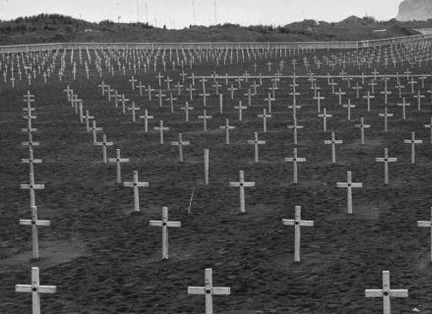
In the weeks after the battle, the dead of Iwo Jima were buried where they fell. Temporary cemeteries were established quickly across the island, rows of white markers set into volcanic soil still scarred by shellfire.
Both Joyle Deering and Melvin Coble were first laid to rest there, on the island they had fought to capture, at the foot of Mount Suribachi.
Sergeant Joyle Deering was interred in the 4th Marine Division Cemetery, alongsidethemenwithwhom he had landed and fought through the black sand.
Corporal Melvin Coble was buried in the 5th Marine Division Cemetery, among the Marines of his own unit who had fallen in the same terrible days.
These cemeteries lay near one another at the base of Suribachi, beneath the mountainthatwouldsoonbecome famous in photographs around the world. The markers stretched in orderly lines across ground that had only recently been a battlefield, a quiet city of the dead growing in the shadow of victory.
Nearby rested another Marine whose story had already become legend — Gunnery SergeantJohnBasilone, the Medal of Honor recipient who had earned national fame for his heroism at Guadalcanal and who was killed on the very first day of the Iwo Jima invasion. Basilone, one of only a handful of Marines in World War II to receive both the Medal of Honor and the Navy Cross, was initially buried there as well, among thesamerowsoffreshgraves.
In those first months after the battle, the famous and the unknown lay side by side — decorated heroes and hometownboysalike—equal in sacrifice beneath the same volcanic earth.
The war ended, but the journey home for many of the fallen had only begun. Years passed before families saw closure. Temporary cemeteries were carefully disinterred as the United States began returning its dead to hometowns and permanent military cemeteries.
In 1948, the body of Sergeant Joyle Deering became the first of Marshall County’s war dead to return home. The Madill Record reported his arrival among thousands of Pacific casualties brought back aboard the transport Walter W. Schwenk. The young Marine who had once written proudly of Madill as “the best hometown in the world” finally came back to it.
Full military rites were conducted in Madill. American Legion and Veterans of ForeignWarsmembersstood at attention. Music echoed through the chapel. The boy whose name had once appeared in school rosters and sports pages returned beneath the flag he had served.
Melvin Coble’s return came later. Reburial services were held with military honors at Kingston cemetery, attended by family members whohadwaitedyearstobring him home. The newspaper listed siblings, relatives, and friends who gathered — a community reclaiming one of its own after too long an absence.
By the late 1940s, the war had already begun to settle into memory, but for MarshallCountythewounds were still close. Schools erected plaques honoring former students lost in the conflict. Names were read aloud by people who had known them as classmates, teammates, and neighbors.
Joyle Deering’s name appeared there — alongside other Madill boys who never returned.
Melvin Coble’s story remained alive in Kingston — remembered through family ties, through a twin brother who survived, and through a young wife whose married life had barely begun when it ended.
These were not distant figures frozen in black-andwhite photographs. They were boys the county had watched grow into men.
This Friday marks 81 years since February 20, 1945 — the day two Marshall County Marines, Sergeant Joyle Roland Deering of Madill and Corporal Melvin Lee Coble of Kingston, were killed during the second day of the invasion of Iwo Jima.
They never lived to see the moment that would become immortal.
Three days after their deaths, Marines raised the flag atop Mount Suribachi, and the photograph of that moment became one of the most recognized images in Americanhistory—asymbol of victory, sacrifice, and the strength of a nation at war. Yet beneath that mountain, in temporary cemeteries carved into volcanic soil, lay rows of fresh graves. Joyle Deering rested among the dead of the 4th Marine Division, MelvinCobleamongthe fallen of the 5th Marine Division, both buried at the base of the very mountain whose summitwouldsoondefinethe battle. Nearby lay Marines whose names would become legend, including Gunnery Sergeant John Basilone, a reminder that on Iwo Jima thefamousandtheunknown rested side by side.
Those temporary graves were never meant to be final. Years later, both young Marines would return home to Oklahoma under military honors, their long journeys endingamongthepeoplewho hadwatchedthemgrowfrom schoolboys into men.
Today, their names endure far from the black sand of Iwo Jima.
They are etched into the memorial on the Marshall County courthouse lawn, carved into stone alongside other sons of the county who did not return. People pass by those names every day — sometimes quickly, sometimes without knowing thefullstory—yeteachname holds an entire life, an entire family’s hope, and the weight of a world at war.
The difference between legend and reality lives in that contrast.
Normandy became the symbol of liberation — the opening of a road across Europe. Iwo Jima was different. There was no road beyond it. Every inch of the island had to be taken the hard way, bunker by bunker, yard by yard.
At Normandy, the beach was the beginning of movement.
At Iwo Jima, the beach was the beginning of endurance.
And on that second day — before the flag, before the cameras, before history captured triumph — Marshall County lost two of its sons.
For the families back home, the date arrived later in the form of telegrams. For the nation, it became one day among many in a long and brutal war. But for Marshall County, February 20, 1945 remains singular — the only day during World War II when two local men died in the same battle on the same day.
Joyle Roland Deering of Madill.
MelvinLeeCobleofKingston.
Two Marines whose stories ended before history took its picture.
And though Deering and Coble never saw the flag raised over Iwo Jima, they nonetheless helped raise it — not with their hands, but with their blood and with their lives. The famous photograph was not born in a single instant atop Suribachi; it was built upon the sacrifice of every Marine who fought andfellbelowitintheashand fire of those first deadly days.
So, the next time you see that photograph — or the bronze statue inspired by it at U.S. Marine Corps War MemorialnearArlingtonNational Cemetery—remember that the image stands on the sacrifice of men whose names most Americans will never know.
Remember two boys from Marshall County. Remember Joyle Deering. Remember Melvin Coble.
Because long after the smoke cleared and the cameras were gone, the meaning of that flag still rests with those who never lived to see it rise — and perhaps that is where their memory belongs, not only in history books, but in the quiet remembrance of the towns that raised them, whereeachFebruarythedate returns like a bell echoing across time.
Though no permanent U.S. flag now flies above Mount Suribachi, its shadow still drifts gently onto the courthouse lawn in Marshall County, where Joyle Deering and Melvin Coble are remembered.
And though the photograph became history, the sacrifice came home — from the red earth of Oklahoma to the black sand of Iwo Jima, and back again in memory.