
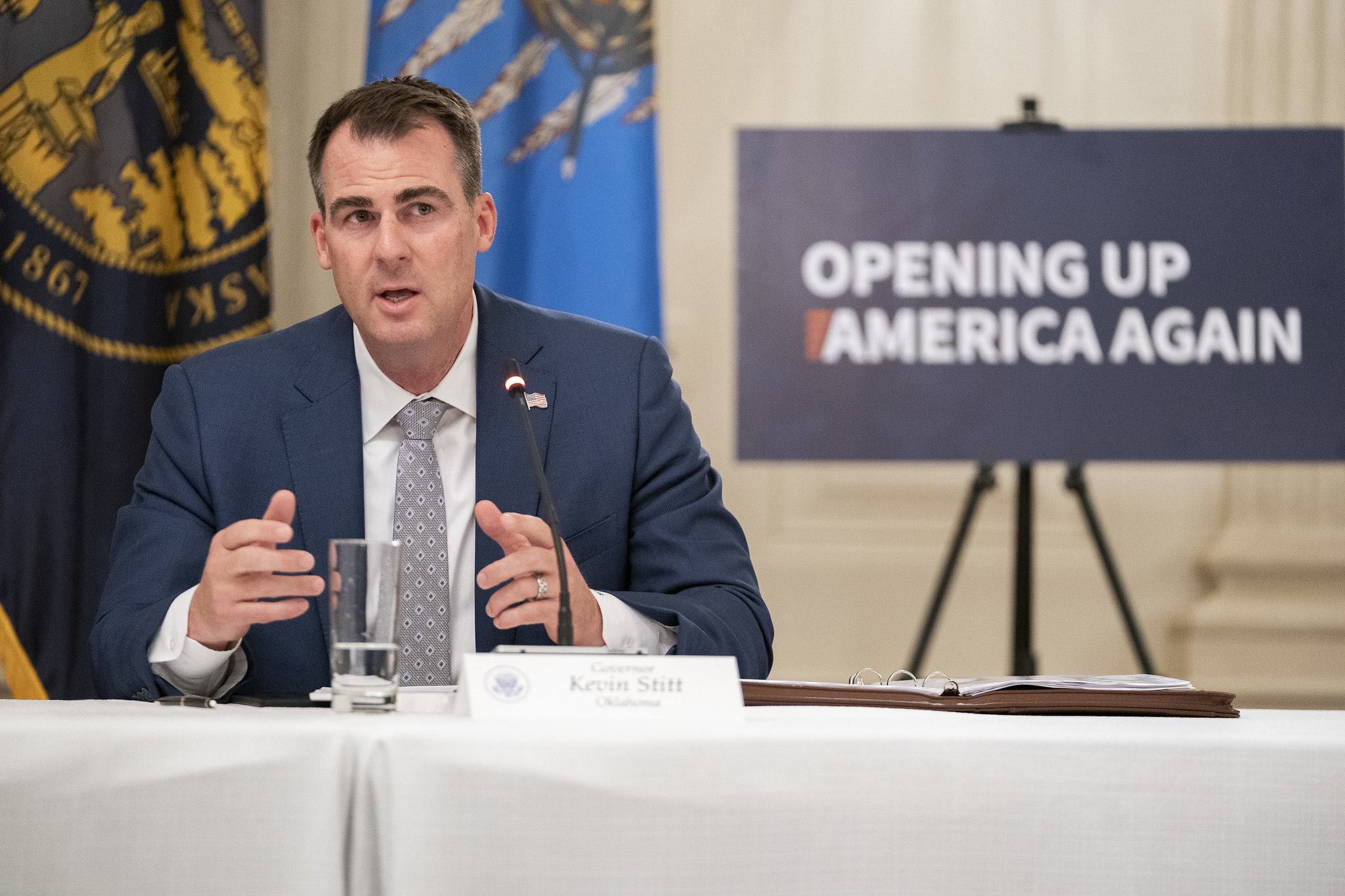
On May 9, Oklahoma Governor Kevin Stitt stunned many legislators by vetoing a bill designed to increase communication and coordination between tribal judicial agencies and state agencies. Oklahoma House Bill 3501, which passed the House of Representatives 69 to three and the Senate 44 to one, pressed upon the Department of Public Safety to “recognize and act upon a report of conviction in a court of any federally recognized Indian tribe within the geographical boundaries of the State of Oklahoma or a court of the United States in the same manner it acts upon any report of conviction from an Oklahoma state or municipal court.”
This means that any listed driving offenses in tribal courts would exact the same consequences with DPS as they would in state and local courts. Stitt stood by his dissatisfaction with the U.S. Supreme Court decision in McGirt v. Oklahoma and vetoed the bill.
He called the bill a “wolf in sheep’s clothing.”
“While Enrolled House Bill 3501 was passed under the guise of public safety… (it) would essentially require the State to carry out tribal court adjudications, no questions asked,” Stitt wrote in his veto. “Specifically, it would bind the Department of Public Safety (DPS), a State agency, to recognize and act upon reports of conviction submitted by courts of any federally recognized Indian tribe located anywhere in the State of Oklahoma in the same manner it acts upon reports of conviction from State and municipal courts.”
The Choctaw Nation Chief Gary Batton said Stitt’s veto was “petty” and it compromised public safety for Stitt’s own political gain and personal distaste over the McGirt decision.
“Tribal courts and law enforcement agencies have a long history of cooperation with state and local governments, including 75 cross-deputization agreements between the Choctaw Nation and other governments,” Batton said in an interview. “HB 3501 strengthens those relationships by requiring the state Department of Public Safety to recognize convictions for traffic offenses in tribal courts. Under this bill, drivers who violate the law and put others in jeopardy will be kept off the road.”
Batton said the large support the bill received in both House and Senate should be an indication of the importance.
“This measure almost unanimously passed the House and Senate, with 96 percent of Oklahoma legislators’ approval,” Batton said. “It has strong bipartisan support. We urge the Legislature to do what’s right for the people of Oklahoma and override this veto.”
Cherokee Nation Principal Chief Chuck Hoskin Jr. and the other Five Tribes chiefs issued a statement using the Inter-Tribal Council of the Five Tribes to convey their disappointment in the veto and ask legislators to override Stitt’s veto.
“It’s unfortunate the governor vetoed the public safety bill, which is an opportunity to keep unsafe drivers off Oklahoma’s roads through sharing information,” the statement said. “Our Five Tribes are committed to upholding public safety, and we welcome opportunities to collaborate and work together to solve the important public safety challenges ahead of us all, but yet again, our governor continues to be uncooperative and unwilling. This bill, with language provided by the Oklahoma Department of Public Safety, and overwhelming support by the legislature, will keep drivers, citizens and communities safe for all four million Oklahomans in our state. Hopefully, the Oklahoma legislature will override Governor Stitt’s destructive veto.”
Stitt noted in his veto letter that he was open to negotiations; however, his tone might have suggested otherwise.
“As I have done before, I again invite tribal and other leaders and partners to work with me toward reasonable solutions rather than engaging in aggressive efforts to strip the State of its established authority to prosecute, tax, and regulate all 4 million Oklahomans, regardless of race, background, or affiliation otherwise,” he wrote.