
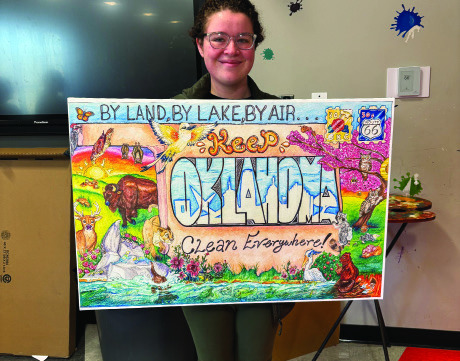
Each spring, as wildflowers begin to line Oklahoma’s highways and the steady hum of traffic returns after winter’s lull, the Oklahoma Department of Transportation quietly launches one of its most enduring and community- driven traditions, an initiative that turns art into advocacy and classrooms into catalysts for change. The ODOT Trash Poster Contest, held annually for decades, invites students across the state to put pencil, paint and imagination to work in a fight that extends far beyond the classroom walls.
What might appear at first glance to be a simple art competition is a cornerstone of Oklahoma’s broader anti-litter campaign, aimed at shaping habits early and reinforcing a shared responsibility for the state’s natural beauty. From elementary and secondary schools in rural counties like Marshall and Johnston to larger districts in Oklahoma City and Tulsa, participation in the contest has grown into a rite of passage for many young Oklahomans.
Teachers build lesson plans around it. Parents help brainstorm slogans at kitchen tables. Students, somepickingupapaintbrush for the first time, are asked to consider a deceptively simple question: what does a cleaner Oklahoma look like?
The answers come back in bold colors and even bolder messages. Posters often feature highways framed by rolling green hills, free of debris.
Others take a more direct approach, depicting the consequences of litter on wildlife, waterways and local communities. Slogans range from playful to poignant, but all carry the same underlying message, what is thrown away carelessly does not simply disappear.
ODOT officials say the contest is more than symbolic. Litter removal costs the state millions of dollars each year, with crews regularly dispatched to clear debris from roadsides, medians and bridges.
Beyond the financial burden, there are safety risks for motorists and environmental consequences that can ripple through ecosystems, especially in areas near lakes and rivers such as Lake Texoma and the Red River basin.
“The goal is awareness,” one department representative explained in a recent statement. “When students take ownership of the message, it spreads far beyond the poster. It reaches families, neighborhoods, and entire communities.”
Winning entries are not just celebrated, they are showcased. Top posters are often displayed at the state Capitol, featured in public campaigns and recognized during special ceremonies that highlight both artistic talent and civic responsibility.
For many students, it marks their first experience seeing their work contribute to a statewide initiative. In smaller communities, the contest can carry an even deeper resonance. In places where local pride is closely tied to the land, where fishing, hunting and outdoor recreation are part of daily life, the message hits close to home.
Marshall County is proud to say that one of their residents took home the firstplace prize. Lailey Irons, a Kingston High School senior, took the coveted first place in the9ththrough12thdivision.
Irons was awarded $300 and invited to ODOT for the awards ceremony. The winning students were also brought to the Capitol and recognized in the House and Senate.
A discarded bottle or fastfood bag is not just an eyesore; it is a threat to the very environment that sustains those traditions. Educators say the contest’s impact is lasting.
Students who participate often carry those lessons into adulthood, becoming more mindful of their own habits andmorevocalaboutkeeping public spaces clean. In that way, the posters serve as both artwork and early civic education.
As another year of submissions begins to take shape, ODOT officials remain hopeful that the next generation will continue to rise to the challenge, not just with creativity but with a commitment to stewardship.
Because in Oklahoma, the fight against litter is not waged solely by state crews in orange vests along the highways. It starts in classrooms, with crayons, markers and a simple idea, that keeping the state beautiful is a responsibility shared by all.