
This is not the history article I usually write.
Every week, I write about Marshall County—about places you can stand in, roads you can drive, names you can still find in records and old newspapers. I write about things that happened in a particular time, in a specific place, among people whose lives were as ordinary and challenging and beautiful as our own. I like history that can be pinned down, examined, and traced. I take a certain comfort in that kind of work—because it feels solid.
This year, Christmas has not felt solid.
This year, with a new position at work with more responsibility, health issues that included a hip replacement, and the steady pressure of life’s trials, I have not had the Christmas spirit I usually do. I have not fully decorated our house like I usually do. In fact, as I write this article, the main Christmas tree in our home isn’t even finished. I usually put up three trees. This year, only one. I have struggled, and I don’t say that for sympathy, but for honesty. And along with the unfinished tree is another detail that surprises me even as I admit it: this year I have barely listened to Christmas music—and I love Christmas music.
I love the old traditional classics, the kind that feel like they were recorded in a time when people still believed in hush and reverence: Nat KingCole,BingCrosby,Andy Williams,theMormonTabernacle Choir, the Carpenters. Those songs have always felt like home to me. And I love newer Christmas music too—MannheimSteamroller, for King & Country, Phil Wickham, and more. In most years, that music runs through December like a ribbon. This year, it has been quiet. Not completely absent, but quiet in a way I noticed.
And in that quiet—somewhere between obligations and fatigue, between the things that must be done and the things that used to be donewithjoy—Ifoundmyself asking a question I almost didn’t want to say out loud: Does Christmas really matter anymore? Is Christmas really that important?
Important, not as a tradition, not as a childhood memory, not as something the calendar turns over and demands, but as something true enough to hold you when your enthusiasm is thin, when your heart is tired, when the season arrives. At that point, it feels like I’m watching it through a window.
For most of my life, it has been. And yet this year, I found myself drowning in doubt. The thought kept returning, uninvited and persistent: What really does matter? And the idea that kept coming back was: which is more important, the cradle or the cross? The birth, I told myself, was beautiful—but the sacrifice was what counted. The redemption came at Calvary, not Bethlehem.
Lost in those thoughts and needing to answer my own question, I was drawn to research, ponder and write this article. It is, in a very real sense, my personal journey back to meaning and back to the question of why Christmas exists at all.
This year, Christmas arrives quietly—not on a Sunday morning, not amid a rush to church or town, but midweek. The Madill Record will arrive in mailboxes early, landing on Christmas Eve itself. It will be sorted alongside cards from distant relatives, circulars, and bills—ordinary things sharing space with something far older. And it may not even be read until the rush of Christmas has passed. Either way, I hope this article, in some small way, helps if you, too, are searching for meaning in aseasonwhensomanythings today can feel meaningless.
Which, almost inevitably, leads to the questions that first drew me to this page. Why Christmas at all? Why does this particular day exist? How did it become the moment the Christian world pausestorememberthebirth of Christ? Why did it matter then—and does it still matter now?
Those questions are not answered by sentiment or tradition alone. They are answered by history, by Scripture, and by intention. What follows is what I came to understand more clearly through study and reflection— an account not just of when Christmas came to be celebrated, but why it was chosen, and why its meaning has endured.
For all the certainty wrapped around the season, one truth bears saying plainly: Christmas has never been about a precise date on a calendar. It has always been about a deliberate act of love. Most people assume December 25 marks the actual day Christ was born. History, however, suggests otherwise.TheworldofJudea two thousand years ago did not keep time as we do, and even though December 25 existed on a Roman calendar, it fell in the heart of winter. Shepherds would not have been keeping watch over flocks in open fields on cold Judean nights. Scripture itself quietly points toward a different season.
Several details in the Gospels suggest a birth during a warmer time of year, likely spring or fall. Luke 2:8 describes shepherds living in the fields and watching their flocks at night. In the Judeanhighlands,December is cold and rainy, and snow is not uncommon. Judean winters are similar to those in Marshall County and all of southern Oklahoma and north Texas. In that season, flocks would typically be corralled under cover rather than left in open pastures overnight. The shepherds in Luke’s account are not described as making a brief stop outside; they are living out there, keeping watch by night, which strongly suggests a milder season.
There is also the Roman census. The birth took place during a census ordered by Caesar Augustus (Luke 2:1– 4). Historians and scholars have long noted how unlikely it would have been for Rome to require subjects to travel across rough terrain to their ancestral towns in winter, when roads could be in poor condition, and travel would be slower and riskier. Rome was efficient. It was practical. And practicality argues for a warmer season.
Some have even tried to estimate the timing through John the Baptist. Luke tells us that Zechariah served in the temple in the priestly course of Abijah (Luke 1:5– 23). Using that detail, some scholars calculate that John may have been conceived in June and born in March. Since Jesus was conceived six months after John (Luke 1:26, 36), that places Christ’s birth in September or October. No honest reader should treat such calculations as absolute proof. Still, they do underscore the larger point: the Gospels themselves do not naturally read like a December birth.
But none of this weakens Christmas.
It strengthens it. Because Christmas was never meant to be a historical trivia question, it was meant to be a declaration. Long before December 25 was fixed on a calendar, the early Church chose it not to settle chronology, but to proclaim meaning—that light had entered a dark world, and darkness would not overcome it.
That same clarity applies to the wise men—the Magi so carefully placed in nativity scenes. The story most people carry in their minds is that they arrived at the stable on the night Jesus was born. Scripture says otherwise. Matthew tells us that the Magi came later, and when they arrived, they did not find an infant in a manger. They found “the child” in a house (Matthew 2:11). The scene is domestic, not pastoral; settled, not immediate. That alone should slow us down, because it means the first Christmas story most people picture is, in at least one crucial way, out of sequence.
Matthew’s account is not merely a sweet add-on for foreign visitors with exotic gifts. It is a collision between two kinds of kingship. The Magi come seeking the One who has been born “king of the Jews” (Matthew 2:2). That question—where is the newborn king? —is not safe in the presence of a man like Herod. It is a spark thrown into dry grass.
Herod’s power was the kind that survives by suspicion. He could not hear the language of “another king” withouthearingthelanguage of “threat.” So, Matthew shows us the machinery of fear beginning to turn. Herod gathers information. He consults religious leaders. He learns prophecy points to Bethlehem (Matthew 2:5–6). Andthenhedoeswhatworldly power often does when it cannot stop God outright: it tries to control the story by controlling the timeline.
Matthew records that Herod called the Magi and asked them, “The time the star appeared” (Matthew 2:7). That is not small talk. That is not curiosity. That is a calculation. It is the cold arithmetic of someone trying to measure how far the truth hasalreadyadvancedbeyond his reach.
And when the Magi depart, Matthew tells us God warned them in a dream not to return to Herod. So, they go home another way (Matthew 2:12). Herod has been denied the information he wanted, and what follows is not merely political—it is spiritual and heartbreaking. Joseph is warned in a dream to flee to Egypt (Matthew 2:13–14). The Holy Family became refugees because the world could not make room for the King it claimed it wanted.
Then comes the line that makes Matthew’s Christmas account impossible to sentimentalize. Herod, realizing he had been outwitted, ordered slaughter. “Then Herod… sent and killed all the male children in Bethlehem and in all that region who were two years old or under” (Matthew 2:16). That detail does more than reveal cruelty. It reveals timing. It tells us the birth had occurred well before the Magi arrived. Herodisactingonthewindow of time he believes he has calculated. His violence is, in a grim way, a historical marker.
This is why nativity scenes thatplacetheMagibesidethe manger—while well-intentioned— flatten a story that Scripture keeps sharp. The wise men were not witnesses to the birth. They were witnesses to the identity of the child, and to the fact that His coming provoked a response from the powers of this world. They stand at the intersection of wonder and warning. They remind us that Christ’s arrival is good news, but it is not tame news. It threatens every throne built on fear.
And the gifts they bring preach before a sermon is ever spoken. Matthew tells us that the Magi “fell down and worshiped him,” and then they opened their treasures— gold, frankincense, and myrrh (Matthew 2:11). These were not random offerings gathered in haste. They were deliberate, costly, and layered with meaning, each one declaring something true about the child before Him.
Gold was the gift of royalty. In the ancient world, it was the metal of kings—treasured, guarded, and reserved for those who ruled. To place gold before the child was to acknowledge His kingship, even while He lay in obscurity. TheMagirecognizedwhat the world around them could not yet see: that this child was not merely born into a family, but into authority. He was a King, though His crownwouldnotbefashioned from gold, and His throne would not resemble those of earthly rulers.
Frankincense was the gift of worship. It was used in the temple, burned as an offering before God, its fragrance rising as a symbol of prayer and holiness. To present frankincense was to confess that this child was more than a king—He was worthy of worship. It was a priestly gift, declaring that He would stand between God and man, offering not the blood of animals, but Himself. Even in infancy, His identity as mediator was being proclaimed.
Myrrhwasthemostunsettling gift of all. It was a spice most often used for embalming and for anointing bodies for burial. It carried the scent of death. To place myrrh before a child is jarring—unless one understands that this child was born to die. Myrrh does not speak of celebration alone; it speaks of sacrifice. It whispers of suffering yet to come, of a body that would be broken, wrapped, and laid away. Even here, at the beginning, the cross casts its long shadow.
Taken together, the gifts form a confession of faith more complete than many sermons. Gold declares Him King. Frankincense declares Him God. Myrrh declares Him Savior—one who would redeem not by force, but by giving His life. The Magi may not have understood the full scope of what they were doing, but Scripture shows us that their gifts carried a meaning deeper than they knew.
Christmas, then, does not merely announce a birth. It announces a mission. From the very beginning, the story is pointing forward—beyond themanger,beyondthesongs andstars,towardthepurpose for which He came. The child adored in Bethlehem is the same one who would be lifted up at Calvary. And the gifts laid at His feet remind us that this was no accident of history, but the unfolding of redemption itself.
Which raises the question many have asked: if December 25 was not likely the date of Christ’s birth, why was it chosen?
The answer lies not in error, but in intention. The date was officially adopted by the Roman Church in the 4thcentury,aroundA.D.336, and several currents flowed together in that decision.
One reason was theological symbolism. Many early Christians believed that great men died on the same day they were conceived, leaving a “perfect” lifespan. This belief was influenced by a Jewish idea sometimes called “integral age,” the notion that some holy lives were whole and complete in God’s design. The traditional date of Christ’s crucifixion was March 25. Adding nine months placed His birth on December 25. In that reckoning, the cradle and the cross were joined not by coincidence but by design. From early on, the Church was not merely celebrating a birthday; it was preaching a single story in two movements: God came near, and God went all the way.
Another reason was cosmic alignment. December 25 marked the winter solstice on the Roman calendar—the turning point when days ceased growing shorter, and light began to return. To a worldattunedtosymbols,this was powerful: the Light of the World entering a darkened creation. It wasn’t simply a date; it was a proclamation in the language of creation itself. “The true light, which gives light to everyone, was coming into the world” (John 1:9). Christmas was never meant to answer chronology. It was meant to make a declaration—that into a cold, dim world, light had come, and darkness would not have the final word.
And there was also a cultural reason. The date coincided with popular Roman festivals like Saturnalia and Dies Natalis Solis Invicti—the Birthday of the Unconquered Sun. By choosing this date, the Church offered a Christian alternative to existing celebrations, making conversion easier for Roman subjects. Celebration did not have to be abolished; it could be redirected. A rival “sun” could be answered with the true Light. A rival “unconquered” power could be answered with the One who would conquer sin and death.
None of this diminishes Christmas.
It clarifies it. Because Christmas was never about getting the date right, it was about getting the truth right. God entered history. God came near. God chose humility over power, weakness over force, love over coercion—and He did so knowing exactly where that road would lead.
And when the truth comes into focus, the wonder deepens rather than fades. It is easy, over time, for familiarity to dull awe. Every December, the nativity returns— on mantels, on courthouse lawns, on the steps of churches—and the pieces are arranged with care. The manger is usually made to look gentle, almost charming. We translate it in our minds into something closer to a crib.
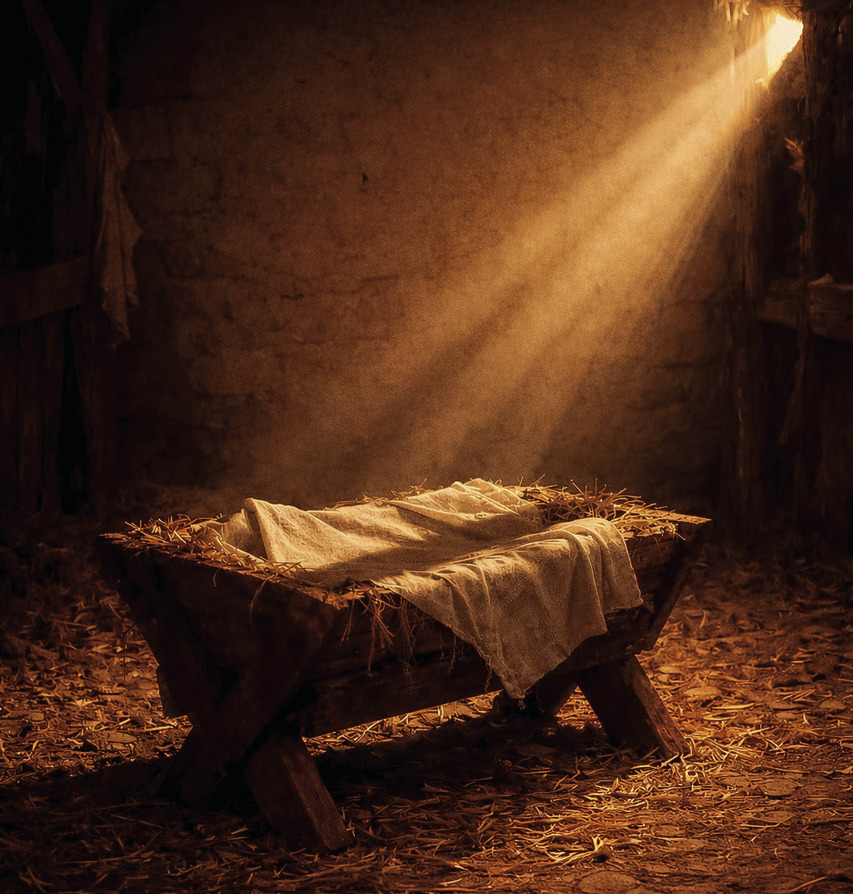
But a manger is not a crib. A manger is a feeding trough. It is the place where grain is poured. It is not a pretty place. It is not a clean place. Cows, donkeys, sheep, and other farm animals would put their muzzles and mouths into the trough, leaving behind slobber and dust, bits of chewed hay and chaff, the stale warmth of breath, the ordinary grime of stable life. It would have carried the smell of animals and the roughness of wood worn downbyyearsofuse—boards not polished for display but scarred by work. It was a place meant for appetite, not for royalty; a place built for feeding, not for holding something sacred.
And yet that is precisely where He was laid.
Not because it was fitting, but because it was available. Not because it was worthy, but because God chose to enter the world without demanding worthiness from the world that received Him. The Savior of the world—the first place the Savior of the world was placed—was in the feeding trough. The Son of God began His earthly life not in linen and comfort, but in a place where animals ate. That is not a sentimental detail. It is a declaration in woodandstraw: thatHeaven does not wait for cleanliness before it comes near, and that God does not require a polishedroombeforeHesteps into human need.
When you let that reality stand, unsoftened and unpolished, the wonder deepens instead of fading. We have turned the manger into a decoration, a quaint prop in a scene we can set on a shelf. But Scripture will not let it remain quaint. The feeding trough was the first sermon Christ ever preached without words. It said, from the beginning, thatHiskingdomwould not be built on spectacle, but on humility; not on force, but onsurrender;notondistance, but on closeness.
It is easy, in our minds, to translate the manger into something clean, almost like a crib. We imagine smooth boards and tidy straw, a holy glow that keeps the mess at bay. But the truth is sharper than that, and more beautiful. God did not arrive above themess.Hecameintoit.Into dust and breath and straw. Into the rough, unadorned places where life actually happens. Into the kind of ordinarythatmostofusknow far better than palaces.
And this is where the story presses us—not toward shame, but toward awe. Because if God chose the feeding trough as the first place to lay His Son, then we have to admit something both unsettling and hopeful: God is not repelled by our low places. He is not frightened of our unfinished rooms. He is not waiting for us to get everything cleaned up, decorated, perfected, and made presentable before He comes near.
He comes low. He comes close. He comes anyway. And the manger, in all its roughness, was not merely where He rested. It was the first sign of where He was headed. The humility of Bethlehem was not temporary. It was the shape of His whole mission. The One laid where animals fed would one day say He Himself is bread for the life of the world. The One who began in borrowed straw would end in borrowed linen. The One first placed in a borrowed feeding trough would later be placed in a borrowed tomb.
Which is why Christmas cannot be separated from Good Friday. The cradle and the cross belong to one another. From the beginning, the shadow of the cross stretches forward. The manger was never meant to be the end of the story. It was the beginning of a road that led, deliberately and lovingly, to redemption.
That detail changes the whole scene. It strips away the polish we’ve added over the years. It takes the nativity out of the realm of decoration and returns it to the realm of holy shock. God did not merely arrive; He descended. He chose weakness, humility, and dependence. He chose the lowest place, and in doing so, He revealed the character of the Kingdom He came to bring.
And then we come to the shepherds—the first to learn of the birth of Christ.
Luke says it plainly: “And in the same region there were shepherds out in the field, keeping watch over their flock by night” (Luke 2:8). While towns slept, while rulers plotted, while the ordinary world kept turning, there were men in the dark doing the work no one applauded—staying awake, standing guard, watching over living, vulnerable things.
There is a modern idea often repeated that the shepherds of Luke 2 were social and religious outcasts. It makes for a tidy twist, but it is not grounded well in firstcentury evidence. Much of what is used to support that claim comes from sources far removed from the time of Christ. Luke’s own account contains a subtle hint against that legend. Luke 2:18 says, “And all who heard it were amazed at what the shepherds said to them.” The amazement is not that shepherds were involved. The amazement is the message itself.
And beyond that is the more profound, older truth: Scripture’s portrayal of shepherds is overwhelmingly positive. The Old Testament forms the imagination of first-century Jews, and in that world, shepherds were not a shameful footnote— they were central figures. Abraham lived among flocks as a shepherd. Moses kept sheep before he ever led a nation (Exodus 3:1). And David was a shepherd before he was king (1 Samuel 17). These were pillars of Israel’s story.
God Himself is pictured as a shepherd. “The Lord is my shepherd; I shall not want” (Psalm 23:1). Jacob’s blessing speaks of “the Shepherd, the Rock of Israel” (Genesis 49:24). The psalmist cries, “Listen, Shepherd of Israel” (Psalm 80:1). Ezekiel records God’s promise in language both fierce and tender: “As a shepherd looks for his sheep… so I will look for My flock. I will rescue them from all the places where they have been scattered on a cloudy and dark day” (Ezekiel 34:12). And then that promise sharpens into prophecy: “And I will set up over them one shepherd, my servant David” (Ezekiel 34:23). A first-century Jew would not hear “shepherd” and think “outcast” first. He would think of Abraham, Moses, David, and God.
TheNewTestamentkeeps the same motif and makes it unmistakable. Matthew ties shepherding language directly to the Messiah: “And you, Bethlehem… out of you will come a leader who will shepherd My people Israel” (Matthew 2:6). Others see the need for a shepherd in the people themselves. “When He saw the crowds, He had compassionforthem,because they were harassed and helpless, like sheep without a shepherd” (Matthew 9:36). Mark echoes it: “When he went ashore he saw a great crowd, and he had compassion on them, because they were like sheep without a shepherd. And he began to teach them many things.” (Mark6:34).Beforebread,He gives truth. Before comfort, He provides direction. The Shepherd does not merely feel; He leads.
And Jesus names Himself withdirectnessthatleavesno room for sentimental décor. “I am the good shepherd. The good shepherd lays down his life for the sheep” (John 10:11). He presses it further: “I am the good shepherd; I know my own and my own know me… and I lay down my life for the sheep” (John 10:14–15). And He widens the field: “And I have other sheep that are not of this fold. I must bring them also, and they will listen to my voice. So, there will be one flock, one shepherd. For this reason, the Father loves me, because I lay down my life that I may take it up again. No one takes it from me, but I lay it down of my own accord. I have authority to lay it down, and I have authority to take it up again. This charge I have received from myFather.”(John10:16).The Shepherd’s pasture reaches beyond Israel. He says it plainly.
Then comes the night the Shepherd is struck. On the eve of His suffering, Jesus quotes Zechariah and places what is about to happen inside God’s plan: “I will strike the shepherd, and the sheep of the flock will be scattered” (Matthew 26:31). The scattering is not the collapse of the story. It is prophecy fulfilled. It is the valley before restoration.
After the resurrection, the Shepherd’s mission continues. On the shore, Jesus commissionsPeter:“Feedmy lambs… Tend my sheep… Feed my sheep” (John 21:15– 17). The risen Christ remains the Shepherd, and He appoints under-shepherds to carry His care forward. The apostles keep the same language without hesitation. “Our Lord Jesus, the great shepherdofthesheep…”(Hebrews 13:20). “For you were straying like sheep but have nowreturnedtotheShepherd and Overseer of your souls” (1 Peter 2:25). “When the Chief Shepherdappears…”(1Peter 5:4). Earthly shepherds fade. This One does not.
So, the Savior, the Great Shepherd, the King of Kings, begins His earthly life and mission not in a palace, not announced around the world with fanfare and pageantry, but in a feeding trough in a stable, surrounded not by royalty, but by farm animals and His parents. And then the Good News—that the Savior was born—was not announced to the masses, to royalty, or to the worldly powers, but to shepherds. How fitting. The Great Shepherd was first welcomed into this world by men He would emulate— men who tended their flocks, protected helpless sheep, and who, in a world with wolves and thieves, would give their lives, if need be, to protect what was entrusted to them.
And yet, the birth of Christ matters only because of the death of Christ.
This is the truth Christmas gently carries but rarely names. We sing about the light of the world, about a star in the sky and angels in the night, but we often stop short of asking what that light demands of us. The cradle was never an end in itself. It was the beginning of a road that led inexorably to the cross. From the moment Christ entered the world, the shadow of Calvary fell across the manger. Bethlehem pointed forward to Golgotha.
Scripture never separates the two. “He was pierced for our transgressions; he was crushed for our iniquities; upon him was the chastisement that brought us peace” (Isaiah 53:5). That prophecy was spoken centuries before the first Christmas night. Long before shepherds left their flocks. Long before a feeding trough was borrowed for a bed. The cross was not a reaction to a failed mission— it was the mission.
God did not come merely towalkamongus.Hecameto redeem us. He took on flesh not to admire creation, but to rescue it. The incarnation— Godbecomingman—wasnot an act of curiosity. It was an act of sacrifice. The cross has meaning only because God first chose to come near. And the cradle has meaning only because God intended to go all the way—to suffering, to death, to the grave.
The wood of the manger and the wood of the cross are bound together. One held a child. The other held a Savior. OnereceivedHimgently.The other rejected Him violently. But both were necessary. Neither stands alone. A baby is easy to love. A Savior who demands repentance is not. A manger invites wonder. A cross demands reckoning. Christmas warms the heart. Good Friday confronts the soul. And yet one without the other empties both of meaning.
If Christ had only been born, Christmas would be a beautiful story without power. If Christ had only died, the cross would be a mystery without mercy. But because God chose both—because He sent His Son to be born and to die—Christmas became the opening chapter of redemption. “And being found in human form, he humbledhimselfbybecoming obedient to the point of death, even death on a cross” (Philippians 2:8). That obedience did not begin on Good Friday. It started in Bethlehem. It beganthemomentGodchose weaknessoverforce,humility over spectacle, and love over dominance.
The child lying in a feeding trough would one day feed the world with His own body. The infant wrapped in swaddling cloths would one day be wrapped again and laid in a borrowed tomb.
And the tomb would not hold Him.
“He is not here, for he has risen, as he said” (Matthew 28:6).
ThisiswhyChristmasstill matters.
Not loudly. Not angrily. Not in the way the world usually asks for attention. It asks quietly—and if we are honest, uncomfortably. We sing about the Light of the World, and in doing so, we rise, at least for a moment, above the weight of the year. But the question Christmas leaves with us is not whether the light is beautiful. We already know that it is. The harder question—the one that lingers long after the carols fade—is whether that light reaches far enough to change us.
Not in the shallow ways that pass for conviction. Not intheargumentswerehearse or the opinions we carry so tightly. Not in the familiar tensions that surface around tables each year, where certainty is loud, and listening is rare.
Christmas presses beyond all of that. It is less interested in what we assert than in what we become.
Christmas presses past that small noise.
It turns the question around.Itaskswhatitmeans for our lives to reflect the light we claim to celebrate. What does it mean to let a small, ordinary life shine in a world trained to notice only what is loud, powerful, and victorious? What does it meantoliveupsidedown—to choose humility where the world chooses dominance, to choose restraint where the world chooses volume, to choosefaithfulnesswherethe world rewards force?
This is where the manger and the cross refuse to remain symbols. They become a pattern. The manger says greatness comes low. The cross says love stays when it costs. And Christmas asks whether we are willing—not justtoadmirethatstory—but to let it shape the way we live, speak, forgive, and remain present in a world that rarely slows down long enough to notice quiet light.
This year has been quite a year for each of us. Some have faced the most significant loss of their lives. Some have found love. Some have earned degrees or started new chapters. Some are struggling simply to get out of bed every day. Some are asking, quietly or aloud, “Where is God in all this?” Where is He going in 2026? Christmas answers that question not with explanation, but with presence.
Godisnotanabstractidea. He is not some man upstairs a million light-years away, someabsenteeparentlooking down on this grand experiment of His. God is here, my friend. God is with us. Jesus. Emmanuel.
Andthatconvictionstands whether your house is fully decorated or not. Whether your tree is finished or not. Whether you’ve listened to a single Christmas album or not. Whether you feel the “spirit” or you don’t. The meaning of Christmas does not rise and fall with your energy level. It rests on something sturdier: what God has done.
For God so loved the world that He gave His only Son (John 3:16). Through a baby born in a stable, God gave us a Savior. Through Him we have redemption. On a dark night, 2000 plus years ago, God came near—He brought Heaven down to earth—and nomatterwhoweareorwhat we have done, God sent that baby boy to save us.
Christmas still matters because it is one day that so much of the world stops to remember.
But the truth is, Christmas shouldn’t be just one day. In the secular sense, Christmas is a day of giving and receiving gifts from friends and loved ones. It comes, gifts are exchanged, and it gets tucked away until next year. But in the spiritual sense, Christmas should be every day. Every day we should remember the greatest gift ever to be given—the gift of the Christ child. The giver of life. The Word!
And there is another truth braided into that one: Christmas matters because the cross matters. The cross matters because the cradle matters. They are totally dependent on each other. One has no meaning without the other. As we celebrate and remember the birth, we have to remember the cross. And vice versa. The cradle tells us God came near. The cross tells us He stayed. The resurrection tells us love won.
Here in Marshall County, we understand something about things being bound together—past and present, hardship and hope, memory and meaning. Our history is not one of palaces and privilege. It is the history of farms scratched from stubborn soil, of towns built far from centers of power, of families who endured droughts, wars, depressions, and loss—and kept going anyway. Old photographs, children’s letters to Santa, and newspaper clippings tell us that early Christmases here were not lavish. They were quiet. Church services by lamplight. Modest gifts. Neighbors checking on neighbors. Children content with little because they were surrounded by much—faith, family, and belonging. Those were not perfect times. No honest historian would pretend otherwise. But they understood something we risk forgetting: meaning does not come from abundance, and hope does not require spectacle.
Christmas tells us the same.
So as this paper arrives in mailboxes on Christmas Eve, as it is opened and read amid the ordinary rhythms of the day, we remember not a date, but a decision. Not a myth, but a moment when Heaven stepped into human history and refused to leave us where we were. “But God shows his love for us in that while we were still sinners, Christ died for us” (Romans 5:8). Christmas matters because redemptionmatters.Because grace matters. Because God so loved the world. And that is something worth remembering— not once a year, but every day.
Yes. Christmas still matters.
It always has.
It always will. In the end, this was not an article I even intended to write. It’s likely safe to say it’s not even an article I wanted to write. But in the end, I’m glad I did. Because, next year, I intend to do all I can to restore the whole Christmas experience in our home and make it as meaningful as it was designed to be—not as performance, not as forced cheerfulness, not as a fragile effort to manufacture a feeling, but as an act of attention. I want the trees up again. All three. I want them finished early. I want the music back in the house—Nat and Bing and Andy, Burl Ives, and the Carpenters; the newer songs too—MannheimSteamroller, for King & Country, Phil Wickham, and the rest— because those hymns and harmonies have always been part of how I remember.
Butmorethanthat,Iwant the meaning to be whole— not just in December, but in ordinary days when no one is singing, and no lights are on. I want the remembrance to remain. I want Christmas to be more than a date on the calendar and more than a mood I have to chase. I want it to be what it truly is: the declaration that God came near, that He went all the way, that the cradle and the cross cannot be separated, and that because of Him, redemption is not wishful thinking. It is real.
And if it is true that Christmas can make us feel both held and hollow, then perhaps a song gets it right when it admits the strange, double weight of the season. In his Christmas song “December,” Kenny Loggins gives voice to what many feel but rarely confess—“Only in December,” when “hearts so full” can also “feel more alone.” Christmas has a way of widening everything—joy and grief, gratitude and longing—until they sit side by side, inseparable. And yet, even there—especially there—the season keeps pointing home. It keeps whispering what we are prone to forget: “December always leads me home.”
So, I will let the last word be a quiet confession I want to carry with me into the days ahead: “I still believe in Christmas.” And more than that, I still believe in the thing Christmas announces— love that came down, love that stayed, love that went all the way.
I still believe in that love. I pray you do too.
MerryChristmas,Family!