
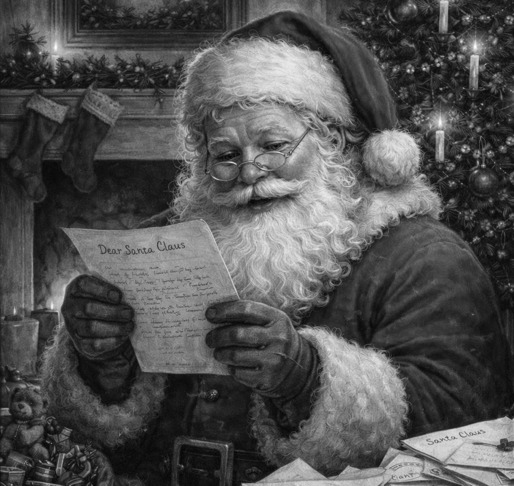
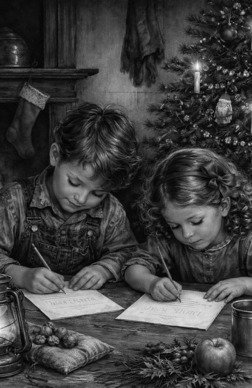
Before Christmas became loud and electric—before screens blinked and catalogs sprawled across coffee tables— it arrived quietly, by ink and paper, folded into the pages of the Madill Record, the Kingston Messenger and other county newspapers that no longer exist.
For generations of Marshall County children, writing a letter to Santa was not a novelty but a rite of passage, as dependable as the first cold north wind or the smell of wood smoke drifting through town. From 1904 onward, thoselettersbecameaseasonal tradition the paper faithfully carried, year after year, as if safeguarding a small but sacred trust.
That trust rested on something children carried naturally, and adults worked hard to protect: belief. Children believe in Santa for the same reason they believe the world is, at its core, good. Belief comes to them not through proof or persuasion, but throughatmosphere—through repetition, through ritual, through the quiet assurance that something wonderful is being prepared just for them, unseen. Santa is not first encounteredasacharacter,but as an experience: the hush of December evenings, the care taken by adults, the sense that kindness itself has weight and intention.
The custom itself was far older and far wider than Marshall County. By the early twentieth century, children across America were writing to Santa Claus in such numbers that the practice became a national phenomenon. Smalltown newspapers from New England mill villages to prairie farmingcommunitiestocoastal towns along the Pacific Ocean printed these letters every December,understandingthat they offered something more enduring than advertisements or holiday editorials. They captured the unguarded voice of childhood—hopeful, polite, sometimes awkward, often profound.
Santa gave that voice a listener. To a child, Santa represented a rare certainty in an uncertain world. He arrived when promised. He remembered names. He noticed effort. In lives shaped by weather, work, and adult decisions beyond their control, Santa offered order paired with mercy, expectations of proper behavior, and a hope for a better tomorrow. He was amoralfigure,butneverharsh. Children did not write because they were greedy; they wrote because they trusted Santa to notice them.
InruralplaceslikeMarshall County, where life followed the rhythms of crops, weather, and work, the letters carried particular weight. Many of the children who wrote them rose before daylight to help with chores, walked miles to school, and learned early that money was finite and effort mattered. A letter to Santa was not an assumption of abundance; it was an appeal. Children introduced themselves carefully, explained how hard they had tried to behave, asked after Santa’s health, and framed their wishes with humility that now feels almost foreign.
That humility was not accidental. Children believed in Santa because belief taught them how the world ought to work. Santa rewarded effort, noticed kindness, and arrived without being asked to perform. In households where disappointment was familiar and certainty was rare, Santa promised something steady: that goodness, even unseen, still counted.
The Madill Record did more than reprint these letters—it gave them permanence. What began at a kitchen table or school desk became part of the community record. Parents read their children’s words in print with quiet pride. Neighbors recognized familiar names and families. In years marked by drought, depression, and war, the letters offered reassurance that imagination still survived. Even when the world asked adults to be practical and restrained, children were allowed—just once a year—to hope out loud. And that hope endured. More than a century later, we are still reading these letters—still moved by their innocence, still sustained by a hope that feels in short supply today, and still reminded that kindnessandlove,oncewritten down, can outlast the hardest years.
Hope, however, did not sustain itself. It was built. Adults labored to make belief possible. Parents stayed up late.Editorsgavecolumnspace. Teachers encouraged writing. Neighbors played along. Belief in Santa was never a trick played on children; it was a gift given to them. The lesson was not deception, but devotion. Children learned—without being told—that goodness often operates quietly, without applause.
The United States Post Office, overwhelmed by letters addressed simply to “Santa Claus,” stepped in as well. By the 1910s and 1920s, postal clerks across the country were quietly answering children’s mail, unwilling to let belief be returned undelivered. During the Depression, this effort evolved into what would later become the Postal Service’s formal Santa program, pairing letters with volunteers who ensured that no child’s faith went unanswered. It was an unofficial covenant between institutions and innocence: some things, especially in hard times, were worth preserving.
Preserving belief mattered because belief teaches more than fantasy. It teaches trust. It teaches patience. It teaches thatkindnesscanexistwithout being seen. And when children eventually learned the truth adults carry—that Santa is not one person, but many— the lesson was not lost, but inherited. Santa became the quiet work of ordinary people choosing generosity over ease.
The letters themselves form a kind of social history written in crayon and careful cursive. Early requests were modest—dolls, wagons, books, gloves, oranges, candy and fireworks. During lean years, wishes grew smaller. Children asked Santa to help their parents, to bring coal or food, and to bring mom or dad home. The language was restrained, deferential,anddeeplyhuman. These were not lists. They were conversations. And in rereading them today, we are reminded that Christmas once rested less on abundance than on belief.
Placed beside those letters from a century ago, modern childhood can feel almost unrecognizable. The contrast tempts an easy conclusion— that children today are more selfish, more demanding, more self-centered. But that conclusion misses the more profound truth. Children have not fundamentally changed. The world that shapes them has.
The children of the 1910s and 1920s were not born with superior character. They were raised in a culture of limits— material, social, and moral. Wanting something required justification. Asking required courtesy. Adults spoke often and plainly about cost, effort, and consequence, and children absorbed those lessons long before they ever put pencil to paper. Scarcity was not an abstract concept; it was visible at the supper table and in the fields.
Modern children grow up in a radically different environment.Desireisconstant and curated. Advertising follows them from screens into pockets. Choice is framed as identity. When something is wanted, it is often already pictured, priced, reviewed, and available with a click. Wanting no longer carries moral weight; it is treated as neutral, even encouraged. In such a world, expectation becomes unfiltered—not because children are careless, but because restraint is no longer modeled as a virtue.
This is where the old Santa letters speak most powerfully. Their humility was not accidental. It reflected what might be called the moral temperature of the adult world—the values, anxieties, and assumptions children quietly inherit. A child who watches parents worry about bills, save string, repair rather than replace, and thank God for small mercies learns instinctively that the world does not exist solely to satisfy them. Their letters to Santa echo that understanding.
Today’s children absorb different signals. Adults themselves live in a state of permanent acceleration— always upgrading, optimizing, customizing. We speak the language of entitlement fluently, even when we don’t mean to. Christmas arrives less as a season and more as a campaign, and children respond accordingly. What sounds like selfishness is often simply expectation without friction—desire untempered by visible cost or consequence.
Theoldlettersoftenincluded apologies: I hope this isn’t too much. Children worried about Santa’s workload. They asked for others before themselves. These were not sentimental flourishes; they were reflections of a world that constantly reminded children they were part of something larger—family, church, community, nation. Modern letters, by contrast, often read like inventories because modern life trains children early to organize their wants, rank them, and expect fulfillment.
And yet, it would be a mistake—an unfair one—to read this as a condemnation of today’s children. Children mirror what they are given. They reflect the moral climate the same way old thermometers once reflected the weather: honestly, without judgment. The difference between then and now is not in the hearts of children, but in the expectations adults place on them—and the examples adults set.
That is why belief still matters. Not because children must believe forever, but becausebelievingteachesthem howtolivewhenbeliefbecomes harder. It teaches them that generosity does not require recognition, that magic often arrives disguised as effort, and that goodness is something people choose to make real for others.
That is why these letters matter now, perhaps more than ever. This weekly column has never been about collecting curiositiesorpolishingartifacts for display. It has been about remembering—aboutlistening carefully to the past and letting it speak into the present. The history of Marshall County, like the history of this country and this state, is not valuable because it was perfect, but because it reveals what once held people together. Week after week, the goal has been the same: to let history be a guide—an honest one—to the values, habits, and quiet decencies that made this place worth calling home.
They are not quaint relics meant to shame the present. They are reminders. They remind us that progress is not always improvement, and that in the rush to move forward we sometimes leave behind things that mattered deeply— neighborliness, restraint, humility,andgrace.Theypoint back to a time when people did not agree on everything, yet still managed to live side by side; when political, religious, and social differences did not automatically become lines of division; when words were not sharpened into weapons, and disagreement did not require hatred.
They show us a time when Christmas allowed space for patience, when desire was shaped by gratitude, and when belief required effort. They recall a world where people looked after one another not because they were told to, but because it was understood to be right; where help was given quietly, friendships crossed differences easily, and community was something practiced rather than proclaimed. In reprinting them, the Madill Record is not merely preserving nostalgia; it is holding up a mirror—quietly asking whether we still know how to teach children not just what to want, but how to ask, andperhapsmoreimportantly, when to be satisfied with less..
In the end, these letters endure because they speak to something constant. Children still hope. They still believe. They still watch adults closely, learning what matters. The question the old letters leave us with is not whether children have changed—but whether we have, and what kind of world our own words, habits, and expectations are teaching them to inherit.
The Letters Themselves Marshall County Children, 1909–1916 What follows are the words of Marshall County children as they appeared in print more than a century ago. Nothing has been corrected. Nothing refined. The spelling, the rhythm, the small mistakes and sudden formalities remain intact. These letters were written in kitchens and schoolrooms, by lamplight and winter daylight, in a time when children learned early how much things cost and how far hope had to stretch to meet reality.
December 20, 1909 Shay, Dee. 20, 1909. Dear Santa Claus: I will write you a letter to let you know that I have been a good boy. Santa Claus I want you to hring me a billy goat hitehed to a wagon and some other things and a toy horse. I will hang up my stockings to get what you maybringme,hopingtogetthe billy goat hitched to a wagon. I can think of no more to write. from little CHARLIE NORMAN.
1915 – Marshall County News Democrat Santa Claus: Please bring Lindsay a born and a donkey and a candy pig and candy mice.
Indsay Haddock. Santa Claus: Please bring Lindsay a drum.
Lindsay Haddock. Dear Santa Claus: Pleasebringmeablackboard andabig hornandastory book. Dear Santa Claus, we have no money now but we will pay you when we can. Mamma is going to sell her butter and milk then we will tave some money. Please Santa Claus bring me some shoes, for I am almost bare- footed.
Best love from Anna Garrido.
Dear Santa Claus: Will you please bring me a good. strong, grass book satchel, a musical top, a saddleblanket for Dixie and a story book?
Yours truly. Robert Chowning, Jr.
Dear Santa Claus: I have been very good this year. I wish you to bring me a little doll bed and a little doll mattress to go with it and a little doll buggy.
FrancesBain.Cumberland, Okla.
Dear Santa Claus: I have been very good this year. I wish you to bring me a little toy pistol and an auto and a pair of red mittens.
Walter Smither. Cumberland, Okla.
Dear Santa Claus: As Christmas is drawing near I will write you a letter and ask you to bring me a little air gun, freight train and some candy.
WillisSmitherCumberland, Okla Dear Santa Claus: Will you please bring me a big doll and story book. (Age 6 years).
ImaTrueMayo.Aylesworth, Okla.
Dear Santa Claus: Please send me a rubber doll and a set of dishes. (Age 3 years) Omego Mayo, Aylesworth. Oklahoma.
DearKindOldSantaClaus: The same Santa Claus we have always had. I am just a year older than I was a year ago. . I am glad when Xmas comes be- cause St. Nick always brings me toys. I want you to send me a celluoid doll and a little doll chair. Some candy, nuts, oranges and (See apples. Also a bugle, fireworks and a nice Christmas book. Decorate my toys with holly. I will thank my parents for having spoken a good word to Santa Claus for me. Will also thank Santa Claus for my toys and Dear Mrs. Santa Claus who does all the sewing, knitting and dressing of the doilies and toys. Will close, wishing a Merry Christmas and Happy New Year to all.
Marie Crockett. Cumberland. Okla.
Dear Santa Claus: Please bring me a story book and a pocket knife. (Age 8 years.)
Logan Mayo. Aylesworth, Okla.
Dear Santa Claus: It is about time for you to come so I thought I would write you a letter. I hope you will come to our house but if you come down the chimney, you will fall into the stove, so come in the window. Please bring me a big doll and story book.
From your friend. Ima Dillow. Woodville. Okla.
Dear Santa Claus: I have been very good this year. I wish you to bring me a little rocking chair. My baby brother, Douglas, wants you to bring him a little train. DouglasandIwantsomecandy and oranges and apples.
Lovingly, Inez Thomas. Cumberland, Okla.
Dear Santa Claus: I have been very good this year. I thought I would write you as it is about time for you to come. I wish you to bring me a tool box to work with. My sister wants a little rocking chair.
Lovingly. Elvin Thomas, Cumberland, Okla.
From Sue Milburn: A little piano, a little horse, a little davenport doll, stand andjumping-Jack.DearSanta Claus will please bring me these things. you Oh, yes, and a wrist wateh, Santa.
Your Loving Little Girl. Dear Santa Claus: Please bring me a raincoat. a china closet and a baby doll buggy. and T be a good girl.
Lovingly.LoReneTaliaferro. Madill. Okla.
Dear Old Santa: Bring me something nice for Xmas.
Minnie Robinson. Madill. Okla.. R. F. D. No. 1.
Dear Santa Claus: I want you to bring me a football and a tie and a tieclasp aud a stick pin, and some roman candles. fire crackers and apples, orangs, candy and nuts, that’s all.
Lawrence Haddock. Dear Santa Claus: I have been a pretty good boy. Please send me sometiting nice for Xmas nad 1 will be a good boy next year. Send me a gun. a auto and a football and something nice to eat I will be wind to get.
E. T. Haddock. Jr. Dear Santa Claus: Please bring me a train, firewagon. with five ladders or it and a man in the front running itand some hose. auto, sparklers, fire crackers, wagon with horses and a man driving it. Te been a good boy. so please bring these things.
Love to you Louis Long. Dear Santa Claus: I want a air gun and some fire crackers and a knife and a storybook and a sled. Estell wants a doll buggy and a doll and some dishs. Your good friend. Willie Goodman.
Dear Santa Claus: I want a ltitle box of tools and s little steam engine and a pocket knife.
Your friend. Edwant Goodmann 1916 – Oakland, Oklahoma Oakland, Okla., Dee. 17, 1916.
Dear Santa Claus: I am a little girl ten years old, in the fourth grade, and 1 go to Sunday School every Sunday. I have been looking forward to Christmas for some time, as I know you will bring me some nice things. I wish that you would bring me doll buggy, sewing box, box of stationery and stove. Please don’t forget mama. papa and my little baby brother.
Your little friend, UNRADA BRUNT.
Oakland, Okla., Dee. 18, 1916.
Dear Santa: I am a little girl, five years old. I go to Sunday School and am in the chart class. I want you to please bring me a little stove, a set of dishes, table, doll buggy and a little train. Please don’t forget my big sister, Excelle and my brother Erwin.
Your little friend. EVA BRUNT.
Oakland. Okla. Dec, 18. 1916.
Dear Santa. I am seven years, old and in the second grade. I can hardly wait for Christmas to come, for I know you will be so nice, as to bring me the nice things that I want Please bring me a drum, horn, train, fireworks, candy and fruit. Please remember my brother, Blanton, and my friends, Russell Nesbitt and Herbert Brock.
Your little friend, BRUM BRUNT.
In 1921, the Madill Record, for the first time, began printing “Dear Santa Letters” from children throughout the county. In the December 22, 1921, issue of the Record, the editor wrote the following: Madill Record, December 22, 1921 “SANTA CLAUS WILL MAKE HURRIED VISIT TO MARSHALLCOUNTYNEXT SATURDAY NIGHT; MANY TO SEE Santa Claus has informed the Record Editor that he will surely be in Marshall County next Saturday night, and he is coming loaded with toys of all kinds. Lots of candies, nuts, and good things to eat. And maybe there'll be lots to wear too - just socks and socks full he said. Santa's trip to Marshall County will be very brief-he'll not have long to stay, for he must go see all the children on this night. Santa is still in good health in fact he rests and sleeps a lot through the summer. If he is busy getting together his Christmas gifts. But no matter if Santa's trip to Marshall County is brief. He'll have time to fill all the socks of the good little boys and girls, especially those who weregoodthroughouttheyear. And to be sure Santa does not forget those who write him, we are sealing him a copy of the Record of this issue in which a number have written him. We wish we had invited all the children to write Santa about some of the things they wanted. But we did not. Next year we are going to ask them to write their letters and let us publish it so we can send it to Santa. Santa gets the Record and likes to read 'em. But if we did not ask the children to send in their letters before Christmas, we want them to send in some thank-you letters afterChristmas,sowecansend them published in the Record to Santa.”
That article printed the first letters to Santa to ever appear in the Madill Record. By 1921, the tone of the letters begins to widen. The children are still polite, still careful, still grounded—but something else rises alongside theirownwishes:anexpanding awareness of other children. The circle of concern grows larger.Santaisnolongerasked only to remember me, but to remember everyone.
December 19, 1921 Dee. 19. 1921. Dear Santa Claus: I guess you are getting ready to visit the little boys and girls on Christmas.Don’tforgettocome to see me and all of my friends. I will tell you what I want. I want a doll that can open and shut its eyes and a little bed. oranges, apples, candies. and a box full of toys to give the little boys and girls who don’t get many presents. Fill every little child’s stocking full to the topwithtoysandgoodthingsto eat, and make every little boy and girl happy on Christmas morning. 1 wish all the little folks Merry Christmas and Happy New Year.
Your little friend, Josie White.
Okla.. Dee. 19. 1921. Dear Santa Claus: I guess you are packing your bag of toys to deliver to the little boy and girls. I am going to tell you what I want you to bring me for Christmas and hope you will bring it to me. 1 want a doll that will open and shut its eyes, and a gold ring. And some candy, nuts. Apples and oranges. A big box full of toys for my little friends. 1 hope you will fill every little boy’s and girl’s stocking» full of toys and fruits and make every one of the little folks happy. I hope you and all of the little children a Merry Christmas.
Your little friend. Pearl Green.
Madill. Okla.. Dee. 19. 1921. Dear! Santa: I guess you are getting ready to make the little children happy, so do not forget me, for I want to be happy on Christmas morning. I am telling you what I want you to bring me. I want a roche comb, a box of handkerchiefs and a big doll with curly hair, some candy oranges, apples and nuts. My little brother wants a horn. a little car, and some apples and oranges. candy and nuts. I hope every little boy and girl will get a happy Christmas morning and have lots of toys to play with and lots of good things to eat and will stay happy all day. I hope you will bring all of the things I have asked for.
Your loving little friend Ethel Green.
Timber Hill, Oklahoma — 1921 As you are parking up for Christmas, don’t forget me when you are putting the toys in the bag. Put me some in too, and some for my little friends. I will tell you what I want. I want a boy of chocolate candy, a doll with long black curly hair. Oranges, apples, bananas, candy and nuts, and I want a plain gold ring, I want a gold watch bracelet. I wish you and all of my friends a merry Christmas and a happy New Year.
Your good little friend. Ruth Sparlin.
Madill. Old Okla… Dee. 19. 1921.
Santa Claus: I know you are good for you, never did forget my brother and me in our life. Well Santa l will tell you what I want. I want a gold ring. Just a plain band ring. And a doll that will open and shut her eyes and will cry momma.Iwantsomefireworks for my little brother. Put him a pumpie-jack and some fruits andnutsinhisstockings.Bring me something that I will enjoy, and all the other little girls and boys.Bringmammasomething to use and papa. too. Bring sister something that she will be proud of and my brother too. I guess you know how many brothers I have for you; you’ve been here long enough. Well, there will be lots of little stockings hung up for you to fill. I don’t see how you get around to see all my friends, brothers, and sister. Well Santa don’t disappoint any orphan child. Fill all stockings every little child will be happy on Christmas morning. Well try and bring me what I have wished for. Bring something to my friends. I wish you and everybody a merry Christmas and a happy New Year.
Your little friend. Essie Setliff.
By 1921, these letters show children thinking beyond the threshold of their own homes. The world has widened for them, and with it, their sense of obligation. Santa is no longer just a giver of gifts—he is a moral agent charged with fairness, memory, and mercy.
The remarkable thing is not that these children asked for toys. It is that they trusted goodness to reach farther than themselves—and believed it was worth asking for.
Voices Beyond Madill Letters from Area Papers, 1921–1925 By the early 1920s, Santa letters were no longer confined to a single paper or town. They moved freely across county lines, appearing in the Kingston Messenger, the Madill Record, and other local publications. The children writing them did not seem to know—or care—which paper would carry their words. What matteredwasthatSantamight see them, and that the wider world might listen.
Kingston Messenger — 1921 Dear Santa Claus-How are you? I am just fine. I want you to bring me a pair of brown shoes and some brown stocking, gloves, embroidery thread and some goods, and some candy and that is all, so I will close for this time. from Juanita Bell. Dear Santa Claus:— I want you to bring me a sweater and toye and things like that, so that will he all Orval Thompson Dear Santa Chrus:- I want you to bring me a pair of black lace shoes and a lit- tle doll cart, and some knitting thread. I guess that will be all.] Helen Thompson. Dear Santa Claus:— Please bring me a doll, buggy and any little thing as I know times are hard.
Your little 7-year-old friend La Trelle Coulter.
Dear Santa Claus- Bring me a big sleepy Doll with curly hair, and a doll buggy.
Your little friend, Martha Louise Overton.
Dear Santa Clause- Will you bring me a gun, a car and some candy. Please tell daddy and Bess to come home for Christmas.
Bill Carroll, Jr. “Dear Santa Claus, bring me a electric train and pedal car, I think that will be all. I had better close.
M. C. Davis, Jr. Dear Santa Claus- Bring me a sleepy head Doll, and our baby a red ball, and my little sister a little doll, and my brother a little wagon.– Layelle Prater. Dear Santa Claus, will you please send me a big sleepy doll and some firecrackers?
Pearl Weldon. Dear Claus: Will you bring me a big sleepy doll and an apple? Please tell Ernest and Maudie to come for Xmas. Dezzie Weldon.
1922 Dear Santa Claus: Please bring me a wicker doll buggy, some stockings, underwear and dresses for the doll you brought last Christmas, and candy and nuts.
Yourlittlefriend.Genevieva Landram.
Dear Santa Claus: Please bring me a little rake hoe and shovel, and lots of nuts candy, apples and oranges, and please don’t forget some tire works, and I will be so good, se good bye till next year.
Joe Wells. DearSantaClaus:Bringme a football and a little Rein Deer, and some candy and nuts, and a little car. Goodbye, Earl Dean Dawson.
Dear Santa Claus: I am a little girl seven vears old. I ko to school and am in the first grade. I want you to bring me a doll, doll buggy, sweater, and a pair of gloves. Don’t forget my sister Jewel. She wants a doll, doll trunk and a pair of gloves. Bring my other sisters and brother something This is ail for this year.
Your little girl. Pauline Vitatoe.
Dear Santa Claus: Please bring me a wicker doll buggy, some stockings, under- wear and dresses for the doll you brought last Christmas, and candy and nuts.
Yourlittlefriend.Genevieva Landram.
Dear Santa: Bring me a suit of clothes, cap, train and tractor and toy. Respectfully, Royal Palmer Lewis, Jr.
Dear Santa Claus: Bring me some marbles, a toy pistol, some caps, blocks and an apple and orange.
Your little friend, Ralph Mitchell.
Dear Santa Claus: I hope you bring me a little doll with curly hair and blue eyes, and some good things to eat. My little brother wants you to bring bin a little horse that goes he ha! he ha! and something nice to eat. I guess Eunice will tellyouwhatshewants,sogood bye I will look for you Xmas.
Venus Beams. Dear Santa Clause Will you bring me a gun, a car and some candy. Please tell daddy and Bess to come home for Christmas.
Bill Carroll, Jr. Dear Santa: I If times are not too hard this Christmas, I want you to bring me a big sleepy headed doll, & little stove, and some fruit and nuts. Please my big brother Karl, & football. And remember I have a new liitle brother and make this a happy Christmas for him.
Elizabeth Ann Setliff. Dear Santa Claus: I am a little boy 4 years old. I don’t go to school and would like to have something to play with. I want you to bring me a little toy train and car, and lots of candy, nuts and fruits. don’t forget to bring Daddy and Mama something. Well, this is all for this year.
Your little boy. Winston Vitatoe.
Dear Santa Claus: I am a little girl seven years old I want you to bring me a big doll with curly hair. I want you to bring mother and daddy a big basket of fine fruit. I go to school I am in the second grade.
I am your friend, Imogene Robinson.
1923 By 1923, the letters grow longer, more conversational, more confident. Children explain themselves. They negotiate. They remember.
Madill, Oklahoma Dee. 8, 1923 Dear Santa: I am writing you a letter to let you know whatIwant.Idon’twantmuch this Christmas. I will tell you what I want. I hope you will bring me what I want. I want a ery-baby doll, a little car. a little set of dishes, a doll buggy, a little pillar and a little guilt to go in the buggy, and be sure and don’t forget to bring my little sister Baby Evelyn, a doll just like mine, and bring us both a cute little piano and bring us some music to play by. And don’t forget to bring Baby Evelyn a little knift, fork and spoon. Bring us both a lot of candy, apples, oranges and bananas. Well I guess thats all so bye, bye.
YoursTruly,CamillaSmith, and Baby Evelyn Smith P.S.SantaIforgottotellyou how old I am, I am 5 years old and Baby Evelyn is 2 years old.
12-11-23 Dear Old Santa Claus: Please send me a pair of Star GlovesandacarforChristmas.
John W. Barber. Madill, Oklahoma Dear Sana Claus. Please bring me a doll buggy. A doll bed, a handbag and a little telephone.
Rachel. SANTA Dear Santy. Please send me a pair of gloves. And mama a Hankerhef. From Lydia to Santy Madill, Oklahoma Dear Santa Claus, please send me a caned doll buggy and an aluminum kitchen set.
Lawrence Ables. Madill, Oklahoma DearSantaClaus-Ithought I would let you know that I am moving to Pt. Arthur. Texas, and hope you won’t miss me. Pleasemeapairofrubberboots for Xmas. My two little sisters want a doll buggy apiece. Bring my baby brother a red balloon that won’t burst. Be sure and don’t forget my cousin. Ferrel Henshaw at Madill. Goodbye Old Santa your old friend Earl Dean Dawson. Madill, Oklahoma Dear Santa: I want a decorated trumpet, a french harp, a racer car, a wind mill, a water gun, drum, Santa and I think you a jolly good fellow too. From Lionel Burrow, To Toy Land.
Madill, Oklahoma Dear Santa Claus, Please sendmeanairgun,Tinkertoys, and a pair of boxing gloves.
Darrell Ables Madill, Oklahoma Dear Santa– I will try to write you as it has a long year to me. It seems like Christmas will never come. I want you to send me one of your toy trains, and I will thank you, your little friend, Therman Hall.
Madill, Oklahoma Dear Santy. I will write to you telling you what I want. Please bring me a doll, baby, and also a ball, and if you can bring a doll bed, well, I will close for this time. Bye, bye XX, your friend Carril Florence Sullivan.
Madill, Oklahoma Dear Santa Clous, Please send me a air gun a sum Roming candles. Lloyd Ables, Santa Close this is all I want for Christmasritesoon andteel me if yon are going to give it to me rite soon.
Madill, Oklahoma Dear Santa, I want you to bring me a doll, an iron, a washing set, a trunk, a buggy, and some nuts and candies I thank you, a very jolly fellow. Some sparklers roman candles and some fire crackers I want a straw buggie a big bed a big buggie.
From Jewel Burrow to toy land Mr. Santy Clause. Send me a 1,000-shot air gun. O. L. M.
Madill, Oklahoma Dear Santa I want you to bring me a pair of gloves and also bring me a little gun and candy, oranges, apples. nuts, coconut and also a rubber ball.
Harrie Taylor, At Home WAY UP NORTH Dear Santa, I’m a good little boy sometimes, and I want you to be sure and find me way up at Muskogee. Can you come that far? If you can come that far, I would like you to bring me a football and be sure and fill my stocking full of candy. Bring my mother something nice and bring a pair of grey kid gloves for my daddy a nice warm bath robe and house slippers.Ohyes,Santa,Iwould like to have a cowboy suit so I can play cowboy. I have my boots so just bring the suit, hat, and spurs and don’t forget all the poor little orphan children who don’t have any mother and daddy to buy them things and if you don’t have enough things for all of them vou can give some of my things to them cause I dont think it’s nice to be selfish. I want all the little children to be happy Xmas. I love story books, so if you have plenty,putafewinthewindow, and I sure will love you good, and I’ll do my best to be a good, sweet boy.
Always your little boy, Billie Huckabee.
1925 A LETTER TO SANTA CLAUS Madill, Okla. Dee. 9. 1925 Dear Santa Claus: tam expecting yon to come soon, hope you won’t disappoint me. But dear Santa. I will be pleased with anything you bring me. Santa, now don’t forget my dear Grandina, because she is very sick. Don’t forget all the poor little boys and girls. Bring me some fruit, nuts and candy. Santa. if you have enough of dolls to give me one and all the rest of the little girls, please bring one. I would like to have a doll buggy. Don’t forget my little baby sisters. BabyEvelynandOletaJoe.hey want dolls too. Baby Evelyn wants a doll buggy too. With lots of love.
CAMILLA SMITH. P. S. Santa, I would like to bave a rain cape to wear to school.
Across papers, towns, and years, the pattern holds. These children believed in Santa—but more importantly, they believed in kindness that reached beyond themselves. The letters endure not because of what was asked for, but because of what was assumed: thatgoodnessshouldbeshared, remembered, and made real.
Read together, these letters form more than a seasonal tradition. They form a record of how children once stood in the world—small, hopeful, observant, and already aware that goodness was something to be asked for carefully and shared generously. Across decades and across county lines, the voices remain remarkably consistent. They ask politely. They remember others. They worry about hard times.TheyhopeSantawillnot forget anyone.
What is most striking is not what these children wanted, but what they assumed. They assumed Christmas was communal.Theyassumedthat joy ought to be spread as widely as possible. They assumed that even in lean years, kindness could still be counted on to arrive—quietly, deliberately, and without fanfare.
They also assumed that belief mattered.
Not belief as fantasy, but belief as practice: the belief that effort is seen, that generosity has meaning, that unseen goodness still moves through the world. Long before these children learned the adult truth about Santa, they had already learned something far more enduring—that love often shows up in work, that gifts require sacrifice, and that the most important things are rarely announced.
In our own time, some caution that belief in Santa is a kind of dishonesty—that allowing children to believe is somehow wrong, misleading, or even sacrilegious. But those objections miss what Santa has always been. Santa was never meant to be defended as a literal man at the North Pole. He was never about fooling children. He was about forming them.
Santa exists—just not as a single person. He exists as an attitude, a posture toward the world. He exists wherever kindness is chosen without credit, where generosity is extended quietly, where love is offered freely, and where hope is kept alive for someone who needs it. The truth children eventually learn is not that Santa was false, but that he was everywhere.
In that sense, Santa was never the point. The point was the community that made him real. Parents who stayed up late. Editors who gave space. Postal clerks who answered letters. Neighbors whounderstoodthatprotecting wonder was part of raising children well. Santa was the name given to a shared promise: that childhood would be honored, even when times were hard.
These letters survive because they remind us of who wehavebeen—andquietlyask who we still want to be. They do not scold the present. They simply offer an example: of restraint instead of excess, of gratitude instead of demand, of joy widened to include others.
As you read these words— written in careful cursive, uneven print, and hopeful haste—may you feel not nostalgia, but recognition. The children who wrote them are gone. The belief they carried does not have to be.
From all of us at the Madill Record, and from the voices of Marshall County’s past, we wish you a Christmas filled not just with gifts, but with kindness remembered, hope shared, and the quiet joy that comes from making the season bright for someone else.
Merry Christmas.