

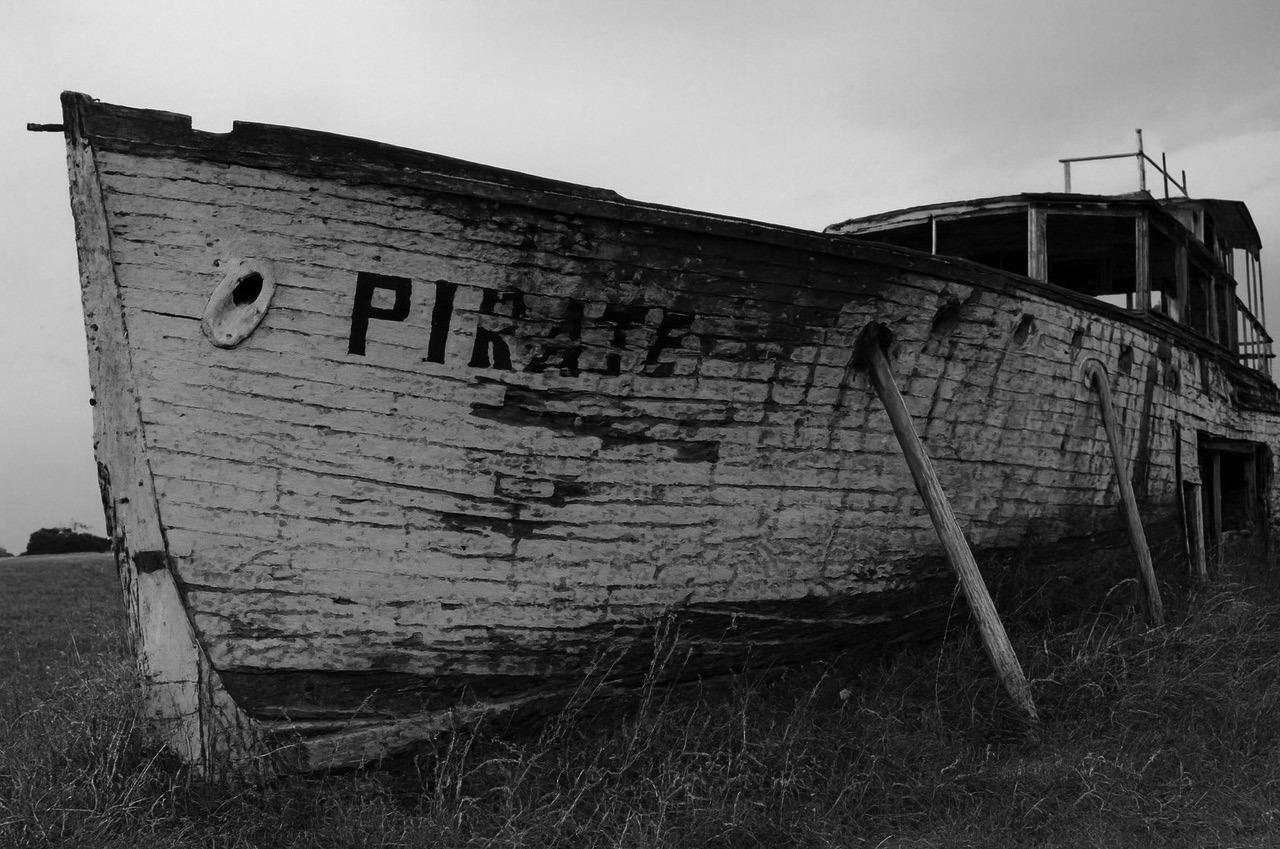
Before the Mississippi Riverboat, Wanderer, ever churned up Texoma’s chop, another big hull had already shouldered its way onto the new lake—a 73-foot cypress-plankedveteranthat answered to a swaggering name: the Pirate.
She arrived as war surplus, workedasagovernment flagship, hauled governors, Rotariansandparkplanners, then ended her dayshigh and dry in a motel parking lot, thenanOklahomapasture— outliving the Wanderer by decades and gathering layers of legend thick as barnacles.
This is another boat story— older than the Wanderer’s but one that stayed alive long after the stern-wheeler burned. It started in the era of William Randolph Hearst and Frank Buck and only came to an end when a West Texas oilman turned her into a bunkhouse.
In the spring of 1944, with the Denison Dam barely finished and the reservoir just beginning to rise, the Madill Record told its readers that a 73-foot craft would soon ride the new lake’s waves. Denison district engineers had gone to New Orleans and bought a second-hand cypress hull pleasure yacht that dwarfed everything else in the Red River Valley. She was 73 feet long with a 13-foot beam, driven by twin 200-horsepower gasoline engines.
The paper said the boat— then still called the Pirate— had “seen service on the Great Lakes, on the Mississippi and on coastal waters in the New Orleans vicinity,” and on the Pacific Ocean, and that the original owner was media magnet, William Randolph Hearst.
The plan was bold and faintly absurd: run her under her own power via the Intracoastal Canal to Houston, then winch the 40-ton yacht onto a flatcar and haul her by rail to Denison. From there, she’d be trucked out across Highway 91 to the drowned valley of Red River and eased into the new federal lake.
Once fitted out for federal service, the big boat became the flagship of what locals half-jokingly called the Denison Dam “navy.” She was renamed Moulton in honor of George D. Moulton of Denison, one of the original apostles for the river project. Naming a boat after a civilian whohadnoofficialconnection to the Corps of Engineers “marked a departure from precedent,” the Madill Record noted, and seemed to acknowledge that this hulking new lake existed because local boosters had dreamed big and agitated hard.
The Record promised that this “granddad of the fleet” was “big enough to ride out the roughest weather that will beach smaller craft,” a rescue boat and tow vessel that could plow straight through the lake’s vicious northerlies. For a community just coming to grips with a man-made inland sea, the very idea of a 73-foot, twinscrew yacht on what had been cotton fields and creek bottoms was astonishing.
The paper loved describing her appointments. The Moulton had two staterooms; a “spacious dining room with overstuffed chairs”; a crew’s berth and a fitted galley; a lounge and a broad main deck. She carried, as a mere lifeboat, a 14-foot inboard motorboat—“enough boat to satisfy most fishermen,” as the reporter put it. Her hull was cypress; her interior finish was mahogany veneer, all driven by twin threebladed screws that measured twenty-two and a half inches.
She was more than a utilitarian rescue craft; she was a showpiece. She was a war veteran—“Gulf patrols” and other assignments—before she ever touched Texoma.
District officers made inspection runs and courtesy cruises. In the years just after the war, she would host a tristate governors’ conference, with the pipes broken out and flags fluttering while the leaders of Texas, Oklahoma and Kansas talked policy on her decks.
But a showpiece is expensive to keep. By 1946, the Corps admitted that the boat was too big and too fancy for routine work on Texoma. She had spent stretches sitting idle, “run-down” and unused. The Tulsa district announced that the 73-foot pleasure craft—“flagship of the Denison Dam ‘navy’”—was up for sale and hinted loudly that she could be converted into a profitable excursion concession by some enterprising civilian.
At that point, the yarn thatwouldgivethePirateher enduring mystique began to crystallize: the story that this was once William Randolph Hearst’s yacht.
William Randolph Hearst was born into money, but he spent the rest of his life trying to buy something less tangible: attention, influence, and ultimately power. In the process, he reinvented American journalism, helped drag the country into war, and left behind an empire that still bears his name— and plenty of controversy.
Hearst was born in San Francisco on April 29, 1863, the only child of George Hearst,arough-hewnmining magnate who parlayed Comstock Lode riches into a U.S. Senate seat, and Phoebe Apperson Hearst, an educated, ambitious Missourian who doted on her son.
He grew up in privilege: European tours, elite schools, a sprawling ranch on the California coast. At Harvard, he joined the Harvard Lampoon and got a taste for publishing and pranks; he was eventually expelled, but the hunger for ink stayed with him.
George Hearst had picked up the San Francisco Examiner as payment for a gambling debt. In 1887, 23-year-old William persuaded his father to let him run it. He promptly stamped his name on the masthead as “Proprietor” and began turning a dull, struggling sheet into what he branded “The Monarch of the Dailies.”
He bought the best presses, hired star writers like Ambrose Bierce, Mark Twain, andJackLondon,andflooded the paper with illustrations, crusades against local corruption, and lurid crime coverage that made respectable publishers sniff—but made readers buy.
California was too small for his ambitions. So, in 1895, Hearst purchased the strugglingNewYorkJournal and set out to topple Joseph Pulitzer’s World from the top of the nation’s most competitive newspaper market.
What followed was a circulation war that helped create the term “yellow journalism.” Hearst and Pulitzer competed with loud headlines, sensational crime stories, sentimental humaninterest features, comics, and eye-catching graphics. Hearst’s papers reported on real scandals and genuine reformefforts—buttheywere not shy about exaggeration, emotional manipulation, and sometimes outright fabrication to excite the public.
During the run-up to the Spanish-American War in 1898, Hearst’s New York papers championed Cuban rebels and vilified Spain. His coverage of the explosion of the U.S.S. Maine in Havana harbor leaned hard toward themostinflammatoryexplanations and helped whip up war fever. Historians debate how much influence he actually had on McKinley’s decision to go to war, but there’s no question he tried to push the country in that direction.
From those foundations, Hearst built a coast-to-coast media empire. By the 1920s and 30s, he controlled 28 majornewspapers,numerous magazines (including titles that became Cosmopolitan and Good Housekeeping), a newsreel company, a feature film studio, a radio network, andasyndicatedwireservice.
At its peak in the mid-1930s, his print audience alone was estimated at 20 million readers a day—an almost unimaginable fraction of the U.S. population at the time.
He wielded that empire aggressively. His editorial pages championed causes he supported and critiqued politicians he opposed. He promoted municipal ownership of utilities, condemned Wall Street, supported labor insomedisputesandopposed it in others, depending on his mood and the market.
His critics accused him of inflaming racism and xenophobia; the Examiner and later papers ran anti-Asian, anti-Mexican and later anti-Japanese campaigns that leaned heavily on stereotypes and fear. Hearst also championed harsh anti-cannabis policies, in part, some argue, because cheap hemp threatened his interests in the timber and paper industries. Hearst didn’t just cover politics; he tried to practice it. WithbackingfromTammany Hall, he won election to the U.S. House of Representatives from New York in 1902 and 1904.
In those years, he called himself a left-leaning Progressive, criticizing monopolies and political machines even as he used one to get elected. He unsuccessfully ran for New York City mayor (1905 and 1909) and for governor of New York (1906), establishing his own Independence Party along the way. After these defeats, onewagdubbedhim“William Also-Randolph Hearst.”
Over time, he drifted to the right. In the 1920s, he constantly warned against big government and “foreign entanglements,” opposing the League of Nations and adopting a fiercely isolationist stance in foreign policy.
Initially, he supported Franklin D. Roosevelt’s rise, playing a role in securing John Nance Garner as FDR’s running mate in 1932; however, he soon turned against the New Deal, attacking Roosevelt as a proto-socialist and using his papers to campaign against administration programs.
His political swings weren’t just matters of principle; they also tracked the interests of his business and his personal grudges. That mix of idealism, opportunism and ego colored nearly everything he did.
In 1903, Hearst married Millicent Willson, a 21-yearold chorus girl. They had five sons and, for a time, led a conventional, if high-profile, family life.
By the 1910s, however, he had begun a long, very public relationship with actress Marion Davies, who was more than thirty years his junior. Millicent eventually separated from him (though they never divorced), while Davies became his constant companion and hostess at parties on both coasts.
Their most famous stage was San Simeon, the fantastical hilltop estate on the California coast. There, Hearst and architect Julia Morgan spent decades building akindofprivatemuseumpalace: towers and pools, guesthouses and terraces, all crammedwiththearthecompulsively collected—Greek vases, Renaissance tapestries, medieval ceilings torn from European churches, entire rooms shipped piece by piece from abroad.
Guests—movie stars, politicians, foreign dignitaries— stayed in rooms decorated with antique furniture and priceless objects. Invitations were coveted; the house later inspired Citizen Kane’s Xan- adu, which is why, for many people, Hearst is forever shadowed by Orson Welles’s fictionalized version of him.
Hearst’s love of display extended beyond the shore. He was, for his day, an avid super-yacht owner. Modern yachting historians have traced at least five large yachts associated with him over his lifetime:
• Buccaneer, a 45-metre vessel built in 1888
•Vamoose,afast34-metre steam yacht built by Herreshoff in 1891
•Oneida,a61-metreyacht launched in 1897
• Hirondelle, an 88-metre French-built yacht from 1911
• Sobre Las Olas, a 32-metre yacht delivered in 1929 He used these boats the way he used San Simeon: as floating stages where movie stars, editors, politicians and royalty mingled under his eye. Gossip columns—many in his own papers—feasted on the parties, the intrigues and the occasional scandal at sea, including the mysterious 1924 death of film producer Thomas Ince after a cruise aboard the Oneida.
Decades later, when Oklahoma newspapers claimed that the Texoma yacht called the Pirate had once been Hearst’s private craft, a treasurer for the Hearst organization wrote a tart denial, asserting that Hearst had owned only two yachts, Hirondelle and Oneida. Yet, modern research, such as the “SuperYacht Times” magazine survey of his fleet, makes it clear that he cycled throughmultiplevesselsover the years.
In other words, the corporate memory that tried to limit him to two “respectable” yachts doesn’t match the historical record: Hearst had a small navy of his own, and more than one hull could plausibly have drifted into later local legends.
Despitehissuccess,Hearst was a catastrophically poor manager of his finances. He borrowed heavily to finance new publications, films, art purchases, real estate and yachts. When the Great Depression struck, advertising collapsed and circulation plummeted.
By the mid-1930s, he was tens of millions of dollars in debt. Advisors finally forced a restructuring that placed most of his properties into a trust controlled by bankers and senior executives. To raise cash, he sold off large chunks of his art collection— tens of thousands of pieces, from paintings to medieval armor—and some of his real estate.
He retreated from San Simeon to more modest quarters in Los Angeles but continued to oversee his newspapers and to live with Marion Davies. His health declined; he suffered a series of heart problems, and his political influence waned as radio and then television transformed the media landscape hehadoncedominated.
William Randolph Hearst died on August 14, 1951, in Beverly Hills at the age of 88. .
On the one hand, he built the first truly national multimedia empire. He modernized newspaper layout, invested in photography and illustration, and embraced comics and Sunday supplements, understandingearlier than most that news could be both informative and entertaining. The modern tabloid owes him almost everything, and even respectable broadsheets absorbed some of his tricks.
On the other hand, his brand of sensationalism eroded basic standards of verification and restraint. His papers inflamed racial prejudice, demonized immigrants, and sometimes helped push the United States toward confrontation abroad. His personal crusades—against communism, against Roosevelt, against marijuana—blurred the line between news and propaganda.
Culturally, he lives on in two powerful myths: the baron of San Simeon, hosting movie stars and moguls under Spanish ceilings; and Charles Foster Kane, the haunted tycoon of Orson Welles’s film, whispering “Rosebud”inthedark.Hearst hated Citizen Kane and attempted to suppress it, but the effort only cemented the film’s association.
Institutionally, his company survivedhim.Themodern Hearst Corporation—now a diversified media and information giant whose profits increasingly come from business-to-business services rather than newspapers— still traces its roots to the day a young man put his name on the masthead of the Examiner.
And in scattered places far from New York or San Francisco—onahilltopabove the Pacific, in a Gainesville Zoo named for Frank Buck, in long-retold stories about yachts that might or might not have been his—ghosts of Hearst remain. Not just the man, but the idea of him: restless, extravagant, eager toturneverystagehetouched into a headline.
According to multiple Oklahoma papers, Hearst had the Pirate’s keel laid in 1909 at a cost of roughly $150,000—serious money even for a baron. Most likely, the yacht was manufactured by The Herreshoff Manufacturing Company,arenowned yacht and boat builder based in Bristol, Rhode Island, which operated from 1878 to 1945. It was founded by brothers John B. Herreshoff and Nathanael G. Herreshoff and became famous for producing fast steam yachts, high-profile sailing yachts, and multiple America's Cup defenders.
The yacht, initially powered by a twin-screw steam engine, was reported to have “sailed the Seven Seas and circled the world numerous times,” her log recording “the top political and social leaders of the globe.” Parties aboard allegedly included kings, princes, studio royalty andpowerbrokers,withsome writers going so far as to say that “world history was shaped aboard the yacht.”
Regardless of the truth about the ownership of The Pirate, which is lost to history, the legend sunk deep into Texoma’s clay; in Marshall County, the big cypress hull on the new lake was Hearst’s yacht, full stop.
Whether strictly true or not, the story fit the man: a publisher who could buy a castle on a hill could certainly buy a 73-foot toy for the sea.
Hearst’s supposed yacht also tied Texoma to another colorful character: Frank Buck, the Gainesville-born animal collector who made a career out of trapping wild creatures and hauling them back alive for zoos and circuses.
Frank Buck lived as though he were carved out of old adventure yarns—half showman, half hunter, and entirely convinced the world was his to wrestle into a crate and ship home. Long before television turned wilderness into a neatly edited spectacle, Buck dragged the wild into the American spotlight with a rope, a grin, and a boast he would brand into American memory: “Bring ’Em Back Alive.”
BuckwasborninaGainesville wagon yard in 1884, raised in Dallas, and left home young—first riding cattle trains north, then drifting toward the tropics. Buck grew up tough and restless. His father died when he was young,andFrankspentmuch of his boyhood outdoors, hungry for anything that broke the monotony of small-town life. He ran away more than once, gravitating toward railroads, cattle pens, and rough company. School held no interest; the world beyond the horizon did.
By his teens, he had drifted into carnivals and animal shows, cutting his teeth handling the kinds of creatures most people only dared to watch from a distance. The young Texan had charm and nerve, and both would become his stock-in-trade. In circus lots he learned that danger sold tickets and swagger sealed the deal.
Buck broke into the animal- trading business almost by accident. In 1911, claiming he had $3,500 saved (though how he saved it remains a mystery even to his biographers), he sailed for Brazil. There, in the seething rainforests, he snared exotic birds and small mammals, then hauled them north to collectors and zoos.
The trip changed him. Buck discovered a market hungry for the wild and a publiceagertoimaginethemselves on the hunt. He began crisscrossing the globe—India, Malaya, Borneo, Sumatra, Thailand—contracting with local trackers, prowling jungleriversbydugoutcanoe, and building a reputation that was equal parts reality and promotion.
He specialized not in trophies but in live capture, a far trickier business. Leopards, tigers, orangutans, giant pythons, rhinos—Buck wrestled with all of them, usually with a small team, a coil of rope, and an appetite for risk.
He would later brag that he always took his animals alive because dead ones were “no good to anybody.” That claim conveniently ignored the morality of the trade, but it made for a noble-sounding public persona.
Buck returned repeatedly to Asia in the 1920s and 30s, sending shipments of rare species to circuses and zoos worldwide. He had that rare gift of turning danger into entertainment, and Hollywood eventually came calling.
In 1932, he released Bring ’Em Back Alive, a book and companiondocumentaryfilm that catapulted him to national fame. The film—equal parts genuine footage and staged encounters—thrilled Depression-era audiences who, for a few cents, could watch a Texan wrestle pythons or lasso wild boars in jungles most Americans couldn’t even pronounce.
The title became a motto, a brand, and a promise. More books followed: Wild Cargo, Fang and Claw, and On Jungle Trails. Each blended fact with flair, told in Buck’s plainspoken style—hardboiled, boastful, and unapologetically masculine.
Buck soon had radio programs, lecture tours, and nationwide popularity. He became,formillionsofAmericans, the face of the exotic world—alivingpostcardfrom jungles they would never see.
By the mid-1930s, Buck’s celebrity rivaled that of movie stars. His khaki suits, pith helmet, and coiled rope became part of his public armor. He toured with the Ringling Bros. and Barnum & Bailey Circus, building massive “jungle camps” full of animals he claimed to have captured himself. Children adored him; adults admired him—or doubted him—but they bought tickets all the same.
Buck was not a scientist and never pretended to be one. He was, first and last, a businessman who understood that the American public craved drama. His storytelling was embroidered, his danger dramatized, his heroism polished for the camera lens. But there was enoughtruthinhisexploits— enough scars, enough real closecalls—tokeephislegend credible. And like all legends, he cultivated it.
During World War II, too old for combat, Buck served asapropagandistandmorale booster. He made patriotic broadcasts, helped raise war bonds, and leaned on his Southeast Asian experience to support U.S. efforts in the Pacific.
After the war he continued touring, speaking, and running animal attractions. One of the most famous was “Frank Buck’s Jungleland” at the 1934 Chicago World’s Fair, a sprawling exhibit of cages, arenas, and demonstrations thatdrewenormous crowds.
Buck married three times, and his private life was often as turbulent as the jungles he claimed to master. His third wife, Amy Leslie, was a theater critic nearly 30 years older than he—an unusual match that nevertheless endured for years.
In his final decade, he operated an animal park at Roosevelt Field in New York, where he replayed his jungle encountersforaudienceswho still hungered for his brand of rough-edged fantasy.
FrankBuckdiedonMarch 25, 1950, in Houston, Texas, at the age of 66.
Buck’s legacy is complicated. On one hand, he was a pioneering naturalist in the sense that he brought living species to zoos at a time when such work required dangerous field expeditions. He opened the eyes of millions to the sheer diversity of the natural world.
On the other hand, modern conservationists rightly critique the animal-capture trade he helped glamorize. Today,fewcelebratethemass trapping of wild animals— even for zoos. But Buck was a creature of his era, shaped by the rough commerce and romantic mythmaking of the early 20th century.
Whatever judgment history passes, one truth remains: Frank Buck understood spectacle. He seized the American imagination by the throat and never let go, selling adventure during an era that desperately needed escape.
And in the end, that’s how he wanted to be remembered— not as a scholar, not as a conservationist, but as the Texas kid who went into the jungle alive and came back with a tiger in a crate and a story to tell.
“Bring ’em back alive,” he said. For a time, he did.
The stories that followed the Pirate to Texoma insisted that Buck once loaded the yacht with a menagerie of captured animals—“a boatload of snakes and animals,” as one local account put it—fresh from an African or Amazonian safari. The boat, that story went, carried Buck’s cargo back to the United States as part of a Hearst-backed expedition.
Whatever the precise facts, the linkage was irresistible. Here was a boat on Lake Texoma with alleged ties both to Hearst’s media empire and to Gainesville’s most flamboyant son. It’s no accident that when Gainesville’s community circus morphed into a permanent zoo, the city renamed it the Frank Buck Zoo in 1954, honoring the hometown boy whose motto was to “bring ’em back alive.”
So, when Texoma locals pointed at the Pirate and said, “Frank Buck once sailed that ship,” they were claiming a piece of that roaring, dangerous world for their own lake.
Once she settled into service as the Moulton, the big boat became the Corps’ floating conference room and calling card.
She hosted inspections, dignitaries, and finally a tristate governors’ meeting in the late 1940s when Texas’ CokeStevenson,Oklahoma’s Robert S. Kerr and Kansas governor Andrew Schoeppel were feted aboard. The pipes and silver came out; the Corps wanted to show off its big New Deal reservoir in proper style.
On the Oklahoma side, Senators, highway commissioners, and park officials rode her decks while they argued over roads, leases and development. In June 1947, Governor Roy Turner, highway chief H. E. Bailey, park superintendent James V. Lloyd and a gaggle of legislators and chamber men boarded the Pirate (by then back under her old name in private hands) at Harston’s dock for a three-hour cruise.
Their mission was blunt: without real roads to Glasses Creek, Little Glasses and the other coves, private capital couldn’t justify lodges, boat docks or motor courts. So, they debated asphalt and appropriations while the Pirate’s bow pointed at the dam and the game-and-fish patrol boats idled alongside like escort destroyers.
It was the same story you saw years later in the saga of the stern-wheel Wanderer— boats becoming stages where the future of Texoma tourism and land use was argued over plates of fried fish.
In 1946, the government finally sold its flagship. The Corps’ Texoma office shifted to Tulsa, and the Moulton, idle and “run-down,” went to F. W. (Floyd) Cooper, an Oklahoma City drilling contractor heading Texola Drilling Company. He planned to use her as a private yacht and as the anchor for a resort concession.
Cooper brought the boat from the engineers’ dock at Denison and then moved the big boat to the Madill docks, then to Glasses Point at Little Glasses Creek, which would later be known as Lakeside. Motors that hadn’t turned in monthsstartedoncommand; carpenters, mechanics and painters swarmed her decks. Marine-paint reps came out to advise on the right coatings for cypress planking. Cooper built a ninety-foot floating dock supported by surplus B-29 fuel tanks, designed to ride up and down with Texoma’s shifting levels.
Madill’s paper noted that Cooper hoped to restore “something of the glory it once knew when, as William Randolph Hearst’s ‘Pirate,’ [it] visited ports in many different parts of the world.” The boat, now firmly re-christened Pirate again, became the queen of Lakeside. She carried Rotary Club officers out on a special installation cruise; she hosted National Park Service regional directors from Santa Fe and Chicago, who toured the lake aboard her and then sat down to chicken dinners on shore. She drew chamber of commerce delegations from Madill, Durant and Kingston, who came to see what an honest-to-God yacht looked like snugged up to an Oklahoma dock.
By 1949, under new owner John Ezell of Gainesville, the Pirate had become the “73-foot queen of Lake Texoma,” available for charter. Parties could rent not only the yacht but also a pilot, maid, and full service; a smaller cruiser was available for more modest groups. The big boat lay alongside a barge once owned by Senator Raymond Gary, used as a boarding platform for tourists in their Sunday best. In photographs from that era, you can see her at the dock near Glasses Point—highsided, roomy, with a houselike superstructure rising aboveaworkmanlikehull—a strange, handsome presence on a young lake still settling into its banks.
ThatishowmostMarshall Countyold-timersremember her heyday: white hull at the Glasses Point resort, bunting up, blue smoke from twin stacks, and the lake’s chop slapping the planks while the “queen” eased away from the dock.
By then, another celebrity craft had arrived: the stern-wheel excursion boat Wanderer. The Record noted in September 1948 that the Pirate, “75-foot boat at Texoma,” was again seen “prowling over the lake” after a stretch of engine trouble and added that she would “soon be joined” by the Wanderer, “as the two biggest on the lake.”
They made a striking pair. The Pirate was a seagoing yacht turned inland flagship, carrying with her a tangle of legends involving Hearst, Buck, Great Lakes storms and Gulf patrols. The Wanderer, built for river work, would later burn at its moorings and drift into legal immortality through Wilburn Boat Co. v. Fireman’s Fund Insurance Co., the Supreme Court case whose wobbly reasoning still “haunts these inland waters” of maritime law.
If the Wanderer gave you Wilburn Boat Co. v. Fireman’s Fund—a legal ghost that still “haunts these inland waters”—the Pirate gave Texoma something different: continuity, connection to a pre-lake world of ocean patrols, Hearstian spectacle, and Frank Buck safaris.
By the early 1950s, though, the Pirate was tired. Business reversals at Little Glasses left the new owner, C. V. Brown, in a bind: the yacht was leaky, expensive to maintain, and no longer earning her keep. In 1953 or 54, Brown hauled her out on the shore, stripped valuable gear—engines, lights, fittings—and contemplated scrapping the hull.
That’s when Olin Oliver “O.O.” Remington, owner of the Grill café and Rem’s Courts on the south edge of Madill, stepped in. Remington was a civic booster with a knack for attentiongetting ideas. Looking at the stripped, listing hulk at Little Glasses, he saw not junk but possibility. On what he later described as an impulse, he offered $500 for the boat— and then had to figure out whattodowithseventy-three feet of deadweight wood and steel.
For five days, the Pirate was transported from the lake on trucks and cribbing, stopping whenever power lines needed to be lifted, which startled cows and motorists along the elevenmile route. Once at the Grill, Pirate was placed in concrete cradles next to the motel and café. Remington planned to set up his office in the old engineroomandopentherest of the boat as a free tourist attraction.
“I feel sure people will come to Madill just to see it,” hetoldareporter,addingthat in the first five days, “I’ll bet I’ve had 1,000 persons out here.” He refused to charge admission, reasoning that thecrowdswouldcompensate him in room rentals and café tickets. Local women’s clubs quickly requested to hold meetings aboard.
The Madill Record praised the scheme as “one of the cleverest stunts” in years. “We’re strictly landlubbers in this section of the country,” the paper observed. “We rarely have the opportunity of going aboard a sea-going vessel and practically never do we have the opportunity of seeing a vessel with the glamorous history of ‘The Pirate.’” Stories about Hearst, Marion Davies and Frank Buckwereretoldforeachnew busload of tourists. School journalism classes came out to climb the gangway and write breathless features on a yacht that had “sailed the Seven Seas and circled the world numerous times.” The Record described how visitors could now “explore the yacht to their heart’s content” and imagine the days when it was supposedly Hearst’s plaything and Frank Buck’s animal carrier.
Remington talked about turning the Pirate into a museum, and for a time, Madill tourism brochures proudly listed “the Pirate and its interesting museum” as the town’s most appealing attraction.
Madill’s tourism pitch was simple: if you wanted to see the famous dam and the newlake,youpassedthrough town. And if you passed through town, you ought to stop and walk through the fabled Pirate, now turned into a museum full of curios and clippings.
In 1958, Remington, tired of the yacht, sold the vessel to William Paul (“Judge”) Moss of Odessa, Texas, for about $1,500. Moss headed the Texas Central Oil Company, ran large ranches in Texas and New Mexico, and had servedasjudgeofthe70thJudicial District in West Texas. In his autobiography Rough and Tumble, Moss described his life as a blend of “cattle, law, and oil,” thick with tales of ranching, hunting and rough-country justice.
Some men build their lives out of straight lines—predictable paths, careful decisions, tidy stories. And then there are men like Paul Moss, who lived in angles, crossing careers the way others cross county lines, and who once bought a 75-foot yacht to sit in the middle of a pasture in Bryan County, Oklahoma, simply because he could.
To understand Moss is to understand Texas in its postwar swagger: oil-rich, dust-tough, ambitious, and unbothered by contradictions. He was a judge who left the courtroom for the oil field, a rancher who wrote books, a businessman who collected land like others collect knickknacks, and finally, the man who gave the storied yacht Pirate its last improbable berth far from any sea.
Paul Moss was born in 1886, a time when West Texas wasstillmorefrontierthan industrial. He grew up in an environment that rewarded grit and punished hesitation. Odessa, the place he would one day help shape, was a raw, wind-stung settlement when Moss was young — but like Moss himself, it was destined for bigger things.
Hestudiedlawandentered a profession that demanded order and restraint—two qualities he had, but only on his own terms. Moss advanced quickly, becoming a district judge in West Texas, earningthenickname“Judge Moss,”whichstayedwithhim long after he left the bench. But while the law carried his name, it was oil that carried his fortune.
In the early 20th century, Odessa was booming. Wells blew in, money flowed out, and the great oil families of Texas were carving out empires. Moss fit comfortably among them. He founded Texas Central Oil Co., gathering leases, drilling prospects, and carving out a financial base strong enough to let him pursue whatever struck his appetite.
Where some men built legacies in courtrooms or boardrooms, Moss built his across dozens of square miles of land. By the late 1940s and early 1950s, he was not only an oilman but a major rancher, with holdings in Oklahoma near the confluence of the Red and Blue Rivers. That land—3,200 acres strong—would soon become the final resting place of a vessel that had once circled the world.
Moss lived large, but not loudly. He preferred action to attention, and he accumulated properties and ventureswiththeunbothered confidence of a man who understood both the value of a dollar and the value of a good story.
Moss also wrote books— several of them—reflecting on law, ranching, oil, and life. His works were a blend of autobiography and observation, revealing a man who, despite his rugged surroundings, took time to think. His writing was plain, thoughtful, and rooted in West Texas like a fence post.
Inaworldthatprizedbusiness over reflection, Moss did both.
In 1958, Moss made the decision that would forever tie his name to Oklahoma folklore: he purchased Pirate. Newspapers delighted in the irony: “An Odessa oilman has purchased the ‘Pirate,’ a yacht said to have belonged to the late William Randolph Hearst—but the craft’s home will be on terra firma.”—San Angelo (Texas) Weekly Standard, wrote on August 15, 1958. The price? $1,500.
Workers chipped the hull out of its concrete cradle, jacked and blocked it, then eased the 40-ton structure onto big equipment for the trip south toward Bennington. Reports in both the Madill Record and the San Angelo press estimated the move at another $2,000 on top of the purchase price, a final, expensive voyage over blacktop and pasture rather than water.
On the ranch, carpenters gutted and re-framed parts of the interior, installed wiring and carved the once-gracious cabin space into smaller bunkrooms. Some locals said Moss planned it as a play fort for his grandchildren; others recalled hearing that he meant to entertain oilmen and politicians there, giving them a surreal taste of seagoing life while coyotes called in the distance.
Moss had a simple explanation for the extravagant purchase:“Thetwonewbrick homes I’m finishing up are less than two blocks from the water. So, we ought to have a boat there someplace.”
That was Paul Moss in a sentence—practical, deadpan, and quietly amused at his own audacity.
Hehauledtheyachtacross Oklahoma farmland to his Bryan County ranch. Locals watched in disbelief as the Pirate—once rumored to have hosted Hearst, Marion Davies, Frank Buck, even Winston Churchill—rolled slowly past pastures and fence lines into a new life as abunkhouseforranchhands.
Some said he wanted it for his grandchildren. Others said he wanted a unique party venue. Still others believed he simply enjoyed doing what no one else dared. All three explanations fit.
Moss’s final years were spent between Texas and Oklahoma, tending to his ranching interests and enjoying the slower pace that successallowed.Heremained a respected figure in both states—an oilman without ostentation, a rancher without pretension, a judge without self-importance.
Whatever the plan was for the Pirate, it appears that the project was never fully completed. Moss died; the ranch changed hands, and by 1976, a Daily Oklahoman feature described the bizarre sight of a 75-foot yacht sitting “right smack in the middle of all that good grass,” startling every driver who rounded the bend at the Tex Schmidt spread at Smith-Lee. The writer listed all the old stories— Hearst and Winston Churchill, Frank Buck, two world wars, governors on Texoma—and concluded that, after so many retellings, “only the Pirate, quietly weathering at her mooring in the pasture, knows for sure. And she’s not talking.
Moss died in 1967, leaving behind land, family, books, and stories that are still told in ranch houses across the Red River region.
Set alongside the sternwheel Wanderer, the Pirate looks like a kind of bookend for Texoma’s first generation. They arrived from opposite directions and served entirely different purposes, but together they sketch the outline of a young lake still trying to understand what it wanted to become.
The Pirate came first. HauledupfromNewOrleans in 1944—part World War II veteran, part Great Lakes rescue boat, part coastal cruiser—she arrived already heavy with stories. She was rechristened, repainted, fitted and refitted, pressed into work as the inland “flagship” of the engineers, the boat that couldplowthroughanystorm this new reservoir could throwather.Later,whenfederal uses faded, she became a symbol of private ambition: the pride of Lakeside, a floating lounge for governors and highway commissioners. In this place, planners and politicians sketched futures for a shoreline still raw and unsettled. In the end, she lived out her last chapters on dry land—first on highway gravel at Rem’s Courts, then in the pasture grass of Bryan County—yet somehow never lost her improbable grace.
The Wanderer came later, built and rebuilt for inland work alone. A stern-wheeler born for excursion trade, she carried fishermen and families instead of Congressmen and movie folk. Her early promise ended in fire, and the insurance fight that followed climbed all the way to the U.S. Supreme Court—Wilburn Boat Co. v. Fireman’s Fund Insurance Co.—a case that left maritime lawyers muttering about the “ghost of Wilburn Boat” every time they tangled with inland water law.
The Pirate predated the Wanderer and outlived her, but they tell the same underlying story: how a brand-new reservoir pulled in dreamers, drifters, engineers, politicians, and promoters; how boats became stages where the futures of two states were argued; how federal policy, private money, and smalltown hope all converged on a body of water that had not existed a decade before. One boat left its fingerprints in the law books. The other left its silhouette in the landscape andinthememoriesofpeople who never forgot her.
Today, if you write about Texoma’s boats—their fires, lawsuits, refittings, and last stands on dry land—you cannot leave the Pirate out. She was the first “big boat,” the one that made people in 1944 stop dead in their tracks when word spread that a 73foot yacht was arriving from New Orleans. She carried wartime scars and peacetime parties; governors and gameand-fish wardens; park planners, Rotarians, oilmen, and tourists in Sunday clothes. She flew different names— Pirate, Moulton, then Pirate again—butalwaysseemedto find another turn in the story when common sense said she was finished.
In that, she was not so different from the region itself. The dam drowned the old towns; new ones rose. Tourism surged, collapsed, then surged again. Resorts changedhands.TheWanderer burned. The Pirate traded water for concrete, then for prairie grass. Still, the stories circulate—told on café stools, courthouse benches, fishing docks, and the pages of the Madill Record—from people who, as children, once climbed a wooden staircase from the parking lot of Rem’s Courts to stand on the deck of an “ocean-going yacht” at the edge of a small Oklahoma town.
Stand where the Wanderer once tied up near the dam,orinthecoveswherethe PiratewasqueenofLakeside, and the water hides more than drowned fence lines and wagon roads. It hides the wake of a vessel that may have carried William RandolphHearstandMarion Davies across foreign seas; that may have hauled Frank Buck’s cages of leopards, monkeys, and pythons; that certainly carried governors and legislators across young Texoma while they argued about roads, leases, budgets, and the future of this corner of two states.
In Madill, people still talk about climbing aboard her when she sat on blocks at Rem’s Courts—peering into cabins, running hands over mahogany veneer, listening to guides claim that “world history was shaped aboard this yacht.” At Bennington, ranch hands once stepped out into the morning light and looked across Bermuda grass to see a seagoing hull wired for electricity, waiting patiently for a party that never quite came.
The Wanderer gave us a ghost in the law books.
The Pirate gave us a ghost in the pasture.
And like all good boat tales, this one ends not with a verdict but with a vessel— quiet, weather-silvered, keeping her own counsel. Her paint peeling, her windows clouding, her secrets locked behind planks that once crossed oceans and later crossed Oklahoma pastureland. The stories about her grow a little taller every year, as stories tend to do. But the hull remains, stubborn as the land beneath her.
A boat that outlived the water it was built for.
A landmark without a lake.
And the last whisper of a time when Texoma’s dreams were big enough to bring a yacht all the way from the sea.