

At the eleventh hour of the eleventh day of the eleventh month in 1918, the guns of the First World War fell silent. Across the trenches and fields of Europe, the world paused—exhausted, grieving, and hollowed by loss—to mark the moment when war at last unclenched its fist. From that silence came Armistice Day, a day not of triumph or parade, but of collective remembrance. For years, Americans honored that stillness, remembering the fallen of what many believed would be the war to end all wars.
But history had other battles to demand. Another worldwarerupted,andagain sons crossed oceans to fight beneath the American flag. And when those battlefields quieted, the hills of Korea soon echoed with rifle fire and winter winds. The nation came to understand that the price of freedom is never paid once. It is paid in every generation.
In 1954, at the urging of veterans who had carried rifles in mud, snow, and desert, Congress broadened Armistice Day into Veterans Day, a day meant to honor all who served—those who fought,thosewhostoodguard in readiness, those who returned homebearingwounds seen and unseen, those who came home in flag draped coffins, and those who never came home and to this day are still missing in action. November 11 was no longer merely the anniversary of an armistice; it became a living promise that this country would remember every defender of the Republic, in every era, in every place duty called.
And so, what we observed this past Tuesday was not a celebration of war, but a recognition of cost. Freedom is not a birthright handed down like a family heirloom — it must be earned, defended, and sometimes paid for in blood. Someone had to bear that burden, and many did.
Despite this week of remembrance for those who served or are serving, we find ourselves living in a troubled hour for the Republic. A time when some openly admit to being ashamed of America, when the loudest voices in our culture are not those of gratitude, but of grievance and accusation. A time when service is ridiculed, when duty is dismissed, and when sacrifice is forgotten.
They sneer at the uniform. They vilify the badge. They curse and burn the flag — that scarred and weathered banner carried through smoke and fire, the same one that has traveled home draped over the coffins of the fallen — is treated with disdain by people who have never paid even a fraction of the price required to keep it flying.
These are people who speak of America’s shortcomings as if they were discoveries, when in truth every chapter of our history is the record of a nation struggling to become better than it was. Progress is not new — sacrifice made it possible. But now we hear voices of those who refuse to stand, refuse to salute, refuse even to remember — and they dare to call that courage.
But that isn’t courage. It is contempt disguised as virtue. Courage is not convenience. Conviction is not comfort. And freedom is not free because someone complained loudly. In truth, they have no courage.
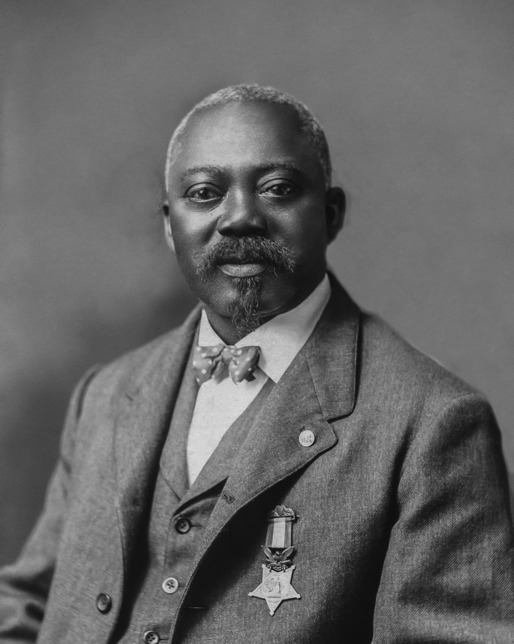
If we are going to talk honestly about this country — about honor, sacrifice, and the meaning of the flag — then we must begin with a man who, by every measure of his life, had reason to despise thenationthatenslaved him… but instead chose to redeem it with his own blood.
His name was Sergeant William Harvey Carney.
And through his story, we will remember what service means, what sacrifice costs, and why the old flag must never be allowed to touch the ground. But most importantly, we will learn the importance of men and women who choose to take up arms to serve and defend this, the greatest country that has ever existed in the history of mankind. And, we will remember those who have served.
Carney was born enslaved in Norfolk, Virginia, on February 29, 1840. His earliest memories were not of childhood freedom but of being treated as a tool, a number, a possession. Yet even in those years, a restless awarenessexistedinhim that the human spirit was not meant to be owned. In secret and at great personal risk, he learned to read by candlelight, the flickering flame reflecting in the pages of forbidden books. Education for a slave was an act of defiance; learning was forbiddenbecauseknowledge unlocks the imagination, and imagination makes a man dangerous to anyone who would chain him.
How exactly he escaped bondage is not recorded with certainty. Most accounts agree that he traveled the clandestine routes of the Underground Railroad, guided by hands and hearts that believed liberty was not theirs to keep unless it could be shared. Step by step, night by night, he moved north until he reached New Bedford, Massachusetts, where his father had already gained his freedom. There, among free Black men and women who worked, worshiped, studied, and built lives of their own making, Carney found a community of dignity. He believed he might one day become a minister. He had known chains; he wished to speak of deliverance.
But history intervened. The nation was cracking under the weight of its own contradictions, and war followed. When Abraham Lincoln issuedtheEmancipation Proclamation on January 1, 1863,thedooropenednotjust to freedom, but to responsibility. Black men were finally permitted to join the Union Army and fight for their own liberation. Carney later said outright and without flourish: “I felt I could better serve my God by serving my country and my oppressed brothers.”Hedidnotsetaside his calling; he understood that the pulpit would have to wait, because the world itself needed preaching.
In March 1863, he enlisted in the 54th Massachusetts Volunteer Infantry, one of the first African American regiments to serve in the Civil War. The men who formed that regiment were not merely soldiers; many of them were formerly enslaved. Their service was not abstract. They were not fighting for land, territory, or strategy. They were fighting for the right to belong to the nation that had once denied their very humanity. Every step, every drill, every command carried the weight of meaning. They knew the country watched them—not in support, but in suspicion. If they faltered, they believed the failure would be used as proof that Black men were unfit for citizenship. If they excelled, they could change the story of the nation itself. So famous was the 54th Massachusetts Volunteer Infantry that, in 1989, it was the subject of the major motion picture “Glory.”
Their first major test for the 54th came at Fort Wagner, a Confederate stronghold built from sand and earth on Morris Island outside Charleston, South Carolina— thesymbolicbirthplace of secession. If the Union could seize Fort Wagner, it could bomb Fort Sumter into submission and tighten the noose around Charleston Harbor, striking at the core of rebellion. However, the path to Wagner was a deadly battlefield. The assault forced soldiers to charge across a narrow strip of open shoreline while under direct artillery and rifle fire. Everyone standing in that line that day knew the truth: many would not return from this mission.
On the evening of July 18, 1863, the 54th Massachusetts was ordered to lead the attack. Some said it was because they were expendable. Others recognized the more profound truth: that those former slaves had earned the right to stand first. Into the teeth of cannon fire they ran, the sand erupting beneath their feet, the air thick with smoke and iron. Men fell in waves. Still, they pushed forward.
At the heart of every Civil War regiment was the flag— the regimental colors and for the Union, the red, white and blue of the flag of the United States of America—held not as decoration but as an anchor.
In the old days of battle, before radios crackled and satellites watched overhead, a soldier could not always hear his commander’s voice. Smoke, thunder, fear, and distance made orders vanish into the chaos. But he could see the flag. The flag was more than cloth—it was direction, identity, and purpose. When a regiment advanced,itadvancedbehind the colors. When it fell back, it fell back to the colors. In the storm of gunfire and confusion, the flag was the one fixed thing, the one point on the field that said, Here is your home, your company, your cause. A soldier who saw his flag standing could gather himself, steady his breath, and go forward again. A soldier who saw it fall felt the heart of the regiment collapse with it.
That is why the flag could not be allowed to touch the ground—not because of superstition, but because the life of the unit was tied to it. If the flag went down, it signaled panic. Men might turn and run. The line might break. Courage might shatter. To carry the colors was notaceremonialprivilege—it was a role given to the bravest of the brave, because the enemy always aimed for the flag first. If they could strike down the standardbearer, they could break the regiment’s spine. And so, men stepped forward to lift it again and again, knowing full well they were making themselves a target. They lifted it not for themselves, but for the brothers beside them, for the cause behind them, for the hope ahead of them.
The flag in battle was not merely a symbol—it was the rallying point for the living, the monument for the dying, and the promise that, even in the darkest hour, the regiment still stood. To keep it aloft was to say, We are still here.Wehavenotyielded.We will not break. That is why the old soldiers said, with no need for poetry or flourish: The flag must never fall.
At the front of that advance on Fort Wagner, the colors were carried by Sergeant John Wall — the Stars and Stripes held high, the heartbeat of the regiment. Then a single bullet found him. He fell, and with him the flag began its descent toward the sand.
Carney did not wait for permission. He did not consider the danger. He threw his rifle aside and ran into the storm. Before the flag could touch the ground, his hands were around the staff. In the next instant, a rifle ball tore into his leg. The pain blazed through him, but Carney forced himself upright, lifted the colors again, and pressed forward, even as the men around him dropped one by one.
Against all expectation and every law of survival, he reached the base of the fort and planted the flag upon its slope — but when he looked around, he found that he was alone. The men who had advanced with him were dead or maimed, the ground behind him littered with the fallen. So, there he stood, a solitary figure pressed against the sand wall of Fort Wagner, clutching the flag while the night around him roared with gunfire. He stayed there for what witnesses later estimated to be half an hour, the colors still raised, refusing to let the heart of the regiment falter.
At last, the battle shifted, and the defenders’ attention turned to another breach. Carneysawmovementahead — soldiers approaching. Believing them to be his own, he lifted the flag once more. But the gunfire that answered him made the truth clear: they were Confederate troops advancing to finish the field.
In that instant, he could have dropped the colors and fled. Most men would have. Almost every man in his regiment had already fallen. But Carney remembered who he was and what he carried. He wrapped the fabric tightly around the staff, shielding it with his body, and ran. He stumbled down an embankment and into a drainage ditch, the water rising to his chest as he waded through. Bullets followed him. One struck him in the chest. Another tore into his right arm. Another shattered his right leg. Still, he clung to the flag.
From a distance, the battered remnants of the 54th saw him — a lone figure dragging himself across the battlefield, bloodied almost to death, with the flag held high as if it weighed nothing at all. A soldier from the 100th New York, retreating with the wounded,passednearbyand, seeing his condition, called out, “Let me carry that flag for you!” But Carney forced himself upright and replied through gasps of pain, “No one but a member of the 54th should carry the colors.”
He kept going, even after another bullet grazed his head. The world probably tilted before his eyes, but he wouldn't fall — not while the colors were in his keeping.
At last, he reached his comrades. Their cheers rose not in triumph, but in awe. He laid the flag down among them, its fabric torn and stained with his blood, and withwhatstrengthremained to him, he said words that ought to be carved into stone in every schoolhouse, courthouse, and memory of this nation: “Boys, I only did my duty. The old flag never touched the ground.”
He would survive his wounds, though they left a permanent mark. When photographed months later, he leaned on a cane, his leg too injured to support him fully, but his arm was wrapped around that flag like a father holding a child. By 1864, he was honorably discharged from the Army because of the permanent injuries he had received at Fort Wagner.
Carney never did become a minister in the traditional sense of the pulpit. Instead, he returned to New Bedford, where he worked maintaining streetlights, and later delivered mail for thirtytwo years—a quiet, faithful service to the community he had once fought to preserve. He later took work in the Massachusetts State House, carrying messages through its marble corridors with the same steady dignity with whichhehadoncecarriedthe colors across the sand. And for a long time, the nation remained largely silent about what he had done. This was not unusual. The Civil War had produced more acts of courage than the young nation knewhowtohonor.More than fifteen hundred Medals of Honor would eventually be awarded for that war alone, and over half of them would not be presented until decades after the last cannon had fallen silent.
So, the years passed. Battles were retold in fading veterans’ halls, photographs yellowed, and the country moved forward. But history does not forget what is owed — it only waits. And on May 23, 1900, nearly thirtyseven years after Carney dragged the flag from the blood-soaked slope of Fort Wagner, the United States at last placed in his hands the Medal of Honor — the nation’s highest recognition of valor. The medal arrived late, as it so often did in those days. Still, it arrived justly, in acknowledgment of a deed that had already entered the marrow of American memory: a wounded soldier, rising again and again, so that the flag would not fall. His action was the earliest by an African American soldier to merit the distinction. However, more than twenty Black soldiers had already received the medal before Carney’s ceremony, as was the irregular nature of Civil War commendations.
He was a husband to Susannah, a father to Clara, and a founding vice president of his local letter carriers’ association —a steady man whocarriednobitternessand demandednoadmiration.He died in 1908, after suffering injuries from an elevator accident at the Massachusetts State House. He was laid to rest in Oak Grove Cemetery, where his headstone bears the image of the Medal of Honor—the symbol of a man who once held the flag aloft when everything around him fell.
This is the kind of man our age has nearly forgotten how to honor—a man with every right to curse his country, who instead redeemed it. A man who understood that the flag does not owe us respect—we owe it respect, because men like him bled to make its meaning real.
But the story does not end with him because we have our own Carneys. We have them here, in Marshall County—beneathcedarsand red earth, in the cemeteries’ quiet of Madill and Kingston, Lebanon and Oakland, Woodville and Powell, Enos, Aylesworth and Willis—boys who left home at a young age and did not return. Men who came home changed. Men who served quietly, faithfully, without ever seeking recognition. Men who stood ready, whether combat came or not.
They were not men of complaint. They were not men of theatrics. They were men of duty and honor. And it is because of them—and men like William Harvey Carney—that the old flag never touched the ground.
If you walk to the south side of the courthouse square in Madill, you will find a place where memory stands in stone. It is not loud. It does not demand attention. It simply waits for you to look upandunderstand.Threepillars ofgraniterisethere—two of gray stone on either side, and between them a taller, deeper column of polished blackgranitethatmirrorsthe skywhenthesunmovesoverhead. At the top of that black stone, the American flag is carved in motion, unfurled as though caught in a living wind, with a bald eagle lifting into flight above it. And beneath that eagle are the words that say plainly what the heart already knows: “This is to honor our brave men and women who are serving and have served in our armed forces, and in loving memoryofthosewhogave the ultimate sacrifice for the freedom of this great nation.”
The stone does not speak loudly. It doesn’t have to. The weight of what it holds does the speaking.
Around the inscription sit the emblems of service: the VFW, the American Legion, the United States Navy, the Marine Corps, the Army, the Coast Guard, the Air Force — each one a symbol of men and womenwhooncestoodapost, bore a rifle, guided a ship, flew a mission, walked guard in the cold hours before dawn, or carried out duties in places most of us will never see. This memorial exists because the Charles B. Burke American Legion Post 99 and the VFW believed that this county — this quiet stretch of red earth and cedar — should never lose sight of the men who left it to defend something greater than themselves.
The monument stands at the courthouse, not by accident. The law of the land is behind it. The names of the county surround it. Life continues before it. But the stones do not move — they hold, guard, and speak to anyone willing to listen. Childrenpassbyontheirway to get ice cream or to their car. Men in boots pass it on their way to lunch. Young people drift past with music in their ears. But for those who pause — even just for a moment — the place settles into the heart.
Because etched into those granite blocks are names— names that once belonged to living voices, laughing faces, hands that could hold a hammer, a pen, a child, a letter home. Names of boys who left Marshall County, a place known not to the world but to us. Names of young men who used to fish these creeks, walk these pastures, sit in these classrooms, kneel in these churches. Names of men who were loved. Men who had families. Men who had plans. Men who had every reason to come home — and did not.
There is a stillness at that memorial if you give it your silence. A stillness that says: they were here. And now it is our turn to remember.
So now — with the same reverence that William Harvey Carney showed when he lifted the flag under fire — we turn to the names carved into this stone.
Not as a list. Not as a record. But as lives. Lives given so that the old flag — our flag — would never touch the ground.
And today we will speak them. One by one. As long as this county stands. The sons of Marshall County who gave the last full measure of devotion. WORLD WAR I Homer R. Armstrong George R. Anderson Charles Boggess Burke Lewis Elmer Coffman Colbert Humphreys Clarence Denton Monte C. Fuller William Grider Robert Marion Halford Ross Herndon Lorenzo D. Herron Noble Lewis Budd Lewis Grover Samuel McConathy Fred McGarr Russel Marion Meyer Leslie L. Mitchell Joe R. Parker W. A. Sperry Benjamin Criswell Ward James Bertie Wheeler WORLD WAR II Jesse Leroy Adams Hollie Akin James C. Allen Dewey R. Barrett Frederick R. Beane Jr. Paul Blevins A. J. Brokeshoulder Jess F. Brown Enoch D. Caney R. D. Churchwell Melvin Coble Arnold W. Deshazer Joyle R. Deering Robert L. Duckett Hugh Allen Derrick William Paul Easles Garland Shelby Eddington Bennie Erickson Lorrie D. Everett John A. Freeman Justus M. Gilbert Clovis Gadberry James Hass Earl Harris Jr. Alvin Hartley Ray Lowe “Pete” Hendrix Tom J. Jackson Jourdan M. Johnson Jack Jones William Kenneth Lawson Emerson Lewis Thomas A. Lord Thomas W. Lowery Warren Harrell McCutcheon Enoch D. McGahey Elsworth Montgomery Moses Jack Morgan Arthur Nelson Olen Ray Porter George E. Potts Rabon Woodrow Oliver M. Simpson Gerald O. Stout Clarence E. Stafford John Ables Scott Plez J. Scott Clarence D. Self Karl F. Setliff E. B. Setliff Don Southworth Lonnie Story Jackson Tom Aubrey E. Teague Charles F. Tillman A. J. Tumey Edwin K. Tutton Marvin Lester Vick Ralph Everett Ward Olan Wilkerson Horace Scott Williams Robert Ray Wilson KOREAN WAR Paul A. Black Harold Gayle Eugene Grubbs Roy G. Kizer Kenneth E. Walker VIETNAM WAR Carl Hershel Ballard Joe Ritchard Jordan Madden Rory Antonio OPERATION IRAQI FREEDOM PFC Clint E. Williams SPC Michael E. Thompson But when we speak of those who gave their lives, we must also remember those who returned. Those men and women who came home to Marshall County still carrying the war behind their eyes—men and women who learned to live again in quiet, deliberate steps. They returned to ranches, shop floors, schoolrooms, farms, and the same gravel roads and church pews they had left behind. They woke before dawn, mended fences, loaded hay, raised children, laughed at family tables, and stood for the anthem with a hand that remembered what it meant to salute under fire. They seldom spoke of what they saw. They carried the war inside them so that others would not have to.
And some wore the uniform but were never called intothesmokeofbattle.Their servicewasnolesshonorable. Armies do not move, ships do not sail, aircraft do not fly, and the wounded do not makeithomeunlesssomeone is standing the watch. These men and women kept supply lines alive, guarded coasts and depots, trained recruits, tended to engines, radios, and maps, and stood sentry on nights when the world slept unknowingly. Service is not measured only by the sound of gunfire, but by the willingnesstogowhenthenation calls. They, too, served. And they, too, deserve our gratitude.
And still today, there are young men and women from this same soil—this same red earth—who wear the uniform. Some serve in distant deserts, some on quiet seas, some in bunkers where satellites whisper across the globe, some in medical tents, some in motor pools, some on college campuses training officers who will command the next generation. They, like those before them, do not ask to be called heroes. They simply stand ready. They carry the same oath. They guard the same flag.
They are the living line between what we love and what we could lose.
There will always be those who stand at a distance from the cost of freedom and speak as though it were owed to them. They wrap themselves in grievance and call it principle. They refuse to stand, refuse to salute, refuse to acknowledge the burden they never had to carry — and they mistake that refusal for courage. But courage does not kneel before comfort. Conviction does not hide behind criticism. And the right to protest, to speak freely, to scorn even the flag itself, was not purchased by the voices that sneer at this country — it was purchased by the men whose names we just spoke aloud.
There are people today who treat America’s sins as though they were revelations newly unearthed — rather than chapters already written in struggle, repentance, and sacrifice. They speak as though we have never tried to become better than we were. They condemn from the shelter bought for them by soldiers who never came home.Theyscorntheuniform from behind screens built by freedoms they did not earn. They speak with ease because others bled without hesitation.
But their noise will fade. It always does. For in the end, it is not the critics who keep the flag aloft.
It is not the commentators, or the entertainers, or the crowds that cheer when outrage is fashionable.
The Republic does not endure because of them.
It endures because of men like Carney, who held the colors when the world collapsed around him.
It endures because of the boys from Marshall County who left these quiet fields and never returned.
Itenduresbecauseofthose who came home scarred but steady, who got up each day and built ordinary lives with extraordinary courage.
It endures because of the quiet watch-standers, the peacemakers, the mechanics, the corpsmen, the clerks, the medics, the pilots, the sergeants, the sailors, the guardians, the Marines, and every man and woman who ever said: “If my country calls, I will go.”
So let the voices of complaint do what they do.
History remembers the ones who carried weight.
And as for us — here, in this county, under this sky — we will remember our dead, honor our living, teach our children the cost of the freedoms they inherit, and stand upright when the flag is raised.
Because we know where it has been.
Because we know who lifted it.
Because we know what it cost.
And so long as their memory is alive in us, the old flag will never touch the ground.
Let us honor the men who laid down their lives for the freedom of this country. They did not fall for slogans, politics, or applause. They fell for us.
For the towns whose soil now holds them.
For the families who still feel their absence at the table.
For the flag that flew over them when they left home, andwhichdrapedthemwhen they returned.
Some people speak of freedom cheaply today.
These men bought it dearly.
At the very least, we can remember their names.
We just did. And we will again. As long as we stand on this ground, as long as we raise our children here, as long as the courthouse stands and the flag rises above it —the old flag will not touch the ground.