
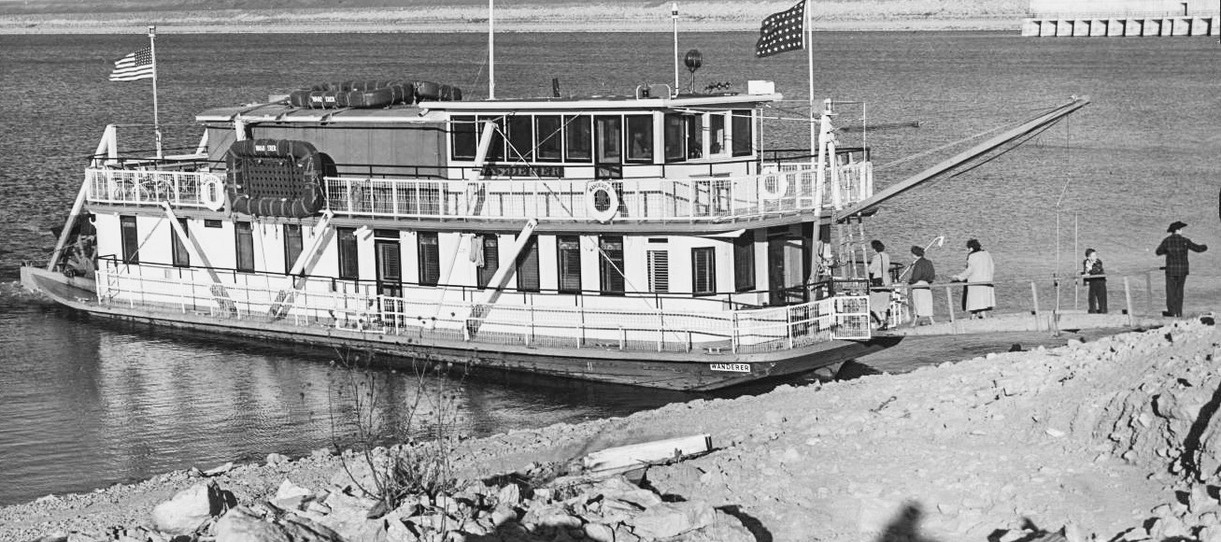
By the time she reached the red banks below Denison Dam in 1948, The Wanderer had already lived a life that read like a ballad. She had not carried cotton or cargo but joy—built in 1931, long after the river trade had faded, as one of the last true excursion boats on the Mississippi. She was born in the twilight of an era, when steamboats had ceased to be the engines of commerce and had become instead the gilded stages of leisure. Her decks once rang with laughter, music, and the high call of her calliope as she carried holiday passengers along the storied bends between Minnesota and the Gulf Coast.
She survived the lean years of Depression and served the nation in another way during the war that followed— her hull repurposed, her decks patrolled, devoted to the country’s cause. And whenthewarwasdone,when America exhaled and turned once more toward recreation and renewal, she was still there—battered, tired, but unbroken.
That was where Part I left her: beached high on the Oklahoma shoreline, resting in the sunlight of a new age, her fittings dulled by time but not surrendering. The Red River had carried her farther than any Mississippi Riverboat had ever traveled, past the cotton fields and pine flats, into a new kind of frontier—the man-made sea of Lake Texoma. Around her lay a landscape in its infancy: raw, unsettled, still shaping itself. Engineers debated dam flows, towns planned marinas, and the promise of prosperity shimmered like heat above the waterline.
And in the midst of it all, The Wanderer waited.
The Wilburn brothers of Denison saw not an antique but an opportunity—a symbol for the new lake and the new age it promised. They planned to moor her at Burns Run, a quiet, protected cove on the Oklahoma side not too far from where the grand Lake Texoma Lodge would later rise. There, through the fall and winter of 1948, they brought her back to life.
She wasn’t just a boat; she was a promise.
In the late fall of 1948, after her long and arduous journey from the Mississippi River to the new Denison Dam, The Wanderer was moored at Burns Run on the Oklahoma side of Lake Texoma. The Wilburn brothers— Frank, Henry, and Glenn of Denison, Texas— had brought her there to take part in the new recreation boom expected to follow the filling of the great lake.
Though she reached Texoma’s shore in midsummer, she would not touch open water again for nearly five months. The Wilburns—grocers by trade and dreamers by nature—had underestimated the time it would take to transform a Mississippi showboat into an inland resort queen. What began as a promise of quick refitting stretched deep into the fall, delayed by paperwork, federal inspections, and the stubborn mechanics of a sternwheeler built in 1931.
That fall and winter, the brothers and their crews rebuilt the vessel from stem to stern. They replaced timbers damaged by time and transit, repaired the paddlewheel, added new brass rails, and gave her a fresh coat of white paint. They installed electric lights, laid hardwood flooring, fitted a modern kitchen, and painted her name— WANDERER—inboldletters on her wheelhouse, sides and stern. Her hull gleamed in patriotic red, white, and blue; her cabins wore a twotone blue décor. Once again, her large red paddlewheel gleamed in the winter sun.
Her old gasoline engine was removed and replaced witha“225-horsepower Gray Marine diesel motor,” as the Durant Daily Democrat and Madill Record both reported, “turning the 30 staterooms into a dancing floor, remodeling the galley, and furnishing the upper deck as a lounge room.”
The Durant Daily Democrat wrote on November 11, 1948: “The Wanderer, fully commissioned, re-powered and remodeled, will be ready to start cruising Lake Texoma next week when the owners receive their Coast Guard approval and license to operate on inland waters.”
It described the reconditioning: “Replacing the old engines with a 225-horsepower Gray Marine diesel motor and installing an electric power plant, turning the 30 staterooms into a dancing floor, remodeling the galley and furnishing the upper deck as a lounge room.”
The paper added that “Texoma’s biggest craft… will be available all winter for chartered cruises and scheduledruns,”andthatshe had already “made several trial runs.”
Even as work continued, she was seen “on the lake… only two weeks ago made it under Roosevelt Bridge in a trip to Lakeside with ease,” reported the Madill Record on November 18. The same piece called her “Texoma’s biggest craft” and described her new fittings: “The remodeled excursion boat has new fire-fighting equipment throughout, and other safety measures including life jackets and life rafts for the total capacity of the craft.” It confirmed her near-term plan: “Though the formal open house and dedication… has been postponed until next spring, the boat will be put into operation immediately and will be available all winter for chartered cruises and scheduled runs.”
Frank Wilburn himself told the paper: “We believe Lake Texoma needs such a boat, and we believe it to be a good business proposition.”
The Coast Guard license was “the last hurdle,” the Democrat observed—“to putting the 93-foot former Mississippi River sternwheel excursion boat into service on Lake Texoma.”
Her safety systems were extensive. “The remodeled excursion boat has life jackets and life rafts for the total capacity of the boat,” Frank told reporters. The Democrat described “a fire-fighting smother system reaching every section of the craft and operated by push buttons at strategic spots.” The Oklahoman added that “latest in fire-fighting equipment is on board including a sprinkling system that operates from a center switch.”
By the third week of November, the red tape finally parted. The Daily Oklahoman reported under the headline “Lake Texoma’s Sternwheel Boat Ready to Sail”: “Lake Texoma’s 93-foot sternwheel river boat, The Wanderer, makes its maiden voyage Sunday. The trio of Wilburn brothers of Denison snipped the last bar of official red tape Saturday… Final Coast Guard, Customs Service, and National Park Service approval was forthcoming.”
The next day, November 21, 1948, the Durant Daily Democrat celebrated with the banner: “Today Is Sailing Day.”
“Fully commissioned and licensed, The Wanderer will make her first official passenger cruises today. The brothers received formal approval this week… Licenses provideforamaximumof150 passengers, and the craft is equipped with 150 life preservers, four 25-passenger rafts, one 18-foot lifeboat, and four large life buoys with 90-foot float lines.”
Shewould“operateonlyon weekendsandforcharterservice during the winter when weather permits.” The rates were modest: “$1 per hour,” the Oklahoman noted—“two hours for afternoon cruises, three for moonlight excursions.”
The boat would launch from the Burns Run beach “at the north end of Denison Dam,” the Oklahoman explained. “A 165-foot all-steel ramp walk leads from the beachtoa20-by-60-footbarge dock, where The Wanderer will tie up.”
Her officers were listed in both the Democrat and Oklahoman: “Frank Wilburn will be the pilot, Alton Wilburn, first mate, W.E. Blackshear, engineer, and Glenn Wilburn, operations manager.” Thecompany—WilburnBoat Co. of Denison—kept its Texas office at 120 North Austin Street, and its Oklahoma affairs were handled through the Durant law firm of Roy Paul.
The press treated her like royalty. The Democrat wrote: “The main deck provides a 35×25-foot hardwood dance floor, a lounge room with cushioned seats and an allelectric galley and snack bar. The upper deck features a place for dining, a screened lounge room and a sun deck.”
The Oklahoman recorded the same measurements: “A 25 x 35 foot dance floor, an all-electric galley and snack bar and a 42-inch handrail around the entire boat. The upper deck has a lounge room with tables for dining and a sun deck.”
Her décor and purpose were described in the Tulsa Tribune: “A two-tone blue décor throughout. Many of the comforts of home are available. The main deck houses a hardwood dance floor, bar, electric galley, and restrooms; the upper deck a lounge, sun deck, and pilot house.”
Other papers emphasized the scale: “An old Mississippi river boat, a side-wheeler, is at home now in Lake Texoma,” United Press reported, “and will begin making daily excursion runs from its dock at Burns Run resort with the coming of next spring.” (Many papers wrote that the boat was a “side-wheel” paddle boat. This was incorrect as it was a “sternwheeler.” In 1948, much of thecoveragethatappearedin far-off papers rode the wire— condensed UP/AP teletype briefs, hurried phone relays, and copydesk rewrites that sandedofflocalnuance.Facts were often garbled by transmission noise, typesetting slips, or editors “normalizing” unfamiliar details, and later hometown corrections rarely traveled back through the syndicate—so minor errors hardened into print.)
The Johnston County Capital-Democrat confirmed in December: “‘The Wanderer,’ fully commissioned, re-powered and remodeled, started cruising Lake Texoma recently when owners received their U.S. Coast Guard approval and license to operate on inland waters.”
It reminded readers that she was “the biggest boat on the lake, taking the honors away from the Pirate, which anchors at Lakeside.”
Even the Delta Democrat-Times of Greenville, Mississippi, ran her story under the headline “Sidewheeler Bought Here Has New Home.” The piece told of her “43-day trip from Greenville to Denison” and “the numerous sandbars upon which the Wanderer lodged,” noting proudly that her “great wheel was a concession to the gay past—while down in its innards is a newly installed 225-horse-power diesel marine engine.”
As December deepened, inquiries poured in from civic clubs, churches, and private parties eager to charter her for outings once spring arrived. “When spring comes,” one syndicated article read, “The Wanderer, a reminder of a gay and departing age in another part of the land, will begin her meandering over Texoma, ushering in a new age of fun in the Southwest’s newest and most popular playground.”
The Madill Record said simply: “The Wanderer will be at home at Burns Run.”
For a few crisp weekends that winter, the promise became reality. Passengers queued along the steel ramp, children waved from the beach,andtheoldMississippi sternwheeler—reborn for a modern inland sea—circled out from Burns Run beneath the shadow of Denison Dam.
Byeverycontemporaryaccount, the Wilburn brothers had accomplished something remarkable. A Mississippi riverboat built in 1931 now floated on a lake not yet four years old, modernized, licensed, and ready for service. For Texoma, she was both symbol and spectacle—the first true queen of the new lake.
But the fates that had carried her there had one last turn to make. Her decks, so newly polished, would soon bear tragedy. What began as a dream of pleasure and prosperity would descend into ruin, and the name Wanderer—oncesungbypassengers and newspapermen alike—would echo again, years later, in the solemn halls of the Supreme Court of the United States.
She was built to entertain, not to endure—but endure she did, until the law itself had to decide how her story would end.
By February of 1949, the Wanderer had become more than a boat—she was a promise fulfilled. Her trial runs had gone smoothly, her charters well attended, and her fame spread from Denison to Madill, from Durant to Lawton,fromDallastoTulsa, and throughout Oklahoma andnorthernTexas. Shewas the pride of Lake Texoma, the “Queen of the Fleet,” her name spoken with admiration by those who had seen her paddle stir the lake to silver under the moon. The Wilburn brothers had done what many thought impossible— brought a piece of the Mississippi’s romance to the plains.
And then, before her first full season could begin, she was gone. February 29, 1949, wasacoldanddarknight,but before dawn, that cold and darkness were interrupted by fire and light.
The Durant Daily Democrat gave the first word, its headline stark as a telegram: “Fire Destroys the Wanderer, Texoma Queen — Night Watchman Discovers Blaze; Owners Attempt to Board Craft But Explosion Sinks Lake Liner.”
The watchman was Jack Bland of Burns Run Resort. It was a little after midnight, 12:40 a.m., when he saw the first faint glow through the darkness—flames licking along the starboard rail. The Democrat wrote: “Bland discovered the ship ablaze and immediately contacted its owners, the Wilburn brothers of Denison, and John Martin, owner of the resort. When the trio arrived at 1:10, the Wanderer wasaflamefromstemtostern and had begun to list.”
They came running through the night—Frank, Henry, and Glenn—armed with fire extinguishers, their hearts pounding with disbelief. They launched small boats in a desperate effort to reach her decks. The Madill Record painted the moment in the stark light of catastrophe: “They armed themselves with fire extinguishers and launched several small boats in a last-ditch effort to save the craft, but by the time they got within 50 feet of the vessel, it exploded and sank.”
Frank Wilburn remembered it with the plain horror of a man who had seen his dream die before his eyes: “Shewasablazefromstem to stern and listing badly when we arrived. We felt if we could just get aboard we could save her, but she blew up in our faces.”
The explosion came without warning—a roar across the cove that rattled the docks and echoed through the winter night. Oil and wood burst together into a column of flame that could be seen from the highway above Denison Dam.
“Bits of the wreckage continued to float about on the water and burn at four o’clock this morning,”* the Democrat continued. “The Wanderer was moored about 300 feet off the Burns Run resort when she caught fire.”
She sank where she had been born anew—barely 300 feet from shore, in thirty-five feet of cold, black water.
The Wilburns stood helplessly as the flames hissed and sputtered across the surface. “She represented a lot of dollars and a whole lot moresweatandtears,”Frank told the Record. “The tears came this morning.”
Henry could barely speak: “I still can’t believe it,” he said. “It was like a nightmare.”
In the following days, the story spread across Oklahoma like the smoke that had once shrouded the cove. The Alva Review-Courier reported simply: “The Wanderer, a Mississippi river boat transplanted to Lake Texhoma for projected use as an excursion vessel, burned, exploded and sank near the Denison dam early Friday… ‘We just don’t have any idea what caused it,’ said Frank Wilburn.”
The Madill Record captured both the tragedy and the cruel irony of it: “Ironically enough, the craft had the very latest in fire-fighting equipment aboard, but it was useless Friday since the fire spread too rapidly to allow anyone to board the craft.”
Only six public excursions had been made—“including both charter and pleasure trips,” the Durant Weekly News observed—before the fire ended everything. The formal inauguration, a gala press cruise planned for mid-March, would never come.
The Record called her loss “one of the most dramatic stories to come out of Lake Texoma.” The same paper retold her journey from the beginning, as if to remind readers what had been lost: “The three Wilburn brothers, who had spent their lives raising cattle and operating a store and market, decided last spring to buy a river boat for an excursion craft on the lake… They located the Wanderer at Greenville, Mississippi, and purchased her for $10,000. The craft was lifted out of the water and carried from behind the dam into Lake Texoma. Extensive repairs were made, and the craft remodeled to conform with Coast Guard regulations.”
Forty-two days it had taken to bring her upriver; less than forty minutes to lose her.
The official cause was never determined. She had not been moved since Tuesday, when a short test run was made to the Texas side. Some speculated that an electrical short had occurred, while others suspected a fuel leak. “The owners said the ship had not been out of dock since Tuesday,” wrote the Democrat. “Origin of the fire was not determined.”
In the shock-lit days after theinferno,everyonereached for the same word: salvage. The lake crowd needed redemption; the Wilburns needed closure; and the papers needed an ending that wasn’t all ash and oil. For a moment, it looked possible.
“They're going to salvage what’s left of The Wanderer Monday,” the Daily Oklahoman announced confidently on February 28, 1949. Resident engineerRichardC.Pyle of the U.S. Engineer Corps said the hull lay “in about 30 feet of the deepest water” and appeared to be “in one piece.” He added, “We hope to be able to tie on to it and drag it ashore in one operation.”
But by then, the Wilburns’ spirits had sunk with their boat. “Buy another boat?” Frank Wilburn told a reporter. “I don’t know. I’d have to do a lot of thinking about it before I could answer.”
The Madill Record found a melancholy poetry in his resignation: “The Wilburns had been besieged with charter requests for the excursion craft and had logged a large number of inquiries running well into the summer. They are still unable to think about battling the elements again to bring a sister ship to the ill-fated Wanderer to Lake Texoma.”
Theinsurance—$40,000— would never replace what the brothers truly lost. As they told the Durant Weekly News, “If you’ll add in all the time and sweat we expended in getting the boat up to Lake Texoma, we figure our total loss to be in the vicinity of $100,000.” About one and a half million dollars today.
Whenthelastofthewreckage cooled, the lake lay still again. Where The Wanderer had floated, only a faint oil sheen marked the surface. Fishermen in later months told of catching glints of brass through the water, and on calm mornings, when the wind turned just right across Burns Run, some said they could still hear the faint creak of timbers—the ghost of her paddle touching the lake she had once ruled.
The Madill Record summed it simply: “Her story has become a saga—one of the most dramatic to come out of Lake Texoma.”
And as Frank Wilburn said, his voice breaking before reporters, “Ours just went down the river.”
Yet through early March, the headlines still clung to hope, “Wanderer Waits on Salvage Crew,” declared the Oklahoman on March 4. “The salvage operation on the Wanderer, the 80-foot sternwheel river boat which exploded and sank Friday, has been held up pending approval by the insurance company,” it reported. “The U.S. Engineer Corps, which previously announced it would handle the salvage work, is standing by waiting approvalfromtheowners,the Wilburn brothers of Denison. They are waiting on the insurance company.”
The Madill Record repeated the same news under the headline “Wanderer Salvage Again Is Delayed.” The paper explained that the Engineers were “standing by awaiting the okay from the boat’s owners, the Wilburn Brothers of Denison, who in turn must wait on the insurance company.”
Meanwhile, Commander Frank T. Burtle of the U.S. Coast Guard’s Houston office “completed his survey of the accident,” interviewing eyewitnesses and calling the fire “regrettable.” He added that “whatever salvage attempt the Wilburn brothers wanted to make was agreeable with the Coast Guard.”
But permission on paper was not a winch on a deck. Paper waited on paper, and the water kept its dead.
Then came a strange kindness from far away. A Houston ice cream executive sent five dollars to the Denison Herald to start a fund he called “Replace the Wanderer.” Frank Wilburn sent it back.
“I appreciate the interest,” he said, “but I just couldn’t accept the money.”
The Durant Daily Democrat echoed the gesture in print: “The Houstonian mailed $5 to the Denison Herald to start a fund which he called ‘Replace the Wanderer.’ We all appreciate the gesture,” said Frank, “but we feel that it is impossible to accept it.”
Meanwhile, the engineers stood idle. The approvals lagged; the insurance company hesitated; the winter hardened into spring. The promised lift never came.
“Wanderer Salvage Again Is Delayed,” the Record finally concluded, the headline itself a kind of epitaph.
And so, beneath thirty feet of cold Texoma water, about 300 feet off the west shore of Burns Run, the Wanderer still lies—her paddle stilled, her hull rusted but whole, a relic of an age when even inland lakes dreamed of the Mississippi. And so, the Queen stayed where she fell. Nocranes.Noslings.Noslow, shuddering emergence with bilge water streaming from her ribs. What the lake had taken, the lake kept.
If you stand at Burns Run on a clear morning and look west, measure roughly three hundred feet from the bathing beach, you’ll be pointing to her grave. She lies there—timbers, fittings, fragments—still and private. The lake does not boast of what it holds.
The papers closed the file with the only words left to them—delay, pending, awaiting approval. The brothers closed their hearts around the same. And Lake Texoma, which had briefly worn a red paddlewheel like a flower, went back to wind and gulls and ordinary boats tracing ordinary wakes.
When The Wanderer burned and exploded that cold February night on Lake Texoma,nooneimaginedher smoldering remains would ignite one of the most influential Supreme Court cases in American maritime history as it drifted all the way to Washington, D.C.—nor that the United States Supreme Court would use her ashes to redraw the boundary between the nation’s maritime law and the authority of the states. Yet that is precisely what happened in Wilburn Boat Co. v. Fireman’s Fund Insurance Co., 348 U.S. 310 (1955)—a case born from the wreckage of a Red River dream and still cited in admiralty courts across the country more than seventyfive years later.
What began as a simple dispute over a denied insurance claim by three brothers from Denison—Frank, Henry, andGlennWilburn—soon grew into a legal tempest that fractured the once-uniform law of the sea, divided the federal courts for decades, and continues to ripple through maritime jurisprudence today.
In the winter of 1949, when the Wanderer went up in flames off Burns Run, it seemed nothing more than a tragic local story: an excursion boat lost to fire, its owners left heartbroken and uninsured. But beneath the smoke and splintered timbers, the question of who would pay—and under what law—set the stage for one of the longest-lasting controversies in American legal history. Out of that quiet lake in southern Oklahoma rose a case that would travel farther than any vessel ever launched there, reshaping the line between federal admiralty and state authority, and casting a shadow still visible in the law of marine insurance today.
The Wilburns were grocers by trade, dreamers by nature, and entrepreneurs by instinct. They had bought The Wanderer and spent months refitting her for Lake Texoma’s emerging tourism scene. When fire consumed her, they turned to their insurer—Fireman’s Fund— for the $40,000 policy they believed would cover their losses.
But Fireman’s Fund refused to pay. The insurer pointed to the “warranties” buried deep in the fine print: the vessel could not be “sold, assigned, transferred, pledged, or chartered” without the insurer’s written consent, and it was warranted for “private pleasure use only.” The Wilburns, without realizing the peril, had done both—they’d incorporated their boating venture and chartered occasional paid excursions on the lake.
Fireman’s Fund claimed that, due to federal maritime law, those technical breaches voided the policy completely— no coverage, regardless of whether the violations had caused the fire. The Wilburns countered that under Texas insurancelaw,nopolicycould be forfeited for a mere breach unless it “contributed to bring about the destruction of the property.”
It was a minor skirmish, almost provincial. But as with so many legal revolutions, its spark came from the provinces.
The Wilburns filed their case in the Texas state district court in Sherman. The insurance company then sought to remove the case to the U.S. District Court in Sherman, Texas, arguing that the case was subject to federal maritime law. In the federal court, the Fireman’s Fund prevailed. The Fifth Circuit Court of Appeals affirmed the insurer’s position, holding that marine insurance was governed by uniform federal admiralty law—not by Texas statutes. From there, the Wilburns appealed to the U.S. Supreme Court.
On March 14, 1955, Justice Hugo Black delivered the majority opinion in Wilburn Boat Co. v. Fireman’s Fund Insurance Co., 348 U.S. 310. It was a ruling that would astonish the maritime bar.
Justice Black began conventionally enough. He reaffirmed that marine insurance policies are “maritime contracts” and thus fall under federal admiralty jurisdiction. But then he drew a bright line between jurisdiction and substance.
“It does not follow,” he wrote, “that every term in every maritime contract can only be controlled by some federally defined admiralty rule.”
The Court found no statutory or judicially established federal rule dictating how warranty breaches should be treated. What the insurance industry had long called the “federal admiralty rule”—that any breach, no matter how slight, automatically voids coverage—was, in Black’s words, nothing but “a general rule of commercial law developed before Erie Railroad Co. v. Tompkins.” It was not a binding admiralty doctrine.
And so, with one sentence, Black turned centuries of maritime uniformity on its head: “We, like Congress, leave the regulation of marine insurance where it has been— with the States.”
Those fourteen words rewrote the map of American maritime law.
Black pointed to the longstanding policy of state control over insurance, the McCarran-FergusonAct,and the absence of congressional action in marine matters. It wouldbe,hereasoned,“piecemeal judicial legislation” for the Supreme Court to invent a new uniform rule when Congress had never done so.
The case was remanded back to the Texas state court, “for trial under appropriate state law.”
Justice Felix Frankfurter, ever the careful craftsman, joined in the result but sounded an unmistakable note of warning. He agreed that this was no oceangoing vessel but “a houseboat on an inland reservoir,” and thus perhaps a proper subject for state law.
But he cautioned against the broader implications of the majority’s language: “It cannot be that by this decision the Court means suddenlytojettisonthewhole past of the admiralty provision of Article III.”
Frankfurter made it clear: he concurred only “in a result restricted within this compass”—the limited world of inland, local waters. The decision, he implied, should stop at Texoma’s shores Justice Stanley Reed, joined by Justice Harold Burton, fired the broadside dissent that still defines the case’s controversy: “If uniformity is needed anywhere,” he wrote, “it is needed in marine insurance.”
For Reed, marine insurance was the “backbone of maritime commerce.” To let fifty states apply fifty different rules would, he said, create “a crazy-quilt regulation” and destroy the predictability on which global trade depended.
“It seems an unreasonable interference with maritime activity,” Reed warned, “to allow the many States to declare the substantive law of marine insurance.”
He would have upheld the insurer’s position and left reform to Congress.
Because of the Supreme Court’s ruling, the case was sent back to the state court in Sherman for retrial under Texas law. There, a jury sided with the Wilburn brothers and awarded them the full valueoftheirpolicy—$40,000 in insurance coverage.
The decision was immediately controversial. Before 1955, marine insurance law had been as stable as the North Star. The rule was clear: warranties must be strictly and literally performed, and the doctrine of uberrimae fidei—'utmost good faith”—governed disclosure.
After Wilburn Boat, every case first asked: Is there an entrenchedfederaladmiralty rule? If yes, apply it. If not, applystate law.
This simple formula created chaos. Courts in Texas, Oklahoma, and Louisiana invoked state insurance codes requiring a causal link between the breach and the loss. Courts in New York and California continued enforcing strict federal warranty rules.
The “uniform law of the sea” became, as Reed had warned, a patchwork of inland statutes and local precedent.
Decades later, the case still refuses to die.
In 2011, maritime scholar Graydon S. Staring, writing in the Journal of Maritime Law & Commerce (Vol. 42, No. 4, October 2011), declared thecasedead—butnot forgotten. His essay, titled “Wilburn Boat Is a Dead Letter: R.I.P.”, became a touchstone in modern admiralty literature.
“Those who know it,” Staring wrote, “raise it at the outset; those who do not are bedeviled by the uncertainties to which it has led.”
He argued that later Supreme Court cases—Kossick v. United Fruit Co. (1961), East River Steamship Corp. v. Transamerica Delaval (1986), and Norfolk Southern Railwayv.Kirby(2004)—had quietly restored maritime uniformity elsewhere. Wilburn Boat, he concluded, was “a doctrinal derelict, adrift and barnacled, but never scuttled.”
“Leading courts have quietly observed its lack of vital signs and stopped short of pronouncing its requiem,” he added. “Requiescat in pace.”
Yet, as Staring himself admitted, the decision lived on in the Fifth Circuit—the very circuit that had once upheld Fireman’s Fund. There, lawyers still cited it as gospel.
Fourteen years later, the Loyola Maritime Law Journal revisited the wreck in a long-form essay titled “Rickety Wilburn Boat and Its Dilapidated Fleet: Marine InsuranceLawintheShadow ofUncertaintySeventyYears Later.”
The Loyola writers disagreed with Staring’s obituary.
“Wilburn Boat sought simplicity,” they wrote. “It achieved entropy.”
They described the decision’s legacy as “a flotilla of fractured doctrines, fifty jurisdictions adrift upon one sea.”
“Wilburn Boat’s central question—whether federal maritimeorstatelawgoverns marine insurance warranties— remains unresolved,” the article declared. “Each circuit has steered its own course. The result is a maritime world adrift, where outcomes depend not on the water the ship sails, but on the courthouse where it lands.”
They concluded, more pointedly than Staring had dared: “Until the Supreme Court reclaims this field, the wreckage of Wilburn Boat will continue to founder in the shallows between state and sea.”
In 2024, the Supreme Court had the chance to correct the course. The case, Great Lakes Insurance SE v. Raiders Retreat Realty Co., involved a yacht policy with a New York choice-of-law clause. Many hoped it would give the Court occasion to overrule Wilburn Boat once and for all.
Justice Brett Kavanaugh, writing for a unanimous Court, upheld the choiceof- law clause, relying on entrenched federal principles of contract enforcement. He explicitly noted that Wilburn Boat “does not control” such cases because an established federal rule already governed choice-of-law provisions.
But it was Justice Clarence Thomas,inconcurrence, whofiredthebroadsidemany had waited decades to hear: “Wilburn Boat rests on flawed premises,” he wrote, “and is at odds with the fundamental precept of admiralty law—uniformity.”
He catalogued its “indefensible reasoning” and its failure to recognize that “federal courts exercising admiralty jurisdiction act as common-law courts.” His final line carried a trace of finality—if not burial: “Today’s decision further erodes Wilburn Boat’s foundation— and rightly so.” But as Loyola’s 2025 editors observed,“theCourtonce again punted.” Wilburn Boat remains on the books—good law, bad precedent, and a ghost still steering.
Lake Texoma, straddling Texas and Oklahoma, is by every metric a “navigable water of the United States.” Barges once crept along its early channels; the Army Corps of Engineers still regulates its harbors.
And yet, when a vessel burns on its waters today, courts apply Wilburn Boat— that is, state law—to resolve the claim.
The irony is too rich. Seventy-five years after the fire that started it all, The Wanderer lies somewhere beneath Texoma’s split waters, her wreck divided almost precisely between two states—Texas and Oklahoma— just as the law she inspired divided the sea.
Her story, as the Madill Record once put it, was “a saga—one of the most dramatic to come out of Lake Texoma.” It still is.
A brief blaze on an inland lake has become a 75-year debate over the boundaries of federal power, the limits of uniformity, and the very meaning of maritime law.
Graydon Staring pronounced the doctrine dead. The Loyola scholars called it “rickety.” Justice Thomas called it “flawed.” But the precedent endures—stubborn, spectral, and unsinkable.
Every time an insurance policy is written for a fishing boat on Texoma or a yacht on Chesapeake Bay, Wilburn Boat still whispers its rule: if there is no federal standard, the states shall decide.
For a case born in the ashes of a pleasure boat, it is a strange immortality.
And perhaps that is fitting. For on this lake, as in the law, nothing ever truly disappears—it just drifts beneath the surface, waiting to rise again.
In the end, the Wilburn brothers won their case—but lost their boat, and with it a dream that had once glided proudly over the calm waters of a new lake straddling two states. The Wanderer herself never sailed again. Her charred remains slipped beneath the surface, settling into the silt not far from where the Red and Washita Rivers meet.
Her spirit, however, rose again—this time in the Supreme Court’s marble halls, where her legal afterlife changed the course of maritime law itself. From a forgotten lake fire, a precedent was born that still ripples through the courts of the nation.
What began as a local tragedy became a national turning point. Wilburn Boat Co. v. Fireman’s Fund Insurance Co. was more than a dispute over an insurance claim—it was the moment when the Supreme Court drew a new line between the power of the states and the reach of federal admiralty. Justice Hugo Black’s majority opinion, declaring that “we… leave the regulation of marine insurance where it has been—with the States,” set adrift what had once been a single, unified body of maritime law.
From the ashes of that small fire on Lake Texoma rose a doctrine that still divides the courts of the nation. The decision gave victory to three local merchants but left behind a precedent as uncertain as the waves that spawnedit—onethatblurred the line between state and federal power and turned the quiet inland lakes of America into testing grounds for the limits of maritime law.
And decades later, scholars still debate the wisdom of that ruling. Some call it judicial restraint; others, a capitulation to confusion. TheJournalofMaritimeLaw & Commerce described it as “a ghost that still steers,” and the Loyola Maritime Law Journal warned that the Court, seeking simplicity, had “achieved entropy.” Seventy-five years after The Wanderer’s fire, those words still ring true.
Yet perhaps that is fitting. For just as Lake Texoma itself belongs to two states and two rivers, so too does the Wilburn Boat decision belong to two realms—state and federal, local and national, land and sea. It reminds us that even from the smallest corners of the map, from a wooden pleasure boat on an inland lake, a story can rise that alters the course of American law.
And so, from one burned boat on a new lake, a doctrine was set adrift that still confounds courtsfromGalveston to Gloucester. Each time a vessel sinks, each time an insurerandamarinermeetin court, The Wanderer’s name surfaces again—proof that even the smallest fire can alter the tides of law.
Sometimes the past refuses rescue. Sometimes it rests. Here, beneath the west side of Burns Run, the Wanderer rests—her bones hidden in the clay and current, her story rising again and again in the wake of thosewhoseektounderstand wherelaw,water,andhuman hope once met.
The Wanderer may be gone,butherwakeendures— rippling outward from Burns Run to the highest court in the land, and still, all these years later, across the restless waters of justice itself.