
After almost six years, six elections, protests, appeals and a trip to the Oklahoma Supreme Court, the longawaited construction of the MarshallCountyCourthouse began in late July 2014. The Rooney & Culp Construction Company began the work of excavation for the foundation, basement and county jail.
The county commissioners originally planned to construct a courthouse and a separate county jail. During the first two or three courthouse bond elections, a separate ballot was issued to issue bonds for the construction of a free-standing county jail. The commissioners believed a separate jail would provide more space and security, so they separated the issues. However, after those bond issues failed, it was decided to drop the idea of a separate jail and include it in the courthouse design.
In the early courthouse designs, there was no basement as the first floor was partiallyunderground,which provided space for a boiler roomtoheatthebuildingduring colder months. So, when the commissioners dropped the plans for a separate county jail, they had Jewell Hicks enlarge the basement and include a small jail along with office space and kitchen for the jail and a boiler room.
AccordingtoHicks'design, the courthouse basement occupies only about a quarter of the building's footprint. It is situated in the northwest section of the structure, with a stairway leading to the courthouse's Rotunda. The remaining space beneath the courthouse is intended solely as a crawl space for accessing plumbing and electrical wiring.
By the first week of August 1914, it was reported in the Madill Times that “The excavating for the basement and foundation has been completed and the concrete laid. Several cars of material have already arrived and placed ready for use. The construction of the walls will be started soon and rushed to completion. The entire building will be completed and ready to occupy in six months.”
After construction began, the county vacated the Lazarus building on the southeast corner of the square. The county had been squabbling with the owner, Henry Lawrence Lazarus, for a few years, and it had moved all offices to the old Madill High School building.
During the battle between the two sides over the courthouse issue,theCityofMadill hired Jewell Hicks to design and oversee the construction of a new Madill City Hall. ConstructionbeganinMarch 1914, and by September, the building was finished and ready for occupancy. However, following negotiations betweentheMarshallCounty Commissioners and city officials, the City of Madill agreed to rent the new city hall to the county during the courthouse construction.
In an article by Marshall County News-Democrat on August 21, 1914, the editor reported, “Arrangements have been perfected whereby the county of Marshall has secured the use of the new city hall of Madill, until such time as the courthouse, now under course of construction, will have been completed. It is expected that the city hall will be ready for the county's use by September 1st, at which time all county offices will be moved from the old high school to the city building.”
After the basement was completed, the weather changed, and for a few weeks, Marshall County experienced several rounds of heavy rain. The rain slowed construction, as it prevented the completion of the plumbing and sewer line necessary forthecourthouse.Therefore, by late September, it was decided to begin running a night crew to allow work to continue 24 hours a day.
The September 25th edition oftheNews-Democratreported, “Contractors Rooney and Culp are making rapid progress on the construction of the Marshall County courthouse. During the latter part of last week, these gentlemen began a night shift on the project, and indications are quite favorable that the structure will be completed well within the time limit.”
By early October, the first floor of the fire-proof concrete walls of the basement and first floor were completed, and work on the second floor began. The News-Democrat, reporting on the progress of the construction, wrote, “The reinforced concrete construction is building the second story rapidly, and all the dressed stone for the stonework is on the grounds. ContractorsRooneyandCulp state that they hope to have the building ready to turn over to the people of Marshall County during the early months of the coming year.”
After being awarded the construction contract, the Rooney & Culp Construction Company hired a local stone mason to carry out the stonework on the courthouse. James Winfield Moon, the owner of J. W. Moon’s Marble and Granite Company, was engaged to complete all the stonework in the courthouse.
James Winfield Moon was born on July 4, 1873, by the Cumberland River in Grant County,Kentucky.Asachild, his family moved to Gainesville, Texas, and in 1892, Moon established himself in Indian Territory between Rush Springs and Marlow on the Bernhardt Cattle Ranch.
In 1898, Moon traveled to Pickens County, Chickasaw Nation, with his new wife, Mittie Monroe Moon. They settled near the future site of Madill, where Moon opened his marble and stonework business. The News-Democrat wrote, “Jim Moon has all the stone for the stonework of the county courthouse. Construction on the building will not be retarded by the stone contractors.”
In the November 13, 1914 issue of the Marshall County News-Democrat, it was reported, “The stone for the first story is practically all set, and all the stone for the second story is on hand. Contractor Moon, who has the contract of furnishing the stone for the building, stated to a News-Democrat representative Thursday that he thought the quarries would cause him little or no delay in the matter of shipments of stone.”
By February of 1915, the courthouse was nearing completion. In its February 19th issue the News-Democrat reported, “The finishing touches are being placed upon the exterior of the Marshall county courthouse and the workmen are busy on the inside finishing. It is thought that the building will be ready for occupancy within a short time and that the commissioners will pass upon and receive the finished building without any delay in the matter.”
As the construction of the courthouse continued, F. W. Porter of the Madill Light Plant performed and completed the work of installing the electric wiring and lighting system in the courthouse. The News-Democrat wrote, “The building looms up well in the interior when the lights are turned on and the lights themselves are most attractive and ornamental.”
By the middle of March, the courthouse was nearing completion. The News-Democrat reported, “It is thought that the contractors will have construction work on the new courthouse completed andhaveeverythingin readinesstoturnthebuilding over to the county by Monday of next week. The work has been done in record-breaking time, and the people of Marshall County have a public structure of which they may well feel proud of.”
On Tuesday afternoon, March 16, 1915, a special Board of County Commissioners meeting was held at the Madill City Hall. At that meeting, the commissioners heard a report from Rooney & Culp that the courthouse was completed and ready for occupancy. At the meeting, the commissioners formally received and took possession of the new courthouse from the contractors. On March 19th, the News-Democrat wrote, “with the acceptance of the courthouse, Marshall County becomes the owner of one of the finest county buildings in the entire state. With the exception of the county courthouse in Ardmore, in Carter County, there is not another courthouse in southern Oklahoma, and in fact, there are but a few in the entire state, that can compete with this structure.”
OnWednesday,March17, 1915, County Judge James Irving Henshaw had the honor of initiating the new courthouse. That morning, while conducting a jury trial, he recessed the court session at noon and ordered the jury, attorneys and parties to reassemble at 1:00 in the new courthouse for the afternoon session.
When Judge Henshaw presided over the afternoon court session in the new courthouse, none of the machinery, tools, or supplies from the construction had been removed. To clear the courthouse grounds of construction equipmentandsupplies, Rooney & Culp hired a Madill resident, Grant Stratton, to load the equipment and leftover supplies, and to remove the construction debris before the courthouse celebration scheduled for the 20th.
In anticipation of the completion of the courthouse, the Mayor of Madill called for a meeting to organize citizens of the county to prepare a celebration for the opening of the courthouse. The Madill Times reported on the celebration in the March 18th edition of the paper. “Pursuant to a call by the mayor of the city of Madill, a number of the citizens of Madill and Marshall County assembled in the hall of the Colonial Theatre for the purpose of arranging a program for celebrating the completion and acceptance of the courthouse by by the entire citizenship Marshall county.”
“On motion Judge I. O. Lewis was elected chairman ofthemeetingandW.E.Bass was elected secretary of the meeting. After appropriate remarks by the chairman stating the purpose of the meeting a motion was made and seconded that the chairman appoint a committee of five gentlemen and two ladies to arrange a program for the meeting. The chair appointed on this committee A. P, Marsh, W. H. Lawrence, W. T. Ross, W. E. Bass, J. W. Moon and Mrs. M. Scott and Mrs. T. T. Montgomery. A motion was then made and seconded that the chairman appoint a reception committee of 20 members, other than the county officers and that the county officers act as a part of the reception committee. The chair appointed the following members: FB Herron,, T T Montgomery,FEKennamer, M Scott, SP Boyd, D Russell, E S Hurt, JW Falkner, WC Rollins, Dr. TA Blalock, A P Marsh, M E Ewing, ET Haddock, H M Rice, JL Derrick, Tom Hollingsworth, J S Dillingham, Lee Davis, J W Colby and J H McMillan. On motion the chairman appointed the following gentlemen as a finance committee to raise funds to defray the expenses of the program and entertainment: Geo. L. Sneed, C. T. Morris and E. R. Carter.”
“Saturday,March20,1915 was selected as the day of celebration. The courthouse will be open all day on this date, and the above reception committee will be there to show the citizens through.” “Let every citizen come out and congratulate himself for living in a county with as magnificent a courthouse as we have in Marshall County, and unless you come and go through it, you will not know just what we have, and that we have something for Marshall County to be proud of.”
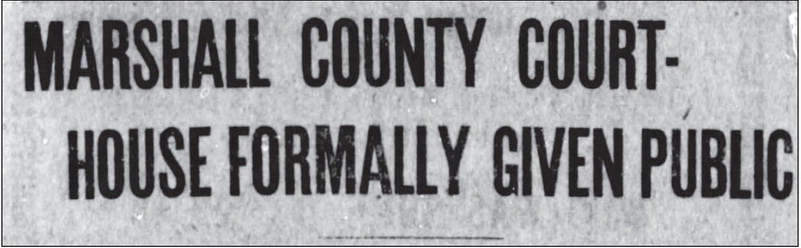
On Saturday, March 20, 1915, hundreds of Marshall County citizens crowded Madill Square to celebrate the opening of the courthouse. The Marshall County News-Democrat, in a front-page article, wrote about the celebration. “'Midst clash of cymbals and blare of trumpets, 'midst ripples of laughter and bursts of eloquence; midst plaudits and cheers, surrounded and filled with the brave and fair of Marshall county's citizenry, on Saturday, March 20, 1915, the brand new $75,000 county courthouse was turned over formally to the people at large of the county.”
“Early in the day, crowds from all over the county began pouring into the city, despite the inclemency of theweather.Withthecoming of the afternoon trains, the crowds increased, and by nightfall, the courthouse interior was a compassed and comingled array of men, womenandchildren-eachone of whom congratulating the other on the magnificence of the structure and on the safety now afforded all public documents, etc.”
“During the course of the afternoon a great deal of forensic eloquence was poured forth upon the virgin air; orator succeededorator,untilthe veryatmosphereonebeathed pulsated and throbbed with bursts of eloquence while the immediate horizon was dedimmed with cloud banks of feathers plucked, gathered and snatched from the 'Great American Bird of Freedom.'
“The Madill (Marine) Orchestra furnished delightful music throughout the day with trombone, trumpet, drum and cymbal. Mrs. C. T. Morris presided at the piano-forte in a most accomplished and masterly manner.”
Among those whose speeches were most attentively listened to and most heartily applauded, those who spoke in the interests of a united and harmonious county were Judge J. I. Henshaw, Judge I. O. Lewis, W. R. Grant of the Kingston Messenger and 'Uncle Ben' Smith. All of these gentlemen spoke in a most entertaining manner, but it was conceded by all present that the most eloquent, most soul-stirring, most laughter-provoking, the most tear-starting speeches of the occasion were delivered by Mesdames M. Scott and T. T. Montgomery, the lady orators of the day.”
“One of the most pleasant features of the occasion was the entertainment given the visiting ladies by the Madill ladies of the Civic League.
Besides escorting the visitors over it, while another section thought were the building, tendering good music for their entertainment and otherwiseaddingwingstothe fleeting hours, the committee presented each lady visitor with a beautiful flower (we knowwhatyoucalled'em,but can't spell 'em) as a souvenir of the date.”
And now the courthouse is in reality the property of all of Marshall County. The days of the semi-feud when one section thought we wanted the courthouse and really needed neither wanted nor needed it, are neitherwantednorneeded it are now history. All bickerings have been settled by the little paper ballot and the courts have adjudicated the matter,andMarshallCounty not Madill has a structure which shall stand for years to come as a monument to the wisdom, to the business foresightandacumenofthose who cared to erect a monument which would afford vaults for the safe-guarding of the public and the private records of the citizens of the county.”
After six long years, six elections, and allegations of fraud, violence, poisonings, fighting, and feuding, Marshall County finally obtained acourthouse.After111years, that courthouse continues to serve the people of Marshall County. Somagnificentisthe courthouse, many years ago, the United States Department of Interior placed the MarshallCountyCourthouse on the National Register of Historic Places.
While the feud was long, ugly and divided the county, intheend,thepeoplereceived a courthouse that still serves today as the center of county government. And while the rivalry continues to this day in the memories, hearts and oaths of the people of Kingston, everyone in the county is proud of the courthouse.
Rivalries die hard, but rivalries are the secret of greatness. As Arnold Schwarzenegger once said, “Rivalry is one of the most powerful motivations in the world.”