
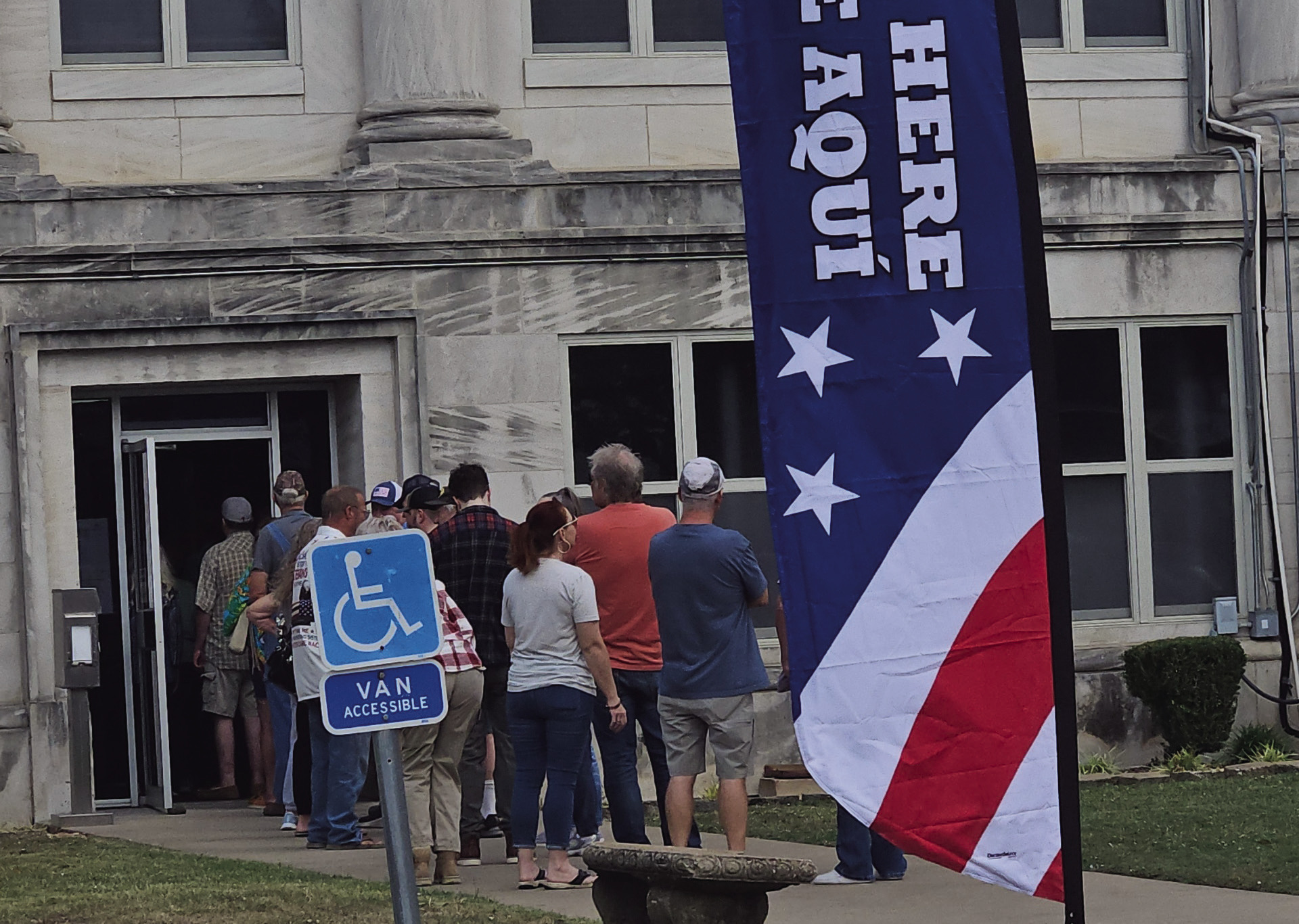
Before every election, the governing bodies allow early voting - a chance for a voter to be able to cast their vote before the polls get crowded with voters on election day. In Oklahoma,avotercancastan early vote a few days before the actual election.
Early voting, also known as absentee voting, began during the Civil War. Union and Confederate soldiers couldn’t leave their posts to go cast their votes, so they were allowed to do it from their battlefield units and have them counted back in their hometowns.
Absentee voting also arose during World War II when Congress passed laws in 1942 and 1944 concerning soldiers stationed overseas. The laws became entangled in controversies over states’ rights and the voting rights of African Americans in the southern states, so the absentee voting didn’t catch traction. Subsequent laws like the Uniformed and Overseas Citizens Absentee Voting Act (UOCAVA) and the Military and Overseas Voter Empowerment Act (MOVE) have been more effective in encouraging service members to cast their ballots through absentee voting.
Even though the number of absentee ballots have been typically small, this past election proved to be a tad different. In Marshall County, there were a record number of 2239 voters who cast their votes in the four-day window for absentee voting. In the state of Oklahoma, it was reported that almost 300,000 absentee ballots were received. Ironically, though, even though the state hit record numbers for absentee ballots, it still came in last for voter turnout.
Speaking of voting, former PresidentDonaldTrumpwas elected as the 47th President of the United States. He had over 75 million votes and 312 electoral votes compared to Kamala Harris who had over 71 million votes and 226 electoral votes.
Trump also had a clean sweep of the seven battleground states - Nevada, Arizona, Wisconsin, Michigan, Pennsylvania, North Carolina and Georgia. A battleground state, also known as a swing state, is a state where candidates of both the Democratic and Republican parties have “similar levels of support.” This means that while Americans hold their breaths to see who will win the presidential seat, these seven states could make or break the election. Arizona was the final state to count their ballots, and their outcome showed that Trump got all seven states.
So far, Trump has announced who he will be appointing to his Cabinet. It is suggested that Trump will appoint Florida Senator Marco Rubio as the US Secretary of State - the president’s main advisor on foreign affairs. There are whispers that the dark horse for the nomination, though, is Richard Grenell, a loyalist who served as ambassador to Germany,specialenvoytothe Balkans and acting national intelligence chief.
It has also been noted that Trump is going to select Florida congressman Michael Waltz as his National Security Advisor - one who counsels the president on various threats to the US. Waltz would also more than likely have to help navigate the US position on the wars in Israel, and in Ukraine and Russia.
Kristi Noem, the Governor of South Dakota, is expected to be selected as head of Homeland Security. That position oversees the security of the US, covering border, cyber threats, emergency response and terrorism. Rumors circulated that she was passed over to be Trump’s running mate over a supposed admission that she killed her pet dog.
If appointed, Noem will work closely with the “Border Tsar” who is rumored to be Tom Homan. This job includes responsibility for Trump’s idea for mass deportation of millions of undocumented immigrants, which was a huge part of his campaign promise.Trump called Homan, who was a former police officer and acting director of the US Immigration and Customs Enforcement (ICE), a “stalwart” on border control.
It is also rumored that Elise Stefanik will be appointed UN Ambassador, Lee Zeldin as Head of the Environmental Protection Agency and Susie Wiles as Chief of Staff.