

History never reveals herself all at once. She hides in the folds of other stories, waiting for someone to care enough to pull a single thread.
There’s a strange kind of joy in stumbling upon a long-forgotten piece of history — a feeling halfway between discovery and reunion. I’m not just finding something; I’m meeting it, on behalf of everyone who’s forgotten. The dust of years falls away, and suddenly a name, a photograph, or a line of print opens a doorway into another time. It feels serendipitous, almost conspiratorial — as if the past had been waiting for me in silence, patient and proud, until I happened to look in just the right corner.
As a lawyer by trade, I find myself especially drawn to the stories where history and law intersect — where a forgotten event ripples into a courtroom, or where a decision rendered long ago still shapes the present. Legal cases, in their own way, are histories too: human dramas bound in parchment and precedent. They preserve not onlywhathappened,buthow we chose to judge it.
In that moment of rediscovery, the distance between then and now collapses, and I remember why I chase these stories: because every forgotten scrap holds a heartbeat, and every rediscovery reminds us that history never really dies; it just waits to be found — sometimes in the quiet of an archive, sometimes in the pages of a forgotten case, and sometimes, quite unexpectedly, in the wake of a boat called The Wanderer.
And that same thing happened whenIbeganresearching the history of the Lake Texoma Lodge—the pianoshaped resort that once stood like a mid-century crown aboveCatfishBay—Ithought I knew the story I was after. The Lodge, built in the 1950s by the Oklahoma Planning and Resources Board, was the pride of the state park system: glass, limestone, and promise. My notes were already full—stories, photos, architect drawings and the tangled sale to private developers.
Then one night, scrolling through more old newspapers, chasing a note about the excursion boat, Idle Time, I came across a faint, almost casual line in a July 7, 1951, article in the Madill Record which stated that the Idle Time was, “the successor to the famed Wanderer, 93-foot sternwheeler…” I nearly passed over it. “Idle Time,” I knew,wasthemostfamousof the Lake Texoma’s excursion boats, but the other name— Wanderer—hit differently. There was age in that word, a resonance you could almost hear.
Who was she? The more I searched, the deeper the water got.
Old clippings surfaced from Denison, Durant, Greenville, Mississippi, and multiple other newspapers across Oklahoma and Texas, and then finally a book entitled “The Kahlke Brothers Marine Railway & Boat Yard, Rock Island, Illinois 1868-1971.”
The Wanderer, it turned out, wasn’t born on Texoma’s shore.Shewasariverboat—a genuine Mississippi sternwheeler, hand-built during the Great Depression by a family of German-American craftsmen whose name had graced the river for half a century: the Kahlke Brothers of Rock Island.
The Wanderer began her life as a pleasure steamer on the upper Mississippi, spent her prime carrying dancers andpicnickersbetweenIowa, Illinois, Greenville, Mississippi, and New Orleans. Later, she served the U.S. Army Corps of Engineers during World War II.
And when the floodwaters of the Red River valley became Lake Texoma, she was reborn for one last voyage—a 1,200-mile odyssey down the Mississippi River, to the Red, and then upriver to Denison, Texas, where three brothers dreamed of turning her into thequeenofOklahoma’snewest inland sea. But her time on Texoma was short and ended in tragedy. Her story had everything—industry, war, courage, and tragedy.
And, as I would discover, it ended not with her physical fate, but in the highest court in the land, with a legal decision that still echoes today—adecisionthatwholly reshaped maritime law.
It began on the Mississippi. ItendedintheSupreme Court.
And somewhere in between lay the heart of a story too proud, too improbable, and too deeply human to stay forgotten. Needless to say, I was hooked. I had to know more. And from that journey, I discovered another lost story about the history of Southern Oklahoma, Marshall County, and Lake Texoma.
To understand The Wanderer, you have to understand the men who built her.
In the latter half of the 19th century—long before highways stitched the Midwest together—the Mississippi River was both its lifeline and its language. Every town with a levee had its own accent: Davenport, Dubuque, Hannibal, St. Louis— all bound not by borders but by current. And at Rock Island, Illinois, just across from Davenport, stood one of the river’s most enduring families of boatbuilders: the Kahlkes.
Their story began across the ocean, in the small shipbuilding port of Brunsbüttel, near the mouth of the Elbe River in northern Germany. It was there that John, William, and Peter Kahlke were born—sons of a shipwright’s village where the smell of pine tar and salt water was the scent of survival. Each brother came to America in the 1850s, at different times, carrying the same instinct for wood and water.
After traveling separately across the country, they met again in New Orleans in the early 1860s. There, they pooled their skills in carpentry and shipbuilding and built one of the first postwar dry docks in the Gulf region. The yard cost $40,000 to complete—an immense sum in that age—and soon employed over 500 men. Their success was swift, their workmanship sound, and for a brief time the Kahlkes were prosperous.
But river fortune is fickle. When their workforce went on strike for higher wages, the brothers were forced to sell at a loss. They tried their hand in Mexico for a time, returned to New Orleans, then moved north in search of calmer waters and steadier work.
By 1866, the Kahlkes had reached Port Byron, Illinois, a small town perched on the Mississippi’s upper reaches. There they tried a sawmill, then farming—both failures. But the river was patient, and their skills with wood soon found a purpose again. They found work at the John TheissenYard,buildinglarge steam-powered vessels, and in their spare hours, constructed a barge of their own to carry their families and belongings downstream in search of opportunity.
That journey ended in Rock Island, Illinois, where they hoped to build not just boats, but a future.
The first night they arrived, a violent storm tore across the river, sinking their barge and nearly all their possessions. When they raised it the next morning, most of their tools were ruined. Peter’s wife, Anna Schmidt Kahlke, had parents living in Rock Island, and the family took shelter with them. With what little they had left, the brothers began again.
No store in Rock Island would extend them credit, so Peter walked miles across the bridge to a grocer in Davenport willing to sell him flour and beans on trust. He carried the food home on his back. Out of such stubbornness, dynasties are born.
In August of 1868, the brothers secured a 15-year lease on a narrow stretch of riverfront property just below the Weyerhaeuser-Denkmann sawmill, owned by Bailey Davenport. The rent was $200 to $300 a year—a steep price, but it bought them a place on the river. They opened their boatyard that summer.
At first, work was scarce. Thencameahardwinter,and with it, salvation. When ice clogged the Mississippi, several vessels limped into Rock Island in need of repair. The Kahlkes took them in, and soon the sound of saws and hammers filled the frozen air. When spring came, their reputation had spread: The Kahlkes do good work.
By 1876, the Holland Directory listed their yard as employing fifty men and operating a steam sawmill, with annual earnings of $50,000–$75,000. They had built their own fortune plank by plank.
TheyremainedontheDavenport property until 1884, whenrentbecameuntenable. With a $100 loan from Phil Mitchell, they bought land farther downriver and never again worked another man’s ground. That patch of mud and timber would soon be one of the busiest boatyards on the Upper Mississippi.
Through the last quarter of the 19th century, the Kahlke Brothers Yard produced a steady fleet of sternwheel towboats, raftboats, and utility vessels. They built for such noted masters as Captain Cyprian Buisson, Captain D. F. Dorrance, Captain George Winans, and Captain John Streckfus, who would later found the Streckfus Line of excursion steamers.
Every Kahlke-built boat bore the hallmarks of their trade: a low, clean bow, a subtle sheer, and lines that seemed to anticipate the current itself. Their motto, stenciled above the yard gate, wassimpleandproud: “Build Her Honest.”
Theirvesselsweren’tluxurious— they were working boats, built for endurance, not applause. Yet rivermen swore by them. “A Kahlke boat,” they said, “handles like she knows what you want before you do.”
By 1900, the yard employed more than fifty men and turned out everything from ferryboats and dredges to snagboats and pleasure cruisers. Smoke rose constantly from their steam sawmill; hammers rang from dawn until dark.
In 1904, the Kahlkes launchedwhatwouldbecome their most beloved vessel— the ferry Davenport. She was a handsome sternwheeler, bright with paint and polished brass, designed to carry passengers between Rock Island and Davenport. For two decades she was a fixture on the river, running with the rhythm of the day—farmers in the morning, workers at dusk, lovers in the moonlight.
When Peter and John Kahlke died in 1924, Peter’s son Fred took over the yard. He rebuilt the Davenport into the W. J. Quinlan, a ferry so familiar to locals that her whistle became the soundtrack of their days. “Two longs and a short,” they said, and every child in Rock Island could imitate it.
Fred was an eccentric genius—wealthy for a time, thanks to good investments, and ruined again after the 1929 crash. He was famous for his “horizontal filing system,” in which paperwork piled floor to ceiling until he moved into another room. His mule Barney worked the yard for three decades, and his dog Soupbone attended church with him every Sunday. When the dog died, Fred took out a small obituary in the local paper: By the 1940s, Fred was one of the last wooden-boat men left on the Mississippi. He considered converting to steel construction, even planned a new dry dock, but the cost—$200,000—was beyond reach. The world had moved on. The river that once smelled of pine and steam now reeked of diesel and iron.
By the early 1960s, Fred was alone, the yard overgrown and silent. In 1965, a flood swept through Rock Island. When the city built its protective levee, it cut straight through the Kahlke yard, erasing a century of craftsmanship. Two years later, vandals torched the W. J. Quinlan. The last Kahlke boat was gone, and with it, the echo of their name.
Today, diesel towboats pass the spot without knowing the ground beneath them once launched a fleet.
Out of that same yard, from the lineage of men who believed a boat’s worth was measured in the straightness of her keel, came The Wanderer.
In the winter of 1930–31, the Kahlkes were commissioned by R. D. Marshall of Rock Island and John Shuler ofDesMoines,Iowa—distant relatives of the family—to build a new excursion vessel. She was to be modern yet nostalgic, practical yet romantic— a pleasure steamer that could revive the fading tradition of Mississippi river cruises.
They built her under a low wooden shed near the levee, her ribs of white oak, her planks of pine. She measured 93 feet from stem to stern, with a 24½-foot beam and a draft of just under four feet. Two decks rose above the waterline: a lower for machinery and passengers, and an upper for dining, dancing, and music. She gleamed with electric lights, a brass-railed pilot house, and a calliope mounted on her upper deck. Her paddlewheel was steamdriven, producing about 120 horsepower—humble, but more than enough for leisure cruising. She was christened The Wanderer—and she lived up to her name.
Throughout the 1930s, The Wanderer was a familiar sight on the Upper Mississippi. From May to September, she ran between Davenport, Dubuque, and Clinton, carrying picnic crowds, wedding parties, and traveling jazz bands. On summer nights, her calliope music drifted over the riverbanks like perfume. The glow of her lights reflected off the current, and young couples, dressed in their finest, waltzed across her deck beneath the stars.
When World War II came, the romance of the river gave way to duty. The U.S. Army Corps of Engineers requisitioned The Wanderer for inland transport and training. Herboilerswerereplaced with a diesel engine, her paddlewheel enlarged, and her wooden hull rebuilt in steel. She never saw combat, but she served faithfully, ferrying personnel and supplies along the lower Mississippi until the war’s end.
When peace returned, so did The Wanderer—refitted and sturdy but adrift in a world that no longer needed her kind. In November of 1946, her owners sent her to Greenville, Mississippi, for engine repairs and winter storage, hoping to reopen her for the 1947 season in Stillwater, Minnesota. But America had changed. The highways glittered where the rivers once did, and gasoline was cheaper than tickets.
The great excursion boats of the Mississippi were gone. The levees that once echoed with their calliopes fell silent.
It was from that silence— on a modest line in a Mississippi newspaper—that her story crossed paths with three brothers seven hundred miles away in Denison, Texas. They were dreamers, like the Kahlkes had been a generation before. They read that an honest, steel-hulled riverboat named The Wanderer was for sale.
And they decided to bring her home—to Lake Texoma, Oklahoma’s new inland sea. Denison in 1948 was a city halfway between its frontier past and its modern future. The war had brought prosperity; the dam had brought promise. The Denison Dam, completed only four years earlier, had dammed the Red River to form Lake Texoma, creating a new inland coast that stretched from Oklahoma to Texas.
The possibilities seemed endless: marinas, fishing camps, resorts, and lodges. TheOklahomaPlanningand Resources Board spoke of “a Riviera for the Southern Plains.” But something was missing—a centerpiece, a symbol of the lake’s identity. Enter Frank, Henry, and Glenn Wilburn. They were local businessmen, known in Denison for their auto and grocery ventures, but they had the river in their blood. They saw in Lake Texoma not a lake but a future—a frontier of recreation.
One evening, flipping through “The Waterways Journal” in the back of their store, Henry spotted the ad for the Wanderer. He read it twice, then a third time. “Twin-decksternwheel…diesel engine…150passengers,” it was then that he came up with the idea of the Queen of Lake Texoma.
Describing the find to the Paris (Texas) News, newspaper, Henry Wilburn stated: “We started looking for a boat about a year and a half ago. We found this one about six months ago and then made the deal about six weeks ago. It isn't quite as big as we wanted, but it'll serve the purpose.”
The Wilburn brothers purchased The Wanderer for $10,000, including spare parts and fittings. They immediately began the logistical miracle of getting her home—not by rail or truck, but by river.
They cast off from Greenville, Mississippi, on June 4, 1947, according to the log kept by Mrs. Henry Wilburn, and headed downriver towards the mouth of the Red. During the intervening six weeks, the Wilburns declared, “they had enough harrowing and hazardous experiences to last a lifetime.” Their story revealed the serious, sometimes almost grim obstaclesinvolvedinbringing the excursion boat over sand bars and through heavy timber drifts, and beneath tightfitting bridges. The trip was supposed to take two weeks. It took six.
The trip took the Wanderer down the MississippiRiver to the confluence of the Red River about 40 miles south of Natchez, Mississippi, and 20 miles northwest of Baton Rouge, Louisiana, near the old Fort Adams, a U.S. Army frontier post established in 1799 on the east bank of the Mississippi River, south of Natchez, Mississippi.
WhentheWanderermade the turn into the Red River, it was the “first voyage of a large craft up the Red River since 1905,” as reported by theDailyOklahomanonJune 11, 1948. The Oklahoman went on to state that “At the dam, The Wanderer will be moved overland around the north end for final launch into Lake Texoma. It will be placed on the lake at an overall cost of between $35,000 and $40,000. Burns Run beach at the north end of Denison Dam (directly across the lake from Washita Point) will serve as home port for the Wanderer, which can travel on as little as two feet of water.”
The Wanderer encountered nearly every obstacle the rivers could throw at her. The channels were narrow, the currents unpredictable, and the Red was infamous for its sandbars and snags. As hard as they tried to keep her steady, more than once the brothers had to lighten her load and push her free from sandbars.
At Alexandria, Louisiana, they spent two days patching a ruptured bilge plate. At Shreveport,theyranaground for ten hours on a bar that “seemed determined to make a museum piece of her,” as Frank Wilburn later wrote.
On June 24, 1948, the Madill Record reported, “The Wanderer had its first real trouble on Friday when its paddle wheel was damaged on a sandbar. The voyage was resumed after the repair of the wheel. Several times, the heavy boat has inched onto sandbars but has been able to back off without injury.”
However, the issue with sandbars worsened and on July 8, 1948, the Madill Record reported, “The boat's skipper said they had shaved off considerable wood from the paddles, which, although slowing the forward motion, has enabled them to slip over sand bars which previously had halted them because the paddles were dragging bottom.”
The Denison Herald also printed regular updates, often under the heading “Texoma Boat Heads Home.”
“The Wanderer reports good progress. Engines sound, spirits high. Grounded near Shreveport but proceeding after repairs.” The brothers took turns at the helm, learning the feel of the current. At night, they tied off to cottonwood trees and slept on deck under mosquito nets.
By the time they reached Paris, Texas, the boat was batteredbutunbroken.Thousands of onlookers crowded the riverbanks and bridges to see the Wanderer gliding up the Red River. The Paris News sent a reporter, who described the excitement as follows: “’Hey, there it is? Hey! Mother, here it comes. That's what one excited youngster yelled Friday night as the Wanderer, a 93-foot river boat rounded the bend near US 271 Red River bridge. It also just about sums up the feeling of a huge number of other persons who had been waiting close to two hours for the ‘showboat’ to make its appearance.”
The Wanderer glided into view like something from another age— agreatwhite vessel with a red wheel churning and the name “Wanderer” still on her bow. The Wilburn Brothers have done what few men would dare.”
Finally, on July 16, 1948, the Durant Weekly newspaper reported,“TheWanderer, a former Mississippi River excursion steamer, chugged to the head of navigation on the Red River Thursday, and after bucking heavy eddies from the Denison Dam outlet works, tied up at the north bank of the river just below the dam.”
'The Wanderer reached her destination on the 41st day of the upstream trip from Greenville, Miss., on the Mississippi River. She was laid up four miles east of the highway Wednesday night for engine repairs, then moved upstream again at the crack of dawn today.”
The Wilburns stepped ashore, sunburned and exhausted, but grinning. They had pulled off one of the most improbable feats in modern boating—a living relic, reborn in a man-made sea.
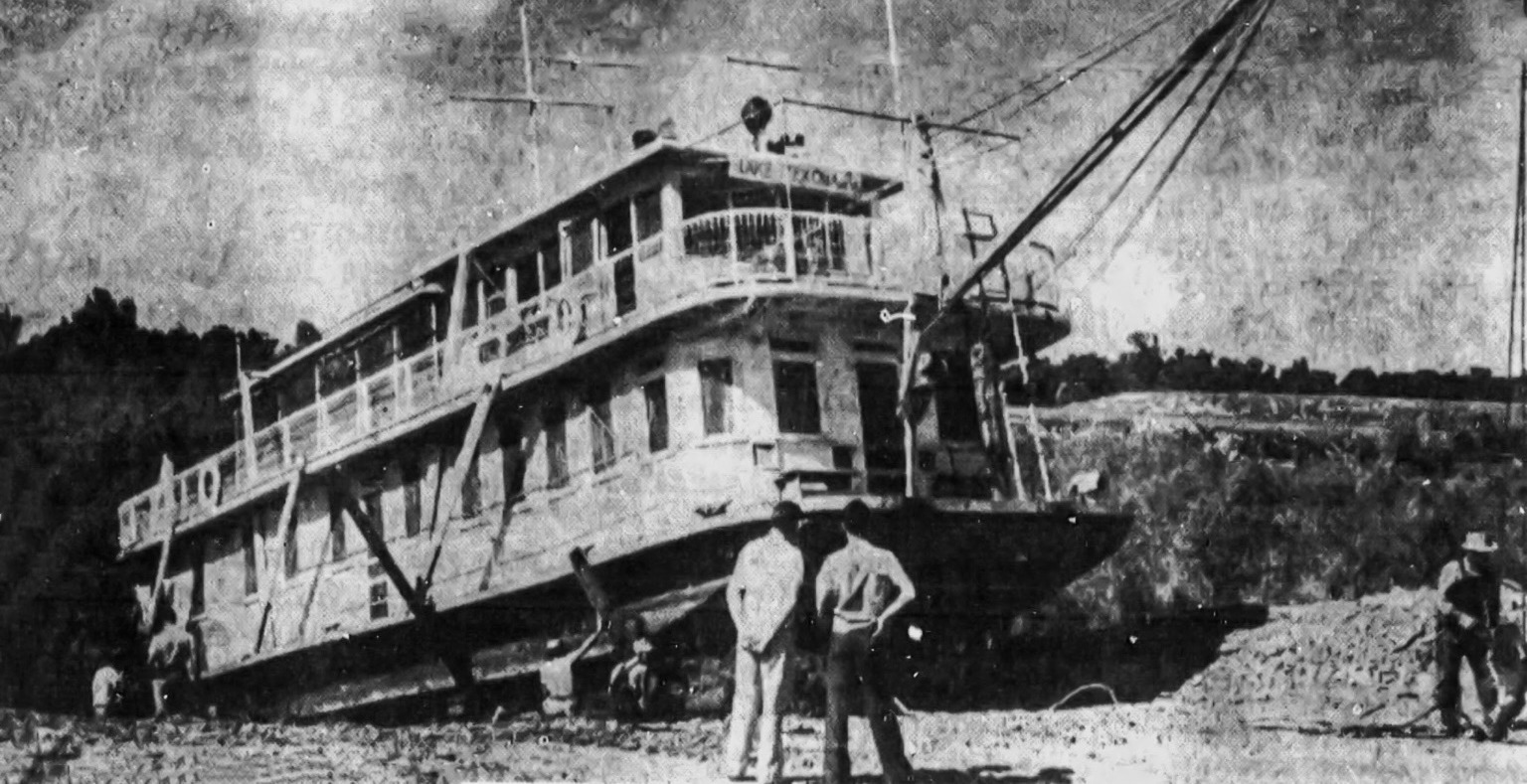
Upon reaching the Denison Dam, the original plan to employ a heavy-duty moving contractor to inch the boat from the river and around the north edge of the dam for launching in the lake has been abandoned, and the Wilburns decided to handle the chore themselves. A 100-foot skid had already been constructed below the dam, and it was used as a sled as the boat was tugged by tractors.
Once at the dam, she had to tie up 100 yards west of the highway bridge for two hours while clearance for her docking at the dam was obtained from the U. S. Army Corps of Engineers.
Crowds lined the banks of the river, waving flags and cheering as the Wanderer emerged from the Red’s muddy mouth to be later placed in the clear Texoma water. Children scrambled onto the rocks for a better view. Veterans from Perrin Field saluted. The Corps of Engineers recorded the moment on film, noting it as “the first sternwheeler to reach the lake by inland route.”
The Durant Daily Democrat reported on July 18, 1948, that “workmen started movingthe'Wanderer,'much publicized river steamer, Saturday, but the big boat was moved only about 1000 feet from her river mooring site, and can be seen by tourists visiting the Denison dam area today.”
'The river boat was placed on skids after being pulled from the river below the dam, and was moved by tractors by use of a crane and system of pulleys. The Wilburn brothers, owners of the boat, said they would probably obtain roller house moving equipment to transport the Wanderer around the north end of the dam to her home port at Burns Run.”
The steamer was then set up on shore on skids, where repairs were made to prepare her for excursion duty on Lake Texoma. Among the repairs was the removal of the walls of the cabins and turning both decks into large salonsfortheaccommodation of excursion customers.
On July 23, 1948, the Durant Weekly News reported, “It will be 30 days, in all likelihood, before final modifications are made and the boat is approved by the Coast Guard for excursion service on Texoma. By that timescheduleswillhavebeen determined and approved by theNationalParkserviceand regular trips will be started. In addition to the scheduled excursions, the boat will be available for charter. It is likely that the 'Wanderer' Will be moored at Burns Run, near the north end of the dam, with possibly a pickup dock for passengers somewhereontheTexasside. However, practically all details of the operation remain to be worked out.”
The paper went on to state that the Wanderer would be out of the water while “modifications will be made to accommodate the number of passengers to be permitted by the Coast Guard on each run. The Wilburns hope to be able to carry as many as 200, but won't know until the Coast Guard conducts tests. Persons who boarded the 'Wanderer' at its mooring near the Highway 75 bridge Thursday morning for the 'last-mile' run to the dam were amazed at the shipshape condition of the vessel. Despitethelongandtiresome journey, the interior was immaculate and the attractive, comfortablefurnishingswere as well kept as those in any home. “
“The craft is already well arranged for excursion purposes, but it is possible that several of the six staterooms may be removed to make more deck space. There are twodecks,andasundeckmay be added atop the longe and pilot-house if it is needed. The galley is spacious and completely outfitted, and the Wilburns plan to serve food and refreshments aboard.”
“Included in the changes to be made in the Wanderer will be the installation of diesel power equipment. A 220-horsepower diesel will turn the big paddlewheels, replacing the 160-horse Hall-Scott gasoline motor that has been in service, the one that brought the craft up the long pull to the dam. Aiding the three brothers in bringing the boat up the river is a fourth and younger brother, Alton, who has just returned from duty with the Navy. His experience on the water was exceedingly helpful to his older brothers, who style themselves as 'landlubbers' (before the river trip, that is)” “Families of all three of the Wilburns were aboard for the short finale Thursday, and Henry's wife had been on from Shreveport. She can vouch for the stories the men tell, because she was right in there in the thick of the fight for much of the time. Mrs. Frank Wilburn, with a friend, Mrs. Blanche Hunter, went aboard at Bonham and were beginning to make good deckhands by the time port was reached. As to the youngsters, they all hove to when there was a job to be done. Because of their baby son, Mrs. Glenn Wilburn was able to join her husband only for the Thursday trip, but both she and the boy enjoyed it hugely and she Will be available for duty when the vessel goes into regular service.”
“All three of the Wilburns took off excess weight, and hardened up their muscles during the six weeks of the trip. But not because of the meals, which they were quick to compliment. Various ones did galley duty, but the ladies took over when they came aboard, and there certainly was no cause for complaint after that. There was one three-day stretch far down the river when the food was running low, but a cornfield on the riverbank helped tide them over.”
“Mrs. Henry Wilburn was asked by reporters if she considered her river trip her summer vacation. 'I'd rather just call it an 'experience'', she replied drily. The Wilburns all are flyers, and have their own plane, so food was flown to the boat on several occasions by one of the group who happened to be back in Denison looking after their market. As one of Henry's boys, Carl Badie, expressed it, 'We've got automobiles and airplanes, and now we've got a boat. On land, sea, land in the air.”
Before a drop of Lake Texoma water ever touched her, The Wanderer’s owners began receiving hundreds of inquiries from individuals andgroupswishingtocharter her for special trips, parties, and other festivities. Still, no engagements were being made that far in advance.
In those summer weeks of 1948, The Wanderer rested high on the shore at the Denison Dam, her paddlewheel quiet, her brass fittings gleaming in the Oklahoma sun.Themenwhohadnursed her up the long red river now walked her decks in quiet satisfaction, and the women who had fed and steered and worked beside them leaned on the rail to watch the wind ripple across the unfinished lake.
She had traveled more than 1,000 miles to get there—from Greenville, Mississippi, to the muddy bends of the Red—and she had brought with her more than her hull and timbers. She carried a history. The craftsmanship of the Kahlkes. The romance of the Mississippi. Thestubbornnessofmenwho refused to let go of a dream, even when the world had moved on.
Lake Texoma was young then, gleaming with promise— and now, at last, it had its very own riverboat.
For the first time since the calliope of the Wanderer had fallen silent on the Mississippi, she would again have music in her decks and laughter in her halls.
Next week: The Wanderer is launched at Lake Texoma to great fanfare—but before her maiden season could begin, tragedy struck. It was supposed to be a new beginning. Instead, it became the last chapter in the story of the Wanderer.
FromtheboatyardinRock Island to the mighty Mississippi, up the Red to the new inlandseacalledTexoma,her journey would not end at the water’s edge. What began as a dream of pleasure cruises and summer dances would twist into a courtroom drama that reached all the way to Washington. The tragedy that befell her sparked something larger—a question of liability, of truth, of whose story the law would believe.
Next week’s chapter follows The Wanderer from her glittering launch to her ruin, fromthehandsandhammers of her builders to the gavels of the justices—from the paddlewheel to the marble steps of the Supreme Court of the United States—where her name, born on the Mississippi, would echo one last time in the marble halls of American law.