
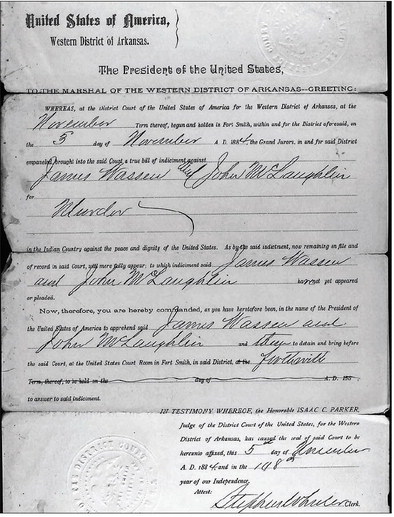
In the searing summer of 1885, as the sun baked the iron bars and stone walls of the Fort Smith courthouse, the wheels of justice turned once more beneath the stern gaze of Judge Isaac C. Parker— the infamous “Hanging Judge” of the Western District of Arkansas. His courtroom, perched above a fetid jail packed with the damned and the desperate, had become a final waypoint for the lawless of Indian Territory. This time, it was James “Jim” Wasson who stood in the dock, accused not merely of violence, but of calculated, cold-blooded murder.
Following his apprehension near Muskogee, Indian Territory, Wasson was first taken to Sherman, Texas, where he was identified and officially arrested for murder, then he was transferred to the federal jail in Dallas. Then on November 5, 1884, the Federal Grand Jury that served the Federal Court for the Western District of Arkansas, and Indian Territory, issued an indictment officially chargingWassonwith the murders of Henry Martin and Almarine Watkins.
Wasson’s indictment was grim: it was for the ambush and execution of Henry Martin, an unarmed neighbor, gunned down near sundown along a lonely path near Woodville in the Chickasaw Nation. The government alleged it was no quarrel in the brush, no heat-of-themoment altercation, but a planned killing carried out with a .45-caliber pistol by Wasson and his suspected accomplice, John McLaughlin. Behind the motive, prosecutors claimed, lay an old grudge—buriednowbeneath blood and silence. A second murder charge loomed in the background—the killing of Almarine Watkins, for which Watkins’widow would later offer a $1,000 bounty. However, it was for Henry Martin’s death that Wasson would first face judgment.
On Tuesday, December 2, 1884, Wasson was delivered to Fort Smith in chains by Deputy U.S. Marshal J. A. McKee of Dallas, Texas. In the December 5, 1884, issue of The Fort Smith Elevator, it was reported that “Deputy U.S. Marshal J. A McKee of Dallas,Texas,arrivedhereon Tuesday night via Little Rock with Jim Wasson and William Lattimore, both charged withmurder.Wassonhastwo murders to answer for; one committed over two years ago and another in July last. His last victim was Almarine Watkins, whose wife paid $1000 for the capture of Wasson. He was arrested several weeks ago and taken to Texas, where he has since been lying very sick in the Dallas jail.”
From his arrival at Fort Smith on December 2, 1884, until his sentence was executed on April 23, 1886, James Wasson was confined in the basement jail, beneath the solemn chambers where Judge Isaac C. Parker presided with grim determination and delivered justice. The jail was a hellish underworld few could imagine, and even fewer emerged unchanged. The basement jail of the federal courthouse was not just any holding cell; it was a festering pit of human misery, a place where the rule of law loomed above, blind to the stench and suffering below.
Constructed as part of the courthouse complex in the 1870s, the jail was designed to hold criminals from the vast and unruly Indian Territory— an area so lawless that Fort Smith became its final frontier of order. With no proper prison infrastructure in the Territory, all federal prisoners were brought into Parker’s jurisdiction. The result was a cell block built for just a handful but crammed with up to 200 men at a time, manyofwhomwereawaiting trialformonthsorevenyears. Murderers, drunks, horse thieves, and innocents alike were thrown into the same sweltering vault, their fates sealed not by juries but by proximity.
Theconditionswereabominable. Light barely filtered through the barred windows, which were obstructed by outer guard walls. There was no plumbing, just buckets for excrement. Bedrolls were matted with lice and filth. Food was scarce, often spoiled, and fights erupted over scraps. In the summer, the air thickened with sweat, vomit, and despair; in the winter, the cold penetrated thin rags and seeped into the bones. Disease festered. Rats scurried about. Death was not uncommon.
The infamous outlaw Henry Starr, who would eventually become notorious in his own right, described the Fort Smith jail as “the worstever.”Herecalledbeing placed in a cell where the bedding stank and was infested with vermin. “The odor of a large, poorly kept jail,” he wrote, “is worse than the animal section of a circus.”
But the worst of all was the proximity to the gallows. Just outside the jailhouse walls, the hangman’s scaffold loomed—a constant, visible threat. Prisoners could hear it being built, see the trapdoor tested, and smell the freshcut lumber. For many, the last sound they ever heard was the clang of the jailer’s boots and the final summons: “Your time has come.”
While Judge Parker was recognized for his commitment to law and order, administering justice to hundreds, including over 160 death sentences, the basement jail beneath him presented a stark contradiction. It was a place where the Constitution’s promise of a fair trial collided with the harsh reality of frontier punishment. In that dark, airless tomb, justice may haveprevailedupstairs—but down below, only survival mattered.
While in jail, Wasson filed urgent requests for witnesses. From the cotton fields near Denison and the dirt trails of the Chickasaw frontier, he pleaded with the court to summon voices that might redeem him: men who could say he was unarmed, who could speak of seeing others fire first, who might tell a different tale entirely. “This application is not made for delay,” Wasson swore, “but in good faith that justice may be done.”
Justice, however, was already sharpening its blade. Representing the United States government were seasoned prosecutors Powell Clayton and Jordan E. Cravens, equipped with an impressive array of testimony from homesteaders, landladies, lawmen, and scouts. Ten witnesses stood for the prosecution, beginning withJohnMerriman—a plainspoken farmer whose testimony traced the final moments of Henry Martin’s life with haunting clarity. Clara Merriman, his wife, corroborated his observations. Elizabeth Brooks, Martin’s landlady, provided the domestic backdrop. Next came Stephen Bussell, Joseph C. Edwards, Jack and Jesse Birdsong, George O. Reeves, and Deputy Marshal John G. Farr—each contributing details of shell casings, horse tracks, and the brutal mathematics of distance and direction. Most curiously, there was Alex Juzan, whose own past was shrouded in shadow but whose recollections on the night of the murder placed the accused near the scene with chilling precision.
Standing against this tide of testimony were defense attorneys William Moore Mellette and James Kent Barnes, ready to mount a final defense. They called five witnesses:JohnA.McAlister, who introduced the possibility of alternate timelines; CharlesandMetWasson,the brothers of the accused, who presented him in a different light; Arnold L. Conyers, who testified about the intricacies of firearm caliber and function; and finally, James Wasson himself—who took the stand, looked twelve jurors in the eye, and attempted to reclaim the narrative of his life.
What followed was more than a trial—it was a parable of frontier justice, a clash between personal vendetta and public order, fought in a room thick with heat, dust, and death. Every story told, every shot described, and every hoof of a horse tracked across the territory became another rung on the rope waiting outside the courthouse wall.
This is the unvarnished account of that trial—testimony by testimony, word by word. The voices that rose in Parker’s courtroom that July spoke not only to guilt or innocence, but to the brutal soul of a nation still struggling to tame its wild edges. What they said, and what the jury believed, would determine whether James Wasson walked free—or danced on air.
And in the shadow of the gallows, with the noose always near at hand, every word carried weight. Every witness, a rung on the rope.
The first witness called to the stand by the prosecution was John Merriman. Merriman, whosehomewaslocated just a mile from Wasson’s, delivered testimony that, while not placing the defendant’s finger on the trigger, painted a damning picture of proximity, opportunity, and deadly consequence. His words traced the path of an ordinary afternoon that ended in a brutal slaying just beyond his fence line.
According to Merriman, it was November three years ago, near sundown, when Henry Martin rode with him from Woodville back toward their neighboring homesteads.Martin,whohad been helping Mrs. Brooks, his landlady and housemate, move across the road from Merriman’s place, was in good spirits and, as Merriman recalled,saidheplanned to visit Alex Juzan’s place a quarter mile northeast. That was the last Merriman saw of him alive.
Shortly after Martin departed, Merriman saw two men ride up on horseback— one on an iron-gray horse, the other on a brown. Though he couldn’t be sure in the dusk, he believed them to be Jim Wasson and John McLaughlin. They dismounted and walked toward Mrs. Brooks’s house, tying their mounts to Merriman’sfence,stepsaway from where Martin had last been seen. Merriman then turned his attention to his chores, and he did not see Wasson and McLaughlin ride off.
A short time later, Merriman heard the unmistakable crack of gunfire, just as the sun slipped below the trees. Merriman, tending his lot, heard a rapid series of shots from the direction of Birdsong’s land, northeast of his property. “They were firing so fast I couldn’t count them,” he said. After a pause of several minutes, a single, final shot rang out, then silence.
Fifteen minutes later, Martin’s horse—saddled and bridled, but riderless—came trotting back to Merriman’s yard. Merriman and Steve Bussell, another neighbor, watched it approach from the northeast—the exact direction from which the shots had originated.
They summoned Eastman Harney, Lucy Juzan’s husband, and the three men followed the trail. What they found was horrifying: Henry Martin, lying face-down in the brush, his pistol still holstered beneath his coat, his body pierced by multiple bullets.
Merriman described the location precisely—250 to 300 yards from his house, ten steps off the road, near a branch and timberline. The men returned with Marshal Jack Relerford, who recovered Martin’s pistol, noting that only one of its six chambers had been discharged.
The next morning, Merriman and others followed horse tracks from the scene: onehorseshodallaround,the other unshod, leading east through the woods toward Alex Juzan’s land. Robert Birdsong, searching the area independently, found ten to twelve spent cartridges scattered near the site—evidence of a close-range, relentless assault.
Martin’s wounds told the rest of the story. Merriman recalled two gunshots through the left side, a third through the neck, and a fourth at the base of the skull, exiting through Martin’s cheek and embedding itself in the hard ground below.
Under cross-examination, the defense tried to draw attention to Martin’s earlier interactions with Wasson and McLaughlin. Merriman confirmed that all three men had been seen laughing and conversing peaceably at Morton & Durham’s store in Woodville earlier that day. He admitted that shooting was not uncommon in the area, and at the time, he thought little of it.
Butinredirect,thegovernment established that the gunfire that night stood out, not just for its volume but for what followed. Merriman reiterated that Martin was unarmed in his final moments, his pistol still holstered, his body riddled with lead.
While Merriman did not witness the murder itself, his testimony offered the court a near-complete sequence of events—from Martin’s departure and the approach of Wasson and McLaughlin to the volley of gunfire, the return of Martin’s horse, and the grim discovery of his corpse.
In a trial where hard evidence was scarce and character was everything, John Merriman’s straightforward account carried the solemn weight of a man who had seen too much death, too close to home.
Whether or not the jury believed it was Wasson who pulled the trigger, there could be little doubt—Merriman’s testimony confirmed a calculated ambush, not a frontier quarrel.
The second witness called to the witness stand by the prosecution was Mrs. Clara Merriman, wife of John Merriman. Mrs. Merriman proved to be as haunting as she was human. Calm, composed, and unwavering under the scrutiny of Judge Isaac Parker’s court, her recollection provided a domestic window into the moments preceding Martin’s death— and the strange demeanor of the men suspected of killing him.
Mrs. Merriman recalled the events of that fatal day with striking clarity. It was a day of relocation—Mrs. Brooks, her neighbor, had agreed to trade houses with her, and Henry Martin, who had been boarding with Mrs. Brooks, had been helping haulwoodaspartofthemove.
Amid the bustling household, Jim Wasson and John McLaughlinarrivedonhorseback, tying their mounts behind the Merriman home. “They asked where Henry Martin was,” she testified. “I told them I didn’t know.” She noted that the men made no further inquiries and left shortly after, heading toward Mrs. Brooks’s new residence, just up the way.
Notably, she observed no overt signs of hostility, but did testify that McLaughlin appeared to have been drinking, laughing and talking freely. “Jim was grinning around too,” she added, though she couldn’t say whetherhewasdrunk.“They both appeared calm.”
Roughly ten minutes after Wasson and McLaughlin rode away, Clara heard what she described as a series of pistol shots— “eight or ten,” she said, echoing earlier testimony from her husband. The sound came from the direction of Mrs. Brooks’s house—the same direction the men had gone.
Within minutes, Henry Martin’s horse returned riderless, a black pony still bridled and saddled, emerging from around the fence line. Clara watched as her husband and neighbor Steve Bussell debated whether to catch the horse. They did not act immediately. “They said they didn’t like to go down there by themselves,” she explained, so a man named Dick was sent to fetch Eastman Harney.
After Harney arrived, the men went to find Martin. By that time, the sun had set, and the prairie dusk had fallen heavy. What they discovered, Clarawouldnotsoon forget: Martin’s body was brought back lifeless, laid out at Mrs. Brooks’s house.
Though Clara did not witness the shooting itself, she corroborated key details presented earlier: that Wasson and McLaughlin had inquired specifically about Martin; that they did not linger, and that gunfire erupted almost immediately after their departure. She noted she did not see any weapons on the men but couldn’t say whethertheywereconcealed.
She also added that Steve Bussell later returned briefly with the pair, but she did not know what happened next. Wasson and McLaughlin did not pass back by her house after the shots. “If they had,” she said, “I reckon I could have seen them.”
Clara’s familiarity with the men gave her added credibility in court. “I’ve known John McLaughlin a good while,” she said plainly. Whenaskedifhehadseemed upset or distressed on the day in question, she shook her head. “He was laughing and talking.”
As for Henry Martin, Clara described him as a boarder, someone who came and went, a man with no known wife, though he was perhaps involved in trading horses. “He and my husband hauled a load of wood apiece that morning,” she recalled.
She was also adamant about one geographical point: the shots came from the west, the direction in which the men had headed.
Under cross-examination, Claraheldfirm.Sheacknowledged she did not see the shooting, nor could she track the exact movement of Wasson and McLaughlin once they disappeared around the bend. But her timeline matched that of her husband: the men arrived, asked for Martin, and departed—then shots rang out.
She confirmed that her husband had gone with Martin to Woodville earlier that afternoon, returning togetherjustbeforesundown. She noted that Martin’s return was only a short while before the attack, perhaps a half hour. And when asked whether it was common to hear gunshots in that part of the territory, she said simply, “Yes sir,” though not usually so many all at once.
While Clara Merriman’s testimony did not provide a visual of the crime, it helped to fill in the human and domestic backdrop—offering the jury a glimpse of what ordinary life looked like in theChickasawNationonthat late autumn day. Her words captured the strangeness of the visit, the haste of the events, and the suddenness with which violence replaced routine.
For the prosecution, her recollections served to link Wasson and McLaughlin directly to the victim’s movements and timeline, giving weight to the suspicion that the two men had sought Martin out—and that the encounter ended not in conversation, but in murder.
With the weight of sorrow and the steadiness of a woman long accustomed to frontier life, Mrs. Elizabeth Brooks—a quiet yet observant resident of the Chickasaw Nation—took the stand next in the murder trial of James Wasson. Brooks was the sister of Luzy Juzan Harney and Alex Juzan. She was also the aunt of Brooks’ stepson, Stephen Bussell.
Her testimony placed Wasson and his companion, John McLaughlin, at her home mere minutes before the murder of Henry Martin, the young man who had, for two or three months, called her house a temporary home.
Mrs. Brooks testified that the events began like any other day. She had moved her household into a new homethatveryday,partlyassisted by Henry Martin, who had helped her haul a load of wood that morning. “He helped me move,” she said. “He was staying down at my house when he was killed.”
Later that afternoon, between sundown and dark, Wasson and McLaughlin arrived at her home on foot, having left their horses tied at John Merriman’s fence nearby. They walked into her kitchen, where she was preparing supper, and Wasson asked directly for Henry Martin.
“I told him I didn’t know wherehewas,”Brooksstated. Without further comment, the two men entered her front room, where Mr. and Mrs. Edwards were staying. Then, without fanfare or further conversation, they left her house, returned to their horses, and rode north, toward the direction of Birdsong’s home—the same direction from which, shortly thereafter, gunfire echoed across the field.
Though Mrs. Brooks could not precisely count the number of gunshots, she confirmed they came shortly after the men departed, and in the direction of Birdsong’s place, which lay to the northeast of her own. “It was a short time,” she said. “Nearly together… about dusk.”
Asked if she saw either man again that evening, she said no. They never returned to her house. But moments after the shots rang out, Martin’s black pony, still saddled and with bridle reins dangling, came galloping riderless to her fence.
“I knew Martin’s horse,” she told the court. “Old man Edwards caught it and tied it to the fence. I then sent for my brother-in-law.”
After the gunfire and the pony’s arrival, Martin’s lifeless body was later brought to her house by Jesse Birdsong and others. “I saw him,” she said plainly, her voice steady. “He was dead. I only saw one wound—on his neck.”
Pressed on the matter, she confirmed that the wounds were not examined closely, butthatthesceneleftnoroom for doubt—Martin had been gunned down between her house and Birdsong’s, lying in the open field as the dusk deepened into night.
Mrs. Brooks, notably, testified that neither man made threats.“Theyseemedtobein good humor,” she said. They did not appear drunk, nor did they speak or behave in any aggressive manner while in her kitchen.
She could not say whether they were armed. Nor did she witness what happened once they left her yard. But the timing, she emphasized, was tight: they came, asked for Henry, left—and then the shooting began.
When asked whether she hadseenthemagainafterthe killing, she replied: “Not until about a year later.”
On cross-examination, Mrs. Brooks remained composed. Defense attorneys tried to challenge inconsistencies in earlier statements, particularly regarding when she last saw Martin alive. In one version, she stated it was in the morning; in another, she said it was in the afternoon.
She clarified she was not familiar with the commissioner at Sherman, Texas, where her previous statement had been made and stood firm that Martin had left mid-morning, after helping her move.
As for the geography, she confirmed that Birdsong’s home lay northeast, while hers was in the southeast corner of the field. Though she didn’t know exact distances, she described the shots as coming from a direction consistent with where the men had gone.
Asked if gunshots were common in the area, she admitted yes—they were not an unusual sound in the Chickasaw Nation. But this was different, in part because the men had just come seeking Martin, and the shots came only minutes later.
Mrs. Brooks had known Jim Wasson since boyhood, a fact that lent her words an added gravity. “I’ve known him ever since he was a little boy,” she said quietly.
Her connection to Mrs. Watkins,whosefamilywould later suffer another tragic loss at Wasson’s hands, gave the court a poignant glimpse into the fabric of community ties—how these events tore through families, friendships, and farms.
Though not a direct witness to the shooting itself, Mrs. Elizabeth Brooks’ testimony was vital to the prosecution’s efforts to trace the accused’s movements, intent, and proximity to the crime.Heraccountsupported the emerging narrative that Wasson and McLaughlin soughtoutHenryMartinthat day—andthathisdeathcame swiftly after.
On the broader patchwork oftestimonywovenacrossthe courtroom,Mrs.Brooks’voice rose not in judgment, but in clarity. Her role was not to speculate, but to report what she saw, what she heard, and what she lived—and in doing so, she helped draw the noose of truth ever tighter around a case that had haunted the Chickasaw Nation for years.
In Fort Smith’s chambers of justice, it was not merely guilt or innocence on trial—it was memory, motive, and the echoingstepsofmurderalong a Chickasaw trail.
With seven more prosecution witnesses to come, the trial of James Wasson continues next week in Part VI of No Man’s Law.