
In the annals of Indian Territory, where justice often lagged behind the blood it sought to avenge, some names echo long after the ropehasfallenandthegraves have settled into silence. One such name is James 'Jim' Wasson. His story is not one of misunderstood rebellion or redemption. It is a tale of wrath, of wasted time and wicked choices, and of two Harney/Woodville men— Henry Martin and Almarine Watkins—whose lives were ended not by fate, but by the cold calculation of a man long at odds with the world around him.
Born in Tennessee around 1848 or 1849, Wasson’s early life remains largely lost to history. However, his early years are believed to have been shaped somewhere in the turbulent margins of the post-Civil War South. From what little information is available, he was raised among rough frontier folk, in a household where guns were kept near the door and grudges were not easily forgotten. By temperament, he was combustible. Men who knewhimlaterdescribedhim as intense, quick to speak harshly, quicker to act when drinkwasinhim.Iftherewas ever a gentle chapter in his early life, it vanished well before he crossed into Indian Territory.
It’s unclear exactly when Wasson arrived in the Chickasaw Nation, but by the late 1870s, he had established himself in the vicinity of Harney, which would later become Woodville. However, a few scattered references place him in Pickens County, Chickasaw Nation, during the mid-1870s. By the time his name started showing up in local records, he was already treading the line between honest living and outlaw ways.Hewasawitnessin cattle transactions—maybe legitimate, maybe not—and was known in Harney and Woodville, where the rough edges of civilization gave way to the untamed frontier. This was a stretch of land rich with tangled woods and red clay, where the Chickasaw people and white settlers shared space uneasily under a web of federal law and tribal authority. Men like Wasson could slip through the cracks of jurisdiction. And they often did.
The first verified record of his presence in Indian Territory appears in the County Court Records of Panola and PickensCounties,Chickasaw Nation, on page 244, dated October 7, 1874.
On that day, he served as a witness to two transactions involving James Beven and the Christian brothers, James and John. (The Christian brothers would later become embroiled in a feud that cost several men their lives. We will discuss that in a later part of this series.)
The first was a bill of sale for ninety head of cattle, marked with a smooth crop off the left ear and two splits in the right ear, branded with a capital “B” on the left side and shoulder. The language of the transaction stated: “I, James Beven, relinquish all right, claim, and title to said cattle and said mark and brand. I, James Beven, defend all demands against said stock.” The bill of sale was signed by James Beven with his mark and witnessed by John Fullington and James Wasson.
On the same page and day, James Wasson also witnessed a second bill of sale from James Beven to the Christian brothers. That document read: “I, James Beven, do bargain, sell, and convey to James and John Christian eighteen (18) horses. Branded B on the left shoulder. To which I, James Beven, relinquish all right, claim, and title to said stock. And I, James Beven, defend all demands against said stock.” Again, it was signed by James Beven, his mark, and witnessed by John Fullington and James Wasson.
JamesWassonhadatleast two brothers: Demetrius (known as Met) and Charles A. Wasson. Met Wasson appears earlier than James in the County Court Records of Pickens and Wichita Counties, Chickasaw Nation, recorded in Book Two, page 81, on April 12, 1872. That record was a Permit Registration, reading: “I hereby certify that Met Wasson is duly registered after being in theemployofBenj.C.Burney for one year from date. Given under my hand this April 12th, 1872.” Signed: Wm. P. Worthington, Clerk.
In June of 1879, James Wasson was charged in the Federal District Court for the Western District of Arkansas with the crime of assault with the intent to kill a man named Thomas Black. The charge stated, “James Wasson, a white man, did in the Indian country, Western District of Arkansas, on or about the 1st day of June, 1879, feloniously, willfully and maliciously commit an assault with a deadly weapon, to-wit, a pistol, upon the personofThomasBlack,with intent him, the said Thomas Black, then and there to kill, contrary to the form of the statute in such case made and provided, and against the peace and dignity of the United States, and I pray a writ.ZackWoody,Subscribed and sworn to before me this 27th day of July 1880, M. F. Wheeler, U.S. Commissioner.” The witnesses to the crime were listed as Alex Juzan, Jerry Lewis and Thomas Black.
Alexander “Alex” Juzan (1853–1887) was a prominent figure in the Chickasaw Nation during the late 19th century. Born on August 9, 1853, in Boggy Depot, Atoka, within the Choctaw Nation in Indian Territory, he was of mixed heritage—his father was Choctaw, and his mother was Chickasaw. This heritage allowed him to claim citizenship in both tribes, a notable status in the Indian Territory. Alex had two sisters and a brother. The sisters were Rebecca Elizabeth “Betsy” and Lucy. Betsy married John Bussell about 1873. She later married John Brooks in Berwyn, Pickens County, Chickasaw Nation, on September 24, 1874. John was born in North Carolina. John died before 1898. Betsy & John Bussell had one son named Stephen 'Steve' Bussell, born about 1864. Betsy & John Brooks had the following child: Aleck Alexander 'Alex' Brooks, born Aug 7, 1876. Betsy and John Bussell’s son will play a prominent role in another part of this series involving the death of four or five men.
Alex Juzan married Henrietta “Nettie” Hume, and the couple had three children together. Alex Juzan passed away on April 13, 1887, in Woodville, Pickens County, Chickasaw Nation, Indian Territory. He was laid to rest in the Juzan Family Cemetery just north of Old Woodville. The Juzan family’s legacy is intertwined with the history of the Chickasaw Nation, reflecting the complex social and legal dynamics of the Indian Territory during that era.
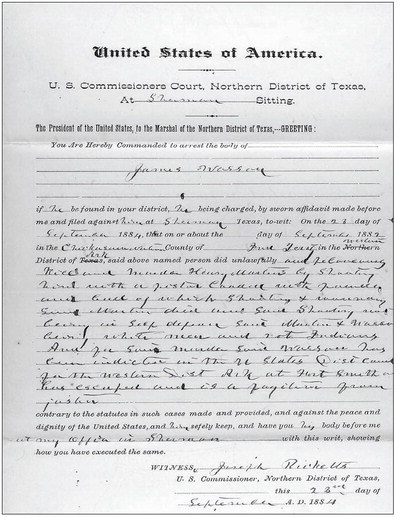
At some point, Wasson made bond and was released from the federal jail in Fort Smith, and he disappeared. On June 30, 1880, the federal court issued an arrest warrant for Wasson. The warrant stated as follows: “United States of America, Western District of Arkansas. The President of the UnitedStates,totheMarshal of the Western District of Arkansas, Greeting: Whereas, complaint on oath hath been made before me, charging that James Wasson did, on or about the 1st day of June, A.D. 1880, in the Indian country, Western District of Arkansas, commit an assault with intent to kill, contrary to the form of the statute in such casesmadeandprovided,and against the peace and dignity of the United States.
Now, therefore, you are hereby commanded, in the name of the President of the United States of America, to apprehend the said James Wasson and bring his body forthwith before me, Stephen Wheeler,Commissioner appointed by the United States District Court for said District, whenever he may be found, that he may be then and there dealt with according to law for said offense. Given under my hand, this 30th day of June 1880, in the 105th year of our independence. Stephen Wheeler,Commissioner,U.S. Court, Western District of Arkansas.Wassonwasnever arrested on this warrant.
These records offer the first solid insights into James Wasson’s life in the Chickasaw Nation—well before he became a killer yet already involved in the frontier’s dealings of violent crime, cattle, permits, and close ties to the law.
Wasson was not alone. He had brothers—Charles, Mel, andMet—andacloseassociation withJohnMcLaughlin,a part-Chickasaw man whose family held significant influence in the region. Together, they formed a circle of men tied not just by blood or friendship, but by a common reputationforrowdyconduct, feuds, and suspicion. And despite already facing the attempted murder charge, by the early 1880s, Wasson had already faced charges of assault. Yet he managed to remain a free man, his temper and temperance barely checked by the slow grind of territorial law.
James Wasson worked as a laborer, sometimes as a hunter, and at times as help on small ranches that bent the law. He teamed up with John McLaughlin, a man of like disposition—tightlipped, armed, and always on the lookout. The two became known in the community, though they were never well-liked. They were moretoleratedthanaccepted, and whenever trouble arose, their names were often the first mentioned.
It was during this time that Wasson crossed paths with Henry Martin, a man in his early forties. Martin was not loud or boastful; he earned respect with his back and with his silence. He worked the land around Harney and was known for fairness, sobriety, and keeping close to family. Those who knew him said he could settle most matters with a few plain words—and people listened. That quiet strength rubbed Wasson the wrong way. Whether it was envy, resentment, or some imagined slight, a bitter seed was planted in Wasson’s heart, and by 1884, it had grown into something deadly.
Wasson began speaking openly—mostly after a drink—about Martin. He said he’d “show that man what happens when he was crossed.” The tension grew. There were whispers of altercations andargumentsonthe road. But nothing stuck until thesummerof1884whenthe spark finally found powder.
In July of that year, Wasson and McLaughlin crossed the Red River into Texas, as they had many times before, to fetch a keg of whiskey. They returned to Indian Territory within days, heavily armed, heavily drunk, and burning with rage. Wasson had decided it was time to settle matters with Martin— permanently.
On the evening of July 29, 1884, two men rode along the scrubland paths west of Woodville. They arrived at Martin’s home near Elizabeth Brooks’ place, only to find he wasn’t there. Word had it he had gone to another neighbor’s house. So, they pursued him.
As the sun dipped toward the horizon along a winding trail near the Birdsong place, Wasson and McLaughlin encountered Henry Martin riding home on horseback. Nowordswerespoken.There was no quarrel, no demand, no warning. Instead, sudden violence erupted - shots cracking through the evening air. Wasson’s first shot struck Martin in the upper chest. McLaughlin’s bullet followed. Martin fell from his horse, hitting the dust hard. Whether he died instantly or lingered a moment is not known,butbythetimeneighbors found his body later that evening, there was no breath left in him. His hat lay in the ditch, and his horse had bolted for home.
Witnesses later recalled the cadence of the gunfire: a flurry, then a pause, then one final report that echoed through the trees. That last shot, it was said, came from Wasson himself, who turned back to ensure the deed was done, firing a bullet into Martin’s head.
The body was left where it fell. Martin lay face down in the dirt, his jaw shattered, his skull split, his torso riddled with bullets. Elizabeth Brooks and the Birdsong family, alarmed by the gunshots, soon came upon the grisly scene. The corpse was carried back to Brooks’ home. The murder, though hidden by woods and dusk, had not gone unseen. Thecommunitywhisperedin fear and anger. Justice would come—but not yet.
The killing sent shock through the community, but Wasson and McLaughlin had already vanished. They crossed the Red River into Texas, disappearing into the wilds near Gainesville, drifting fromonecamptoanother, protected by a mix of kin and criminal company who cared little about the law of Indian Territory. For nearly two years, Wasson remained on the run. He drifted across the borderlands and the open plains, staying ahead of the law.
Two years passed. Then, for reasons known only to himself, and with the arrest warrant issued for him regarding the shooting of Thomas Black still pending, Wasson returned to Indian Territory. He came back to the very ground where he had spilled blood. Perhaps he believed the trail had gonecold.Perhapshewanted something. Upon his arrival back at Harney/Woodville, where life moved slowly and grudges lasted a long time, he kept a low profile but couldn’t escapehispast.Hereportedly attended a church revival where someone urged him to repent. He refused, saying there could be no salvation for a man who had killed in cold blood. That answer chilled those who heard it.
The community watched him warily. A murderer had returned, unpunished, defiant, haunted but unrepentant. James Wasson’s name would soon be tangled in another tragedy. But for now, it was the death of Henry Martin—raw, brutal, and without mercy—that echoed through the blackjacks and bottomlands of the Chickasaw Nation.
In the summer of 1886, just after the heavy rains had passedandtheWashitaRiver ran thick with clay and driftwood, two men—Alvarado Tucker and W.A. Riddle—assaulted the Weaver brothers and made off with a stolen horse and mule. They moved quickly, heading south past the scrublands and across the Washita into Texas. But their crime would set in motion events far larger than the theft itself.
A posse quickly formed in pursuit of the thieves. At its head was Almarine Watkins, a well-respected Chickasaw farmer and husband of Lucy Juzan Watkins. Lucy had married Almarine only eight months before. Though their union had been brief, it was spoken of as a rare bond-a marriage of both trust and quiet strength.
Amongthemenwhojoined thepossewereJamesWasson and Jerry Lewis. Wasson’s participation surprised some. Perhaps he sought redemption. Maybe he saw an opportunity for revenge, or simply for violence. Whatever his reason, he rode with them.
The group found Tucker and Riddle near Colbert Station, holed up near a ravine not far from the Washita River bottomlands. These men were not armed for battle. They surrendered quickly and, under questioning, admitted they had left the stolen livestock in a clearing wheretheyhadleftthemtied. But what should have been a lawful return of prisoners to federal marshals began to unravel. Someone had whiskey. A bottle was passed. The air grew thick with suspicion and argument.
At the edge of a dry creek bed, as the party paused to collect the stolen animals, a sharp disagreement broke out. Wasson, whose blood never ran cool under the influence, demanded that the thieves be hanged then and there. Almarine Watkins, steadfast and resolute, refused. He insisted they be brought to the authorities. His voice was calm but unwavering.
The exchange turned deadly. Amid the shouts and mounting tension, Wasson drew his weapon and fired. Five shots ripped through the air, striking Watkins in the chest and shoulders. Though mortally wounded, Watkins managed to draw hisownweaponandfirethree times—each shot missing its mark. Then Wasson stepped forward and fired once more into Watkins’ skull.
Watkins collapsed near the riverbank, his blood mingling with the earth. The rest of the posse, shocked and horrified, took Tucker and Riddle back to town. The livestock were retrieved and returned to their owner. But theonemanwhoshouldhave been brought to justice that day vanished into the timber, leaving behind not only a corpse, but the betrayal of every man who had ridden with him.
The murder of Almarine Watkins marked the second bloody chapter in the growing infamy of James Wasson, whose name by this time had become a watchword for violence whispered across the Chickasaw Nation. His escape after the killing of Henry Martin had hardened him,bothinresolveandinthe darkness of spirit that now seemed to claim him entirely. It was not just a matter of lawlessness anymore. Wasson had become something else: a man at war with decency, carryingashadowthat stretched beyond his own life.
The killing of Watkins, like the slaying of Martin, did not arise from some momentary spasm of anger. It came, instead, in the aftermath of a posse’s ride.
News reached Woodville quickly. The death of Almarine Watkinsstunnedthecommunity. But if justice hadn’t struck in that moment, it had begun to stir. And its name was Lucy Juzan Watkins. Lucyhadburiedonehusband already—Almarine was her second. But this death, unlike the quiet burial of her first love, stirred something in her that would not be silenced. She had ties—family ties, bloodlines that wound back through the powerful Colberts and the House of In-cun-no-mar. She had a voice. And she used it.
Afterburyingherhusband in Woodville Cemetery, she began her campaign to bring James Wasson to justice. She wrote to federal authorities at Fort Smith. She sent word to Indian agents and Chickasaw authorities alike. She gave them names, sightings, whispers. She told them where he’d been, who had seen him, and what direction he was last heading. Lucy Juzan Watkins became the driving force behind the effort to locate James Wasson. She kept the pressure steady.
Within days, she posted a $1,000rewardforthecapture of James Wasson. In 1884, it was a kingly sum, as today that amount would be almost $35,000. Her message was clear: the law might be slow, but it would not be denied. Her determination sparked whispers across the territory. A widow’s grief had become a community’s cause.
Men who once feared involvement now spoke up.
Posses were formed. Bloodhounds were deployed. Every creek, cabin, and cottonwood grove south of Fort Washita became a place of scrutiny. The name James Wasson, once muttered behind closed doors, now hung heavy in the mouths of lawmen and farmers alike. But Wasson had gone north. And it was in Muskogee, far from the red clay roads of his old haunts, that his shadow would finally be caught.
By then, Wasson had crossed into unfamiliar territory. He traveled northeast, away from his old haunts in Woodville, likely hoping to vanish into the borderland woods near Muskogee. It was acountryhedidn’tknowwell, and it made him nervous. He traveled light, avoiding towns, buying food when he could from Choctaw traders and settlers who asked few questions.
But every stop left a trace. A horse recognized here. A man’s voice remembered there. The whisper of a name passed through the smoke of a trading post campfire.
In Muskogee, far to the north, a Choctaw man came hurriedly into town and reported seeing Jim Wasson, the murderer of Almarine Watkins, about three-quarters of a mile west of town and going around. Sheriff Simp Bennett immediately gathered a crowd together and started in pursuit. Hearing he was at a house about a mile from the ferry, a man was sent ahead to hold him in conversation.
The man rode up and dismounted his horse, saying he was looking for cattle and that there was a party of cowboys with him. The lead man took a seat between Wasson and the door to prevent Wasson from running in. Soon, Sheriff Bennett and the rest of the posse rode up, remarking, 'lets stop and get a drink' as they dismounted. Wasson was entirely caught off guard and suspected nothing. As the Sheriff’s men walked by him, the Sheriff pointed his gun at Wasson and ordered him to hold up his hands. He had no choice but to comply when his pistol was taken from him and he was bound. Wasson’s lone response was, “Did Lucy send you?”
He was taken back to Muskogee, where Agent Tufts, a federal deputy marshal, decided to hold him. Telegrams were sent to Colbert Station requesting photographs. However, on Tuesday morning, Wasson weakened slightly and made several admissions that convinced the officers they had the right man. Upon arrival in Sherman, his identity was confirmed by men who knew him in Colbert Station.
After several days, Wasson was put on a train and transported under heavy guard to Fort Smith. There, beneath the enormous federal courthouse of Judge Isaac Parker—the “Hanging Judge”—Wasson was placed in the basement cell. He waited there, alone with the spirits of Henry Martin and Almarine Watkins, and the sound of his own breath in the dark.
The gallows would come. But that tale—of—courtrooms, witnesses, and judgment— would wait for another telling.
Next week, in Part V, we will discuss the trial of James Wasson.