
After being commissioned by several businessmen from Madill to create preliminary plans for the Marshall County courthouse during the bond issue battle, the County Commissioners officially contracted with Jewell Hicks as the architect for the courthouse. In a commissioner meeting on May 9, 1914, the commissioners signed a contract with Hicks to act as the architect and “GeneralSuperintendent”for the design and construction of the courthouse.
Based on the next action of the commissioners, Jewell Hicks had already completed the design and full architectural plans for the courthouse before the county officially hired him as the architect. Because on May 15, 1914, thecommissionersmetagain, and at this meeting, they issued a “Notice for Bids” for construction. The notice stated as follows: “Notice is hereby given that the Board of County Commissioners of Marshall County, Oklahoma, will receive sealed proposals and bids from contractors until 12 o'clock noon on the 22nd day of June A. D. 1914, for the erection and completion of a court house building, to be erected at Madill, Oklahoma, in accordance with the plans and specifications heretofore adopted, which plans and specifications will be on file and open to inspection at the office of the county clerk of said county on and after May 22nd, A. D. 1914. Bidders desiring the exclusive use of a set of the plans and specifications may obtain the same by depositing the sum of one hundred ($100.00) dollars with the county clerk, which will be repaid upon the return, before bids are received of the plans and specifications. If plans and specifications are obtained and no bid is filed twentyfive ($25.00) dollars will be retained to cover the cost of preparing a set of the plans and specifications.”
“A certified check for 5 percent of the total amount of the bid submitted, payable to the county treasurer, must accompany each bid, such check to be forfeited to the County as assessed and liquidated damages should the contract be awarded to a bidder or firm, and be or they fail within ten days after being notified to execute a contract and furnish a bond double the amount of the contract based on his bid.”
“All bids or proposals shall be made out on a blank form furnished by the county clerk and no bid be considered that is submitted in any other way than on this, which must be filled out without any interlineations or changes.”
“Bids are invited on this work only as a whole; no detailed bids will be considered except such alternates as are called for by proposed blank. Each bidder most file with bid a letter from a surety company duly authorized to transactbusinessintheState of Oklahoma, stating that said company will furnish a bond in case contract is awarded. The county commissioners reserve the right to accept or reject any or all proposals or bids submitted.”
Fromtheabove,wecansee that Hicks had completed the full architectural plans long before being hired because the notice for bids was issued only one week after Hicks was officially hired. The notice stated that “… biddersdesiringtheexclusive use of a set of the plans and specifications may obtain the same by depositing the sum of one hundred ($100.00) dollars with the county clerk…” No architect could design a three-storybuildingandhave a complete “set of the plans and specifications” ready in six days.
Hickscompletedtheentire design of the courthouse, both inside and out, before he was legally hired. This was againstthelaw.Countiesand towns must solicit bids for all construction projects prior to hiring architects or contractors. Hicks’s preparation of the plans and specifications for the building before his official hiring demonstrates that the commissioners acted without requesting bids and without public notice.
Bids were opened on June 22, and Rooney & Culp Construction Company of Muskogee, Oklahoma, was awarded the contract for the courthouse construction. The next lowest bidder was Fails City Construction Company of Louisville, Ky. Their bid was one dollar and two cents higher than Rooney & Culp’s.
When the contract was awarded, it was agreed that construction would commence within the next ten days, the building would be finished, and the keys would be handed over to the county within one hundred sixty working days.
Rooney & Culp was a well-respected construction firm that has built several courthouses throughout Oklahoma. The “Rooney” in Rooney & Culp refers to James J. Rooney, who was born in Iowa City, Iowa, on January 2, 1864. He and his brother, Lawrence Henry Rooney, relocated to Indian Territory in the early 1880s.
The Rooney brothers both founded construction companies around 1886. James J. Rooney was a partner in the Muskogee construction firm of Vogel and Rooney, andLawrenceHenryRooney founded the Manhattan Construction Company of Muskogee.
Lawrence Rooney’s Manhattan Construction Company is the first corporation registered in Oklahoma and holds corporation record number 1. In 1886, when Oklahoma was a territory, Rooney traveled to New York City to get his corporate charter. When the clerk at the office where his company was chartered began to fill out the charter form, he asked for the company name. Rooney, who had not decided on a name, told him to call it Manhattan becausetheywereinBorough of Manhattan in New York City when the document was signed.
Lawrence Rooney's Manhattan Construction Company built Oklahoma's original Capitol building at Guthrie in 1907, constructed the new Capitol building when the state capital relocated to Oklahoma City in 1919, and the company headed the team that built the Capitol's dome in 2002.
Manhattan continued its expansion and, in 1942, opened a branch office in Houston, Texas, to oversee part of over $1 billion in military construction contracts that the company secured during World War II. The company built Camp Gruber and the Tulsa Bomber Plant in Oklahoma in the early 1940s. Since then, the Muskogee firm has established branch offices in Tulsa, Oklahoma City, Dallas, Texas,Washington,D.C., Tampa, Florida, Richmond, Virginia, and Mexico City, Mexico. Over the years, the enterprise has constructed many courthouses, banks, hospitals, churches, college campus buildings, and various business facilities across Oklahoma. By the turn of the twenty-first century, Manhattan was the largest construction company in Oklahoma and remained owned by the Rooney family.
After starting the construction business with Henry Vogel, James J. Rooney later partnered with Henry Preston Culp to form Rooney & Culp. Unfortunately, James J. Rooney lived only about seven more years after the Marshall County Courthouse was completed, while his brother Lawrence lived until 1936. Together, the Rooney brothers' two companiesconstructedmany state, county, and municipal buildings, including two state capitols, numerous county courthouses, city buildings, and schools.
Finally, the bonds approved after five elections were issued and sold to E. D. EdwardsofOklahomaCityin late June 1914. Therefore, after the hiring of Hicks, the architect and construction superintendent, the construction company Rooney & Culp, and the sale of the bonds, everything was ready for construction to begin.
But before construction could begin, the commissioners had to make one more major decision: what type of stone should be used for the exterior of the building. With that task at hand, the commissioners decided they should travel to various locations around the state to view and inspect public buildings and stone for building materials for the new courthouse. They wanted to use Oklahoma stone in the building and see what type of stone would work best.
By the second week of July 1914, the contractors had unloaded a carload of building materials and supplies, and excavation work for the foundations was about to begin. But before the ground could be broken, the commissioners needed to determine the orientation of the courthouse in the town square. The building was to be built in the center of the oldMarketSquare,whichthe town of Madill had donated to the county, but it had to be determined how they would align it.
At a meeting of the commissioners on July 7, 1914, the alignment of the courthouse and the type of stone to be used for the building's exterior were finally decided. At that time, the commissioners issued a resolution outlining their decision. That resolutionread,“WHEREAS: At the letting of the contract for the courthouse to be built atMadill,Oklahoma,onJune 22nd, 1914, the specifications called for Bedford stone, with an alternate calling for Bromide stone; and WHEREAS: Said proposition was left open to be decided on at a later date; and WHEREAS: Said proposition being brought up at the meeting of the Board on this the sixth day of July 1914, it was unanimously agreed by the Board to use Bromide stone in lieu of the Bedford stone called for by the specifications.
Second: And WHEREAS, itbeingnecessarytoestablish a grade line for the courthouse, it was agreed by the board to take the sidewalk corner of the D. B. Taliaferro Building on the southwest corner of the square as a grade line.
There being no further business to come before the Board, a motion was made and carried that the Board adjourns to July 7th to make up their estimate for current expenses for the fiscal year 1914-15.”
When Jewell Hicks designed the building, he specified that the exterior be clad with Bedford Stone. Bedford Stone is a type of limestone mainly quarried in southcentral Indiana, between the towns of Bloomington and Bedford. Due to the commissioner’s preference for using Oklahoma stone, it was decided to substitute Bromide stone for Bedford stone. Bromide stone was also a form of limestone, but instead of coming from out of state, the stone came from Bromide, Oklahoma in Johnston County.
Bromide, Oklahoma, is nestled within the Arbuckle Mountains. Its rich history is tied to its limestone quarries, which played a pivotal role in the town’s economic development. In the early 20th century,Bromideemergedas both an industrial hub and a health resort.
The discovery of abundant oolitic limestone in the hills surrounding Bromide paved the way for its industrial growth. In 1912, Tulsa oilman Robert Galbreath launched the town’s first major quarry operation. Acknowledging the value of this high-quality stone, Galbreath also constructed a three-story hotel, which was later converted to accommodate the Bromide State Bank, using locally sourced limestone. This signified the start of an era of economic opportunity focused on quarrying.
With the Missouri, Oklahoma and Gulf Railway (MO&G) constructing a rail spur into Bromide in 1911, transportation infrastructure enabled large-scale extraction and shipment of the limestone. A rock-crushing plant was erected on the outskirts of the town to process the stone efficiently for construction purposes. The quarries quickly became a cornerstone of Bromide’s economy, supplying stone for prominent buildings such as the Chickasaw and Robinson Academiesandotherregional structures.
In addition to its industrial importance, Bromide became known for its mineral springs, believed to have therapeutic properties. The KO&G Railway actively marketed Bromide as “the best health resort in the southwestern states,” organizing weekly excursions to attract visitors. The town gained popularity for both its scenic landscape and its dual promise of industrial and personal rejuvenation. Tourists arrived seeking healing, while laborers and businessmen found work in the limestone quarries.
This symbiotic relationship between industry and tourism sustained Bromide’s prosperity for many years. The sound of quarry operations and the bustle of tourists brought a steady rhythmofgrowthtothetown, establishing it as a regional focal point.
Despite its early success, Bromide’s prosperity proved vulnerabletolargereconomic forces. The Great Depression of the 1930s devastated both its tourism and quarrying industries. As national demand for building materials decreased, quarry operations slowed. Simultaneously, fewer tourists had the means to travel for health retreats. Businesses closed, and the local economy faltered.
By 1950, the Kansas, Oklahoma and Gulf Railway, which had succeeded the MO&G, abandoned its line into Bromide. This marked the end of an era for the town’s limestone quarries. The quarries could no longer sustain large-scale operations without access to reliable transportation infrastructure.
Although the quarries have long stopped operating, their legacy is still embedded in Bromide’s history. The remnants of the old rockcrushing plant and other structures serve as silent reminders of the town’s industrious past. Local historians and residents keep honoring the role that limestone quarrying played in shaping Bromide’s identity.
The stone extracted from Bromide helped build enduring landmarks across southern Oklahoma, symbolizing the town’s contribution to regional architecture and development. The Marshall County courthouse is one such landmark.
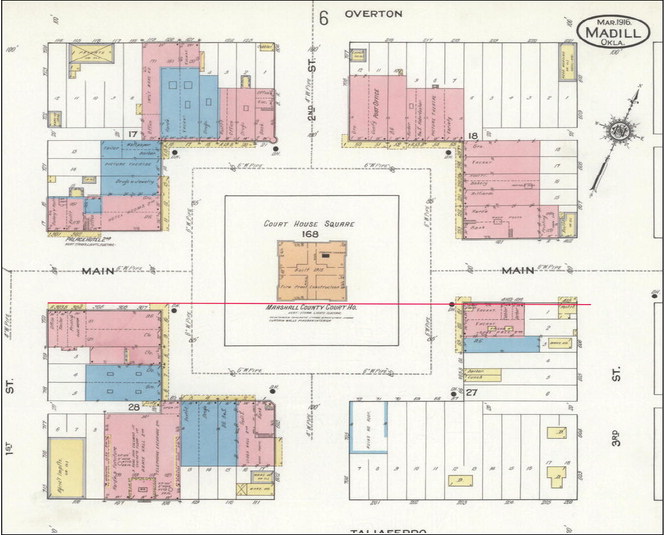
As to the “grade line” for the alignment of the courthouse, the commissioners picked the sidewalk along the north side of the D. B. Taliaferro building on the southwest side of the square. Taliaferro’s building is now known as Gorrell’s Martial Arts & Fitness building. If you draw a straight line from the sidewalk on the north side of the building to the east across the courthouse square, you can see that the courthouse itself is perfectly squarewiththatlinefromthe sidewalk on the north side of Gorrell’s. It was from this line thatthecourthousewasbuilt. Thephotoaccompanyingthis article is from the 1916 Sanborn Map for Madill.
Sanborn maps, officially known as Sanborn Fire Insurance Maps, are some of the most valuable historical documentsforunderstanding the urban development of American towns and cities. Produced by the Sanborn Map Company from the mid-19th century through the early 20th century, these detailed maps were created to assist fire insurance companies in assessing fire risk. Over time, they have become an indispensable resource for historians, architects, city planners, and genealogists who seek to reconstruct the physical and social landscape of the past.
The Sanborn Map Company was founded in 1866 by Daniel Alfred Sanborn, a surveyor from Massachusetts. The company specialized increatingdetailedmaps documenting the layout of cities and towns across the United States. At a time when urban fires were a constant threat, fire insurance companies needed accurate data about the construction materials, building usage, and proximity of structures to one another to calculate insurance premiums and assess fire risks.
These maps were primarily intended to provide fire insurance underwriters with information about buildings andinfrastructure.Eachmap included detailed features such as the shape and size of buildings, their materials (e.g., brick, wood, or stone), the location of windows and doors, and the presence of fire hazards such as boilers and chimneys. Streets, alleys, railroads, and water sources were also marked to help insurance companies gauge how quickly and effectively fire services could respond to emergencies.
Sanborn maps are distinguished by their remarkable level of detail and standardized symbols.Typically,maps were drawn at a scale of 50 feet to 1 inch, providing an almost aerial view of each city block. Each building was color-coded to indicate the type of construction material, with yellow representing wooden structures, red for brick, and blue or gray for stone. Symbols and annotations described building height, function (e.g., residence, factory, church), and potential hazards like flammable materials.
In addition to structures, Sanborn maps recorded essential infrastructure elements such as water mains, fire hydrants, and street widths. They also noted institutional buildings like schools, hospitals, and government offices. These details not only served fire insurancecompaniesbutalso documented the growth and transformation of American cities over time.
Today, Sanborn maps are invaluable tools for researchers studying urban history. They provide a snapshot of cities and towns at various points in time, offering insights into how communities evolved in response to industrialization, population growth, and technological advancements. They also have been particularly useful for historic preservation efforts. Architects and preservationists use them to identify the original features of historic buildings and neighborhoods, which can guide restoration projects. Similarly, city planners rely on these maps to understand past urban layouts, enabling more informed decisions about modern development and zoning.
Sanborn maps were produced for Madill in 1902, 1903, 1906, 1911 and 1916.
By late July, men with teams had begun excavation forthefoundationofthecounty courthouse. In the July 24, 1914 issue of the Marshall County News-Democrat, the editor reported, “The construction company which has the contract of building the Marshall County courthouse have begun the work of excavation for the foundation and are getting along very fast with that part of the work. Quite a force of men and teams are employed, and it will probably be only a few days until the work of laying the foundation will begin.”
After almost six years, six elections, protests, appeals and a trip to the Oklahoma Supreme Court, the longawaited construction of the MarshallCountyCourthouse had finally begun.