
On May 3, 1911, the Marshall County Commissioners considered a petition containing 562 signatures on the courthouse petition and 547 on the jail petition. On that day, the County Commissions acted on the petitions. They passed a resolution and order, calling for an election in Marshall County, Oklahoma, on the 8th day of July 1911, to submit to the qualified voters the question of whether they should expend the sum of $65,000.00, and issue negotiable coupon bonds in said amount for the construction of and furnishing of a Court House in said Marshall County and of expending the sum of $15,000.00 and issuing the County negotiable coupon bonds, in said amount to construct and furnish a Jail. But because of the passage of Senate Bill 174 in 1909, in all elections for issuing bonds for countyowned courthouses and other buildings, the vote required a supermajority of three-fifths (3/5) of the electors, or 60%, voting upon such proposition. Therefore, a simple majority was not sufficient.
On July 8, the citizens of Marshall County went to the polls and cast their votes. When the polls closed that evening, the “Yes” votes outnumbered the “No” votes by 947 to 807, and the “Yes” votes for the county jail outnumbered the “No” votes by 911 to 820. However, the “Yes” vote only garnered 54% of the vote, so the bond issue for both the courthouse and jail failed to pass. Once again, the people of Kingston, Willis, Powell, Lebanon, Shay, and Aylesworth defeated both bond issues.
Kingston got its revenge once again. The Kingston Messenger wrote: “By their votes last Saturday, the people of the county said emphatically that they were not ready to bond the county for a new courthouse and jail. This does not mean that they are not in favor of such buildings but simply that they do not think that this is the proper time to take up the proposition. The county is already heavily loaded with bonded indebtedness, and there is not money enough on hand to pay the running expenses of the county. Our people think that they had better get along with what they have for a while longer and, in the meantime, get the county on a better financial basis.Wewantpeopletocome amongusandbuyhomesand invest their money, but if we meet them with a high rate of taxation…it will not be muchinducementforthemto stay with us. Let's quit this bond extravagance and get the county on a good footing. Then we can talk courthouse, and the people will be humorous enough to listen and act favorably.”
But Madill was not finished. Just after the election, the Marshall County News-Democrat wrote, “Just keep pushing. Madill grows without the courthouse. But never mind the defeat; we’ll get it next time.” And “next time” came quickly. By September or early October of 1911, another petition calling for a bond election was circulating.
Interestingly, though, this new petition was circulated by Lebanon citizens, where the previous election results showed the “NO” vote winning by a total of 57 to 24. As to this petition, the Marshall CountyNews-Democrat wrote, “We have a petition signed by the citizens of Lebanon andLebanoncommunity asking for bond issues for the purpose of erecting a court house, jail and constructing good roads over the county. The petition further suggests that a county mass meeting be called for the purpose of discussing the question and making the move a general one over the county.” The petition was circulated throughout the county for the next three months, seeking enough signatures to put the issue before the county commissioners for a third time. And by the first of March, the petitioners submitted the question to the county commissioners.
The new petition being circulated stated the following: “We, the undersigned voters and taxpayers of Marshall County, Oklahoma, hereby show that said County has no courthouse adequate for the needs of the County, and it is in the sense of your petitioners that an urgent need exists for the construction of a suitable courthouse in and for said County.”
“Your petitioners, therefore, pray that an election be called and held in said County, at which there shall be submitted to popular vote the following propositions: FIRST: Shall the Board of County Commissioners of MarshallCounty,Oklahoma, be authorized to expend the sum of $80,000.00 for the construction of a courthouse in and for said County?
SECOND:ShalltheBoard of County Commissioners of MarshallCounty,Oklahoma, be authorized to issue the negotiable coupon bonds of said County in the principal sum of $80,000.00. Said bonds to bear interest payable semi-annually at the rate of five percentum, to provide the necessary funds for constructing a courthouse in and for said County in addition to all other taxes sufficient to pay the interest on and principal of said bonds when due?
Along with the petition for the courthouse, a second petition was presented to the county commissioners requesting the issuance of bonds for $20,000 for the construction of a county jail, thus making the total for the two bond issues $100,000.
On March 4, 1912, the county commissioners met to consider the petition and passed the following resolution. “WHEREAS, on the 4th day of March 1912, there was filed in the office of the County Clerk of this County a petition in writing praying the County Commissioners to call a special election for the purpose of submitting to the voters of said County the question of issuing the bonds of said County in the principal sum of $80,000.00 for the purpose of constructing a Court House and $20,000.00 for the purpose of constructing and furnishing a jail for said County, said bonds to draw interest at the rate of 5 percentum perannum.Now, therefore, this Board doth fix the 6th day of April 1912 for the purpose of hearing and considering such petition and any complaint or objection that may be made thereto, and the County Clerk shall give notice of such meeting by publishing the notice in two successive issues of a weekly newspaper published and of general circulation in said County.”
Inresponsetothisthirdattempt at holding a bond election, a group of citizens began pushing for a vote to disassociate the southern part of the county from Marshall County, join Bryan County and force the merger of the northern part of the county with Johnston County. In response to this movement, the Kingston Messenger wrote, “There are rumors floating that a movement is to be made to dismember Marshall County and attach its territory to adjoining counties, as the way to avoid high taxes and the expense that is threatened in building a courthouse, and jail. The people of the county don't like the looks of a $100,000 bond issue.”
Asoddasthisideaseemed, the Oklahoma Constitution allowed for such a situation. In Article XVII, Section 4 of the Oklahoma Constitution, the framers wrote: “The legislature shall provide by general laws for the creation of new counties or altering or changing lines and the equitable division of assets and of liabilities, and the original location of county seats in such new counties: Provided, That when territory is to be transferred from an existing county to either a new or an existing county, there must be 60 percentum of the vote cast in such particular territory in favor of the transfer, and, in case the transfer be to an existing county, the acceptance of such territory must first be approved by a majority vote of the electors of said county, at an election to be called and held therefor, as may be provided by law.”
Thankfully, the push to split the county failed to gain much traction, and the idea died. Such an effort would have required a supermajority victory in Marshall County to allow the split and asupermajorityinBryanand Johnston Counties to accept the areas of Marshall County wishing to split from the remaining part of the county.
Thecountycommissioners met on April 6, 1912, to consider the petition for a bond election. After hearing protests and complaints against the proposed bond elections, they issued a resolution calling for a third bond election on May 18, 1912. However, a new and unexpected wrinkle was added to the mix that would further complicate the matterandmakethepassage of a bond issue even more difficult.
On May 13, 1912, the U.S. Supreme Court issued a landmark decision in Choate v. Trapp, solidifying the legal protections of Native American land rights and tax exemptions. At the heart of the case was a conflict between the federal government’s promises to Native American allottees and the state of Oklahoma’s attempt to impose taxes on their lands. The ruling not only affirmed Native Americans’ rights under federal law but also highlighted the supremacy of federal commitments over state actions.
The case arose during the allotment period following the implementation of the Dawes Act of 1887 and related agreements. Under these policies, communal tribal lands were divided into individual allotments to encourage assimilation and agricultural self-sufficiency among Native Americans. Thefederalgovernmentoften included a tax exemption for the lands in the allotment agreements to protect the allottees from economic exploitation during the initial years of transition.
In Oklahoma, however, a controversy emerged over whether these tax exemptions continued after federal restrictions on the sale or transfer of the allotted lands were lifted. The state argued that the lands were subject to state taxation once these restrictions were removed. Allottees, however, contended that the tax exemptions were vested rights guaranteed under federal law and could not be revoked.
The Supreme Court, in a unanimous decision authored by Justice Lamar, sided with the Native American allottees. The Court held that the tax exemption was a vested right, meaning it was a legal guarantee that could not be rescinded, even after restrictions on alienation were lifted. Justice Lamar emphasized that the exemption was part of the inducement offered to Native Americans to accept allotments, and the government could not unilaterally alter these terms. The decision mandated that all taxes previously collected on these lands, whether paid by Native Americansthemselvesor by purchasers of such lands, had to be refunded, and the Court indicated that this tax immunitywouldremainineffect until 1926 unless federal law or treaty stipulations were changed in the interim.
The decision reinforced the principle that federal agreements with Native Americans must be honored. It also underscored the supremacy of federal law and treaties over state legislation concerning Native American lands and rights. Further, the requirement that the state and the various counties in Indian Country had to refund taxes collected on allotment lands could potentially burden the counties. And the inability to collect taxes on those lands until at least 1926 would further burden the counties.
The Choate v. Trapp decision had far-reaching implications. First, it reaffi rmedtheU.S.government’s obligation to uphold promises made to Native Americans, particularly in the context of allotment agreements. Second, the court provided a strong legal shield against state encroachments by declaring the tax exemption a vested right.
Second, the ruling limited states' ability to interfere with federally protected Native American lands. It sent a clear message that states could not undermine the rights granted under federal law, ensuring a degree of economic security for Native American allottees during a period of significant upheaval.
Finally, the case set a critical precedent in U.S. Indian law, influencing later decisions on taxation, land rights, and the broader relationship between federal, state, and tribal authorities. It demonstrated the judiciary’s role in protecting the rights of Native Americans from potential violations by state governments.
The Supreme Court’s decision in Choate v. Trapp was a victory for Native Americans and reaffirmed federal commitments to uphold their rights. Still, it was a loss for the counties, including Marshall County. By ruling that the tax exemption was a vested right, the Court reinforced the legal framework protecting Native American lands from state interference. This case remains a cornerstone of U.S. Indian law, symbolizingtheenduringimportance of honoring federal promises in pursuing justice and sovereignty for Native American communities.
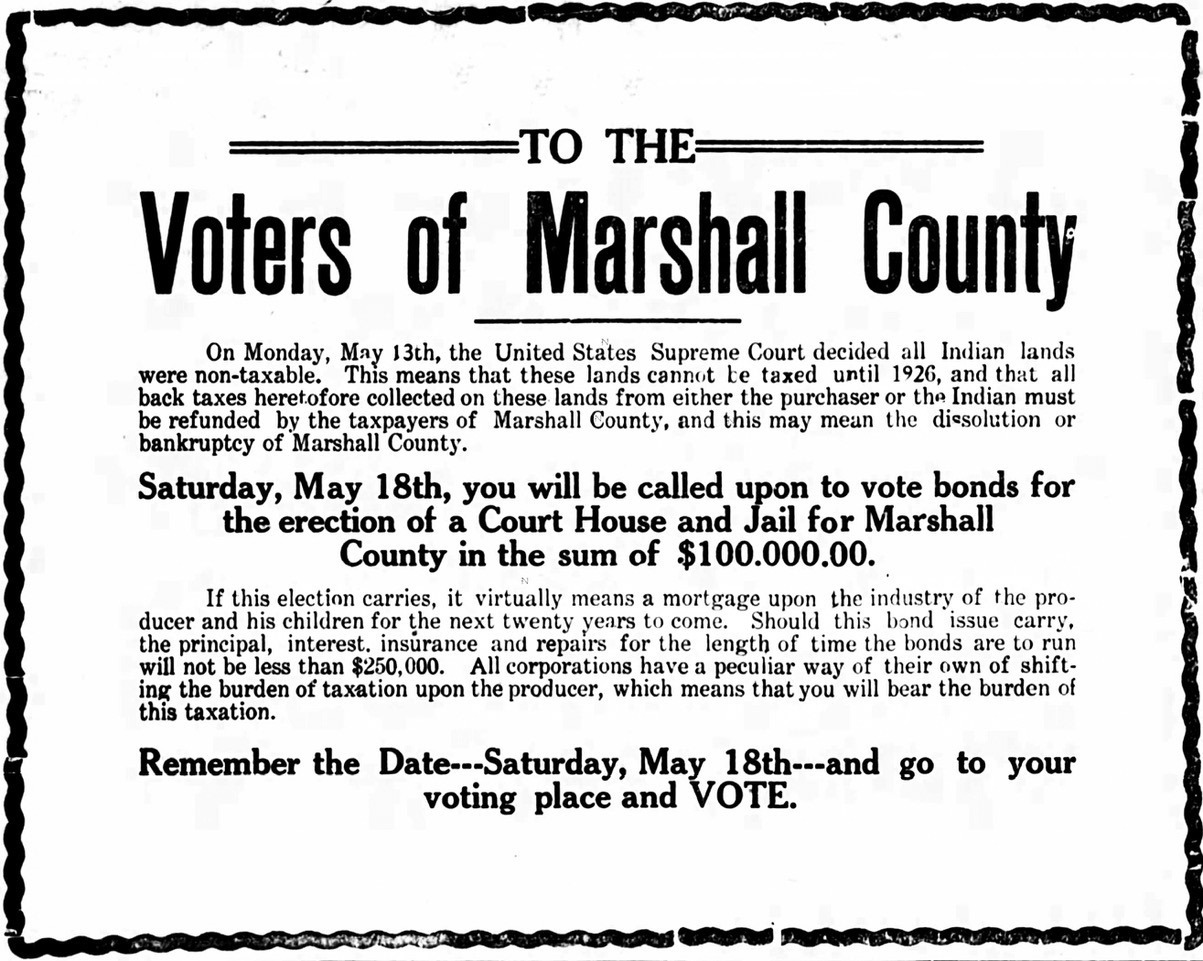
When the ruling was released, the people of Kingston seized on the point and turned the case into an argument against bond issues. An ad exploiting the Supreme Court case was placed in the Kingston Messenger, and it read as follows: TO THE Voters of Marshall County On Monday, May 13th, the United States Supreme Court decided all Indian lands were non-taxable. This means that these lands cannot be taxed until 1926 and that all back taxes heretofore collected on these lands from either the purchaser or the Indian must be refunded by the taxpayers of Marshall County, and this may mean the dissolution or bankruptcy of Marshall County. Saturday, May 18th, you will be called upon to vote bonds for the erection of a Court House and Jail for Marshall County in the sum of $100.000.00. If this election carries, it virtually means a mortgage upon the industry of the producer and his children for the next twenty years to come. Should this bond issue carry the principal, interest, insurance and repairs for the length of time the bonds are to run will not be less than $250,000. All corporations have a peculiar way of their own of shifting the burden of taxation upon the producer, which means that you will bear the burden of this taxation. Remember the Date---Saturday, May 18th---and go to your voting place and VOTE.”
On May 18, the citizens of Marshall County went to the polls for a third time regarding the two bond issues. Just as in the first two elections, the “Yes” vote failed to achieve a supermajority; this time, it only received 51% of the vote. The bond issued failed, and Kingston got revenge for the third time. It appeared that the supporters of the courthouse bonds were losing ground. And again, it was Kingston, Tyler, Isom Springs, Willis, McMillan, Lark, Powell Lebanon, Alyesworth, Cumberland, Lynn and Shay who resoundingly defeated the bond issue.
Following the election, the Kingston Messenger published a letter from C.P. Hoggard that stated, “The courthouse bond election is now over. We hope the citizens of Marshall County will be permitted to enjoy the rest they justly deserve. It seems thatsomehavemisjudgedthe farming class of the county, in believing that all Madill had to do was to just let the people know they (Madill) wanted a thing done and Immediately, things would get in motion and keep moving to the satisfaction of Madill. The writer remembers distinctly an article which appeared in the Madill paper sometime in 1907, stating that when Madill wanted a thing done, it generally done it. People should so live and act that past errors cannot be termed malicious offenses.”
“We of Kingston believe we should have a voice in the public sentiment expressed by the people for the upbuilding of Marshall County. We further propose to stand by and work for the interest of the MAJORITY OF THE TAXPAYERS of Marshall County. We will not stand idly by and see our working people hoodwinked into a thing that we know will prove a hardship to our people. I admit that in due time and at the proper time, all counties should have a courthouse and jail, but first believe that a fair and just taxation should be in force and that if the same was properly and judiciously handled, the financial condition of our county would enable us to meet these county needs, in a way that would not be so burdensome to the working-class of people living in Marshall County. We believe that harmony should be the password of every good citizen in the county and that sometimeorsomehow,Madill will find that there is a right way and a right time to ask for things in a state where the farmers' vote is worth as much as that of he who sits in his easy chair, with an unlimited bank account.
I believe that if we would take more time to talk the good roads system, and strike bonds in any reasonable amount, and give the farmer something that would be of material benefit to him, we would be doing something that posterity would be proud of.”
The Editor of the Kingston Messenger also responded to the vote. He wrote, “The bond question has been again acted upon for the third time by our people. They have said emphatically that they are not yet ready to assume any extra tax burden. This should satisfy the Madill folks, as they would be the direct benefi ciaries of the proposed new buildings. Practically all the votesforthepropositioncame from that place. Now let us hope that the people may be given a rest on this proposition and allowed time to get in a financial condition that will justify them in acting favorably on the proposition. The 'hill-billies' have some rights that are entitled to consideration even by ‘we.’' However, the county's people would not be “permitted to enjoy the rest they justly deserved.” Just one week later, a meeting of the businessmen of Madill, Woodville and Kingston met in Kingston to discuss the need for a county courthouse. And following the meeting, it seemed the anti-bond sentiment had changed, even at the Kingston Messenger. The Kingston Messenger wrote the following about the meeting.
“At a conference of the businessmen of Kingston, Madill and Woodville, held here yesterday, the views of the parties present discussed in regard to the building of a courthouse. It was really a 'get together' conference in view of harmonizing discordant elements and pulling together for the general good. The meeting was harmonious in every way, and the best of feelings prevailed. Everyone conceded the need for a courthouse, and it was the unanimous opinion of all that a suitable building could not be erected for less than $75,000.Withthatamountas a basis, it was decided that a movement be started at once to have an election called for a bond issue for building. It is proposed to call the election in August. Put up your hammer. Bury your hatchet and join hands for a general forwardmovementinuniting MarshallCountyinthebonds of fraternal unity.”
One week later, a petition signed by more than 500 voters of the county was filed with the county commissioners, asking that they call an election allowing the voters of the county to vote on the proposition of voting bonds to the amount of $75,000 to build a courthouse for Marshall County.
The proposition was circulated just days after the conference in Kingston with the people of several localities in the county. The people reacted so favorably to it that it was decided that this was the opportune time to present the question of a bond issue for a courthouse to the county's voters.
Petitions were prepared on a Friday afternoon and were sent out on Saturday and circulated for signatures. The petitions filed with the county commissioners show that many signatures were secured at Aylesworth, Kingston, Woodville, Willis, Powell, Lebanon and Madill. This seemed to indicate that there was new support for the issue.
The Madill Times wrote, “Not only do we find the people in those communities willingandreadyforthebond issue,butfromtheexpression from representative citizens from all parts of the county, it is no farther a question as to whether or not the county should have a courthouse. All concede that the county shouldhaveacourthouseand that now is the time that the bonds should be voted. The election will be called for Aug. 5th. 1913.”
Hadthetideturned? Were the people of Kingston and the other communities in the southern part of the county ready to support Madill and the courthouse proposal? It appeared the dispute between Madill and Kingston may be over. Was the Kingston Messenger, right? Was it time to “Bury your hatchet and join hands for a general forwardmovementinuniting MarshallCountyinthebonds of fraternal unity?” Was the rivalry over? Time would tell. A fourth election was coming. Maybe the fourth time would be the charm.