
In recent years, politics and political campaigns have been deemed the most ugly and dirty in United States history. The 2024 U.S. presidential election has been marked by intense partisanship andunprecedented mediascrutiny,makingitthe “dirtiest” in recent memory. From negative campaigning to disinformation and legal battles, the race has underscored the highly polarized environment in the United States.
And while negative campaigning is not new to American politics, many believe the 2024 election has taken it to new extremes. Both candidates have been relentlessly using negative ads focusing more on personal attacks and character assassination than policy differences. These ads often exaggerate or even distort facts to paint opponents in a negative light. The rhetoric has become so hyperbolicthatevennow,one campaign and its surrogates have labeled their opponent as Adolph Hitler. Remember him; he slaughtered over elevenmillionJewsandother victims, including Roma (Gypsies), disabled individuals, Poles, Soviet prisoners of war and political dissidents. It is quite an exaggeration to say someone who sends mean tweets and makes fun of opponents is on par with a maniacal despot who slaughtered eleven million people, but that is where we are in politics today. The approach isdesignedtoswayundecided voters and energize each side’s base by invoking solid emotional reactions like fear and anger. This strategy may effectively rally loyal supporters but risks further dividing the nation by casting each candidate as an existential threat to American democracy.
Social media has also played an outsized role in the 2024 election and has becomeasignificantplatform forspreadingmisinformation and disinformation. Both organic posts and paid ads frequently contain exaggerated, misleading, or outright false information. Specific platforms have struggled to moderate content effectively, allowing the viral spread of conspiracy theories, doctored images, and misrepresented quotes. Many voters now struggle to determine what is accurate; some may base their decisions on unverified claims. This wave of disinformation risks eroding trust in democratic institutions and the integrity of the electoral process.
And legal challenges have become an almost expected part of recent election cycles. Allegations of voter suppression, disputes over mail-in ballots, and accusations of election interference have led to numerous lawsuits in recent years. Both sides have invested heavily in legal teams prepared to challenge results in crucial battleground states. This has introduced the possibility of post-election litigation that could delay results and deepen national divisions. By politicizing the electoral process and casting doubt on its fairness, these legal battles contribute to a perception that the election is “rigged” or “stolen,” depending on one’s political affiliation.
Finally, media coverage of the 2024 election has been ubiquitous and highly polarized. News outlets often cater to specific audiences, which leads to biased coverage that reinforces preexisting beliefs rather than informing the public objectively. Sensationalism, rather than substantive analysis, usually dominates headlines as media companies compete for viewers’ attention. This creates an environment in which fact-based discussions are overshadowed by inflammatory commentary,making it harder for voters to find reliable information. The role of partisan media has, in many ways, become one of the most divisive elements in the election.
The cumulative effect of these “dirty” tactics is a disillusioned electorate. Many Americans feel that the electoral system is rigged in favor of elites and that their votes may not matter. This perception can lead to lower voter turnout, as some may choose to disengage entirely. The risk is that democracy becomes weaker as fewer people participate in the process, and those who do are increasingly skeptical of the system’s fairness. Restoring faith in the electoral process may be impossible, but it is undoubtedly one of the biggest challenges we face in the coming years.
The 2024 presidential election has become a flashpoint for the United States’ political, social, and economic tensions. Negative campaigning, misinformation, dark money, and legal disputes have contributed to distrust and disillusionment. Though part of a long “dirty” campaigning history, these tactics seem to have reached new heights in 2024.
But have they reached new heights? In many ways, what is occurring today is not much different from the antics of the supporters of Madill and Kingston during the county seat fight of 1908. Today, many complain about the dirty campaign tactics and express disbelief that we have reached this point, but the truth is, nothing has changed. Granted, in 1908, no one compared the other side to Hitler, but then he was just 19 in 1908. And in 1908, there was no radio, television, internet, Facebook, Twitter, or a plethora of other media services. But the campaign was still ugly and ruthless.
The battle between Madill and both sides alleged allegations of wrongdoing. Claims of vote fraud, vote buying, and personal attacks were rampant. As was reported last week, it appears that supporters of one side effectively poisoned a stump speaker for the other side to prevent him from delivering a campaign speech. It sounds a lot like 2024. But in the campaign's last week, the attacks got worse and more personal. Andtheygotuglier.
Inonereport,theKingston Messenger made the following claim. “Jack Colby, a Madill merchant, is authority for the information that the Mayor of Madill, J. L. Carter, is a defaulter. Colby stated that the city council and other men and officers of Madill are acquainted with the defaulting actions of the Madill officer. They have said: “Keep quiet. Do not let this get to the people till after thecountyseatelection.Then we will turn him out of office and prosecute him.”
“Among the charges against the Madill Mayor is one that he received a check for $5.00 from an inmate of a Madill house of ill fame and changedthecheckfrom$5.00 to $105.00 and had the said check cashed in a neighboring town. Perhaps the mayor of Madill is preparing to go in pursuit of Roy Smith, MADILL'S DEFAULTING BANKER.”
A “house of ill fame” is an old-fashioned term used to describe a place associated with prostitution or other illicit activities, often a brothel. Historically, such places were known for hosting morally dubious or illegal activities, leading to the term “ill fame,” implying a bad or scandalous reputation. This term often appeared in legal language, particularly in laws or ordinances aiming to curb vice or regulate certain areas within towns or cities. So, the Kingston Messenger was alleging that the mayor of Madill was a customer of a brothel and that he effectively stole money from one of the women at the “house of ill fame.”
The Marshall County Democrat issued a response through an affidavit from Jack Colby. In that response, Colby stated, “That the above is a lie out of whole cloth, that I never thought or heard of such a thing until I read it in the Kingston Messenger.” Then the editor of the Democrat stated, “Anyone who knows anything at all knows that if the Mayor of Madill, J. L. Carter, had raised a check from $5 to $105 that he would have been prosecuted for it. This is forgery and felony which is a penitentiary offense and the Messenger well knows that should he have donethathewouldhavebeen prosecuted. I guess they will accusemewithhavingrunoff with some other man's wife next and call that campaign argument.” But even with the denial of the forgery, there was not refutation of the claim that the Mayor frequented a brothel. So the claim may have worked on some level.
Then, the Marshall County Democrat alleged, “A man came into the office of the Marshall County Democrat. During a conversation with him, he volunteered the information that he had been working for Kingston for two weeks and expected to continue working for Kingston. He also volunteered the information that he had been given a lot in the town of Kingston in consideration of his services and was also drawing a daily wage. Four affidavits to these facts, with the name of the man, will be published if this is denied.”
The Kingston Messenger responded, “If any living man made that statement, he lied. Perhaps he was a 'Madill man' talking to the other 'four Madill men; they could make affidavits that these false words were uttered by ‘a man who came into the office of the Marshall County Democrat’ for campaign purposes. THE MESSENGER will give $100.00 to the PublicRoadFundofMarshall County if the Democrat will produce an affidavit from the above-mentioned man, with any shadow of deed, proof or evidence that he is drawing a daily wage from and has been given a free lot by Kingston for his services, including number of block and lot, with name of man by whom transferred. The money is ready. Will you call for it? We say you will not.”
The Kingston Messenger thenprintedaswornaffidavit from J. W. Johnson alleging “About four years ago, on the streets of Madill, Nub Taliaferro, of Madill, was trying to hire some laboring men to work for him; he tried to hire me; he said he would pay the working men whom he desired to hire, Twenty Dollars per month, but they must board themselves; he wanted it understood that the work demanded of one man, at this price, was to feed three hundred head of cattle, make his (Taliaferro's) fires, milk his cows and do all other chores around his house. I refused to work for him; he then stated in the presence of several men that he wished to see the day come when all laboring men would have to work for twenty-five cents a day, and board themselves. I am a farmer, and I live near Cumberland, Oklahoma.”
In response, the Marshall County Democrat printed an affidavit from W. N. (Nub) Taliaferro, the founder of Madill. In that affidavit, Taliaferro stated, “I do not know J. W. Johnson and have no recollection of having tried to hire him at any time, and state positively that I never had any such conversation with him or anyone else, that I never said that I wished to see the day come when all laboring men would have to work for twenty-five cents a day, and board themselves, and that anyone making an affidavit to such a statement does it knowing that he is making an affidavit to as black a lie as was ever sworn to. That I was raised on a farm and made two share crops, that I am fully in sympathy with the farmers and wish that their labor would demand a better price.”
But to add insult to injury, the Democrat then made allegations against J. W. Johnson by printing another affidavit from a man named S. Huffman. In that affidavit, Huffman alleged, “I am a farmer living in the Grantam neighborhood, and know J. W. Johnson whose affidavit appeared in the Kingston MessengerunderdateofJuly 3, 1908, in which he states that he had a conversation with W. N. Taliaferro, of Madill, and in which conversation he states that the said W. N. Taliaferro said: ‘That he would be glad when the laboring men could not get but twenty-five cents per day and board themselves.’ Which affidavit was headed, ‘Read Laboring Men.’” “In the fall of 1907 I caught this very said J. W. Johnson in my corn crib stealing corn and I had my shot gun and arrested him, and he begged so hard, and on account of his having a family to support, I released him on his promise to move out at once, and made him carry the corn that he had stolen back and put it in the crib. He left on time. I know him to be an infamous liar, and I would not believe him on oath or any other way.”
In an issue of the Madill News, the editor of the paper attacked the minister of the Kingston Methodist Church when it made a short entry stating, “We wonder what that METHODIST preacher SPOUTS from the pulpit on Sundays.” The paper alleged that the minister was preaching about the county seat fight in support of Kingston.
In response, the Kingston Messenger stated, “The Madill Newshasneverhesitated to attack and falsify honorable manhood in its mad and deranged attempt to mislead the people for county seat votes, but its madness and derangement, increasing daily by the certainty of defeat, have driven that paper to desperation, as proven by its hellish attacks on the ministry of the Gospel of Jesus Christ.”
“Read here the language of that sacrilegious sheet: ‘Wonder what that METHODIST preacher at Kingston SPOUTS from his pulpit on Sunday?’” “This is a willful slur and a malicious attack on Brother McKinney, a Methodist minister, working honestly, faithfully and sincerely in the service of the Lord. He is a Christian gentleman, one of God's noblemen, and moves, lives and exits in an atmosphere of purity never to be obtained in this world or in the next by any man who assails a faithful servant of his Maker. The man who thus attacks the ministry of Christ is past redemption; he can never hope for human sympathy nor divine mercy. No living human has ever heard Brother McKinney speak one word from his pulpit on the county seat question. As a private and individual citizen, he has a legal right, a moral right and a Christian right to be for Kingston for county seat because he believes it would be in the best interest of all the people.”
Next the Kingston Messenger printed an affidavit from J. L. Howell, alleging two businessmen in Madill offered him money to vote for Madill. In the affidavit Howell wrote, “On or about the 10th day of June 1908 John Vandervort and J. W Moon, of Madill, Marshall County, Oklahoma, came to see me (Continued from page 2A) at my home near the town of Tyler,Oklahoma,andoffered to hire me to work for Madill for county seat by submitting to me the following proposition: They agreed to give me a credit of Forty ($40.00) Dollars on a note which I owed John Vandervort; to give me Twenty-four ($24.00) Dollars incashforexpensemoney;for me to come down to Madill, and he (Vandervort) would see that I would get a lot, and could get on my feet again. John Vandervort pulled out a handful of silver dollars and rattled them at me. I told himthejingleofmoneywould sometimes touch the tender cords of a man when nothing else would, but Madill did not have enough money to buy me and could not get enough money from their rich New York Jew friend.”
The“NewYorkJewfriend” that Howell was referencing was Samuel Isaac Lazarus, who was on the St. Louis-San Francisco (Frisco) Railway board.In1901,Lazaruscame to Madill and built a large and well-known building on Market Square named “The Lazarus Building.” The building was located on the southeast corner of the square on the corner of East Main. In 1908, the County Courthouse was the most important tenantoftheLazarus Building. Before statehood, the Lazarus Building housed the “Territorial Courthouse” for the Federal Court. Then, after statehood in 1907, it became the Marshall County Courthouse. From 1907 to 1914, the county leased the building from Lazarus for $100 monthly. County offices occupied the entire second floor, and some small space was on the ground floor. Because the building initially housed a bank, the county could use the old bank vault to store and protect early-day court records. The County leased the building from Lazarus until the new MarshallCountyCourthouse was completed and opened in 1914.
In addition to allegations andclaimsmadebypartisans in the campaign, citizens of the county who were not residents of either Madill or Kingston began sending letters to the editors of each paper. Two appeared in the Kingston Messenger. One was from a writer using the pen name, Lebanon Duck.
To THE MESSENGER: The following is the way a 'Lebanon Duck' sees the county seat business: First, we will take notice some of the last things spoken of by Madill. She boasts of three banks, two railroads and water works. It seems to me like I heard of a Madill banker, who stole about $20,000.00 of the bank's money and skidooed. Are her water works paid for? Someone said she would try to make Oakland pay for some of the ‘water bonds,’ by making Oakland a ward of Madill. Any town can have water works by issuing bonds and taxing the people. I don't believe railroads and water works are worth very much to farmers. Railroads may help merchants, but if railroads and water works are worth anything to farmers why don't Madill give the farmers more for their products? Ask the farmers how potatoes are selling in Madill” “ThoseMadillfellowsharp about one large town being better for us farmers than several small towns. Look at Dallas. While neither Madill or Kingston will ever make the south end of Dallas, we want to ask how much more does Dallas give for products than the smaller towns around her. Answer, Madill. If a farmer's wife gets sick, won't a Madill doctor charge more for going to see her than he will charge for going to see a town man's wife? His answer will be that he did not have to go so far. Now, the poor old farmer don’t want to go so far to sell his stuff.”
“It looks like Madill is trying to build her a political ring like Dallas. Just as soon as one of her men gets in the constitutional convention, the state senate or county office, he pulls for Madill and sets down on us farmers. I notice a piece in a Madill paper where the present organizer says the Socialists will be allowed to exercise their opinion on this question just the same as Democrats and Republicans. I want to say to this organizer that the Socialists do not need him to tell them that they are free and can act for themselves. I will also inform the present organizer that a majority of them will support Kingston, because they believe it is to their interest and the interest of all the people to do so. I don't know of but two Socialists whoareforMadill,andone of them is hired at a promise of $3.00 per day.”
Then a farmer from Oakland offered this letter; “To THE MESSENGER: As a farmer, I am for Kingston. As stated in print and conversation, I think country people should look to their interest and vote their county seat as near the center as possible. Madill wants everything her way. She says, if she cannot get all the courts and trimmings, she don't want any of them. I call this selfishness; don't you?”
“I have been in Madill several times and have heard those boomers say, ‘I have skinned that old farmer, so and so,’ and would laugh about it. When those Madill fellows would meet me on the street, they would not know me, but when I would go into their stores to spend my money with them, they would bow as polite as you please. Is that not so, farmers? Mr. Boomer, we farmers are not all blinded, and have some sense yet awhile. There was a meeting of farmers at a schoolhouse northwest of Madill a short time back, and a whole lot of good, old farmers gathered there to see how the county seat was getting along.”
“They were all for Kingston, except one, and he decided he would vote for Kingston too. Some of the farmers said, if they could vote both ends, top and bottom, they would vote for the county seat at Kingston. A farmer living near here had 2 mules to get out, and he found them at Madill in the townpoundandtheycharged him $7.50 for one night and day, He was a Madill man, but he and all his neighbors are for Kingston now. The people around here say, if they voted for Madill for anything, it would be for an asylum.”
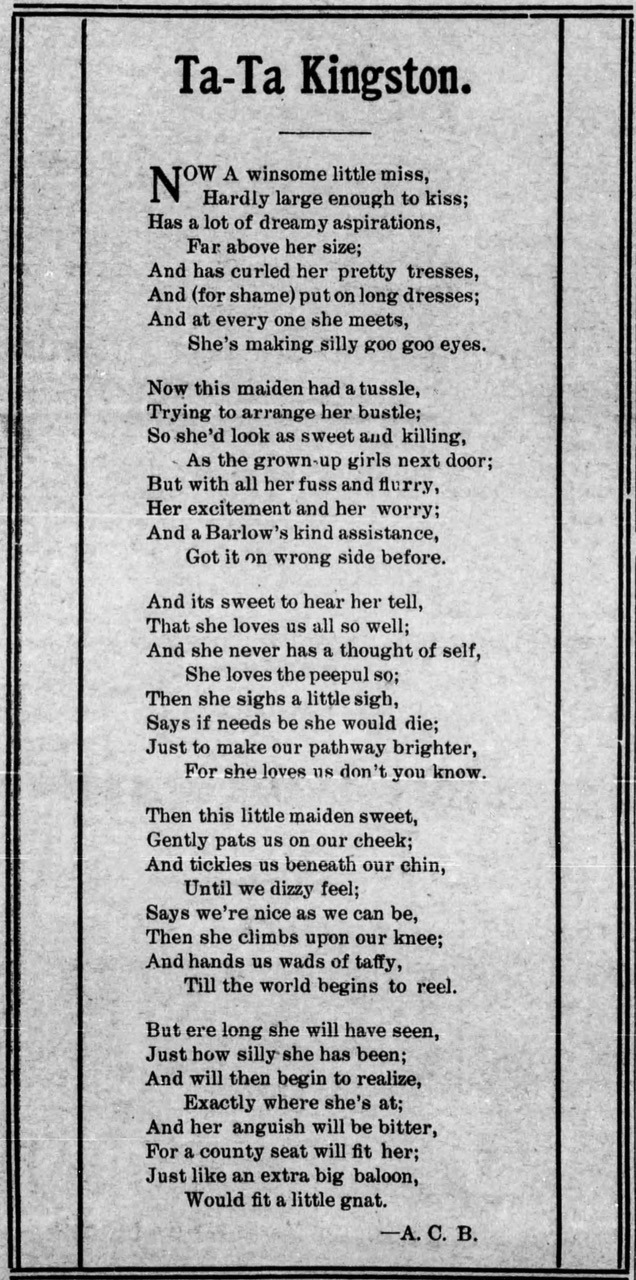
Not to be outdone, the Marshall County Democrat printed letters to the editor and poems or limericks written by readers. One of the limericks is attached to this article and is quite cutting toward the people of Kingston.) One of the more interesting letters printed by the Democrat was from a young girl from Aylesworth. Her letter stated: “Dear Editor: As there has been so many writing on the county seat question, I thought I would say a few words on behalf of Madill.”
“I am only a little girl, 13 years old, but I feel like I want to say something for Madill, as I think Madill is the proper place for our county seat. My papa is for Madill teeth and toenails and I am following in his footsteps. I know it will make Madill a better market, and that is what we want. I don't think it could help Kingston as she hasbeentherelongenoughto be a town if it ever intends to be. I don't believe she would know what to do with the County seat if it was to get it. But there is no danger of her getting it, so hurrah for Madill.”
“As long as Kingston has out such men as Judge Hurt talkingforKingstonandsuch menasJ.W.Johnsonwriting for Kingston, they need not expect to get the county seat. If Judge Hurt makes enough while at work for Kingston, the Baptist people of Cumberland would like for him to pay his house rent he owes them for living in the Baptist parsonage some time ago. They need the money as they are all poor old, sunburned farmers.”
“I saw in the Democrat a letter from my schoolteacher, Professor Mayo. I want to compliment his letter; I think it was good and true. I think the truth is the best always, There is so much in the Messenger that is false that even little children like me can see it is untrue. Stick to the truth is what my mamma and papa says, and my good schoolteacher says stick to the truth, and I believe that is right.”
“Well Mr. Editor I am not wearingaMadillbadge,butif I had one, I would wear it all the time, and if I could vote, I feel like I would count two, but you see I can't vote, but I will do all I can in an honest way. Hurrah for Madill! I can say that and I will continue to say it. I want to say Madill has good water, she has good people and they have a good town, and we want a better town. You know we never get too much of a good thing, so, hurrah for Madill. Even our good old Dr. Dean is for Madill.Heknowswhatisbest for us all. I want to come to Madill before long, when my papa comes, and say hurrah for Madill for the permanent county seat. I think Kingston was acting bad when she was slurring that poor old man because he could not write. I feel sorry for him, it looks like they would too if they love the old farmer as much as they say they do, but I don't think theymeanalltheysay,doyou dear reader? If they do, Lord pity them and help them to do like Judge Hurt; make some apologies for their misconduct during this campaign.”
“I have lots of friends in Madilland some in Kingston, but those in Kingston have not seen the light yet, but perhaps they will, before it is too late. Kingston denies wanting the county seat for their benefit, they want to helpthepooroldfarmer.Now don't tell a falsehood, you know you don't care much for the farmer, you just want his labor, that is all.”
“Madill says she wants it because it will be better for their town and I think it will be better for the farmer too, but we all know each one is looking out for his own benefit. The good book says: A liar is worse than a thief, and I believe it because you can lock out a thief and you can't a liar. It also says a man that won’t provide for his own household is worse than an infidel. Now be careful and let us stay on the right side. So, hurrah for Madill, as I believe she is right. Now Mr. Editor, if this don’t go to the waste basket I may write again after the county seat is located at Madill forever and ever, Amen. A FARMER'S DAUGHTER.”
But in all the hatred and vitriol spewed from each side, a letter from Professor Mayo, a county schoolteacher, presented a light shining through the darkness. It was a letter that was positive and uplifting. Honestly, it shares some wisdom and truth we need in 2024.
Without taking a side in the fight, Professor Mayo’s letter was as follows: “I received a supplement to a Madill paper in which Madill reply to Kingston's questions. As to questions and answers I have nothing to say, but in commenting upon the motives by which the voters will be prompted, you say the selfish motive cannot be condemned.”
“Any man who casts his vote solely from a personal standpoint is a perverter of justice and abuses the privilege of voting, which every loyal citizen appreciates. The voter with ballot in hand should not consider what is Madill's, Kingston's, orhisowninterest,onlytothe extent that they are a part of the county.”
“Courts are public utilities and should be used for the public good. A man living in two miles of the county line said to me that he would give five hundred dollars and borrow the money, to locate the county seat in his town. How is that for personal interest? How would that sound to a man on the opposite side of the county from him? Yet we manifest the same principle, if we vote for Madill or Kingston for the reason, it is to our personal interest to do so.”
“One of our main reasons for wanting statehood was because the Federal officers manipulated our political affairs to their personal advantage, and of course, detrimental to the good of the public, because personal interest rarely ever coincides with the interest of the public. Take the lives of our great men of the past, who have been public benefactors. Was selfishness the prompting motive of their lives?”
“In the sixteenth century when all Christendom reeled and staggered under the iron rule of Catholicism, men died a martyr's death that we might have religious freedom. Did they die for their personal gain?”
“Did Washington take up arms against the Mother Country and suffer the perils of war with his men for his personal gain? If so, why did he not take pay for his services? Surely, he did not, but his main purpose was to destroy the efforts of a principle that was detrimental to the Colonists but was satisfying the selfish motive of British officeholders.”
“If we go to the polls the 10th of July and vote solely for our personal interest as individuals, we seek to defeat the very principles defended by our forefathers. Shall we turn like Cain of old and slay each other?”
“Surely not, none of us live for ourselves alone. We form a part of the whole country. None can say: ‘I belong to myself.’ We should be neighbors now, and after the election. We are children of a common Father, and therefore brothers and sisters. CARSON MAYO.”
In the end, nothing has changed. Politics is ugly and it has always been ugly. The people of Madill and Kingson in 1908 were no different than those of Oklahoma today. Political campaigns are dirty and ugly. But we could all learn something from Carson Mayo’s commentary on the reason to vote. The question of whether to vote based on self-interest or the commongoodisanimportant one and speaks to the balance between personal and collective responsibility in a democracy.
Voting in one’s self-interest is natural; each voter has personal priorities that directly affect them. Voting based on these concerns ensures that individual needs and viewpoints are represented in government. When individuals vote to secure their own well-being, it can encourage policies that make life better for people facing similar issues.
On the other hand, voting with the common good in mind promotes unity in our society. By considering the broader implications of policies, voters can support candidates and measures that may benefit society at large, even if they don’t personally gain. This approach canstrengthencommunities, protect vulnerable populations, and address systemic issues.
Ideally, a balanced approach to voting—one that considers both personal interests and the common good—can create a healthier democracy.Bybalancingselfinterest withanawarenessof broader societal needs, voters contribute to policies that both improve their own lives and foster a stronger society.
OrasProfessorMayosaid, “none of us live for ourselves alone. We form a part of the whole country. None can say: ‘I belong to myself.’ We should be neighbors now, and after the election. We are children of a common Father, and therefore brothers and sisters.”
Amen!