
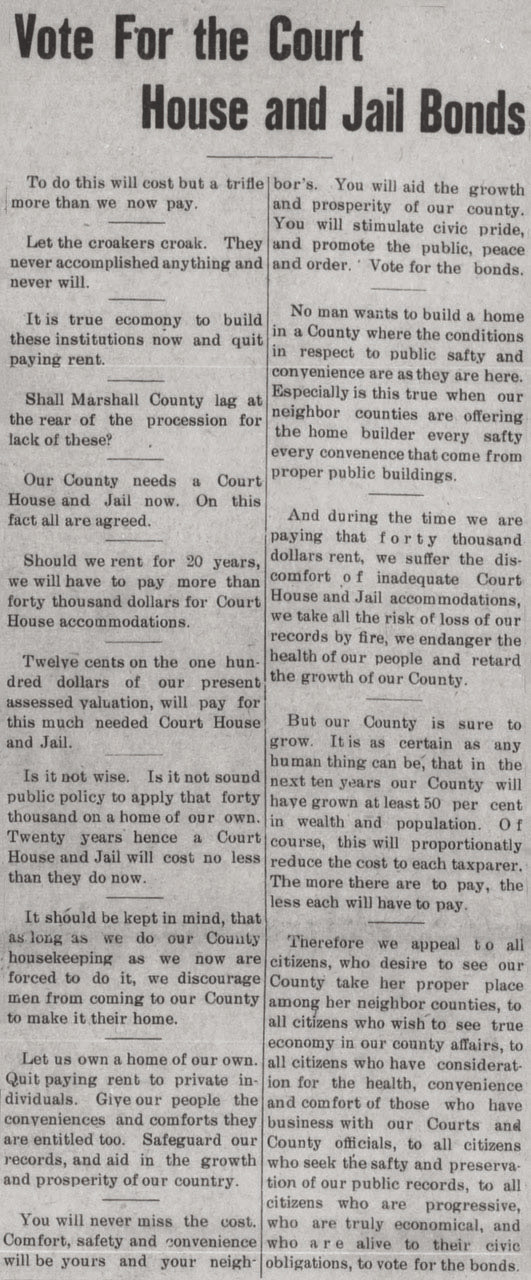
On November 8, 1910, the citizens of Marshall County went to the polls to vote on a bond issue to construct a courthouse and county jail. When the polls closed, and the votes were counted, Kingston got its revenge. The bond issue was defeated by a vote of 633 to 586, meaning that no courthouse could be built in Madill for the time being. But within a few weeks, Madill businessmen and residents planned to pursue a second bond issue.
In March 1911, Madill supporters began circulating two petitions for a second election on the bond issue throughout the county. One petition was for the county courthouse, and the second was for a county jail. The petition for the courthouse read: “To the Board of County Commissioners of Marshall County, Oklahoma. We, the undersigned qualified electors and taxpayers of the County of Marshall, State of Oklahoma, do hereby pray that a vote be taken at an election to be called and held in said County according to law on the question of issuing the negotiable coupon bonds of said County to the amount of $65,000.00, for the purpose of providing funds for erecting and properly furnishing a Court House in and for said County. Said bonds are to bear interest not exceeding (5) Five per centum per annum payable semi-annually, and a direct annual tax to be levied on all the taxable property in said County sufficient to pay said bonds and interest thereon as same accrues and becomes due…” The petition for the county jail stated, “To the Board of County Commissioners of Marshall County Oklahoma. We, the undersigned qualified electors and taxpayers of theCountyofMarshall,State of Oklahoma, do hereby pray that a vote be taken at an election to be called and held in said County according to law on the question of issuing the negotiable coupon bonds of said County to the amount of $15,000.00, for the purpose of providing funds for erecting and properly furnishing a County Jail in and for said County. Said bonds are to bear interest not exceeding Five (5) per centum per annum payable semi-annually, and a direct annual tax be levied on all the taxable property in said County sufficient to pay bonds and interest thereon as same accrues and becomes due.”
By the first of May, the petition organizers had collected 562 signatures on the courthouse petition and 547 on the jail petition. On May 3, 1911, the County Commissions acted on the petitions. At that time, the commissioners passed a resolution stating as follows: “ The said resolution and order, so adopted and passed was in words and figures as follows: A resolution and order, providing for calling and holding of an election in Marshall County Oklahoma, on the 8th day of July 1911, for the purpose of submitting to the qualified voters thereof the several propositions of the said County expending the sum of $65,000.00, and issuing its negotiable coupon bonds in said amount for the construction of and furnishing of a Court House in said Marshall County at the Countyseatandofexpending the sum of $15,000.00 and issuing the County negotiable coupon bonds, in said amount for the purpose of constructing and furnishing a Jail in and for said County at the County Seat; and of levying and collecting an annual tax upon all the taxable property in said County, in addition to all other taxes sufficient to pay the interest on and principal of said Court House and Jail bonds whendue.Whereastherehas been presented to the Board of County Commissioners of Marshall County Oklahoma two petitions with 562 signatures and 547 signatures respectively…” “Whereas, by reference to the registration and tax list of said County, and from other reliable sources, this Board has ascertained and determined, and hereby declares, that each signature to each of said petitions is the genuine and original signature of a qualified voter and taxpayer said County, that the signers of each of said petitions constitute more than more than one-sixth (1/6) of the qualified voters and taxpayers of said Marshall County, that each of said petitions are legally sufficient, both in form and substance, and sum, and” “Whereas it has been ascertained, and it is hereby stated and declared, that the total assessed valuation of all the taxable property in said Marshall County, as shown by the last assessment as equalizedforStateandCounty purposes is $4,714,631.00 dollars, that the total indebtedness of said County of every class and character whatsoever, amounts to the sum of $33,432.35 dollars that the total cash in the hands of the County Treasurer of said County, for County use amounts to the of $26,285.93 dollars but no part of said cash is available for the construction of and furnishing a Court House and Jail for said County by reasonwhereofitisnecessary toborrowtherespectivesums of $65,000 and $15,000 and issue the negotiable coupon bonds of the County, therefor in order to provide the necessary fund for the construction and furnishing said Court House and Jail respectively; and the total outstanding indebtedness of said County together with the $65,000 and $15,000 of bonds proposed to be issued as prayed for in said petitions will not exceed Four (4) per centum of the assessed valuation of the taxable property within said County as shown by the statement herein recorded and does not exceed any Statutory or Constitutional debt limit of said County.”
“Whereas the Board of County Commissioners of said County considers it to the best interest and the needs of the County to immediately erect and furnish a Court House at the County Seat at a cost of $65,000 and to erect immediately and furnish a Jail in and for said County at a cost of $15,000 and to issue the County's negotiable coupon bonds in said sums respectively. Now, therefore, be it resolved and ordered by the Board of County Commissioners in and for Marshall County, State of Oklahoma:” “Section I That a special election be and the same is hereby called to be held in Marshall County, State of Oklahoma on the 8th day of July 1911 for the purpose of submitting to the qualified voters thereof, the following propositions: First Shall the Board of County Commissioner of Marshall County Oklahoma, be authorized to expendthesumof$65,000for the purpose of erecting and furnishing a Court House in and for said County? Second Shall the Board of Commissioners of Marshall County Oklahoma, be authorized to issue the negotiable coupon bonds of said County to the amount of $65,000 to provide the necessary funds for the construction of and furnishing a Court House in and for said county, and levy and collect an annual tax upon all of the taxable property in said county, in addition to all other taxes sufficient to pay the interest on and principal of said bonds when due.”
“Third, Shall the Board of County Commissioners of Marshall County Oklahoma, be authorized to expend the sum of $15,000 for the construction of and furnishing a Jail in and for said county. Fourth, Shall the Board of County Commissioners of Marshall County Oklahoma, be authorized to issue the negotiable coupon bonds of said county to the amount of $15,000 to provide the necessary funds for the construction of and furnishing a Jail in and for said County, and levy and collect an annual tax upon all of the taxable property in said County, in addition to all other taxes, sufficient to pay the interest on and principal of said bonds when due.”
“Section 2: That a proclamation or notice of said election shall be called and the same is hereby authorized and ordered to be given in substantially the following form, to-wit: Election Proclamation By virtue of the authority conferred by the Constitution and laws of the State of Oklahoma and pursuant to a resolution and order duly adopted and passed by the Board of County Commissioners of Marshall county, State of Oklahoma, at a regular session thereof held on the 3rd day of May, 19II public notice is hereby given that a special election will be held in Marshall county on the 8th day July A. D. 1911…” “Said election will be held at the polling places designated by the County Election Board for the holding of general elections in said Marshall county, the same being the usual place for holding elections therein…” “The polls of said election will be opened at the hour of Eight (8) o'clock in the forenoon and close at the hour of Six (6) o'clock in the afternoon of said election day.”
In the first bond election, the “No” vote was the majority, prevailing by 47 votes. Therefore, the issue of a “super majority” was not relevant. However, according to an Oklahoma law passed in 1909, for a bond issue to prevail, it must pass by a supermajority; bond issues require that the “Yes” vote obtain at least 60% of the total votes cast.
In 1909, the Oklahoma Legislature passed, and the Governor signed Senate Bill 174, which provided in Section 3:“Beforeanybondsshall be issued as herein provided, the same shall be ordered by a vote of not less necessary than three-fifths (3/5) of the electors voting upon such proposition at an election to be held for that purpose, as hereinafter provided.” This law would ultimately become an issue for those supporting the courthouse bond issue.
In addition to setting the bond election, the county commissionersmadeanother interesting move: they hired a “Tax Ferrett” to help collect more taxes. The county hired a fellow named Jim Jones from Pauls Valley, who was known as a “Tax Ferrett.” Jones was tasked with going through and attempting to collect delinquent taxes for the tax years 1908, 1909 and 1910. This was done to raise more money for the construction of the courthouse and jail.
The deal made between the county and Jones provided that Jones would be paid on a commission basis.
He is to receive as his commission for collecting personal taxes eight and one-third percent of what he collected and 12 and one-half percent on real estate taxes collected. He was to be paid each month out of the money collected. This move was to appease those who opposed raising taxes because so many citizens were delinquent in paying their taxes. The commissioners hoped this move would lead to the electoral success of the bond issue.
Over the next nine weeks, the Madill and Kingston Messenger newspapers exchanged reasons for and against issuing bonds for the courthouse and jail. The Kingston Messenger began pushing back almost immediately after the County Commissioners ordered an election on the bond issue. In an article on May 5, 1911, Messenger stated: “In a number of counties of the state, a proposition to issue bonds for the erection of courthouses have been defeated because the required 60 percent of the vote was not in favor of the proposition. Oklahomans evidently believe that there is a time to call a halt to increasing indebtedness, and that time is now.” However, in an odd twist, the Messenger began running weekly “paid” articles identical to those written in the Marshall County News-Democrat and the Madill Times newspapers. These articles supported the bond issue, and this caused a bit of an uproar in Kingston.
In response, the Kingston Messenger wrote: “In order to correct a wrong impression regarding our position on the courthouse and jail bond issue, we wish to say that we havenotchangedourviewsin the least. As we have before stated,andwenowrepeat,we are opposed to increasing the indebtedness of the county at the present time, thereby adding to the tax burdens of the people. The matter we are publishing in favor of the proposition is furnished by the people who favor the proposition, and is paid for by them at a stipulated price, and does not in any way represent our views. The space was sold to them strictly on an advertising basis, with the distinct understanding that it in no way committed the paper to the proposition and that our columns were open to anyone who might wish to present the other side of the proposition.”
In addition to running articles paid for by Madill supporters, the Kingston Messenger also ran several “letters to the editor” from county citizens opposed to the bond issue. One was from longtime Kingston resident C.P. Hoggard, a well-known businessman and philanthropist who had donated the land where the Kingston School was constructed. In his letter, Hoggard stated, “THE VIEWS OF A CITIZEN. There has lately been a lot of junk circulated over the county for the purpose of influencing the taxpayers to vote for the bond issue for the erection of a new courthouse at Madill and I will say that it did look good to the county officers, as well as to some of the non-taxpayers, but to the man that has worked hard to pay for his little home, or tried topayoffthatmortgageonhis team, and waited and waited for it to rain on the corn crop that went to the bad, and the cotton that is doubtful, and the wheat and out-short, it does not look very good. I also had a talk with a man who was at Madill for a week as a witness and trying to convict a boot-legger, and when the trial was over, and he called for his pay, it was given him in county script, which he said he sold for 65 cents on the dollar, the buyer told him itwasbecausethecountywas so deeply in debt.”
“The writer has tried very hard to get some good roads in Marshall County; so have the farmers. There was talk of getting bonds voted for this purpose. We need them. We need bridges all over the county. Farmers, as a rule, have a hard enough time making and gathering their crops, and when they start to town with a bale of seed cotton and stick to stay at the first bad creek bank, it is aggravating, to say the least.”
The Commissioners and Trustees say we are too deeply in debt to buy lumber to build bridges. We have the maimed, the halt and the blind; we need a farm for the poor, but we are too deeply in debt to buy one. Of course, there has been some talk along this line, but show us. You will find the county too badly in debt. Now, I verily believe that if the good people of Madill will recall the county seat election, they will very readily remember that they promised to build the courthouse without the cost of one cent to the farmers of Marshall County. Stick to your word, boys. Don't forget your promise. Go ahead and build her, but do not let the taxes of the hard-working farmers have to do this. In fact, I believe the house we already have is good enough for our officers.”
“Remember, boys, you were raised on a farm in a log house, and some of our best men ate corn-bread and buttermilk at home with father and dear old mother Don't go back on your raising, and as long as the farmer is not kicking about a new court house I am sure you should be satisfied with the one you have, and besides you may not be elected next time, and then you would be kicking yourself, if the bond issue should carry. In all the campaign talk last year, I never once heard anything about a new courthouse.
Now, in all fairness to everyone, I believe the first great thing to do is to get Marshall County out of debt, build good roads, get a home for our old and infirm people, and do many other things necessary to the upbuilding of the people, and remember the old tale of the man that built a $2,000 barn to hold a herd of ponies, which had been used to running on the prairies. We are afraid you boys that are filling the different offices would take the big head, or get lost in the kind of a building, you propose to run the county in debt for. C. P. HOGGARD.”
C.P. Hoggard hit a critical pointintheargumentagainst the bond issue. During the county seat fight between Madill and Kingston, one of the main arguments the Madill people used against Kingston was that if Kingston were declared the county seat,thecountywouldhaveto issue bonds to pay for a new county courthouse. Still, if Madill remained the county seat, a courthouse would not be needed as the county already had a rented courthouse. The Madill supporters also promised that when the time came to build a new courthouse, the county would have enough money to fund theconstructionwithoutraising taxes. But as it tyåpical in elections today, campaign promises are almost always quickly forgotten or broken. And in this case, the promise of “no new taxes” was quickly broken by the Madill supporters.
In response, the Madill Times explained why a new courthouse was truly needed. In an editorial, W.G. Draper the editor wrote: “Some objection is raised to the amount of money asked for the purpose of building our courthouse and jail. It is urged that $40,000 would be sufficient for courthouse and $20,000 for our jail. These objections are seriously made, by some of our good citizens, and are entitled to being met and treated with consideration. It is true a building large enough for our courthouse could be constructed from brick and wood, far above the amount and a jail building of the same character of construction could be produced for $10,000 or less, but the question is, is it wise, is it economical to build our public buildings of that kind of material, or of that character of construction?”
“The general experience of men is that the life and usefulness of a public building, of ordinary construction from brick and wood, is about thirty years, and this record is only accomplished by constant care and attention to repairs, while steel and concrete, modern construction, is built for all time, with practically no repair bills. So thoroughly is this fact established and the value of the buildings of this kind appreciated, that the buildings now being constructed, by the National Government are almost exclusively of steel and concrete modern construction. So also those of our State, and of numerous counties in the state.”
“The reason for this is reached through long and practical experience in building and is prompted by consideration of economy, by a desire to get the best results for the least money. Results have taught the architects of the Federal Government, and of our State that the greatest economy in building is to be had from modern construction and that for public buildings, at least, ordinary construction is obsolete, dangerous and costly. The first cost of modern fireproof constructed buildings is greater than if built in the ordinary way, but the final cost is infinitely less. In the light of almost universal experience, it would be most unwise to build our courthouse and jail, in any but the most substantial manner out of materials that defy fire and decay. In case we built buildings of ordinary construction, we would be a little better off than at present. True, we would save what we now pay in rent for wholly inadequate and unsanitary quarters. True also we would have better accommodations and greater conveniences for the transaction of public business; but in the all-important matter of protection against fire, we would be practically where we are now. What we need and what we should build is safe, permanent and enduring buildings; buildings of the highest efficiency in strength, the greatest safety, as to fire, and the most durable in resisting the ravages of time, at the same time keeping the cost within such limit as will not prove a burden to the taxpayer.”
“Fortunately, the science of building has developed in recent years a material and method that fully meet their requirements. It is reinforced concrete. Concrete is as old as history, but the method of combiningconcretewithsteel is of very recent date. Reinforced concreteanswersisthe wizard of modern building.
It is what makes possible buildings fifty stories high a thing unheard of a few years ago. It is equally adopted to buildings of two or three stories. So wide is its range of usefulness, that we find it in all manner of durable construction from the ornamental lawn seat to the massive railway bridge, from the fence post to the skyscraper. As a building material it stands without a åpeer, the embodiment of strength, durability and safety as well as comparatively low in cost.”
“The foremost architects of the country place the difference in cost between ordinary construction of brick and wood and modern reinforced concrete construction at thirty percent. That is to say, for the same size building, the cost to build it from steel and concrete will be only thirty percent greater than if built of brick and wood. This is a very small price to pay for absolute safety from fire, for eliminating the cost of insurance, for increasing the life of the building fourfold, and for reducing repairs to the minimum. For these reasons,$80,000investedina courthouseandjailofmodern construction is the essence of economy, whereas $50,000 spent in ordinary constructed buildings would be little short of wastefulness.”
“Reinforced concrete walls, reinforced concrete floors, hollow tile partitions, fire-proof stairways are what is meant by modern fire-proof construction. Contrast these with wood floor joist, wood floors, wood partitions and wood stairways, which soon shrink and rot and which form a fire trap from the day they are built until they fall intodecay.Keepinyourmind these pictures and you will grasp the difference between a modern fireproof building and the old type of fire trap building. Then think and consider the difference in the first cost as between them is only 30 percent. How shortsighted would be the policy of building a courthouse and jail of brick walls outside and wood inside at a cost of $50,000 when for 30 percent more, on the first cost we can build them out of steel and concrete. Numbers of countiesthroughoutthestate which, in the last few years, have built courthouses, and practically all that are now building or contemplating building have resorted to reinforced concreteandmodern methods. One and all recognize the value of economy, of safety and endurance. The small additional cost between a cheap courthouse and jail buildings of ordinary construction, liable to destruction by fire or cyclone at any time, and buildings of modern fireproof, rainproof, concrete construction that secures the least possible risk of loss, is the best investment the people can make. Reinforced concrete building is the cheapest form of insurance possible to carry. Not alone is this true of the buildings themselves but it is equally true of the contents of the buildings.”
“The records of the county are of great value. These records include the proceedings of our courts, civil and criminal, probate records, tax rolls of the property taxable in the county, titles to land and many other writings, which, if destroyed, would be impossible to replace. As time goes on, these records and writings increase in quantity and become more and more valuable. Even now, new as is our county, it is impossible to place on them an adequate money value. Imagine the cost, worry, effort and trouble necessary to reestablish titles to land to justly distribute property in probate, were the county records to burn. Think of the litigation sure to ensue were the records of civil cases pending destroyed, to say nothing of the prosecutions of criminals where the onlyevidencewasinthecourt records.”
“When we consider these matters in relation to our courthouse and jail, one is bound to conclude that a ‘penny wise and pound foolish’ policy in the building would be the height of folly. Can we afford to assume so great a risk when it can be avoided for so small a cost? Think these things over as though they were your own affairs, as in a sense they are your own affairs.”
“Money saved is money made. If the voters of Marshall County would be economical, let them vote the bonds to build a courthouse and save the rent, insurance, and risk that is now being expended for the present accommodations. It is not a question with the voter as to whether Marshall county needs a courthouse. That question has been solved by all, It is an evident fact that we need a courthouse, and need it bad, but the question that must now be answered is, is it cheaper to vote for bonds and build the county a courthouse of her own, or to pay a big monthly rent to a rich New York JEW, pay a high rate of insurance because of the probability of a destruction by fire, and run the great risk of having your legal documents that are now filed with the county and having the valuable papers and records of the county that cannot be replaced destroyed by fire.”
Ultimately, history has been kind to those who pushed for a courthouse constructed of fireproof steel-reinforced concrete. The courthouse is now about 110 years old. While maintenance is a continual process, the building has served the county well and barring some other tragedy, it will be in service 100 years from now. Over the past 110 years, the county's irreplaceable records have been preserved, safe from fire and destruction.
Looking around Madill, you can see other steelreinforced concrete buildings still in use after over 100 years. Some examples are the Madill Professional Building and the McMillan Building, which will soon reopen as Southern Coach Works. These buildings will be here 100 years from now, still serving the people of Madill.
However, this election also saw a renewal of some of the animosity of the county seat election. Returning to a previous playbook, the Kingston Messenger made allegations of fraud during the current election. Near the end of this campaign, the Messenger alleged: “Rumor says that a Woodville voter was offered $4.50 for his vote in favor of the courthouse bonds and that he pocketed the cash but failed to vote either way.”
And in response to these allegations, the Madill Times angrily responded. “A FEW WORDS FOR THE KINGSTON MESSENGER MAN It may be possible that we have judged Bro. Grant wrong in these articles, but it occurs to us that they have been actuated by improper motives and were written with wrong ideas in view. At any rate we shall ask our readers to indulge us for a short time that we may proceed to show the brother where we think he is wrong. If we are wrong we now ask your pardon. The first squib that we shall notice reads thus: ‘Rumor says that a Woodville voter was offered $4.50 for his vote in favor of the courthouse bonds, and that he pocketed the cash, but failed to vote either way.’” “Now, we are not prepared to say just how much truth thereisinthatstatement,but we believe that the readers of this article will agree with us that there can very little confidence placed in what ‘Rumor’ has to say. In fact, we believe that we would be safe in making this statement; in ninety-nine and one-half cases out of every hundred, the statements made by ‘Rumor’ are false or misleading. At least, that is the case with the ‘Rumor’ that we know. When anything is told that is true, we always say that Bill Smith or Tom Jones or one of the Johnson boys told it and they will stand by it, but when the story is false, without foundation, and is slanderous in its nature; and we wish to give it publicity with the hope that it may injure some cause that we want crippled or blacken the fair name of someone whom we wish to discredit, we credit it to Rumor. Never yet have we heard of the name of ‘Rumor’ as authority in any matter where the case is expected to be won by fair means and sound argument.”
“Brother Grant, do you know that we would not repeat on the street a statement purported to have been started by ‘Rumor’ much less to think of putting it in the paper? Shame on you, Bro. Grant. Don't never let us hear of you doing such a thing again. But if the statement attributed to ‘Rumor’ and published in the Kingston Messenger be true, we would like to offer this thought: that if the $4.50 were offered by a Woodville party, we are of the opinion that nothing further shouldbesaidaboutit,taking it for granted that he was only over anxious to see the county have a court house which he realized thattheysomuchneeded;but if it were offered by a Kingston man, we believe that he should be brought before the County Insanity Board and that they would send him to Norman; but on the other hand we are of the opinion that if the man who made the offer was a Madill man that he should be reported to the courts that he might be dealt with according to law for trying to bribe an honest voter.”
In another letter published by the Kingston Messenger an anonymous “Taxpayer” wrote, “I noticed in your paper last week an array of figures purporting to be the cost to the people of the county in the building of a courthouse and jail on a bond issue of $80,000.00. Now this looks very nice on paper, and figures out well for the promoters, but it occurs to me that there may be something misleading in the figures. In the first place the figures show $4,000 a year interest for ten years as the first payment when in fact there must be created a sinking fund to be collected annually in order to have funds on hand to retire the bonds as they are due. This would mean an additional amount added to the interest to be collected each year.”
“Again the total cost of these buildings at the end of twenty years is put at $142,000, or $7,100.00 per year, but will be considerably more than that by the time street paving, sidewalks and other 'extras' are added to the bill. Again it is argued that our present assessed valuation is $6,000,000.00, and further that in ten years it will have increased 50 per cent, which will bring it up to $9,000,000, and that our population will reach 16,000. Admitting this to be true, then it would be best for the county to worry along until that time with what we have got. During this time the various school district bonds would be retired, or the most of them at least, and the county would be in a condition to build the courthouse and jail for considerably less money, at least 50 percent. and at a lower rate of taxation. Our county taxes run to about $3.00 on the $100 at present and I don't think many of our people want this increased, especially when from present prospects the product of much of the land will not pay the taxes.”
“Now as to the rent proposition. It is claimed that it now costs the county $2100 per annum for rent, I don't know just where a this comes in, as the County Commissioners have a contract with the owner of the building now occupied at $1800 per year, and it would seem that if the county is paying the amount claimed, it is out of pocket $410 every year somewhere.”
By continuing to rent courthouse space, “there would be saved to the people $35,000.00 which would mean a considerable saving in taxes, and as I mentioned before, the county would, in the meantime, be getting out from under the load of indebtedness it is now carrying, by reason of the money derived from increasing population and tax valuations.”
“Again, we need better schools and better roads. If this additional burden is added, then there will be a reduction in the school tax levy, for there must necessarily be a cut somewhere, as the people cannot carry so much load. It will be better for us to look after the education of our children and prepare them for the duties of citizenship than to build courthouses and jails and let them grow up in poverty and ignorance and furnish mates for the jail and poor house. It is a matter of fact that the school fund is now too small to carry them on as they should be. Let us wait a while until we get in better condition financially and then talk about Courthouse and jail bonds.” A Tax Payer.
In response to this letter, the Marshall County New-Democrat responded by saying, “A Taxpayer in the Kingston week points Messenger of last out that the cost to the citizens of the county of the courthouse will be considerably more when the cost of sidewalks and street paving is added. It is a fact, and it seems to us that everyone ought to know it, that every town has to pave its own streets and build its own sidewalks and Madill citizens could not make the county pave her streets and build her sidewalks if they wanted to and all parties were willing.”
“Now as to the rent proposition the taxpayers must remember that the county attorney's, the treasurer's and school superintendent's offices are in offices in other buildings in addition to the ones that Sam Lazarus gets $1800.00 per year for. With argumentsthatthistaxpayer puts up, met in other articles in the News-Democrat, we submit that with 6 million of taxable property, Marshall county is no pauper, and that she is amply able to build a courthouse now. We also have before us the attorney General's ruling that Indian Lands are taxable. This is another source of revenue that has not been at hand before.”
“A willing mind can easily see that it is economy to build a courthouse now. ‘Convince a man against his will, And he is of the same opinion still.’ And at no time is the quotation truer than with those who are objecting to the courthouse bond issue. See the error of your way and help get the courthouse.”
After three years, Madill and Kingston's fight was still waged at a fever’s pitch. The rivalry was intense, and the war of words had not tempered. It was beginning to look like a rivalry that would not soon end. How much longer could Kingston block the construction of the county courthouse? They would quickly find out as a second bond election was close at hand. Would the issue pass, or would Kingston succeed in achieving some form of payback for their belief that Madill stole the county seat?