
Editor’s Note: Due to a computer issue, the last few paragraphs of last week’s article were cut off and incomplete. Therefore, the remaining part of the article appears here before the beginning of Part III.
But as big as the news of Overton’s exploits was around the country, it was nothing compared to the excitement backhomeinMadillandacross Marshall County. Following his exhibitions in Washington D.C., the Madill Record wrote on April 11, 1918. “Overton Bounds, an Oklahoma boy, has been thrilling thousands of Washingtonians and war department officials every afternoon for the past week in a series of spectacular aerial gymnastics. Bounds, who is a professional aviator, is here demonstrating to war department officials a new type of battle plane that is manufactured at Elizabeth, N. J. He flew from Dayton, OhiotoWashington.coveringa distance of 400 miles by airline in five hours and twenty-two minutes. Bounds made his first flights in Washington Easter Sunday afternoon and had as his passenger J. Berry King, of Tahlequah, who is a first lieutenant in the provost marshal's office.”
“Bounds' repertoire of flying stunts includes more spectacular and daring fetes than have been executed by members of the Royal Flying Corps, who have been flying around Washington for the past six weeks.
Bounds home is at Madill, in Marshall county. His parents reside there now. He was formerly a student of the state university at Norman, and has been flying for two years.Washington News Agent.”
“The above story from the daily press of last Sunday is self-explanatory. Overton Bounds is serving his country. He is a patriotic young man who is giving his all for Old Glory. If there is a part of the service in which we should feel proud it is the aviation section; because the aeroplane, we believe, is going to be the greatest of any one factor in winning the war. The young man who enters the aviation service must submit to a severe and dangerous training. He must meet the enemy in midair and there defeat him-or else meet death.”
“Overton Bounds is a Marshall County boy, a boy we all love, a boy we know is doing his full duty toward destroying that Prussian menace which has threatened the entire civilized world. And knowing that this boy, this boy from our hometown, is giving his life if need be, that right and justice shall prevail-we cannot help wondering about the man who refuses to buy a Liberty Bond to supply him with food and clothing, fighting material; we say we surrender if that man can go to bed and have a peaceful night of rest and quiet when he knows that he is shirking his duty. How can a man, any reasonable man say that he can't buy a bond when the democracy of the world is at stake when the German empire has crushed, bleeding and helpless Belgium when it is not impossible that the same fate might befall you and I, and our families. Oh me, you men who have not bought a Bond, can you lay down and sleep when your boy and your neighbor’s boy is possibly at this moment in need of supplies from home.”
“If you have bought a bond, then go back and buy another, and buy all you can. Fight the Kaiser with a Liberty Bond. When you go home each evening, ask yourself the question. 'Have I done my duty?' If you say yes and have not bought as many bonds as you ought to-then God pity you.”
In just two short years, Marshall County’s Overton Martin Bounds went from being a hometown and home state sensation to a nationally recognized sensation. He was the Chuck Yeager of World War I and the Neil Armstrong of 1917-1918.
Overton Martin Bounds was largely responsible for America’s achieving air superiority during World War I. This dominance contributed to the German war effort's final collapse and the war's end.
Overton Bounds, Madill’s hometown boy, was indeed a national hero.
World War I ended on November 11, 1918, when the Armistice of Compiègne was signed between the Allies and Germany, ending the fighting on the Western Front. The official peacetreaty,theTreatyof Versailles, was signed on June 28, 1919, formally concluding the war.
When World War I ended, military demand for aircraft dropped dramatically. The U.S. government canceled many aircraft contracts, and companies like Standard Aircraft struggled to survive. Additionally, the market was flooded with surplus military planes, making it difficult for manufacturers to sell new aircraft. As a result, the Standard Aircraft Corporation ceased operations in the early 1920s.
As a result, Overton Martin Bounds returned home to Oklahoma and began the third chapter of his professional life. But from his travels across the country, especially from his time as a celebrity and hero in Washington, D.C., he found love. More on that next week in Part III of the Marshall County Fly-Boy.
Part III: In mid-1918, as America’sinvolvementinWWI escalated, the United States government began exploring the idea of using airplanes to transport military orders and documents necessary for the war effort between Washington, D.C.andNewYork,where transport ships were regularly embarking for Europe. The plan also involved the United States Post Office.
Because of its success in developing airplanes for the war, the government once again contracted with the Standard Aircraft Corporation to create and produce airplanes for the Post Office’s planned “airmail” service. Overton Martin “Rusty” Bounds was the test pilot for the program.
Over the next few months, Standard Aircraft Corporation, in collaboration with Bounds,producedandbuiltthe Standard JR-1B airplane for the Post Office. The Standard JR-1B represented an evolution of the earlier Standard J-1 trainer, which had been built for the war effort, but it included several significant modifications to enhance performance and reliability. The JR-1B was equipped with a morepowerful150-horsepower Wright-Hispano (Hispano-Suiza) engine, replacing the less reliable Hall-Scott engines utilized in the J-1. This upgrade addressed prior issues with engine performance and safety. The aircraft featured equal-span wings with the lower wing positioned beneath the fuselage and redesigned tail surfaces. The radiator was mounted on the nose, enhancing aerodynamics and cooling efficiency. The J-1B had a wingspan: 43 feet 10 inches. It was 26 feet 7 inches long and 10 feet 10 inches tall. Its maximum speed was 85 miles per hour, with a maximum service ceiling of up to 15,000.
Additional modifications included covering the front cockpit to create a mail compartment and reinforcing the tail skid to withstand frequent landings on unpaved fields, which would be necessary for airmail service.
On August 6, 1918, the Standard Aircraft Corporation delivered six Standard JR-1B airplanes to the United States Post Office in Elizabeth, New Jersey. Then, on August 12, the first permanent aerial mail line, using airplanes owned andoperatedbythePostOffice, began operation. This event marked a new epoch in transportation history and initiated the Age of Commercial Aerial Transportation -an age more significant than the Steamship Age and the Railroad Age.
The service ran between New York (Belmont Park, Long Island), Philadelphia, and Washington, D.C. (College Park, Maryland). Pilot Max Miller flew the first civilianoperated airmail flight from College Park, MD, to New York carrying 400 pounds of mail. This marked the first time the U.S. government officially handled airmail, setting the foundation for future airmail routes and commercial aviation. The service expanded rapidly, leading to transcontinental airmail routes by the 1920s.
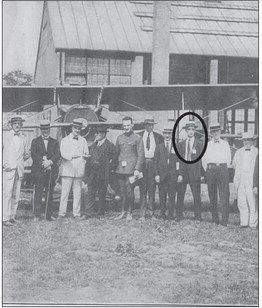
On August 12, 1918, the inauguration day of the Post Office airmail service, a grand celebration took place in College Park, Maryland, where the first flight originated. Hundreds of government, military, and civilian dignitaries attended. Chief among the distinguished attendees was OvertonBoundsfromMarshall County. Manydignitarieswere photographed in front of the Standard Aircraft Corporation JR-1B airplanes to commemorate the day, with Bounds also prominently featured in the picture.
The decline and then collapse of the Standard Aircraft Corporation, following the end of World War I, Bounds returned to Marshall County where he continued operation ofBoundsAeroplaneCompany that he had incorporated on May15,1915. Healsoreturned working with his brother Frank and his father James on the Bound’s Ranch between Madill and Kingston.
Despite working with his family on the Bounds Ranch and trying to build his airplane company, Bounds continued to barnstorm around the country. He continued holding exhibitions at county fairs in Oklahoma and Texas and occasional events in other far-off locations. He continued these exhibitions because he wanted to introduce others to the joy of flying and the possibilities of commercial air transport.
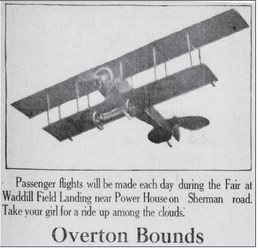
This desire turned from a dream into reality in late 1919 when Bounds bought the parts for a plane he designed while at the Standard Aircraft Company that he then built in an automobile showroom in Texas. It was a threepassenger airplane that he intended to use for excursion flights at events in Oklahoma and Texas. On August 9, 1919, the Fort Worth Record Telegram reported, “A threepassenger 200-horsepower Liberty model airplane, which was received here yesterday in knocked down form, is being assembled in the showrooms of the Dumas Motor Car Company. The machine is owned by Overton Bounds, an experienced aviator who is well known in Sherman, and when assembled, will be used by Mr. Bounds for passenger flights around Sherman.”
“Two expert mechanics are working on the ship, and it is expected to be ready for flight by Saturday. The machine was shipped from New York, where Mr. Bounds has been engaged in testing new machines for the government. It is a six-cylinder Liberty-motored plane designed by Mr. Bounds and will carry two passengers in addition to the pilot.”
“Mr. and Mrs. Fred Dumas will be among the first passengers taken up by Mr. Bounds. Mr. Dumas expects to make a trip to Dallas in the airship. Mr. Bounds is a former student at Austin College and alsoplayedbaseballatonetime with a local team. He has been flying a number of years and was among the first to make a flight here. He is a nephew of Mr. and Mrs. E.H. Bounds of South Elm Street.”
After these first flights, Bounds began advertising and providing flights at various locations throughout North Texas and Southern Oklahoma. These events were well received and large numbers of people received their first taste of flying with Overton Bounds.
In October of 1921, Bounds flew the Ardmore, Hardy Sanitarium ambulance airplane fromDallas,Texas,toArdmore in one hour. At the time, this was a record for travel time between Dallas and Ardmore. On October 10, 1921, the Daily Oklahoman reported on the new record. “What is believed to be a record flight between Dallas, Texas and Ardmore, was accomplished during the latter part of the week when Overton Bounds, aviator, accompanied by an Ardmore filer, flew the Walter Hardy ambulance aeroplane over the route,adistanceof100mileson an airline, in one hour.”
In addition to Bounds’ love of flying, he also had a passion for sports. After returning to Marshall County, Bounds began organizing sporting events in Kingston. He was a big football fan, and he loved playing in games. Because of that passion, Bounds worked to reorganize a Kingston football team. On September 29, 2021, the Kingston Messenger wrote, “Overton Bounds will reorganize the Kingston All Star 'Ringers' football team during the coming week. It is expected that the strongest aggregation of men ever gathered together on the Kingston banner, will do battle on the gridiron this fall.” Over the next few months, the Kingston all-star team competed against numerous opponents across southern Oklahoma, including Bounds as a player. The team had a large following and was Kingston's pride for some time. Eventually, “Ringer” teams were formed in basketball, baseball, and football in other towns, including Madill.
Bounds revered and honored war veterans, seizing every chance to celebrate those heroes. After the war, communities nationwide organized annual events to recognize local members who returned home and to commemorate those who sacrificed everything. MarshallCountywasno exception. These celebrations drew visitors from across the county in the early years after the war. Bounds was one of the feature attractions for these Marshall County events.
On July 14, 1921, The Madill Record wrote, “Claiming the ‘biggest and best’ celebration in Marshall County this year, the Soldiers and Sailors Reunion under the auspices of the Kingston Commercial Club has perfected generous arrangements for your entertainment. Indian dances and contests are the special feature and will be held all three days, the 4, 5 and 8th days of August. Clark's Greater Shows with a high-classreputationandoften larger than the big one contracted last year will be on the job. Overton Bounds, Marshall county's expert aviator will again get into the clouds. The Reunion has been thoroughly advertised and record crowds are expected. The Kingston Commercial Club has underwritten the expense, while the proceeds will go to the paying out of beautiful Soldiers and Sailors Park, which was purchased last year and donated to the town of Kingston. This beingaMarshallCountyaffair, interest is manifested from all parts of the county by our citizens who yearly honor the event, which commemorates the returning of Marshall County war boys.”
Then, on January 7, 1922, Bounds’ world changed completely. An article appeared in the Washington, D.C. newspaper, The Evening Star on January 8, 1922 announced, “At 2 o'clock yesterday afternoon an effectively arranged home wedding took place at the residence of Mr. and Mrs. Alfred Lee Lewis, when their daughter Ursula became the brideofMr.OvertonM.Bounds of Oklahoma.”
“The ceremony took place against a background of southern ferns, and was performed by the Rev. Bernard Braskamp. The bride's sister. Mrs. Robert Copeland Jones, acted as matron of honor and her husband, Maj. Jones, was best man. The bride wore a becoming gown of beige crepe and a corsage bouquet of lilies of the valley and orchids and was given in marriage by her father.”
“Immediately preceding the ceremony Mr. Edward Hutchinson sang 'Because' and 'At Dawning,' accompanied by Mrs. Alwilda Matlock, who played the wedding march. Only intimate friends and relatives attended ceremony, and immediately after the bride and bridegroom left for visits in New York City, Chicago and other points and will be at home after January 20 at Madill, Oklahoma.”
Ursula Lewis Bounds was born and raised in the Washington, D.C. area. Her father, a prominent ship captain, was well-known in the shipping community, and her grandfather was a hero of the Civil War. The Lewis family held considerable respect and influence in Washington, D.C., and Ursula’s marriage to Bounds attracted national attention, both due to Bounds’ fame and the legacy of the Lewis family.
In 1923, Overton and Ursula Bounds welcomed their first child, Ursula Jeanne “Betty” Bounds. Then in 1928, the two welcomed their second child, James Lewis “Jimmy” Bounds. Betty Bounds would eventually attend school in Oklahoma City, where the family lived for many years. She graduated from Classen High School in Oklahoma City in 1941. Then in 1943, she married George Kalamaroff, from Rochester, New York. They would eventually have three children. During their marriage, George and Betty livedinTulsaandSanAntonio, Texas, before eventually settling in Rochester, New York. Betty lived in Rochester until her death on February 24, 1910, at the age of 87 years. In her later years, Betty worked tirelessly to honor her father. Eventually creating a page on the “Early Birds of Aviation” webpage and the Early Birds of Aviation library in Ohio.
Sadly, though, little Jimmy died on December 6, 1929, at the age of 10 months. On December 8, 1929, the Daily Ardmoreite wrote, “Friends and acquaintances of the Bounds familyweresorrytolearnofthe death of little James Bounds, son of Mr. and Mrs. Overton Bounds of Oklahoma City. Mrs. Fannie Bounds, mother of Overton and Frank, left early Saturday morning and attended the funeral at the city on Sunday.”
After living in Oklahoma City for a few years, the family moved to Tulsa, where Bounds was hired as the general manager of the Garland Aircraft Company.
The Garland Aircraft Company, founded by Robert F.F. 'Bob'Garland,playedapivotal role in shaping the aviation industry in Tulsa, Oklahoma, during the late 1920s and early 1930s. As aviation technology advanced and air travel became increasingly viable, Garland recognized the potential for commercial and instructional aviation in the region. His efforts contributed to Tulsa’s aviation history and laidthegroundworkforfurther developments in the local aeronautical industry.
In 1929, Garland established the Garland Airport at the northeast corner of 51st Street and Sheridan Road in Tulsa. This facility served as both an airfield and a base of operations for his Garland Aircraft Company, which specialized in aircraft sales, servicing, and pilot training. The airport provided a hub for early aviators in the region and helped establish Tulsa as a key player in the burgeoning aviation industry.
The company was heavily involved in aircraft sales, serving as a dealership for renowned manufacturers such as Bellanca, Stearman, Consolidated, and Fleet. This strategic positioning allowed Garland Aircraft Company to introduce state-of-the-art aircraft to Tulsa’s aviation community, fostering interest and participation in aeronautical advancements. In addition to sales, the company operated theGarlandSchoolofAeronautics, which trained new pilots and aviation professionals, further contributing to the region’s aviation development.
In October 1931, Garland AircraftCompanymergedwith the McIntyre Airport Company, a competing aviation business owned by Duncan A. McIntyre, a notable aviation pioneer. The merger, valued at $350,000, led to the formation of the Tulsa Commercial Airport, marking a significant expansion in aviation services. The integration of these two businesses allowed for a more structured and professionalized aviation industry in Tulsa, accommodating both commercial and private aviation needs.
The newly formed Tulsa Commercial Airport became a regional central hub for aeronautics, supporting commercial airline operations, pilot training, and aircraft maintenance. This transition reflected the broader trend in the United States toward commercializing aviation and integrating it into mainstream transportation networks. The partnership between Garland and McIntyre played a crucial role in enhancing Tulsa’s aviation infrastructure, providing a foundation for future growth in the industry.
The legacy of Garland Aircraft Company extends beyond its immediate contributions to aircraft sales and pilot training. The establishment of Garland Airport, the introduction of modern aircraft to Tulsa, and the company’s role in expanding aviation education all played critical roles in fostering the city’s aeronautical development. The merger with McIntyre Airport Company further solidified Tulsa’s reputation as an aviation center, paving the way for future advancements inbothcommercialandprivate aviation.
After first being hired as the company's general manager, Bounds would eventually be promoted to vice president and Technical Advisor for the company. On August 4, 1929, the Daily Ardmoreite wrote, “Overton Bounds, son of Mrs. J. H. Bounds who lives seven miles south of Madill on the Madill-Kingston highway, has been advanced from general manager of the Garland Aircraft company at Tulsa to the position of vice president technical advisor of the firm, according to information received here this week. Bounds has been connected with the aviation work for more than 15 years, having served during the World war with the air corps and since then has been doing commercial flying except for two or three years spent on his mother's farm here in the county.”
Much if not most of the early success of the Garland Aircraft Company can be attributed to Marshall County’s own, Overton Martin Bounds. As the vice president and technical advisor, he oversaw all of the company's operations from aircraft sales to the construction and operation of the Garland Airport.
Overton Bounds was a master of the air and a businessman with a vision of the future and the importance that aviation would have in the years to come. He truly was Marshall County’s Fly Boy. More next week in Part IV.