
On Wednesday, March 16, 1921, the last witness stepped down in the murder trial of Clara Smith Hamon. For nearly a week, the courtroom in Ardmore had been the setting for one of the most sensational criminal proceedings in Oklahoma history. The jury had heard from physicians, nurses, law-enforcement officers, businessmen, newspaper reporters,membersofClara’s family, and the widow of the dead man. They had listened to conflicting accounts of Jake Hamon’s final conversations, examined the rooms at the Randol Hotel where the shooting occurred, and watched Clara herself demonstrate the struggle she claimed had ended with the discharge of a pistol. Now the evidence was closed. The witnesses could offer nothing more. What remained was the law, the lawyers, and twelvemenwhowoulddecide whetherClaraSmithHamon was a murderer.
Last week, we followed Clara into the witness chair. She admitted that the pistol was in her hand when it discharged but denied deliberately shooting Jake Hamon. According to Clara, Hamon had been drinking, had beaten and choked her, and had threatened her with a knife before the struggle over the weapon. She acknowledged that she could not say precisely how the pistol fired. It might have discharged when Hamon struck it, or she might have pulled the trigger during the struggle. Attorney General S. P. Freeling subjected her to approximately four hours of cross-examination, questioning her account of the shooting, her relationship withHamon,andstatements attributed to her in a newspaper interview conducted while she was in Mexico. Through it all, Clara maintained that she had loved Hamon, even during the years when she sometimes hated the circumstances of their relationship.
The State had answered with five rebuttal witnesses. A Texas driver testified about seeing a pistol in Clara’s handbag during her flight from Oklahoma. Chicago newspaperman Sam Blair defended the substance of theinterviewhehadobtained fromherinChihuahua.Other witnesses returned the jury’s attentiontoHamon’shospital room, where even the nurses, physician, and business associates disagreed about conversations supposedly held during the wounded man’s final days. When the last witness stepped down, neither side had produced anyone who actually saw the shooting. The State had offered testimony suggesting a deliberate killing. Clara had offered an account of violence, fear, and a pistol discharging during a struggle. The evidence was complete, but the central question remained unresolved.
The Daily Ardmoreite understood the importance of what was coming. Its March 17 edition described the proceeding as the “Most Bitterly Contested Criminal Case In Oklahoma’s History” and announced that “Master Legal Minds” were hurling their “oratorical anathemas” across the courtroom. The language was extravagant, as newspaper writing often was in 1921, but the underlying observation was sound. Some of Oklahoma’s most accomplished trial lawyers had gathered in Ardmore, and the contest was about to move from the testimony of witnessestothepersuasionof jurors. Among those lawyers was Charles Arthur Coakley, the former Marshall County Attorney whose career we have followed throughout this series.
The final two days would provide the climax of a story that had begun nearly four monthsearlier.OnNovember 21, 1920, a pistol discharged inside the Randol Hotel, wounding Jake L. Hamon, one of Oklahoma’s wealthiest and most politically influential men. Five days later, Hamon was dead. Clara, his longtime companion and secretary, had fled Oklahoma, eventually reaching Mexico. Her return, arrest, and prosecution attracted nationwide attention. Newspapers followed the proceedings with an intensity ordinarily reserved for presidential elections, national disasters, and the most notorious criminal cases.
But for all the publicity, the question before the jury remained remarkably simple: Had Clara Smith Hamon unlawfully killed Jake Hamon, or had the fatal shot been fired under circumstances that Oklahoma law recognized as excusable or justified?
The Judge’s Instructions
Before the lawyers could make their final appeals, District Judge Thomas W. Champion had to instructthe jury. The surviving court file contains his written charge, consisting of thirty-four numbered instructions. Contemporary newspaper reporting described the charge as seventeen typewritten pages. It was considerably more than a routine explanation of the law. Judge Champion had to provide the jury with a legal framework capable of accommodating several competing versionsofthesameshooting, ranging from premeditated murder to an accidental discharge of the pistol during a violent struggle.
The instructions began with the fundamental principles governing criminal trials. Clara stood before the courtpresumedinnocent,and that presumption remained with her unless the State establishedherguiltbeyonda reasonable doubt. The jurors had to decide the case based on the evidence admitted at trial, not newspaper accounts, public sentiment, or their personal opinions about Clara’s relationship with Hamon. They also had to determine the credibility of witnesses, an especially important responsibility in a case where so many accounts contradicted one another.
Judge Champion explained that the jury could reject testimony it believed to be deliberately false on a material matter. This was no small consideration. Dr. Walter Hardy had acknowledged that he initially repeated the accident story even though he later testified that Hamon privately blamed Clara. Frank Ketch had admitted participating in efforts to conceal the circumstances of the shooting and arranging Clara’s departure from Ardmore. Sheriff Buck Garrett had testified about different accounts Hamon gave him. The nurses disputed important portions of the testimony concerning Hamon’s hospital conversations. The judge’s instructions left the evaluation of these contradictions where it belonged—with the twelve men who had heard the witnesses.
The jury was not limited to deciding between murder and acquittal. Judge Champion explained the elements of murder, manslaughter in the first degree, and manslaughter in the second degree. Under the instructions, a finding of murder required proof of a killing committed with a premeditated design to effect death. First-degree manslaughter presented a different question, involving an unlawful killing without such a design but under circumstances defined by Oklahoma law, including certain killings committed in the heat of passion. Seconddegree manslaughterpermitted consideration of a killing resulting from culpable negligence. The distinctions mattered because Clara had acknowledged possession of the pistol and the possibility that she pulled its trigger. Even if the jury rejected the State’s theory of deliberate murder, it still had to consider whether her conduct constituted another criminal offense.
The potential consequences were enormous. Judge Champion instructed that a murder conviction carried punishment by death or life imprisonment at hard labor. First-degree manslaughter carried imprisonment for a term of not less than four years. Second-degree manslaughter carried lesser penalties, including imprisonment or a fine, depending upon the punishment selected under the law then in effect. Thus, the verdict would determine not merely whetherClararemainedfree, but whether she might spend years or the remainder of her life in prison—or face the death penalty.
Yet the most important portions of the charge concerned the circumstances under which a killing could be excused or justified. Judge Champion instructed the jurors that homicide could be excusablewhencommittedby accident or misfortune under the circumstances defined by law. He also explained that a person could lawfully defend herself against an attempt to kill her or inflict serious bodily injury. These were distinct legal theories, but both arose from Clara’s account of what happened inside the Randol Hotel. If the pistol discharged accidentally during an otherwise lawful struggle, the jury had to consider the law governing excusable homicide. If Clara reasonably believed she faced imminent death or serious injury, the law of self-defense became controlling.
The judge’s instructions explained that a person confronted with an apparent threat to her life or safety was entitled to act in selfdefense when the circumstances reasonably justified that belief. The law did not require her to wait until an attacker actually inflicted the threatened injury. Nor did it necessarily require that the danger prove, upon later examination, to have been real. The question was whether the circumstances reasonably appeared to justify defensive action at the moment it occurred.
This was the legal foundation upon which Clara’s defense rested. She had testified that Hamon beat, kicked, and choked her, threatened her with a knife, and then took the pistol from her purse. Her sister, niece, and mother had testified that they observed bruises afterward. Thedefensewantedthe jurors to imagine those final moments not from the calm security of a courtroom several months later, but from the standpoint of a woman who believed she was being attacked by a larger, stronger, and enraged man.
Judge Champion’s written instructions expressly directed the jurors to examine the circumstances from Clara’s standpoint, as they reasonably appeared to her at the time. His charge also emphasized that self-defense was defensive rather than offensive and that the right to use deadly force depended upon necessity or apparent necessity. Once that necessity ceased, so did the right to act. The law therefore did not give Clara an unlimited privilege to shoot Hamon merely because he had previously mistreated her. It required the jury to determine whethershereasonablyfaced imminent danger when the pistol discharged.
The distinction between actual and apparent danger was essential. If Clara reasonably believed Hamon was about to kill or seriously injure her, the fact that someone examining the circumstances afterward might reach a different conclusion would not necessarily defeat her claim. But the belief had to be reasonable, and the defensive actionhadtobenecessary or apparently necessary underthecircumstances.The judge’s instructions required the jury to examine the encounter asawhole,notsimply choose whichever witness or statement it found most sympathetic.
Judge Champion also explained the meaning of reasonable doubt. It was not an imaginary or speculative doubt, nor did the law require mathematical certainty. It was a doubt grounded in reason and arising from the evidence or the absence of evidence. The jurors were required to consider all the testimony together, including the contradictions and omissions that had become so prominent during the trial. If they retained a reasonable doubt about Clara’s guilt under the offenses submitted, or about whether the shooting was excusable or justified under the instructions, they were required to acquit.
The judge concluded by reminding the jurors that sympathy, passion, and prejudice had no proper place in their deliberations. They were to decide the case according to the evidence and the law, regardless of their feelings toward Clara, Jake Hamon, or the extraordinary relationshipthathadbrought both into the national headlines. He also cautioned them about the arguments they were about to hear. The lawyers could assist the jury in analyzing testimony and applying the law, but their arguments were not themselves evidence.
It was an appropriate warning. The next stage of the trial would involve some of the most emotional courtroom advocacy Oklahoma had witnessed.
The State Opens Its Argument The first closing argument belonged to H. H. Brown, the special prosecutor appointed because Carter County Attorney JamesA.Mathershad previously been retained to defend Clara. Brown faced a difficult task. The State had presented testimony that Hamon accused Clara of shooting him, but it had also introduced witnesses whose recollections differed considerably. Several acknowledged that they initially participated in spreading the story that Hamon accidentally shot himself. The defense had spent much of the trial exploiting those contradictions.
Brown’s argument was direct. According to contemporary reporting, he warned the jury against permitting a woman who had killed a man to escape criminal responsibility merely because she had appeared sympathetic upon the witness stand. His appeal reached beyond Clara and Hamon to the reputation of Oklahoma’s courts.
“You cannot let this defendant go free,” Brown told the jurors. “You cannot tell the rest of the world that a woman killed a man in Oklahoma, brazenly faced a jury and goes scot-free.”
The words revealed the prosecution’s concern. Brown understood that Clara had made a favorable impression. Contemporaryaccounts repeatedly described her as composed, attractive, and remarkably effective under cross-examination. Reporters had noted her tears, her occasional humor, and her ability to withstand the Attorney General’squestioning. Brown wanted the jurors to remember that their duty was not to reward a compelling performance but to determine whether a crime had been committed.
His argument also attempted to separate the moral questions surrounding Hamon’s relationship with Clara from the legal question ofhisdeath.Hamonhadbeen unfaithful to his wife. He had maintained a relationship with Clara for years. His conduct might have been reprehensible, but Brown couldarguethatnoneofthose facts gave Clara the right to kill him. The criminal law protected imperfect people as well as admirable ones, and the State was entitled to insist that the jury judge the shooting rather than the character of the deceased.
The prosecution’s theory remained that Clara deliberately shot Hamon because she feared losing him. His political ambitions had reached their height following Warren G. Harding’s election, and his wife and children were expected to occupy the public position beside him that Clara could never claim. The State argued that the prospect of abandonment supplied the motive for a killing that was afterward concealed through Hamon’s own efforts to protect her.
Brown’s warning about allowing Clara to go free was also an appeal to the jurors’ sense of public responsibility. The case had received national attention, and the outcome would be reported throughout the country. The prosecutor suggested that an acquittalmightcommunicate that a woman could kill a man and escape punishment through charm, sympathy, or public sentiment. It was a forceful argument, but it carried a risk. The defense could respond that the jurors’ responsibility was not to protect Oklahoma’s reputation before the nation. It was to decide whether the State had proved Clara guilty beyond a reasonable doubt.
A Remarkable Defense Maneuver What happened after Brown’s opening argument was one of the most unusual tactical moments of the trial. Rather than immediately beginning their own speeches, Clara’s attorneys offered to waive further argument and submit the case to the jury. The State was reportedly takenbysurprise.Contemporary reporting described the maneuver as an infrequently used tactic, and observers said it was the first time such an approach had been attemptedinaCarterCounty courtroom.
The defense had an obvious reason to consider such a course. Clara’s testimony had made a strong impression, and the defense may have believed that additional speeches would accomplish little. By waiving argument, her attorneys also hoped to prevent Freeling from delivering a final prosecution appeal after the defense had finished. The tactic would have allowed the jurors to begin deliberating while the impression of Clara’s testimony and the contradictions in the State’s evidence remained fresh.
The problem was that Freeling was not in the courtroom when the proposal was made. Judge Champion declined to rule immediately and waited for the Attorney General’s return. The proceedings paused while the lawyers and spectators considered what might happen next. Reporters noted that the attorneys had not been placed under a strict time limitfortheirarguments,and the defense’s proposal raised the possibility that the case might reach the jury much sooner than expected.
Ultimately, Judge Champion refused to permit the case to be submitted without the remaining arguments. The defense would have to proceed, and Freeling would have his opportunity to answer. Contemporary newspapersreportedthatthe defense began its arguments Thursday morning after the judge rejected the proposal.
The episode is worth remembering becauseitreveals how the defense lawyers assessed the case. Whatever their private conversations, they were sufficiently confident to offer to place Clara’s fate in the jury’s hands without delivering the elaborate closing speeches that ordinarily mark the conclusion of a major murder trial. The maneuver also demonstrated their willingness to employ courtroom strategy rather than rely solely upon eloquence. Lawyers such as Coakley, Mathers, McLean, and Champion understood that sometimes the most effective argumentistheonean opponent never gets to make.
JamesMathersandthe Hamon Millions James A. Mathers approached the jury from an unusual position. He was Carter County’s elected prosecutor, yet he sat with the defense because he had begun representing Clara before he assumed office. The conflict had required the appointment of Brown as special prosecutor, but it had not prevented Mathers from participating in Clara’s defense. Now, in his closing argument, he sought to persuade thejurythattheState’s evidence failed to establish the certainty required for a criminal conviction.
Mathers also attacked the influenceoftheHamonestate and the powerful interests surrounding it. According to contemporary reporting, he argued that Clara had contributed through her business activities to the accumulation of wealth that was now being used against her. The prosecution, he suggested, had become more than an ordinary criminal proceeding. It was a contest between a woman with limited resourcesandthefinancial and political influence of the dead man’s associates.
The argument had a factual foundation in testimony concerning Clara’s business interests. Frank Ketch acknowledged that he and Clara jointly owned a motionpicture theater and that she had interests in other enterprises connected with Hamon’s business affairs. Clara testified that she had receivedonly$125fromthose interests since the shooting and had been forced to pawn diamonds Hamon had given her to pay the expenses of her defense. Mathers used those circumstances to portray Clara as a woman whose financial position had deteriorated sharply after Hamon’s death, even while the estate and its associates retained substantial resources.
The defense’s appeal was calculated to resonate with jurors who might distrust the influence of great wealth upon the administration of justice. Hamon had been a millionaire oil and railroad promoter, a Republican National Committeeman, and a man whose political connections reached Washington. Clara had been his secretary and longtime companion. The contrast between their positions had been evident throughout the trial, but Mathers now placed it directly before the jury as a question of fairness.
He also criticized the involvement of Governor J. B. A. Robertson, whose administration had sent Attorney General Freeling to assist in the prosecution. The defense suggested that the intervention of the state’s highest legal officer reflected the political influence surrounding Hamon’s death. Freeling would later defend the governor’s action, explaining that the local county attorney’s conflict made the Attorney General’s participation appropriate. The dispute illustrated how difficult it was to separate the murder case from the political world Hamon had occupied.
Mathers returned as well to the inconsistencies in the evidence. The defense could acknowledge that Clara possessed the pistol without admitting that she deliberately shot Hamon. It could acknowledge that she left Ardmore without accepting that she fled from guilt. Frank Ketch had testified that Hamon ordered Clara’s departure and supplied money for her journey. Clara herself had testified that she wanted to remain with Jake but was instructed to leave. The defense argued that conduct undertaken at the directionofthewoundedman and his business manager could not automatically be treated as evidence of a guilty conscience.
Mathers also questioned the physical evidence, including the clothing Hamon supposedly wore on the night of the shooting. The Ardmoreite reported that he argued the suit introduced during the trial was not the one Hamon had worn when he was wounded. Mathers drew attention to Dr. Hardy’s testimony about an older suit and contrasted it with evidence that Hamon had intended to wear a newer one to the presidential inauguration. What might have appeared to be a minor disagreement about clothing became another illustration of the defense’s larger argument: if the State could not reliably establish such details, how confidently could the jury accept its reconstruction of events behind a closed hotel-room door?
The clothing question had troubled the case from the beginning. Russell B. Brown, the former county attorney who initially investigated the shooting, testified that Ketch told him Hamon’s shirt and underclothing had been burned. Ketch denied making that statement. The disagreement did not prove that evidence had been destroyed, nor did it establish what happened during the shooting. But it allowed Mathers to remind the jury that uncertainty had surrounded important physical evidence from the earliest days of the investigation.
Mathers’s broader theme was that the State’s case required the jurors to make too many assumptions. They were asked to believe that Hamon’s first explanation was false, that certain later statements were true, that Clara’s departure established guilt despite testimony concerning Hamon’s instructions, and that the physical evidence supported a deliberate shooting rather than a struggle. The defense maintained that these were not conclusions compelled by the evidence, but choices among competing possibilities.
The Ardmoreite captured the defense’s moral argument in the phrase “Woman More Sinned Against Than Sinning.” It was an appeal to the jury’s understanding of the relationship that had dominated the testimony. Clara was not presented as blameless in every respect. She had participated for years in an adulterous relationship withamarriedman. But the defense asked the jurors to consider the disparity in age, wealth, influence, and power between the two, and to distinguish moral wrongdoing from the crime of murder.
That distinction was essential. The jury was not being asked to approve of Clara’s relationship with Hamon. It was being asked to determine whether the State had proved that she unlawfully killed him. Mathers wanted the jurors to understand that a woman could have lived an unconventional or morally compromised life and still be entitled to the full protection of the criminal law.
The Other Champion Among the defense lawyers was J. B. Champion, the twin brother of the judge presiding over the trial. Their presence on opposite sides of the courtroom’s most important dividing line was one of the case’s unusual features. Thomas W. Champion sat upon the bench, responsible for maintaining order and instructing the jury. His brother stood among the lawyers defending Clara, free to employ the emotional force of advocacy in a way the judge could not.
Champion’s argument took the jury back to the beginning of Clara’s relationship with Jake Hamon. The newspapers described him portraying Clara as an innocent country girl who had entered the orbit of an older, wealthy, experienced man. Hamon had helped finance her education and employed her as a stenographer, but Champion argued that the relationship had become far more complicated and destructive. According to contemporary reporting, he characterized Clara as an “innocent country girl” whom Hamon had educated under the pretext of preparing her for employment while pursuing a very different purpose.
The contrast was central to the argument. Hamon was no ordinary employer. By 1920, he had accumulated substantial wealth through oil, railroads, and other enterprises, and had become one of the most influential Republican political figures in Oklahoma. Clara, by comparison, had entered his life as a young woman with limited financial resources and little experience of the world in which he operated. Champion wanted the jurors to consider what that imbalance meant during the years that followed.
He could draw upon evidence the jury had already heard. Hamon paid Clara’s tuition. He employed her. Their relationship continued for years while his business and political fortunes expanded. The defense introduced a written agreement addressing her employment and even the possibility of a child being born to them. Clara testified about promises of marriage, affection, dependence, and violence. Her family described its distress upon learning of the relationship. By the time Championreachedtheevents of November 21, the defense had supplied a history intended to make Clara’s fear of Hamon understandable.
The argument was powerful because it asked the jury to look beyond the moment of the shooting without forgetting it. The State wanted the relationship to establish motive: a woman who had waited years for marriage became desperate when the promised future appeared to be slipping away. Champion wanted the same history to establish context: a woman who had spent years under the influence of a powerful man finally found herself in a violent confrontation she could not control.
Those competing interpretations could not be resolved by the mere fact that Clara hadlovedHamon.Sheadmitted she had sometimes hated him, too. Attorney General Freeling had attempted to use that admission to establish motive, but Clara insisted that love remained the stronger emotion. Champion’s argument invited the jury to accept that contradiction as a feature of a deeply troubled relationship rather than proof of a deliberate killing.
There was also a broader appeal in Champion’s presentation. The jurors were twelve men living in Oklahoma in 1921, a time when public expectations concerning women, marriage, sexuality, andpersonalconductdiffered considerably from those of today. Clara’srelationshipwith a married man had made her a subject of scandal long before the trial began. The defense could not erase that history. Instead, Champion attempted to turn the jurors’ attention toward the conduct of the man who had shared responsibility for it.
If Clara had been wrong to enter the relationship, what responsibility did Jake Hamon bear for sustaining it? If she had been dependent upon him, who had created that dependence? If she had endured violence, was the jury prepared to ignore it because the relationship itself violated prevailing moralstandards?Thesewere not substitutes for the legal requirements of self-defense, buttheywerequestionscapable of influencing how jurors evaluated Clara’s testimony.
Champion’s argument also placed him in a position familiar to Charles Arthur Coakley. Both men built careers in the courtrooms of southern Oklahoma, where a lawyer’s ability to tell a coherent story about human conduct could matter as much as his command of statutes and precedents. A successful murder defense often required more than identifying contradictions. It required giving the jury an explanation of events that made those contradictions understandable.
The praise Champion received afterward suggests that his speech made a considerable impression upon observers. The Ardmore Statesman,writingonMarch 24, declared that Champion had “easily carried off the palm for oratorical effort displayed inthecase.”Thenewspaper reported that visitors to its office praised his ability as a lawyer and speaker, with some claiming that few advocates in the West could equal his skill in presenting a case to a jury. Mathers also received substantial praise for his address.
McLean and the Defense of Clara
W. P. McLean Jr., another of Clara’s principal lawyers, brought his own formidable courtroom personality to the closing arguments. McLean had been one of the defense’s most aggressive cross-examiners, repeatedly challenging witnesses who claimed to know what Hamon said during his final days. He had also been at the center of the courtroom disturbance when special prosecutor Brown referred to Clara’s mother as “the old woman.” McLean’s immediate protest drew applause from spectators and forced Judge Champion to restore order. The incident illustrated the emotional atmosphere in which the lawyers were now making their final appeals.
One of the most striking phrases associated with the defense’s closing presentation was “GOD DID IT.” The words captured the religious and moral dimension that had surrounded the trial almost from the beginning. Hamon’s death had been described by some observers as a consequence of his private conduct, while Clara’s defenders portrayed her as a woman who had suffered for years in a relationship that ultimately destroyed both lives.
The phrase was not a legal explanation of how the pistol discharged. It was a moral argument about the tragedy itself, inviting the jury to consider the consequences of Hamon’s conduct and the forces that had brought the two together. Such language belonged to a courtroom culture in which lawyers frequently invoked religion, providence, family, and community values to make their arguments meaningful to jurors.
But the defense could not rely upon moral judgment alone. Whatever the jurors believed about Hamon’s treatment of Clara, they still had to decide whether the shooting was murder, manslaughter, excusable homicide, or justifiable selfdefense. McLean and his colleagues therefore had to connect the emotional history of the relationship to the specific legal instructions Judge Champion had given.
The testimony of Clara’s relatives was particularly important to that connection. Her sister and niece said they saw bruises on her throat, breast, and hands the morning after the shooting. Her mother said the bruises remained visible when Clara reached El Paso several days later. Those observations did not establish precisely how the pistol fired, but they supported Clara’s claim that a physical confrontation occurred. Thedefensecouldask the jury to consider whether thoseinjurieswereconsistent with a calculated murder committed by an uninjured assailant or with the violent struggle Clara described.
The testimony of the nurses offered another important consideration. Rose CannontestifiedthatHamon embraced and kissed Clara whenshecametothehospital after the shooting. The State could explain that conduct as an effort by Hamon to protect the woman he still loved. The defense could argue that it was equally consistent with the absence of a deliberate attempt to kill him. Once again, the jury faced competing interpretations of the same conduct.
McLean’s argument, like those of Mathers and Champion, ultimately returned to reasonable doubt. The State had presented evidence that Clara shot Hamon, but Clara had not denied the possibility that she pulled the trigger. The dispute concerned the circumstances and intent surrounding the discharge. If the jury believed the weapon fired accidentally during a struggle, or that Clara acted under a reasonable apprehension of imminent serious injury, the law required acquittal.
Freeling’s Final Argument
Attorney General S. P. Freeling carried the responsibility of answering the defense’s arguments for the State. His task was particularly difficult because the trial had moved far beyond the narrow question of who possessed the pistol. The jurors had heard an extensive account of Hamon’s relationship with Clara, including evidence that reflected poorly upon the dead man. The defense had portrayed him as powerful, controlling, and violent. Freeling had to persuade the jury that none of those circumstances relieved Clara of criminal responsibility if she deliberately shot him.
The Attorney General had made clear that he would not ask the jury to impose the death penalty as a specific demand. Instead, he said he would seek whatever punishment the jurors considered appropriate under the evidence and the law. That decision was significant. A demand for execution might have alienated jurors already sympathetic to Clara, particularly after her emotional testimony and the defense’s extensive account of her relationship with Hamon. Freeling therefore focused on securing a conviction rather thanpushingfortheharshest possible punishment.
Freeling could remind the jurors that Clara had carried a pistol and that several witnesses testified to seeing firearms in her possession before and after the shooting. He could point to the statements attributedtoHamoninwhich the wounded man blamed Clara. He could emphasize that the shooting occurred at a time when Hamon’s political future was expanding and Clara’s position in his life appeared increasingly uncertain. The State’s theory was thatjealousyandresentment culminated in an intentional act, followed by flight and an elaborate effort to conceal the truth.
But Freeling did more than appeal to motive. He attempted to demonstrate that Clara’s account of the shooting was physically inconsistent with the evidence. According to a contemporary report published in the Montgomery Advertiser on March 18, Freeling took the pistol in his hand and used it to illustrate his argument. Clara had testified that the weapon discharged when Hamon struck her with a chair, or as the pistol fell from her hand. Freeling contended that the weapon could not have discharged merely from such a blow. He further argued that if a hand holding the pistol were struck, the muzzle would tend to rise, whereas the course of the bullet through Hamon’s body was downward.
This was a significant moment in the closing argument because it returned the case to the physical mechanics of the shooting. The defense had spent considerable time describing Hamon’s treatment of Clara, the years of dependence, and the contradictions in the testimony. Freeling attempted to bring the jury back to the pistol itself. If Clara’s account was physically impossible, then the jurors could reject her explanation regardless of how sympathetic they found her.
The Attorney General’s demonstration was an argument, however, not independent scientific evidence. The jurors had to evaluate it against the testimony they had heard, the pistol admitted into evidence, and their own understanding of how a weapon might move during a struggle. The prosecution’s theory depended upon persuading them that the downward path of the bullet was inconsistent with Clara’s description. The defense could answer that a chaotic struggle involving two moving people, a chair, and a small automatic pistol was not easily reconstructed from a single physical observation.
The issue also illustrated the limitations of the evidence available in 1921. Modern forensic reconstruction was still in its infancy, and the courtroom lacked many of the techniques that later generations would come to associate with homicide investigations. The jury had no video recording of the shooting, no neutral eyewitness, and no complete scientific reconstruction that eliminated the competing possibilities. It had testimony, physical exhibits, and the arguments of lawyers who interpreted them differently.
Freeling also defended the involvement of Governor Robertson and the Attorney General’s office. The defense had suggested that political influence lay behind the prosecution, but Freeling maintained that the state’s participation was proper because the elected county attorney had already been retained to represent Clara. He denied that the prosecution was motivated by politics. Theargumentwasnecessary because the defense had attempted to portray the case as a contest between a comparatively powerless woman and the wealth and influence of Hamon’s associates.
The Attorney General’s strongest evidence remained the statements attributed to Hamon by his friends and associates. Several witnesses testified that Hamon eventually accused Clara of shooting him. Freeling could argue that the original accident story was part of the concealment Hamon ordered to protect her and his family. The defense’s contrary interpretation— that the accident story reflected the truth or at least contradicted the claim of deliberate murder—required the jury to choose among competing accounts.
The difficulty was that the witnesses did not agree upon precisely what Hamon said. Some accounts suggested a deliberate shooting while he rested upon a bed. Others referred to a struggle. The defense had also established that several men initially repeated a false story, according to their own later testimony. Freeling therefore had to convince the jury that the differences were not substantial enough to defeat the State’s case.
It was a contest between two fundamentally different ways of understanding the evidence. The prosecution asked the jury to assemble the circumstances into a coherent account of motive, deliberate shooting, concealment, and flight. The defense asked the jury to recognize that the same evidence could support a very different explanation: years of dependence and mistreatment, a violent confrontation, an accidental or defensive discharge, and a departure ordered by the wounded man himself.
The jurors had heard enough testimony to support arguments on both sides. Whatremainedwaswhether the State had carried the burdenJudgeChampionhad explained.
The Case Goes to the Jury On Thursday, March 17, the lawyers finally completed their arguments. For days, the courtroom had been crowded with spectators eager to hear every development. The trial had attracted reporters from across the country,andnewspapershad treated Clara’s appearance, testimony, and prospects almost as a national spectacle. But the final decision would not be made by reporters, spectators, or lawyers. It belonged to the twelve men selected a week earlier.
Contemporary accounts place the submission of the case to the jury at approximately 1:30 that afternoon. The men had been entrusted with deciding a case that had occupied Oklahoma’s attention since the shooting in November and had drawn national interest because of Hamon’s wealth, political connections, and the circumstances of his death. The evidence had occupied several days and involved complicated questions of credibility, intent, accident, and self-defense. Judge Champion had supplied thirty-four instructions covering multiple possible verdicts. A conviction for murder could carry death or life imprisonment. A manslaughter conviction could sendClaratoprisonforyears. An acquittal would end the prosecution and permit her to walk out of the courthouse a free woman.
The jurors did not take hours.
They returned in approximately thirty-nine minutes.
By the time the jury came back into the courtroom, the afternoon was still young. The men had been entrusted with deciding a case that had occupied Oklahoma’s attention since the shooting in November and had drawn national interest because of Hamon’s wealth, political connections, and the circumstances of his death. The speed of their return surprised observers who expected a prolonged deliberation. Yet the verdict they brought was unmistakable.
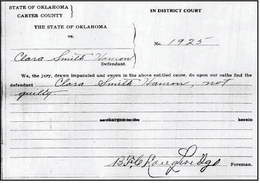
“Not guilty as charged in the information.”
Clara Smith Hamon was acquitted.
The Daily Ardmoreite announced the result in the unmistakable language of a newspaper reporting the climax of a sensational trial: “SMITH TRIAL ENDS IN ACQUITTAL.” Another headline declared, “‘NOT GUILTY!’ IS VERDICT OF JURY.” The woman who had fled Oklahoma after Jake Hamon’s death, returned from Mexico to face prosecution, and spent months preparing for trial was free.
Contemporary reporting recorded Clara’s reaction in wordsthatcapturedtheenormous relief of the moment: “I amthehappiestwomanalive. I knew that you would free me.” The statement reflected the conclusion of an ordeal that had consumed nearly four months of her life and exposed her most intimate affairs to public scrutiny. She had entered the courtroom charged with the murder of one of Oklahoma’s most influential men. She left it acquitted by twelve jurors after less than an hour of deliberation.
The courtroom erupted in applause when the verdict was announced. Contemporary accounts described an enthusiastic demonstration by spectators who had crowded into the room to witness the conclusion of the trial. The jurors themselves reportedly smiled broadly, and Clara expressed her gratitude to the men who had acquitted her. The Ardmore Statesman later reported that the defense attorneys received numerous congratulations.
The speed of the verdict immediatelyraisedquestions about what had persuaded the jury. Had the jurors believed Clara’s account of the struggle? Had they accepted herclaimofself-defense?Had the prosecution’s conflicting witnesses created reasonable doubt? Or had the defense’s portrayal of Hamon’s treatment of Clara produced sympathy that the State could not overcome?
The verdict itself did not answer those questions. It established only that the jury found Clara not guilty of the offense charged under the instructions given. It did not constitute a formal finding that every detail of her testimony was true, nor did it identify which defense theory the jurors accepted.
Yet the jurors themselves soon began speaking.
Their comments would offer a remarkable glimpse into what had happened behind the closed doors of the jury room. After days of testimony, conflicting accounts, emotional appeals, and arguments bysomeofOklahoma’s most accomplished lawyers, the twelve men had required only thirty-nine minutes to decide Clara’s fate. But had the decision really been made that quickly? Or had the jurors reached their conclusions long before Judge Championinstructedthemto retire and deliberate? What they told newspaper reporters afterward would raise intriguing questions about the evidence, the lawyers’ arguments, and the extraordinary speed of the acquittal.
And while the verdict ended Clara’s prosecution, it did not end her story. The woman who had entered the courthouse facing the possibility of spending the remainder of her life in prison emergedtofindthatthesame national publicity that had accompanied her prosecution now offered unexpected opportunities. Newspapers continued to follow her movements, motion-picture interests sought to capitalize uponhernotoriety,andClara spoke of religion, redemption, and beginning her life anew. Yetfreedomfromprosecution could not erase the past, nor could an acquittal answer every question about the night Jake Hamon was shot.
For Charles Arthur Coakley and his fellow defense attorneys, the verdict represented the successful conclusion of a difficult and nationally publicized criminal defense. For Clara, it marked the beginning of a new and uncertain chapter. And for those who had followed the case from the first reports of the shooting at the Randol Hotel, the questions surrounding Jake Hamon’s death remained as compelling as ever.
Next week, in Part XX of The Lion of the Courtroom, we will return to those thirtynine minutes and examine what the jurors revealed about their deliberations, including whether the outcome had been decided before the lawyers finished their arguments. We will also follow Clara Smith Hamon beyond the courthouse doors, exploring her immediate reaction to freedom, the remarkable attention she continued to receive, her efforts to begin a new life, and what ultimately became of the woman whose trial had captivated the nation.
The jury had spoken. The murder trial was over. But the story of Clara Smith Hamonwasfarfromfinished.