

Part I traced the big moves—the leases and bond votes, the speeches under a July sun, the architect’s pencil sketching a piano on a bluff. Part II is the lived part of the story. This is where the blueprints turn into terrazzo underfoot and a two-story hearth throws heat on winter meetings; where buses idle at the portico, a high-school band warms up on the patio, and a waitress named Virgie learns the names of half the county and most of the legislators. If the first half showed how the lodge was imagined, the second shows how it felt—what it sounded like, what it promised, and how long that promise held.
We will step inside as the doors open in 1956 and stay long enough to hear the clink of glass in the ballroom and the hush when the whiteway lights blaze across the Roosevelt Bridge. We’ll walk the cabin rows and past the mushroom-shaped pool, follow the brochures’ boasts and the booking ledgers’ realities, and watch the lodge do exactly what it was built to do: host, gather, and knit a region together. Then we’ll stay as the years turn— through full summers and thinbudgets,throughrepairs postponed and systems tired by wind and water—until pride hardens into worry and the conversation shifts from upkeep to sale.
This is a chapter about endurance and neglect in equal measure; about how public beauty thrives when tended and fails when forgotten. It is also, stubbornly, a chapter about people—about the staff who kept the lights on and the guests who filled the rooms, about a county that measured its seasons by the crowds on the patio and the boats in the bay. With the ribbon already cut and the key already “thrown in the lake,” we begin where memory meets proof: the lobby, the dining room, and the long half-century that followed.
The Lake Texoma Lodge rose above Catfish Bay like a modernist crown of glass and stone, its long wings unfolding toward the water in the unmistakable shape of a grand piano. Seen from the bridge, its pale façade gleaming through the shimmer of the Oklahoma heat, itappearedtoalmostfloat—a testament to the belief that Oklahoma could marry civic purpose with architectural grace. For half a century, it stood as a symbol of the state’s ambition, a place where governors met, families gathered, and the lake itself seemed to lean against the glass to listen.
From the road into the park, travelers saw a vision of Oklahoma’s mid-century confidence. A circular drive curved to the entrance, framing manicured lawns and a proud flagpole at the center. On summer weekends, the parking lot filled with chrome and color—Buicks and Oldsmobiles from every corner of the state—while families unloaded suitcases, fishermen hefted tackle boxes, and couples stepped out to claim their piece of leisure on the state’s own inland sea.
From the bluff, the view was nothing short of majestic. To the east stretched the Roosevelt Memorial Bridge, a line of concrete arches that seemed to mirror the lodge’s clean geometry—two structures born of the same belief that progress could be both practical and beautiful. Below the hill, the park spread out in deliberate order: picnic grounds, golf course, boat docks, and, most beloved of all, the mushroomshaped swimming pool—its turquoise water gleaming beneath striped umbrellas, a splash of color against the red earth and green lawn.
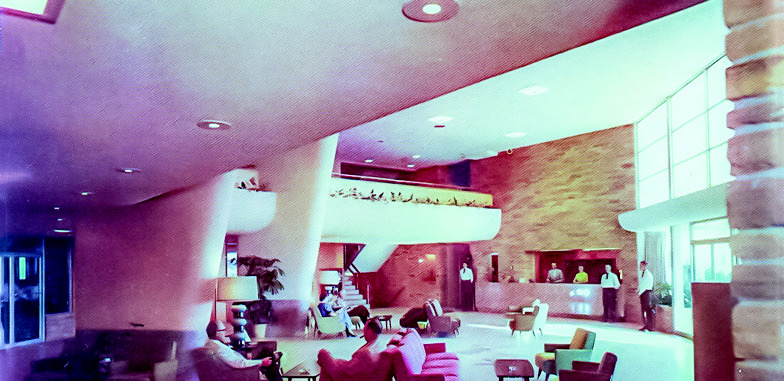
Inside, the lodge was a cathedral of modern hospitality. The grand lobby rose two stories high, anchored by a massive native-stone fireplace that glowed with warmth and pride. The terrazzo floors reflected the light that streamed through wide glass walls on the south side, while the air—cool and faintly perfumed with cedar and polish—carried the low hum of conversation. A sweeping mezzanine curved above like a ribbon, where guests leaned over railings to watch the rhythm of arrivals and departures below. Staff in pressed uniforms moved briskly across the lobby, while at the front desk, attendants greeted each traveler with the practiced courtesy that made the lodge feel at once grand and familiar. It was more than a lobby; it was the living room of Oklahoma itself—where the state’s dream of refinement met its trademark hospitality.
From that central heart, hallways branched into the two wings—each lined with guest rooms that blended simplicity and style in perfect balance. When it opened in May 1956, the lodge offered 106 rooms: seven suites, forty studios, thirty twins, and twenty-nine doubles, all served by three elevators— one for passengers, one for room service, and one for freight. Every floor was carpeted, every corridor cool with air-conditioning, and every room carried the quiet hum of comfort.
At the time of the lodge’s construction,twinanddouble beds were the national standard— the familiar sizes found in nearly every hotel and home across America. Thelarger“queen”and“king” mattresses that we take for granted today simply hadn’t yet become common. They were introduced only a few years earlier and would not gain widespread popularity until the 1960s, when homes grew larger and sleeping habits changed.
Thus, the Texoma Lodge’s suites,twinanddoublerooms reflected their era: efficient, modern, and designed for the postwar traveler. Couples shared doubles, families rented adjoining rooms, and the new luxury wasn’t size—it was air-conditioning, terrazzo floors, and a window view of the lake.
The suites were sanctuaries of understated luxury. Paneled in warm wood and softened by draperies that caught the afternoon light, each suite opened into a sitting area furnished with low-slung sofas, angular chairs, and polished tables that seemed to float above the carpet. Lamps cast a gentle glow over geometric curtains, and the air carried the steady purr of the latest technology—the hum of airconditioning, still a novelty in much of Oklahoma. To stay in a suite at Texoma wastoexperiencethepromise of the modern age without pretension—refinement in the midst of nature, comfort in the heart of public space.
In the double-bed rooms, that same sense of dignity deepened into simplicity. Each space carried the calm of order: paintings on the walls, heavy curtains patterned in mid-century florals spanning windows that filled an entire wall, and twin nightstandswithlampsglowing like sentinels at dusk. These rooms spoke softly of the Oklahoma spirit—unpretentious, sturdy, and gracious. For many guests, this wastheirfirstencounterwith the luxuries of modern travel: air-conditioning, telephones, and for half the rooms, a view of the lake framed like a painting beyond the window. For the other rooms, the view was an expansive view of the park.
The twin-bed rooms offered practical elegance. Two neatlymadebeds,trimmedin thick coverlets and framed by matching lamps, stood ready for weary travelers. Patterned drapes swayed in the lake breeze, and sunlight fell across clean lines of walnut furniture. The design was modern yet warm—angular chairs, low tables, and soft carpeting underfoot. Builtin radios and telephones brought a touch of sophistication, reminders that the state had built something more than a park lodge—it had built a resort worthy of pride.
But for those who wanted more privacy, the Deluxe Cottages offered a retreat unlike any other in the state park system. Lined along the lake’s edge, thirty duplex cottages stood amid the trees— each a study in mid-century grace. Inside, two bedrooms, a kitchen, and a spacious living room framed a great Henryetta sandstone fireplace that divided the home in two. The stone glowed gold in the lamplight, and the air carried the scent of polished pine and lake breeze. Modern appliances, built-in cabinetry, and cool air-conditioning made them suitable for every season. Families could cook breakfast, dry towels by the fire, or sit on the patio and watch the sun rise behind the water. These were not rustic cabins—theywereminiature homes of glass and stone, designedtomakeeveryOklahoman feel they belonged in the age of progress.
To the west of the lodge, the mushroom-shaped pool shimmered like a turquoise mirror. Its unique stem-andcap design drew crowds each summer day: the main body, one hundred by forty feet, opened into a deep circular basin with a smaller stem leading to the diving section which included two low diving boards and a high dive tower with diving board. A wide concrete deck wrapped around it, shaded by striped umbrellas and ringed with aluminumlawnchairs.Families gathered in the shallow end, children splashed at the edge, and attendants in crisp uniforms kept watch with friendly authority. The bathhouse nearby stood as neat as a postcard—its central check room flanked by men’s and women’s sides, each tiled in bright mid-century color. Beneath the pool’s deck, the filtration plant hummed quietly, hidden from view—a symbol of the lodge’s blend of beauty and modern efficiency.
For dining, no room rivaled the Circle Dining Room, the crown jewel of the lodge and perhaps the most elegant space ever built under the Oklahoma State Parks banner. Suspended between glass and sky, the circularroomcurvedoutward over the slope of the bluff, its floor-to-ceiling windows framing a panoramic view of Catfish Bay. By day, sunlight poured across the terrazzo floor, glinting off polished silver and white tablecloths. By night, chandeliers reflected in the glass, and the lake shimmered like black velvet studded with stars. The tables—set with pink napkins, salt and sugar at center—were arranged in perfectorder,andthemodern green chairs echoed the optimism of the age. Here, governors dined beside fishermen, newlywedsbesidelegislators, all looking out upon the same blue horizon. It was a dining room that made every meal feel ceremonial—a space where Oklahoma could see itself reflected in glass and water, confident and complete.
Beyond the dining hall stood the ballroom, a vast, airy chamber capable of seating five hundred for banquets or seven hundred for conventions. Its acoustics were perfect, its floors gleamed, and its windows framed the distant bridge like a painted backdrop. In its day, it hosted everything from legislative conferences to high school proms—a public stage where the state’s ambitions were dressed in dance and laughter. And for decades, it was the home of the yearly, Kingston High School Alumni Banquet. In addition to banquets, dances and meetings, the ballroom was capable of being converted into a theater where movies could be shown for special events, or for an additional experience for lodge and park guests.
Outside, the terrace captured the soul of the lodge. Beneath canopies of bright yellow and blue, guests gathered at tables overlooking the bay, sipping iced tea or cocktails as the wind off the lake carried the scent of water and sun. Couples leaned back in aluminum chairs, watching the boats drift on the placid water, while children played on the lawn. The terrace was both elegant and democratic—a place where luxury belonged to everyone. In that sunlight, Oklahoma’s dream seemed realized: that beauty and belonging could share the same space.
Behind it all, unseen but essential, the lodge’s infrastructure hummed like clockwork. A water treatment and storage system, a sewage plant, and a propane fuel network kept the resort self-sufficient—a small city on a hill. Even the fisherman’s lodge, a twenty-room annex with its own store and showers, spoke of order and design. Everything had a purpose, and every purpose was bound by pride.
Of all the great lodges that once crowned Oklahoma’s state parks, only Lake Texoma Lodge could boast its own airport. It was a point of pride inthebrochuresandasymbol of its standing as the state’s premier resort — a place designed not just for tourists, but for conventions, retreats, and the kind of gatherings that once demanded polish and purpose. “Truly, Lake Texoma Lodge has all the facilities you need to make your convention a success,” andoldpromotionalbrochure promised. And it wasn’t exaggeration. Guests could arrivebycarorbyair,landing on a hard-surfaced, lighted airstrip for private planes — 50 feet wide, 2,500 feet long, with tie-down service and fuel services just steps from the lodge. While other state park lodges offered rustic escape, Texoma offered full connection: golf, tennis, boating, fishing, horseback riding — and, uniquely, the freedom to fly right to the doorstep of Oklahoma’s most modern resort.
From the air, the Lake Texoma Lodge appeared as a perfect composition—geometry and landscape married in harmony. Its wings reached toward the bridge, its terraces faced the water, and its lawns rolled gently to the bay. It was more than architecture; it was philosophy rendered in concrete and glass. Here, in the middle of Oklahoma,thestateprovedit couldbuildsomethingbeautiful, lasting, and public.
The Lake Texoma Lodge was not just a building—it wasabeliefmadevisible:that modernity could be kind, that progress could be shared, and that beauty could belong to everyonewhoclimbedthehill above Catfish Bay and called it, for a night or a weekend, home.
Dedication weekend, May 26–27, 1956, unfurled like a regional world’s fair. On Saturday, every room and all the cabins were filled with legislators and dignitaries. Guests rode the Idle Time excursion boat; a Southeastern State College orchestra played at dinner; “Winona and Her Braves,” in full Indian regalia, sang Indian songs accompanied by Virginia Walker of Madill. Their portion of the program concluded with the group leading the crowd in the singing of “Oklahoma,” the recently adopted State Song.
The climax of the evening— the moment that crowned all the festivities— came when the Roosevelt Bridge “whiteway lights” were turned on “by remote control” from the lodge patio. The “Whiteway” name originally came from the Whiteway Street Lighting System introduced in the 1910s for urban boulevards—rows of ornamental lamps creating a continuous “white way” of illumination.
As the switch was thrown, the lake below came alive in a surreal tableau of modern wonder, a vision where engineering and elegance met beneath the wide Oklahoma sky. The bridge, gleaming in perfect white arcs, stretched across the dark waters like a jeweled ribbon, its reflection trembling in the stillness of CatfishBay.Guestsgathered on the patio in hushed admiration, their faces lit by the soft glow as the twin lines of light reached farther and farther into the night. For a longmoment,bridgeandlake seemed to merge into one luminous dreamofprogress—a radiant promise of a new era for Oklahoma, born of stone, water, and light.
Then, Sunday brought the flood. A rain shower at noon forced the ceremony into the ballroom, but by two o'clock, the skies cleared, and cars were stacked so deep that spectators “could see automobiles parked halfway across the Roosevelt Bridge.' Estimates ranged from 10,000 to 15,000 visitors pressing into the terraces; the 18th Air Force Band was flown in to play, Guardsmen from Durant raised the flags, and water skiers threw spray on the bay. Dr. W. K. Haynie, a member of the Oklahoma Game and Fish Department, handed Governor Gary the key. “We might as well throw it in the lake,” the Governor joked—meaning, if you don’t open it, it’s wasted—and this lodge will never be closed. Governor Gary then forecast that Texoma would boost the state’s tourist trade by $100 million in the coming Semi-Centennial year.
Theguestlogthatdayread like a scorecard of the American midlands. Allen Shivers, GovernorofTexas;FredHall, Governor of Kansas; John F. Simms, Governor of New Mexico; Edwin C. Johnson, Governor of Colorado; Orval E. Faubus, Governor of Arkansas; Phil M. Donnelly, Governor of Missouri; and Earl Long, Governor of Louisiana— each stood alongside Oklahoma’s own Governor Raymond Gary, their handshakes and smiles sealing a moment of pride and promise on the shores of Catfish Bay.
After an open house from four to six o’clock, the lodge began taking its first public registrations. By nightfall, the lights burned bright across the glass façade, and Oklahoma’s most ambitious public resort was open.
When the Lake Texoma Lodge opened, the state promoted it with the pride the new Capitol dome achieved decades later. A glossy brochure called it “one of the largest and finest resort lodges in the Southwest,” perched on a bluff overlooking “93,000-acre Lake Texoma, one of America’s most popular water playgrounds.” By actual count, the brochure boasted, “more than half a million pleasure seekers enjoy this huge man-made lake each month.”
“Built at a cost of more than $2 million,” the lodge was the centerpiece of the Oklahoma State Park system’s great mid-century expansion. Counting the lodge, cabins and lodge annex, the literature promised modern luxury—“263air-conditioned rooms, all carpeted wall to wall, with contemporary furnishings.” The brochure continued, “In addition to the 106-room Lodge, the shoreline is dotted with modern duplex and deluxe vacation cottages, the latter with two bedrooms, living room (with a big fireplace), and kitchen. There is also the 20-room Lodge Annex and several rustic cabins. The Lodge Annex has nicely furnished twin bedrooms with a large lobby, including television, overlooking Catfish Bay. It is ideal for small groups up to 40 persons.”
The brochure offered that inside, the grand lodge offered every amenity the Atomic Age could imagine: telephones in every room, piped-in Muzak, and both a newlycompleteddiningroom andalargeballroom-banquet hall that stood as the crown jewels of the complex.
The state’s own brochure boastedproudlythat“thedining room is circular with floorto- ceiling picture windows overlooking the lake on one side. A multitude of recessed lights in the ceiling permit great flexibility in lighting. The hall is wired for sound and has facilities on each side for motion picture projector and screen.” Ingeniously designed, large eight-by-eightfoot doors opened through a storage area to the outside, “making it possible to bring automobiles and boats into the hall for shows.”
The ballroom, even larger, stood as the heart of the lodge’s public life. “It will seat more than 500 for banquets and 650 for meetings,” the brochure declared, “and has a permanent stage at one end. Here, too, floorto- ceiling picture windows overlook the lake.” The space was designed not merely for dining and dancing, but for transformation—into a fullfledged theaterwhenneeded. With its dual projector setups, adaptable acoustics, sound system and screens, the ballroom could shift effortlessly from banquet hall to movie house, hosting film screenings, promotional reels, and community events where visitors might watch travelogues or industrial showcases while the lake shimmered just beyond the glass. And there were “large (8'x 8’) doors opening through a storage area to the outside” making it possible to bring “automobiles and boats into the hall for shows.'
“You can be sure,” the brochure promised, “of getting excellent food, well prepared and at reasonable prices, whether you choose hamburger or thick steaks.” In truth, the promise extended beyond the menu. The Lake Texoma Lodge was built to be as versatile as it was grand— a place where Oklahoma’s citizens could dine, dance, or sit back beneath the dimmed chandeliers and watch the flicker of motion pictures against the same walls that reflected the sunlight over Catfish Bay.
For those too young to remember, Muzak was the first company to introduce and provide a background music service that once filled American elevators, department stores, office buildings and hotels. Muzak provided the soft soundtrack of modern life, designed to calm shoppers, boost workers and fill silence with something smooth, safe and endlessly forgettable.
Outside,theparkbrochure listed a playground of amenities: golf, tennis, horseback riding, pontoon boats, water skiing, a lighted landing strip for small planes.” The state’s promotional copy urged civic groups to hold their conventions there, assuring them they would “get more done—because your entire group will be together and free of big city distractions.”
It was Oklahoma’s promise of prosperity in print form—a declaration that the state could compete with the great resort lodges of the nation. For a time, it did.
Fordecades,LakeTexoma State Park and Lodge fulfilled exactly what it was built to do—serve as Oklahoma’s shining retreat and civic centerpiece. It anchored familyvacations,hostedhundreds— if not thousands—of conventions, reunions, and public gatherings, and stood as the state’s glossy postcard to the nation. Here, on the blue expanse of a federal lake where the excursion boat Idle Time once cruised beneath the sun, Oklahomans came by the millions. In its very first year alone, an astonishing 5,108,908 visitors passed through its gates—proof that the dream of a “resort second to none” had taken firm root in red clay and pride.
Foratime,thedreamheld. Through the long summers that followed, cars streamed down Highway 70, families unpacked for weekends on the bay, and the terrazzo floors of the lodge echoed with the sound of voices, music, and laughter. The piano-shaped landmark became a living symbol of what Oklahoma could build when vision and will aligned — a place where legislators held banquets, honeymooners watched sunrises and sunsets, and children learned to swim in that broad mushroom- shaped pool.
For the next fifty years, the Lake Texoma Lodge stood as both monument and memory—born of optimism, shaped by stone and glass, and sustained by the laughter of travelers who came to rest beside Oklahoma’s inland sea. From its opening in 1956 to its closing on December 1, 2006, the lodge watched generations come and go—families arriving in Buicks and Fords, legislators gathering beneath its soaring mezzanine, newlyweds dining under the soft light of its bay-facing windows, and family reunions by the hundreds. For decades, my own family held the Henry Family Reunion in cabins 10 and 12 every Labor Day weekend. My entire youth was spent at that park, in those cabins and that grand lodge, where the smell of coffee and lake water seemed to mingle as one.
Through those years, the lodge became something larger than a place to stay— it was a rhythm of life. In the 1960s, Texoma was the crown of Oklahoma tourism. Busloads came in summer, businessmen held conferences in winter, and families from across the state marked anniversaries and holidays within its walls. Musicians played on the patio, fishing tournaments filled the bay, andeachdawnthelakeshone silver through the great dining room’s windows as breakfast trays rattled and coffee pots hissed.
By the 1970s, the lodge had matured into a landmark, belovedbutshowingits years. The state park system expanded, and the lodge adjusted to the times—its décor changed, its prices rose, but its spirit endured. In the 1980s, as road trips waned and private resorts multiplied, the crowds thinned but the regulars remained—the retirees who fished the coves, thefamilieswhoreturnedout of habit and love.
By the 1990s, the shine had dulled, but not the affection. The terrazzo floors still gleamedundertherightlight; the dining room still served catfish and cobbler with the same easy grace. Employees came and went, yet many stayed for decades—caretakers of a tradition that felt as rooted as the pines.
The lodge had weathered storms, droughts, and shifting budgets. Its grandeur was quieter now, but it was still home to memories that spanned generations.
And when the end finally came in 2006, it wasn’t a sudden fall but a long, sad fade—the kind only a public treasure can endure. For half a century, the Lake Texoma Lodge had stood as Oklahoma’sgreatdemocratic resort, welcoming everyone from governors to fishermen, from newlyweds to the widowed seeking comfort by the shore. Built to serve the many, not the few, it kept that promise faithfully for fifty years.
But time, even in the most beautifulplaces,isaquietand patient adversary. Seasons passed, budgets tightened, and priorities shifted. Paint dulled, roofs leaked, and the hum of the lodge softened to a whisper. The terrazzo floors still gleamed, but fewer footsteps crossed them. The great hearth still glowed, but there were fewer to sit in her warmingembrace. Laughter offamiliesgavewaytothelow murmur of committees, and soon even those fell silent. What had once been Oklahoma’s proudest experiment in public hospitality began to agewithoutachampion—too expensive to maintain, too beloved to replace.
Like so many grand dreams that outlive their patrons, the Lake Texoma Lodge slipped gently into neglect. It did not die from lack of love, but from lack of care. Its decline was not a collapse but a slow unspooling—one empty room, one missed repair, one quiet decision at a time. Through droughts, floods, and lean budgets, it had endured—its great fireplace still warm, its terrazzo floors still shining—but time is a merciless landlord. By the dawn of a new century, the once-modern resort had become a relic of another age, its promise dimmed and its purpose uncertain.
Public buildings need what bonds don’t buy: maintenance andmemory.Onthat windyriseaboveCatfishBay, the Lake Texoma Lodge once pulsedlikealiving thing—air systems humming, kitchens clattering, glass walls blazing with morning light. But buildings, like people, have metabolisms. When care slows, the heart falters. Roofs lift, concrete cracks, and water finds its way. Rooms went dark one by one. The ballroomthatonceseatedfive hundred grew still. The pool, once blue as the bay, turned green and silent.
By the early 2000s, the same boldness that once built the lodge had turned to caution. The state that had once dreamed in stone and glass now dealt in contracts and concessions. And in the end, the promise of renewal came not from those who loved her, but from those who saw her as acreage and opportunity. With the stroke of a pen, Oklahoma surrendered not only the lodge but the land thatframedher—aparkbuilt by and for the public—sold away under assurances of something grander, brighter, richer.
Developers arrived with renderings of luxury: a resort, a marina, a golf course, and a mixed-use community that would bring jobs, tourism, and prestige to the shoreline—lifting all boats, as some said. County leaders were promised revenue and rebirth, a new era of prosperity rising where the old lodge had stood. And so, in 2009, the grand old lady of Catfish Bay—the pride of Marshall County and the crown jewel of Oklahoma’s lodgesystem—wastorndown to make way for the future. But the future never came. The ground stayed bare. The promises dried up. The grand resort that was to rise bigger and better than before never moved beyond the page.
By 2014, the state’s patience ran dry. Through the Commissioners of the Land Office, Oklahoma filed suit against the developers for breach of contract, arguing the company had failed to meet its obligations to build the promised facilities. The state sought to reclaim what it had given up — not just the land, but the faith of a region that had watched its crown jewel torn down in the name of progress. The legal battle dragged on for nearly two years before a late 2015 settlement returned roughly 50 acres to state ownership for $4 million, while allowing the developers to retain most of the property free of its originalcommitments. Many called it a bitter compromise: the state paid to buy back a sliver of its own park, and the developers kept the rest without having delivered a single lodge, cabin, or convention hall. To this day, the promise remains largely unfulfilled — a broken echo ofthesamedreamthatbegan in 1951 with the vision of “a resort second to none.” The lodge was gone. The cabins were gone. The golf course— gone. The grand old lady that had once hosted governors and orchestras was reduced to dust and memory.
The sale of the old Lake Texoma Lodge property to private developers—and eventually to the Chickasaw Nation for a casino—marked a turning point in what the lake once represented. For fifty years, the lodge was a family haven: a place where kids ran barefoot down terrazzo hallways, fathers grilled catfish by the shore, andmotherswatchedthesun sparkle on the lake below, from chairs along the winding patio. It was affordable, public, and proudly simple— state-built and open to everyone. Its purpose wasn’t profit; it was creating memories. The state park system saw in it a promise that families of modest means could enjoy a touch of luxury, share a few days of laughter, and have a view of the water that didn’t come with a price tag shaped like a slot machine.
A casino, no matter how opulent, does not carry the same soul. Its rhythm is different— driven by chance, commerce, and neon. Its light never changes, its laughter sharper, its purpose narrower. Where the lodge once echoed with the splash of children and the laughter of families, the new complex hums with the low electronic murmur of slot machines and the endless shuffle of chips. Families with children— the heart and spirit of the old state park—no longer gather there. The easy laughter of picnics and the smell of charcoal and lake water have given way to the artificial shimmer of neon and the ceaseless chorus of electronic bells and flashing lights—sounds that fill the air where once only wind and water spoke.
The land once meant for fishing poles and folding chairs now caters to high rollers and passing tourists. It is not a place of belonging anymore—it is a place of transaction, where the promise of shared public joy has been replaced by the solitary gamble of fortune.
Progress, some say. Prosperity, otherscallit. Butthose who remember the old lodge understand what was lost: the quiet dignity of a public space made for everyone. A casino may sparkle brighter, but it does not glow with the same warmth. One was built for families and faith in shared joy; the other, for risk andreward. Andthoughthey both look out over the same lake, they do not reflect the same world.
Meanwhile, at about the time the state settled with the developers, all across Oklahoma, the sister lodges Texoma once outshone were reborn. The state reinvested millions in the lodges at Roman Nose, Sequoyah, Robbers Cave, and Beavers Bend,—all restored to their original glory and all alive again. And to add insult to injury, the state completely replaced the lodges at Quartz Mountain and Lake Murray. Today, their rooms are full each summer, their lobbies echo with families, and their restaurants hum with the same civic pride that once filled Catfish Bay.
But not here. Texomawasdifferent.Her land was too valuable, her view too tempting, her promise too easily sold. While the other lodges were restored by the state that built them, Texoma’swassurrendered— handed to private hands with glossy plans and grand assurances that a greater glory was just ahead. They said the new would surpass the old. They said progress required sacrifice. And so the grand old lodge was torn down, its foundations traded for blueprints and renderings that have yet come to life.
Can you imagine what could have been if the Lake Texoma Lodge and state park had been given the same chance as the other state lodges? If the grand old lady had been granted the same love and care the others received? Instead, Marshall County and the people of Oklahoma have lived through twenty years of missed weekends, lost wages, and quiet disappointment. The money that might have flowed into local businesses, the visitors who might have returned year after year, the children—like me—who might have grown up with treasured memories of blessed times with family nowlonggone,whooncegathered at that piano-shaped lodge by the lake. That time, and those experiences would have yielded untold memories and vast riches for the people and businesses of the county.
But all of that was lost to neglect, sold on promises unfulfilled, and demolished for a dream that still hasn’t materialized.
We study history not only to honor what stood, but to understand why it fell. The Lake Texoma Lodge was more than a building—it was a covenant between a state and its people, a belief that public beauty was worth the cost. For fifty years, it kept that promise. The loss of it is not just a matter of brick and timber; it is a lesson in stewardship.
Promises are easy to make when ribbon-cutting is near and elections are closer still. But endurance—actual, generational endurance—comes from care, from accountability, from the quiet, unglamorous work of upkeep. Now, as new plans rise, we are called to remember—not out of bitterness, but out of duty. So that when the next ribbon is cut and the next switch is thrown, the light that follows is not another flare of hope fading over Catfish Bay, but the steady glow of something that lasts.
We write these stories not to mourn what’s gone, but to keep what mattered alive. Every generation inherits both the triumphs and the mistakes of the last—and the duty to learn from both. LakeTexomaLodgewasborn of vision, built with pride, and lost to neglect. Its story belongs to all of us who live in the shadow of its absence and the promise of its return.
And the study of history is to steady the compass. It reminds us that progress without preservation is just repetition in disguise, and that the measure of a community is not what it builds, but what it keeps. Marshall County has always stood at the meeting point of dream and endurance. In remembering the grand old lodge by the lake, we remember ourselves.
As I researched and wrote this article, one person kept coming to mind: my old friend, and in some ways my predecessor and posthumous mentor,thelateVirgieWhite. Every grand place needs a keeper of its spirit, and for the LakeTexomaLodge—andfor Marshall County itself—that soul was Virgie. She was its heartbeat, its voice, its unappointed ambassador. From her corner of the dining room, she greeted governors and farmers alike with the same sparkle in her eye, the same genuine warmth that made strangers feel like locals. She didn’t just serve meals—she servedmemories,bindingthe community to the lodge in a way no blueprint or budget ever could. From the day the doors opened in 1956 until her passing, she ruled the dining room like a smalltown ambassador with a big heart. For over a quarter of a century, she carried plates, stories, and smiles—serving governors and farmers with the same unwavering grace.
She was, as former U.S. House Speaker Carl Albert once said, “just a waitress”— but that undersells her entirely. From her corner of the lodge dining room, Virgie became a confidante of governors, legislators, and travelers from across the South. She poured coffee with one hand and collected political intelligence with the other, earning a reputation as a “real listening post” in a part of the world where local knowledge was gold.
Her wit carried her far: Johnny Carson dubbed her “the world’s oldest active waitress” on The Tonight Show, and she charmed television audiences on Real People and PM Magazine. But fame never turned her head. Virgie White stayed close to Kingston and to the people whose stories filled her order pads and her heart. Long before me,shewrotenewspaper columns about the history of Marshall County, broadcast from a telephone in the lodge lobby, and dispensed local wisdom with a smile sharp enough to cut through pretense. She became a living landmark to every tourist who crossed the Roosevelt Bridge. Her sharp wit and warm laugh were as much a part of the lodge as its terrazzo floors and native stone fireplace. Born in Indian Territory in 1897, she lived through a century of Oklahoma change, and remained, to the end, a keeper of its soul—a reminder that greatness often wears an apron and greets you with a cup of coffee. When she died at ninety, the state honored her with a plaque at her old station, in the lodge, calling her “a lady whose love of God and her fellow man transcends all time.” Today, that plaque no longer hangs in Virgie’s lodge. Another piece of history, lost to neglect.
One can only imagine how she’d have felt to see her lodge—the grand old lady she served so faithfully—fall, then vanish, her terrazzo floors buried beneath the weight of broken promises and fading memory. I know she would have been heartbroken. I know she would have fought hard to keep that old lodge alive and thriving. And I know that she would be heartbroken that the place she loved so much would be tossed aside for some private development. But, in the end, if I know Virgie like I think I do, she would have just grinned, adjusted her apron,andsaid,“Well,honey, it sure was something while it lasted.”
And it was something. The wind still carries their echoes: the laughter from the terrace, the shuffle of footsteps on terrazzo floors, the hum of music somewhere deep inside the lobby. The scent of hot rolls and coffee drifting out over Catfish Bay—theslapofscreendoors, the splash of the pool, the soft murmuroffamiliesgathering year after year to remember loved ones who had gone on to the reward that awaits us all—these things still linger, if you listen closely enough.
It was a time when public places were built not to dazzle investors or serve as playgrounds for the rich and powerful, but to welcome ordinary families—in a simpler time, to offer rest, beauty, and belonging to all who came.
May we never forget that piano-shaped lodge on the windy rise, nor the families, travelers, and dreamers who gave it breath. Its walls once held more than guests—it held a soul. Built from the hands and hopes of ordinary Oklahomans, it was filled with life by the visitors and vacationers who believed their state could be both beautiful and kind.
Progress without remembrance is a slow kind of forgetting. When we sell away what was built for everyone, we lose more than stone and timber—we lose a part of ourselves. The land remains, but the heartbeat fades. For history, once traded, never fully returns; and when we barter heritage for promises, we learn too late that promises do not echo the way memories do.
Yes, progress has its place, but the true measure of a people lies in what they refuse to surrender—their stories, their landmarks, their shared pride. Some places are not just geography; they arecommunion.Theyremind us of who we were, and who we still might be if we listen to the wind across the bay.
So let us keep the faith— not in blueprints or tax proposals, but in the enduring worth of beauty, history, and belonging. For once they vanish, no groundbreaking, no casino light, no politician’s speech, and no developer’s promisecanbringthemback. Some treasures live only so long as we remember to love them.
Yet love must have memory, and memory must have courage. Too often we are told that tomorrow will be grander if only we surrender what yesterday gave us. But a community that forgets its past begins to forget itself. The lodge may be gone, its terraces quiet, its laughter only an echo—but the spirit it carried still drifts across Catfish Bay. It waits, patient as the water, for its people to remember.
The wind that once lifted the flag above the lodge still wanders through the tall grass, carrying with it a voice that remembers. It does not speak in anger, but in ache — a longing for what once made this place more than wood and stone. It whispers that true wealth is not measured in new lights or polished glass, but in the keeping of the things that once bound us together: memory, purpose, belonging.
May we have the wisdom to know the difference. May we have the courage to say that not every promise, no matter how gilded, is worth the surrender of our soul. And may we never again confuse the selling of our heritage with the building of our future.