
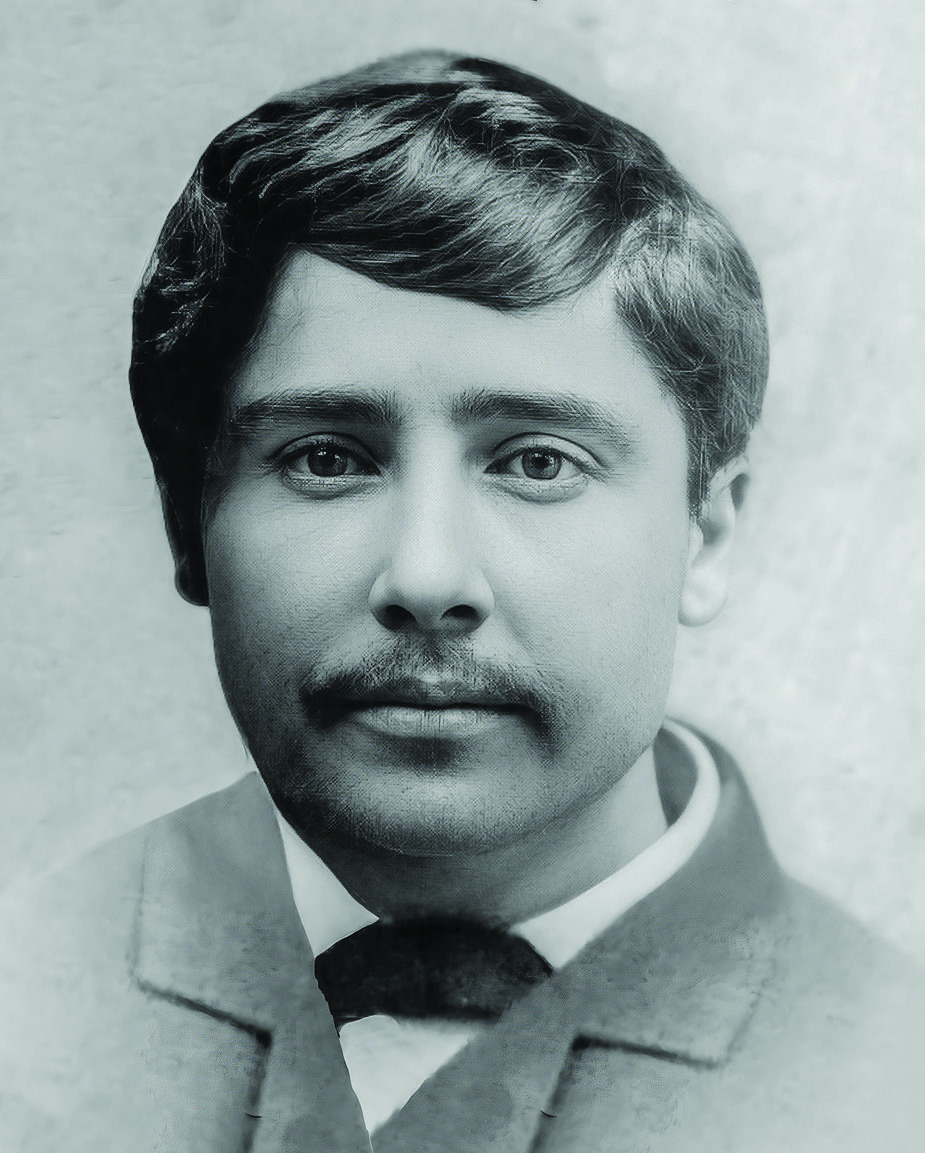
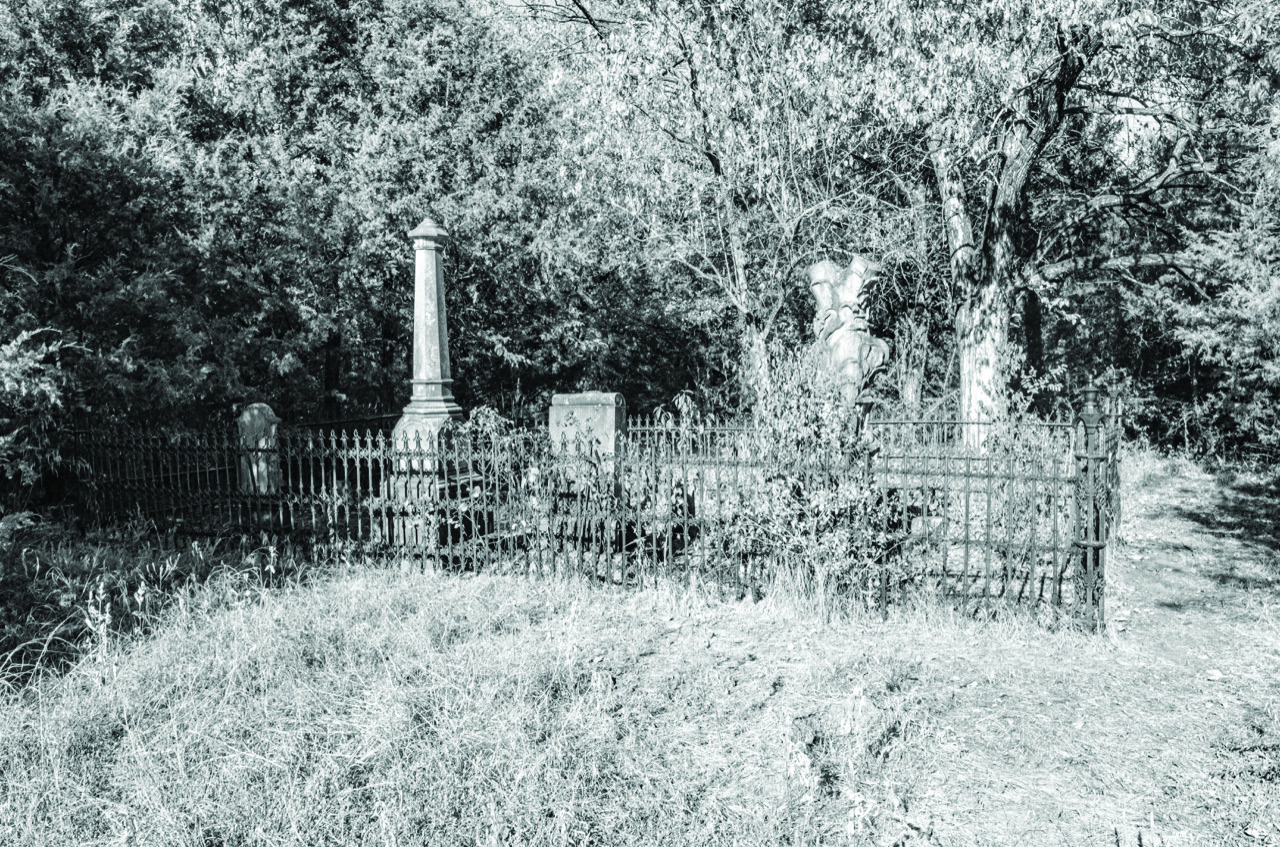
From 1881 to 1887, five members of the Alexander “Alex”Juzanfamilywereburied in a small family plot on thefamilyhomesteadinPickens County of the Chickasaw Nation at the convergence of the Washita and Red Rivers near what would later become Woodville, Indian Territory. The individuals buried in the small, intimate cemetery were Alexander Juzan, his first wife Mary and their three children.
That cemetery, the second oldest in the county, remains a silent memorial for a man and his family. After one hundred thirty-seven years, this little cemetery is all that remains as evidence of the lives of the Alexander Juzan family.
Alex Juzan was born on August 9, 1853, to Jackson and Mississippi Juzan. Jackson Juzan was a citizen of the Choctaw Nation and was born in Tennessee around 1808. Alexander’s mother was a citizen of the Chickasaw Nation and was born in Mississippi in 1812. It was very common during that time for Native Americans to be known by the name of the state of their birth because their Indian name was difficult for white folks to pronounce.
Mississippi first married Charles Colbert in Mississippi in 1834. Their union produced one child named Rebecca Elizabeth Colbert. Sometime after Rebecca’s birth, Mississippi and Charles Colbert divorced and then a short time later, Mississippi married Jackson Juzan.
Jackson and Mississippi then had four children. The oldest was Charles, born in 1845, followed by Thomas, born in 1847, Lucy in 1849 and Alexander in 1853.
The Juzan family was a strong pioneer family that was forced to move from the Chickasaw homelands in Mississippi to Indian Territory during the removal of Native Americans following the passage of the Removal Act in 1830 and the Treaty of Doaksville in 1837. Alex was most likely in the first generation of Chickasaw Indians born in Indian Territory. He was most likely born somewhere in what is now Love or Marshall Counties. Eventually, he had land just north of Harney, later renamed Woodville.
Because his father was Choctaw and his mother was Chickasaw, Alexander claimed citizenship in both tribes. However, when the Dawes Act was enacted, Alexander’s siblings enrolled in the Chickasaw Nation.
In 1879, Alex married a white woman named Mary Pitts. Little, if anything, is knownaboutMaryotherthan that she was Alex's wife. At the time of their marriage, Mary was 20, and Alex was 26. Just over a year later, Alex and Mary welcomed twin sons on the 13th or 15th of October 1880.
Sadly, when the twins were just 13 months old, they were killed by some tragedy, and both died on the same day, November 22, 1881. What caused the simultaneous death of the twins is lost to history, as are their names. The only markings on their headstones are A. Juzan and M.C. Juzan. I would assume one was Alexander, Jr., but that is just a guess. However, the loss of twins via some accident or tragedy on the same day must have been devastating.
On January 1, 1883, Alex and Mary welcomed a third child, a son named Eastman. Eastman was named after Alex Juzan’s brotherin- law, Eastman Harney, who was married to Alex’s sister, Lucy Juzan Harney. Eastman Harney tragically died in an accidental drowning in the Washita River on June 23, 1882, prompting Alex to name his third child Eastman. Alex and Eastman Harney were very close.
Sadly, just 28 days after giving birth to Eastman, Mary Pitts Juzan, Alex’s wife, died. While there is no written information about her passing, it is likely that Mary died due to complications arising during the birth of Eastman. Such was not uncommon in those days.
Then, horrifically, Eastman Juzan died just five months later, on June 22, 1883. His death was also just 364 days after the death of his namesake,EastmanHarney. Nothing is known regarding thecauseofdeathofEastman Juzan, but it is likely that his death was due to a childhood illness or birth defect.
One cannot fathom the depths of grief that Alex Juzan suffered. The loss of three children, a wife and a close brother-in-law, all within a span of three years, would be devastating to anyone.
But, in early 1884, Alex did find some happiness. It was then that Alex married Henrietta Hume, also known as Nettie. Nettie was also a white woman.
In August 1884, Alex Juzan was elected to the Chickasaw Legislature as a Representative for Pickens County, Chickasaw Nation. Pursuant to the Chickasaw Constitution,PickensCounty only elected four Representatives, so Alex was influential enough to be one of only four representatives of Pickens County.
This is even more impressive when you consider the size of Pickens County. Pickens County was between the Washita and Red Rivers in the southwestern part of the Chickasaw Nation. The Washita River formed its eastern and northern boundaries, and the county’s western boundary was the western edge of the Chickasaw Nation, also known as the 98th Meridian. Pickens County was unusually large and sprawling. It included the present-day cities of Ardmore, Duncan, Madill, Marietta, and Sulphur, extending almost as far as Chickasha. The election to the legislature was a major accomplishment for Alexander.
In those days, the Chickasaw Constitution limited legislators' terms to one year and one day before the election date. Alex was defeated in his reelection in 1885. It is likely that an event in March of 1885 played a part in Alex’s defeat. At that time, Alex and two other men posted bond in the Federal Court in Fort Smith, Arkansas, for a cattle rustler named Abram Morgan. The judge in the case was Judge Isaac C. Parker, the infamous “Hanging Judge.” From the Court records, it appears that Abram Morgan skipped bond,andAlex,alongwithhis co-signees, were then sued in Federal Court for the bond as it was ordered forfeited. According to the Marshall’s return, only Alex and one other co-signer were ever served with the summons, and it appears both were required to pay a judgment to the Court. Since cattle rustling was considered a hanging offense in those days, and because Alex was sued by the Federal Government, this likely contributed to his defeat in his run for re-election to the Chickasaw Legislature.
Around September 1886, Nttie became pregnant with her and Alex’s first child. Sadly, Alex did not live to see his fourth child’s birth as Alex was killed in April of 1887 in a shoot-out with a posse that had been formed to locate and apprehend him for the murder of James Christian a few days earlier. (I will cover that event in a future story.) Alexander’s widow, Nettie, named their daughter Alexia after her father. But even more tragically, Alexia died in Ardmore on May 22, 1901, attheageof13years.Leaving Alex with no descendants.
In the small Juzan Cemetery, the most ornate headstone is that of Alex. It stands over six feet tall and is handcarved in Italian Marble. It is adorned with numerous fascinating icons that each tell a tale of their own.
Throughouthistory,tombstones have been designed to tell a story. Many are absolute works of art. The men who carved these stones by hand were true artisans. They were absolute masters in their craft. And these stonesweredesignedtospeak for and about the deceased and it is from these icons that we can learn a bit more about the dearly departed.
Alexander’s large tombstone is in the form of an oak tree, with the top cut off. The tree has four branches or limbs that are also all cut off short. In the center of the tree is a large Christian Cross. Laying at the base of the cross is a large anchor with its rope wrapped around the cross. The rope is cut off and hanging at the bottom of the cross. Beside the cross is a lily with its stem broken about halfwayup,andthelilybloom hangs over the cross. Finally, the tree appears to have ivy vines and evergreens with pinecones wrapping around partsofthetree.Eachofthese icons or symbols all have a very specific meaning. They all are meant to represent the virtues of the deceased and they all are designed to tell the life story of the dearly departed.
A tombstone in the form of an oak tree was meant to symbolize strength, honor andsteadfastness.Atreethat is cut off symbolizes a life that has been cut short—that is, the deceased died young. The cut-off branches signify the number of immediate family members who have predeceased the decedent. The Christian Cross signifies that the deceased was a Christian—a follower of the LordandSaviorJesusChrist. The anchor at the base of the cross, with its rope wrapped around the Cross, signified hope and steadfastness, and it indicated that the deceased wasfirmlyanchoredinChrist and his Cross.
The rope hanging and cut off at the bottom symbolized a life cut off or the cessation of life. The lily represented a marriage or the resurrection. However, since the lily stem is broken on this stone, it represents a marriage that had been broken by death. Lastly, the ivy and evergreen growing around the tree represented immortality and rebirth or regeneration. Just try to dig out the ivy in your garden to see how tough it is to stop it from coming back. And non-evergreen trees lose their leaves each fall, but pine trees stay green all year long, and in this way, they symbolize the eternal nature of the soul.
As they pertained to Alex, the cut-off tree signifies that Alex’s life was cut short as he was just 33 when he was killed. The four cut-off branches represented the lives of his three children, Alexander Jr., M.C. and Eastman, along with his wife Mary, who all died before him. The cut-off rope connected to the anchor likewise signified that Alex’s life was cut short.
The broken lily stem signified Alexander’s marriage bond was broken by Mary's death. The ivy vines and evergreens with pinecones show that Alexander, like all who believe in God, was covered by the redemptive blood of Jesus Christ, and he has immortality and eternal life. Finally, the cross signifies that Alex Juzan was a Christian, anchored in the Cross of Jesus Christ.
Alexander was the last to be buried in the cemetery. Following Alexander’s death, Nettie and Alexia left the familyhomesteadandmoved to Ardmore, where they lived until Alexia died in 1901 and Nettie’s death in 1911.
Following his death and Nettie’s move to Ardmore, Alexander’s brother Thomas Juzan took over the homestead. He protected and cared for his brother’s family cemetery, close to the large Juzan home on the acreage.
When the federal government began acquiring land for the construction of Lake Texoma, all the Juzan land was going to be taken, including the cemetery. Thomas Juzan’s daughter, Amelia Juzan Steele, the niece of Alexander, fought the government and the Army Corps of Engineers to preserve the cemetery. After lengthy negotiations, Amelia persuaded the government to leave fifteen acres of the Juzan homestead to the Juzan family. The fifteen acres included the old home site and, most importantly, the family cemetery. Today, that land is surrounded on three sides by land owned by the Army Corps of Engineers as part of Lake Texoma.
Miraculously, the cemetery remainstoday,muchas itdidin1887whenAlexander Juzan’s body was lowered into his final resting place. The cemetery is surrounded by a wrought iron fence that looks like it was installed ten years ago, and while weathered and worn, the stones of Alex, Mary, Eastman, Alex Junior and M.C. are all still intact and legible. This is a testament to their strength and the craftsmanship of the men who carved the stones by hand.
This is a solemn and reverent site surrounded on three sides by trees. Each stone faces the east so they may greet the rising sun each morning, bringing a new day of remembrance and life. While the last soul departed this existence one hundred thirty-seven years ago, their names and lives will be remembered forever.
This cemetery is sacred ground, and it should be prized and protected by all the citizens of Marshall County. This place and its stones will continue to tell the story of Alexander Juzan andhisfamilyforgenerations to come.
Long may they live in the heartsofMarshallCountians and forever rest in peace.