

In the old Chickasaw Nation, before the hammer of statehood struck and before the cottonwoods along the Washita had seen a single paved road, a town did not truly breathe until it had a hotel. In the railroad age, a hotel was more than a business— it was a declaration.
The hotel told every traveler stepping off the train that this place believed in its own tomorrow. It promised warmth, meals, conversation, and community. In a time when drummers carried their sample cases from town to town, and families rode the rails seeking somewhere to plant their lives, the hotel became the heart of the settlement. Its dining room was often the first civic hall, where townspeople met, churches gathered, political arguments simmered, and the long evenings softened into fellowship over cups of coffee that rarely cooled.
This truth lay beneath the rise of Helen, Indian Territory—a town born not by chance but out of necessity and timing, shaped by tribal citizenship, federal law, and the relentless march of the railroad. But Helen’s story started earlier, out on the rolling prairie where a man named Jeff King settled around 1890. King built his house and began constructing a schoolhouse at a place he called King’s Chapel. The schoolhouse was a modest gathering place that served as both a church and the seed of a community. Before he could finish, illness took him away, but others completed the school and added homes and businesses, naming the settlement King’s Town in his honor. That name was later shortened to Kingston, and by 1894, the post office was open, the cotton gin was running, and the small town was confident in its future.
But that Kingston stood two and a half miles southwest of the present-day Kingston, and the whole world was about to shift under its feet.
Among Kingston’s young merchantswasJamesHampton “J. Hamp” Willis, a Chickasaw citizen by birth and right, the son of Raleigh Britton Willis—the founder ofWillis,Oklahoma—andthe son-in-lawofChickasawGovernor RobertMaxwellHarris. In 1897, he opened a store in Kingston, and through his family’s connections, he soon heard whispers that the St. Louis–San Francisco Railroad planned to run a new line from Sapulpa all the way to the Red River and on to Sherman-Denison. The railroad rarely announced its route outright, but the rumors persisted enough to cause concern: the line might not pass through Oakland, the county’s first established town, and it might not touch Kingston at all.
By 1900, the survey crews arrived, driving stakes into the prairie like nails into a coffin. The Frisco bypassed Oakland by a mile and Kingston by nearly two and a half. The new line cut across open Chickasaw land to the northeast—rightthroughthe ground where Willis saw an opportunity.
At that time, all of southern Oklahoma was part of the Chickasaw and Choctaw Nations. Willis could not buy tribal land outright because Chickasaw land was held communally under Chickasaw law. However, by then, federal authorities had already set up a system within Indian Territory for creating towns on tribal land. The Organic Act of 1890, strengthened by the Curtis Act of 1898, allowed communities to be surveyed, platted, and sold through federally appointed townsite commissions. Although these laws came from the federal government, they were the only legal way to establish new towns in the Nations, even for Chickasaw citizens like Willis. They made it possible to plan townsites, sell lots, and develop businesses—while the proceeds were held in trust for the tribe.
Willis moved fast. Once the Frisco line cut through the prairie, he relocated his Kingston store to the tracks. It became the first building in the new settlement. He then laid out a townsite according to federal rules, marking streets, blocks, and lots so that when the townsite commission eventually arrived, a community was already living, breathing, and ready to be recognized under the law. He named the place Helen, after his young daughter, Helen Robenia Willis.
Helen grew with remarkable speed. The first permanent settler who followed Willis to the new townsite was Dr. E. F. Lewis, whose arrival gave Helen its first physician and its first anchor of stability. Soon,twomorestoresand two residences were moved bodily from Kingston to the new townsite, reinforcing whateveryonesuspected:the future lay along the railroad.
About November 1, 1900, the townspeople took up a collection to build a schoolhouse. This was not a small undertaking in those days—most materials had to be brought in, and labor came from the community itself—but the work progressed quickly. On April 15, 1901, the school opened with E. R. Macreedy as its first teacher. Macreedy would later establish the Helen Weekly Herald newspaper, giving the town both its first schoolmaster and its first editor in the same man. As in many frontier towns, the schoolhouse served as the place of worship for all denominations until 1904, when the Methodists built their own church, followed by the Baptists two years later.
Helen’s early years were marked by ambition and construction. Around 1903, the first brick building went up—an unmistakable sign of permanence in a land where most structures were still framed in pine and sheathed in rough boards. That brick building still stands today on the northwest corner of Highway70andMainStreet, a stubborn survivor of an age long gone. In 1903, the town’sfirstbankopened.Two years later, in 1905, the First NationalBankwasorganized and bought out the first bank, replacing its wooden quarters with Helen’s third brick building. That building also stands today, the last of Helen’s original structures still standing watch over the modern town.
By 1905, Helen was roaring with life. The town boasted seven dry goods and grocery stores, two hardware stores, a lumber yard, two blacksmith shops, a bank, a barbershop, a livery stable, a cotton yard and elevator, two hotels, and somewhere around eight hundred inhabitants. For a Chickasaw Nation town on the eve of statehood,Helenwasabooming place, second to none in the county.
But Helen lacked one thing—a post office. And in those days, a post office was nearly as vital as the railroad. It tied a town to the outside world, carried its business, and confirmed its existence. Helen petitioned the U.S. Postal Service, but the request was denied. There was already a town in the Territory named Helena, and the postal officials feared the names were too similar. So, while freight and passengers arrived daily by rail, the mail still went to Kingston, nearly two miles away. Today, that would be a minor inconvenience; in 1905, with no automobiles and rough wagon roads, it was a significant burden.
Thus, the town found itself in a peculiar bind. Helen had the railroad but no post office. Kingston had the post office but no railroad. And in the era of rail supremacy, a town without a depot was a town fading fast.
In 1906, a decision was made that would end both towns—and save them as well. The Kingston Post Office was moved to Helen. When that happened, the remaining businesses in Kingston followed the mail. Jeff King’s Town, the original Kingston, was absorbed into Helen and it vanished from the map.
But the post office kept its name: Kingston.
This created a confusion only Indian Territory could produce. The town was Helen. The rail depot was Helen. But the post office was Kingston. Freight went to Helen. Mail went to Kingston. Mail arriving on the train—well, good luck sorting that out. Folks in Helen said they lived inKingston;folksinKingston found themselves living in Helen. Two towns existed in name, but only one existed on the ground.
Finally, in an effort to end the confusion, the Frisco Railroad agreed in 1906 to rename the Helen depot to Kingston. And then, on November 2, 1906, the town of Helen was officially incorporated asKingston.Twotowns died, one town was born, and the name that survives today carries both histories within it.
So, for everyone who calls Kingston home—whether today or in memory—your roots run through two identities. Kingston is Helen, and Helen is Kingston. A Chickasaw Nation settlement, born from Jeff King’s humble schoolhouse, carried forward by J. Hamp Willis, shaped by federal law, transformed by the Frisco Railroad, and knit together at last by a single stubborn post office that refused to change its name.
And in the middle of it all—the thread that anchored the town’s sense of permanence—the hotel that welcomed the world and helped turn a raw railroad stop into a community with a future.
To understand the man behind the hotel—the Chickasaw citizen who helped give Kingston and Helen their brick-and-mortar confidence— we need to step back from the town itself and trace the longer arc of his life. The hotels didn't appear out of nowhere; they were the natural result of a career spent building, negotiating, and standing in the gap between the old Chickasaw Nation and the new state that would absorb it.
The story of Kingston and Helen is, at its heart, a story of place — of a schoolhouse on the prairie, a railroad line cutting a new destiny across Chickasaw land, a post office that refused to change its name even as it moved its walls. But towns do not build themselves, and hotels do not rise out of bare ground on their own. Behind the brick and timber, behind the depot and the stores and the dining rooms that never seemed to close, stood men and women who believed this corner of the Chickasaw Nation was worth the gamble.
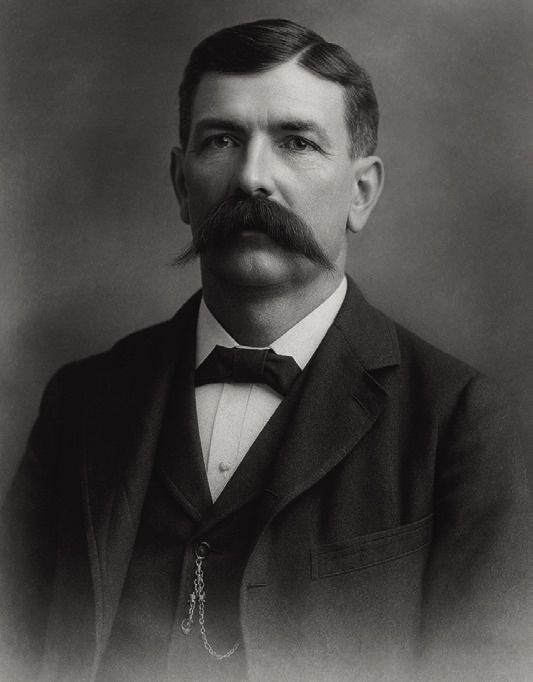
Chief among them was a Chickasaw citizen whose namethreadsthroughnearly every chapter of this region’s early life. Before Kingston had its brick storefronts, before the Helen Hotel cast its shadow along the tracks, before statehood had even arrived to redraw the map, Holmes Willis was already at work—on the land, in the council houses, in the schoolrooms, and finally in the very streets of Kingston itself. To understand how this little railroad town came to have a brick hotel bearing the stamp of his vision, we have to step back from the depot platform and follow the longer arc of the man who helped shape both the Nation and the town that rose upon it.
Holmes Willis entered the world on July 16, 1857, in the old Chickasaw Nation, in that stretch of Red River country where the land rolls gently toward Texas, and the families who settled there seemed rooted as deeply as the pecans along the banks. He was the son of James Hamilton Willis and Elvira Love Worthington, names that tied him to two of the great Chickasaw and frontier lineages. His mother carried the blood and memory of the Love family, one of the most influential among the Chickasaws. His father, already a man of substance by the time Holmes was born, died when Holmes was only four years old. That early loss—not unusual in its era but shaping in its force—left him to grow into manhood surrounded by a sprawling network of siblings, halfsiblings, cousins, and kin whosestorieswoundthrough his life like tributaries across the prairie.
He grew up in a world of blended families: the Jones children from his mother’s first marriage; the older Willis children from his father’s first marriage; and the younger children born to James and Elvira. In that crowdedworldofmanyvoices and few luxuries, young Holmes learned early the quiet disciplines that would carry him through life. Even as a boy, he was known for his reliability, a trait that frontier communities notice more quickly than any other. He became a farmer, then a merchant, then a civic figure ofgrowingconsequence—not by sudden ascent but by the slow accumulation of trust.
By the time he was nineteen, the Chickasaw Nation trusted him enough to elect him sheriff of Pickens County. The Oklahoma Star recorded the result in 1876. From that election onward, his name appeared regularly in the newspapers of Indian Territory, a rarity reserved only for men who carry real weight. In the decades that followed, he became one of the central figures of Chickasaw public life: a senator, a committee member, a school superintendent, a negotiator with the Dawes Commission, and a repeat member of national delegations sent to Washington whenever the tribe’s fate was on the table.
The 1880s and 1890s were years of turbulence, uncertainty, and bitter division for the Chickasaw Nation, and in those years Holmes Willis’ name appeared again and again beside the men who shaped the Nation’s future—Sam Paul, the Colberts, the Burneys, B. W. Carter, and other figures whose reputations stretched acrosstheTerritory.Newspapers called Willis one of the most progressive, intelligent, and trustworthy men among the Chickasaws. They spoke openly of him as timber for a governor. When the question of allotment loomed, when the Dawes Commission demanded compliance, when factional lines split communities, it was Holmes Willis whom governors appointed to negotiate on behalf of the people.
Those delegations were not honorary. They were heavy with consequence. The treaties and supplementary agreements of the early 1900s determined the end of tribal sovereignty, the legal titles to land, the rolls of citizenship, and the survival of every school and institution the Chickasaws had built since Removal. In all these matters, Holmes Willis’ signature and counsel carried influence. It was said that for seven years, he and a handful of others “shaped the policies of the Chickasaw Nation.” And that was not an exaggeration.
But he was more than a statesman. As the new century came on, he turned his attention to the rising little towns of southern Oklahoma— Kingston, Woodville, Madill, and the whole region the Frisco Railroad had begun to animate. For most of his adult life, Holmes served as a board member of banks in Madill and Kingston. In Kingston, especially, he became one of the architects of the town’s early commercial life. He built brick buildings when the settlement was still a young cluster of wooden storefronts; he erected a brick hotel near the depot; he opened a large department store that carried everything a farming family might need—from dry goods and groceries to farm implements, wagons, buggies, and machinery. Farmers trusted him because he paid fair prices; townspeople trusted him because he sold goods honestly and refused to let anyone be cheated. The Kingston Messenger in 1908 spoke of him with unusual admiration, calling him “one of the best and most popular men in Oklahoma,” a friend of the laboring man and a businessman whose success had been earned without a single stain on his record.
His personal life was marked by the same steadiness that guided his public work. He married Viola Gibson in 1879, and together they raised a family that carried both the burdens and the blessings of frontier life. They lost two infants—tragedies as everyday as dust in that era—but their home remained full. They raised Will, Sid, Hortense, Overton, and Juanita, children who themselves would scatter across Marshall County and Oklahoma in the decades to come, marrying into the Martins,Johnsons,andother families whose names still echo in the county’s records.
By the 1910s, age and illness began to take their toll on him. He suffered a paralytic stroke in early 1914 and never fully recovered. Yet even in his decline, the newspapers followed his condition with a personal concern rarely shown to public men. The Ardmoreite reported that he was “one of the best-known citizens of the old Chickasaw Nation” and that he was not expected to live. The Kingston Messenger echoed the anxiety of neighbors and friends across the county.
He died on November 18, 1914, at the age of fifty-seven, at his home near Kingston. His obituary was more than anannouncement—itwasan outpouring. The Messenger devoted a long tribute to him, describing his generosity, his upright character, his service to his people, his lack of vanity or pretense, and his nearly unmatched influence. The church was full beyond capacity. The casket, it was said, was buried beneath flowers. Friends from Ardmore, Sherman, Oologah, Woodville, and towns across the region came to stand with his family. And when the service was finished, his body was carried to the Willis Cemetery,notfarfromwhere he had been born nearly six decades earlier.
There are men who leave monuments and men who leave reputations, but the rarest are those who leave both. Holmes Willis stood among that small number. He was a man of the old Chickasaw Nation, born before the Civil War, shaped in the Reconstruction years, tested in the Dawes era, and instrumental in the final years of tribal government. He was a businessman who helped build Kingston from the ground up. He was a public servant whose name appears in nearly every political record of the Chickasaw Nationforfortyyears.Hewas a neighbor whose kindness, according to the newspapers of his day, reached more people than anyone could easily number.
And in the end, when the Messenger said, “There can be but one Holmes Willis,” it was not exaggeration. It was a tribute. The man they buried in 1914 was not simply a figure of local history; he was one of the last great bridge-men between the old Indian Territory and the new state of Oklahoma, between the communal life of the tribe and the private enterprise of the twentieth century, between the world his parents had known and the one his children would inherit. His life was a long thread through the fabric of the Chickasaw Nation—and though the man is gone, the thread holds.
It was only natural, then, thatinboth HelenandKingston, when the community needed brick, stability, and a visible sign that the town intended to last, they turned to Holmes Willis. The first real hotel that anchored Helen’s identity, and its great reincarnation after fire, both rose on the strength of his money, his judgment, and his belief that this little rail town on the prairie deserved more than rough board and temporary dreams. The story of Helen-Kingston’s hotel is, in no small part, the story of Holmes Willis written in brick and mortar.
And so the next chapter in this story is not simply about a building, but about a statement. This hotel rose from red clay and ambition, carrying the imprint of the man who believed Kingston deserved a future as solid as the bricks he stacked upon its prairie.
The Helen Hotel was born in the years when Helen itself was still young enough to be called a townsite rather than a town. It rose in 1903, the same year the Frisco line split the prairie and gave the settlement its reason for being. Holmes Willis, who had already spent a lifetime building the bones of southern Marshall County, put his money and name behind the project. It was only the second brick building ever raised in Helen, a two-story structure ofsimplelinesandpurposeful strength, set near the depot to catch the custom of travelers, drummers, farmers, and newly arriving families. On the ground floor stood the lobby, the dining room, and thekitchen;upstairswerethe sleeping rooms where generations of strangers would take shelter from the restless winds rolling off Texoma. In total, the hotel contained almost 6000 square feet of floor space.
A hotel covering nearly 6,000 square feet was no small undertaking for a young railroad town on the Chickasawprairie.Eachfloor measured just shy of 3,000 square feet, which meant the downstairs alone—housing the lobby, the dining room, and the kitchen—was larger than most early mercantile buildings in south-central Indian Territory. A ground floor of that size did not simply allow for a dining room; it allowed for a large one, the kind capable of serving dozens at a time. It meant a lobby spacious enough for drummers to spread their goods, travelers to rest their feet, and neighbors to linger over conversations that lasted longer than the coffee stayedhot.Itmeantakitchen with room for real operation: separate prep areas, a full range, dry storage, and the kind of workspace needed to feed both guests and townspeople who regularly came there for meals. In short, a nearly 3,000-square-foot lower level, said the town expected company—and plenty of it.
But it was the second floor that truly announced the scale of the place. Another almost 3,000 square feet overhead, devoted entirely to rooms, meant the Kingston Hotel was built to house far more guests than the typical frontier hostelry. In small towns at the turn of the century, hotel rooms were modest—usually 8 to 10 feet wide, often 10 to 12 feet deep, just large enough for a bed, a washstand, and a small stove or radiator. That meant almost 3,000 square feet could easily accommodate fifteen to twenty rooms, depending on hallways and interior partitions. The surviving photograph shows eight windows across the north side of the second floor, with blank spaces wide enough for another three or four spaces that may have concealed the men’s and women’s bathrooms, or simply moreguestroomswithout exterior windows. Either way, it was an impressive upper story. For a town the size of Kingston in 1903, a second floor of that scale meant the hotel was not only receiving travelers—it was expecting an influx. It meant the town believed in its growth, its railroad, and its future. A two-story, 6,000-square-foot brick hotel in a town of only a few hundred residents was not merely a building; it was a statement, bold and proud, that Kingston was not a stopgap settlement but a place that intended to stand tall on the prairie.
In those early years, the hotelwasmorethanaplaceto stay. It was a piece of Kingston’s identity, a signal that this new town intended not just to exist but to prosper. Advertisements from 1907 boasted of its service and its nearness to the depot. For $1.25 a day, travelers could find a clean bed and a hot mealunderthemanagement of W. R. Humes, who promised “a first-class house” and the best attention a frontier hotel could offer. Between the lines, you can hear the pride of a community carving a future out of red clay and rail smoke.
But frontier towns are tinderboxes, and Kingston was no exception. In October of 1909, fire slipped into the town after midnight and blazedthroughtheveryheart of it. It began in a shed filled with wheat and hay, where someone — perhaps carelessly, perhaps unknowingly — flicked away the cigarette that became the instrument of ruin. Flames leapt from the shed to the livery barn belonging to Holmes Willis, then onward to the mercantile building beside it, and finally to the Kingston Hotel itself. By the time the fire died, the hotel had been reduced to charred wreckage. Its then proprietor, Thomas Burnett, lost every item of furniture he owned; there was no insurance to cover his loss. Willis, more fortunate, carried $1,000 in coverage on his barn and the grain stored within, though that was a fraction of what the blaze consumed. None of the others had any insurance.
For a lesser man and a lesser town, the story might have ended there. But Kingston, inthoseyears,wasdrunk with growth. The “building boom” of 1913 found the town putting up new houses, warehouses, and businesses. It was inevitable — almost fated — that the Kingston Hotel would rise again. By the summer of that year, the people of Kingston were reading that Holmes Willis hadtakenbidsforanewbrick hotel to stand on the footprint of the original hotel on southwest Main Street. Bids came in tight and competitive, but the contract ultimately went to White & Cruce, craftsmen whohadalreadybeenatwork in Kingston for more than a year. Excavation began at once. A few months later, the Red River Farmer was boasting that the Kingston Hotel was “up to date throughout,” with $2,000 worth of new equipment and the experienced management of Mr. Lambert.Thelanguageofthe paper makes it clear: this was no mere boarding house. It was a statement — a symbol — of Kingston’s aspirations.
From that moment, the Kingston Hotel became a fixture in the life of the town. Travelers along the Frisco line stopped at the “splendid new hotel on Main Street,” and locals knew it as one of the most dependable establishments in southern Oklahoma. The Maxey House, a competitor, advertised in 1911, may have vied for business, but the Kingston Hotel held its ground.
By the mid-1930s and 1940s,timehadbeguntotake its toll on the old brick building. Its founder, Holmes Willis, had passed in 1914, and the property stayed within the family until Sid Willis sold it in 1946 to Pete Eaton, a carpenter of practical mind and capable hands. The war years and material shortages slowed construction, but Eaton set to work on repairs, converting the structure into a combined apartment house and tourist hotel. Twelve rooms were filled almost immediately; the rest were under reconstruction as materials trickled in. The Ardmoreite called it “the old Kingston hotel,” a phrase that already carried a touch of nostalgia. The building had become not just a hotel but a landmark, an anchor of memory for anyone who had stayed there in the early days, when the town was still stretching its legs.
The post-war boom brought new ownership. In 1947, Mr. and Mrs. W. B. Corzine of Chickasha took over the operation, preparing for a summer they expected would bring crowds to Texoma. A taxi service was offered to ferry guests to the lake, a modern convenience that hinted at the hotel’s attempt to stay relevant in a changing world. Twenty-one rooms were promised soon; a few were ready immediately. Even then, Kingston was casting its lot with tourism, and the hotel tried to keep pace.
By 1950, Mrs. Treva Bean of Oklahoma City purchased the hotel and embarked on a series of redecorations and modernizations.Sheplanned to remake the old place from top to bottom, painting, repairing, and preparing for an open house. The Madill Record reported that she was an experiencedhotelwoman—a sign that the Kingston Hotel, well into its fifth decade, needed a seasoned hand.
But time, as it does, was catching up. In September 1950, the papers reported that Mrs. Bean was modernizing the hotel; four years later, in October 1954, ten guests fled in the night as smokerolledfromanupstairs room. The fire was small, quickly checked by an alert night watchman, Joe Wilson, who spotted the smoke and raised the alarm. The guests themselves helped fight the flames, a scene as old-fashioned as bucket brigades but fitting for a hotel that had always been more community than commodity. The building survived with only minor damage, but the tremors were beginning.
The final blow arrived not from fire, but from gravity. On March 1, 1955, two upstairs walls of the Kingston Hotel suddenly collapsed. Miraculously, no one was hurt. Many of the men staying there were laborers on the Lake Texoma Lodge project, but all were out at the time of the crash. Mrs. Treva Goldsmith — formerly Mrs. Bean — had passed under the doomed walls moments before they fell. The Madill Record noted that the 50-year-old building had been closed for some time, but had reopened when the influx of lake tourists began revitalizing Kingston. For a moment, it looked like the hotel might not survive the accident. Yet once again, the rooms that remained standing were filled by the same lodge workers who had become its lifeblood.
The Ardmoreite’s columnist, visiting after the collapse, wrote with the dry humor of a man familiar with old buildings: he had stayed in that hotel “forty years ago when it was too new to fall in.” That single sentence capturedboththeageandthe endurance of the place. The Kingston Hotel had reached its twilight, but it had held on longer than anyone had a right to expect.
Its true end came quietly in the late 1960s. By then, Kingston was changing, and the old hotel had outlived its usefulness. Bill Buckaloo and a partner purchased the abandoned building, not to restore it but to dismantle it piece by piece. The bricks, the lumber, the beams—every bone of the old structure was salvaged. Some were carried into new homes built by Buckaloo and his partner; fragments of the Kingston Hotel still stand in the walls of houses scattered around Marshall County. It was recently reported that a silverweddingcoinwasfound in one of the walls during the demolition of the hotel. The coin was dated before 1910—a small relic sealed away during the hotel’s earliest years, a whisper from the dawn of the town itself.
And yet, even as the hotel was dismantled and carried away board by board, the place itself refused to vanish. Though the building is gone, its outline has not disappeared. The old foundation and slab remain, sitting silently on the lot just north of the railroad tracks on the west side of South Main Street. Sprawled against the earth like the shadow of the hotel that once crowned it, the concrete base endures as a mute reminder of the structure that rose and fell and rose again upon its back. It is an old frontier habit—to leave foundations in place even after the building has gone—and in Kingston, that custom has become a kind of monument. Anyone who walks past can still see precisely where the Kingston Hotel stood, and the silent slab serves as proof that what once existed here mattered.
So the Kingston Hotel did not vanish. It diffused. It melted into the county it had helped shape. Its bricks hold up living rooms now; its joists brace roofs under which children grew. It lived long enough to see Kingston transform from a depot town to a lake town, from frontier settlement to modern community. It survived fire, reconstruction, collapse, and decades of hard use. And when it finally died, it did not leave the county poorer. It left pieces of itself behind in everyday houses—the last quiet service of a building that had spent its life serving others. But buildings are not the only things that fade. Memory fades faster still. And for all the decades the Kingston Hotel stood—rising from fire, surviving collapse, housing travelers, laborers, merchants, and families—it slipped quietly out of public recollection once its walls camedown.Thebuildingwas salvaged, the footprint left behind, its bricks scattered into homes across the county, but sadly, time has a way of covering stories as surely as Bermuda grass creeps over concrete. By the late twentieth century, the hotel had passed into something rarer than ruin: it had passed into forgetting.
That truth was revealed notlongagowhenIpostedthe photograph accompanying this article on the Marshall County History and Memories Facebook page. What followed said as much about Kingston’s living memory as the building itself ever told about the town. Comments poured in—astonishment, curiosity, disbelief. Lifelong residents, people who had fished Texoma since childhood, who had walked Main Street a thousand times, who knew every surname from Washita Point to Woodville, suddenly realized they had never heard that Kingston once had a brick hotel standing proud beside the Frisco tracks.
Some asked if the photo was real. Others wanted to know where the building had stood. A few recalled vague stories. And then came the more intimate recollections, the kind that only surface when a forgotten landmark is suddenly given back to memory.Onepersonremembered living next door as a child, spinning around on the barstools inside while the owner handed out Chocolate Soldiers to drink. Another saidhergrandmother’shouse was built from the very bricks salvaged from the ruins. Someone else recalled that when they were in second grade, a classmate actually lived in the hotel itself. These were fragments, small personal threads woven across generations—but together they revealed something striking. For most people, the discovery of the old Kingston Hotel was entirely new. It surprised them. It delighted them. And it reminded all of usthatacommunity’shistory is deeper, broader, and more layered than the present landscape reveals.
What the photograph proved was not how much Kingston had forgotten, but how much still lies waiting justbeneaththedustofyears. A town can lose a building. It can lose two. It can see its depot torn down, its early storefronts replaced, its old hotel scattered into living rooms, chimneys, and backyard flowerbeds. But what it cannot afford to lose are the stories—because stories are the last scaffolding a place has when the bricks are gone.
And that is why the Kingston Hotel, though physically gone, now lives again in the rediscovery—a photograph shared, a memory stirred, a community reminded of its own depth. The hotel has outlived even its own foundation, stepping back into the light one comment at a time.
What remains now is memory, and in Marshall County, memory counts for more than stone. The Kingston Hotel stood for more than sixty years, rising twice from disaster, sheltering travelers, laborers, salesmen, railroad men, and families. It belonged first to the vision of Holmes Willis—the man who believed Kingston deserved a brick hotel when Kingston was scarcely more than a dream—and then to the dozens of owners, managers, guests, and workers who kept its doors open long after the world had shifted out from under it.
A town can afford to lose many things. It cannot afford to lose its stories. The Kingston Hotel is gone, but the story remains, rising and falling like the walls that once sturdy in purpose, simple in design, and built, above all, to last.
In the end, the story of Kingston is not the story of one town or one building or even one man. It is the story of how a place takes root—how a schoolhouse on the prairie becomes a community, how a railroad line reshapes the map, how names shift and towns merge and foundations rise and fall, yet something essential carries forward all the same. Jeff King’s chapel, J. Hamp Willis’ gamble on the rails, the stubborn post office that refused to change its name, and the steady hand of HolmesWillisguidingbothNation and town—each left its mark on the soil, and together they shaped the Kingston we know today.
The Kingston Hotel may be gone, its bricks scattered into the walls of family homes and its rooms carried off by time, but its memory still hangs in the air like the scent of coffee from a long-cooled pot. It stood at the edge of the tracks for more than half a century, welcoming the weary and anchoring the town’s sense of itself. It rose from ashes, survived collapse, and bowed out only when the world around it had changed beyond recognition. And though its walls no longer stand, its story—like Kingston’s own—refuses to disappear.
A town is more than lumber and brick. It is the sum of its people, its crossings, its courage, and its scars. Kingston may not look today as it did in the days of drummers, depot bells, and dusty wagons, but the spirit that built it—the spirit that Jeff King sparked, that J. Hamp Willis carried forward, and that Holmes Willis stamped into brick—still runs through its streets.
And perhaps that is the truest measure of any place: not how long its buildings stand, but how long its stories do.
Kingston’s hotel is gone. Its story remains. And as long as it is told, the town still stands tall on the prairie.